
ARCH-430 · Lesson 11 of 12 · 21 min
Substantial completion and closeout
Eighteen months after the first piles went in, the Rail Yard Commons looks finished from the street. The larch is weathering to silver on the park side, the roof teeth catch the north light over the makerspace and the city has posted an opening date for the start of the school year. Inside, the reality is less tidy: painters are touching up the stair, the commissioning agent is running the third set of tests on the heat pumps, the elevator inspector has not yet signed off the second car, and there are 412 items on the deficiency list. Fairweather has asked the architect to certify the building as substantially complete. Thibodeau tells Ingrid, who will lead the review, that this is the most consequential certificate she will sign on the job. 'It moves money, starts warranties and shifts risk from the contractor to the owner,' he says. 'Get the date right and get the reasons on paper.'
What substantial completion means
Under A201, substantial completion is the stage in the progress of the work when the work, or a designated portion of it, is sufficiently complete in accordance with the contract documents that the owner can occupy or use it for its intended use. The contractor prepares a comprehensive list of items to be completed or corrected, the punch list, and asks the architect to inspect. If the architect's inspection finds the work substantially complete, it prepares a certificate of substantial completion, usually on G704, which establishes the date, states the responsibilities of the owner and contractor for security, maintenance, utilities, damage to the work and insurance, and sets the time for completing the remaining items. The date matters well beyond the building: warranties and the one-year correction period begin, retainage is released or reduced under the contract and state law, and liquidated damages, if any, stop. In Minnesota the statute governing building and construction contracts limits retainage to 5% and requires it to be released within 60 days after substantial completion, though the owner may keep amounts for incomplete work and for final paperwork as the statute allows.
The test is about use, not perfection. A building with 412 open items may well be substantially complete if the items are small and the building can be used for its purpose; a building with ten open items may not be, if one of them is the fire alarm. Ingrid's review therefore separates the items that prevent use, such as life safety systems, the building official's sign-off, the second elevator and the systems needed for heating and ventilation, from those that do not, such as paint touch-ups, a scratched door, missing signage and the larch boards to be replaced on one wall. Only the first group can hold up the certificate.
# Test substantial completion: can the owner use the building for its intended use,
# and is the value of the punch list small enough to hold back safely?
contract_sum = 16_030_000 + 412_000            # original sum plus approved change orders
punch = {  # value of work to complete or correct, from the punch list priced by the architect
    "paint and finishes touch-up": 18_500, "larch boards on the south wall": 26_000,
    "signage": 14_200, "landscape planting (seasonal)": 61_000, "door hardware adjustments": 6_300,
    "second elevator final adjustment": 9_800, "minor electrical items": 12_700,
}
blocking = ["fire alarm acceptance test", "certificate of occupancy"]   # items that prevent use
total = sum(punch.values())
retainage = 0.05 * contract_sum                # retained under the contract, within the state limit
print(f"punch list value {total:,.0f}  retainage held {retainage:,.0f}")
if blocking:
    print("not yet: items that prevent use ->", ", ".join(blocking))
# One week later, the fire alarm is accepted and the certificate of occupancy issued.
blocking = []
if not blocking:
    print("substantially complete: issue the certificate with the punch list attached")
    keep = 2.0 * total                         # amount kept for incomplete work, as the contract allows
print(f"release {retainage - keep:,.0f} now, keep {keep:,.0f} until the punch list is finished")punch list value 148,500 retainage held 822,100 not yet: items that prevent use -> fire alarm acceptance test, certificate of occupancy substantially complete: issue the certificate with the punch list attached release 525,100 now, keep 297,000 until the punch list is finished
For the Rail Yard Commons the punch list is worth about 148,000 dollars, small against the retainage of about 822,000. The building is not yet usable, though, because the fire alarm acceptance test and the certificate of occupancy are outstanding. A week later both are done, and Ingrid recommends a date. Under the contract the owner keeps twice the value of the punch list until it is finished and releases the rest of the retainage, within the time the state statute allows. The seasonal planting is the largest item, and Thibodeau notes that it could reasonably have been listed with a later completion date in the certificate.
Retainage and the payment chain
Throughout construction the owner pays the contractor monthly on the architect's certificate, usually on G702 and its continuation sheet G703, and holds back retainage from each payment as the contract states. Retainage is security for the owner that the work will be finished and corrected; unlike the Canadian holdback, it is not mainly a protection for lien claimants. Minnesota's statute for building and construction contracts limits retainage to 5%, requires contractors to pay their subcontractors within ten days of receiving payment and to pass on released retainage within ten days, and sets interest on late payments. On public work subcontractors cannot lien the property, so they rely on the payment bond and the state's prompt payment rules for public owners. Contract administrators should check the current wording of the statutes and the contract before certifying any release.
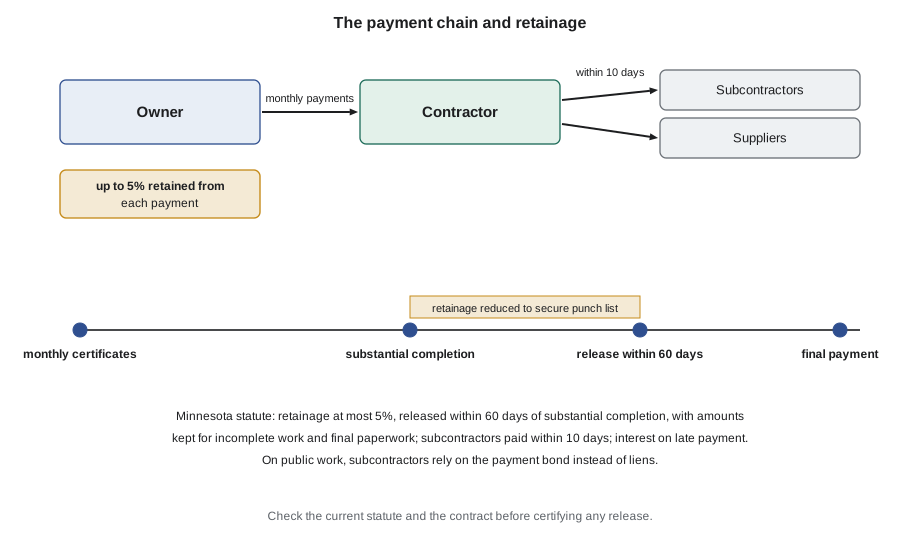
The architect's certificate for payment is a statement that, to the best of its knowledge from its site visits and the contractor's application, the work has progressed to the point indicated and the quality is in general accordance with the documents. It is not a guarantee, and it is not a valuation of the contractor's costs. Certifying more than the work justifies harms the owner if the contractor later fails; certifying less than it justifies harms the contractor and, through the payment chain, every subcontractor. Ingrid reviews each application against the schedule of values, her own observations and the stored materials on site, and adjusts lines she cannot support, explaining why.
From substantial completion to final completion
After the substantial completion date the contractor finishes the remaining items, and the architect reviews them as they are completed. The deficiency list shrinks quickly at first and slowly at the end; the last few items, such as a replacement panel that must be ordered or a seasonal planting, can take months. Each list must be specific: the item, its location, the document it relates to and who is responsible. Lists produced by the whole team walking the building together, with the contractor's own list as the starting point, are faster to close than lists that arrive item by item from different reviewers.
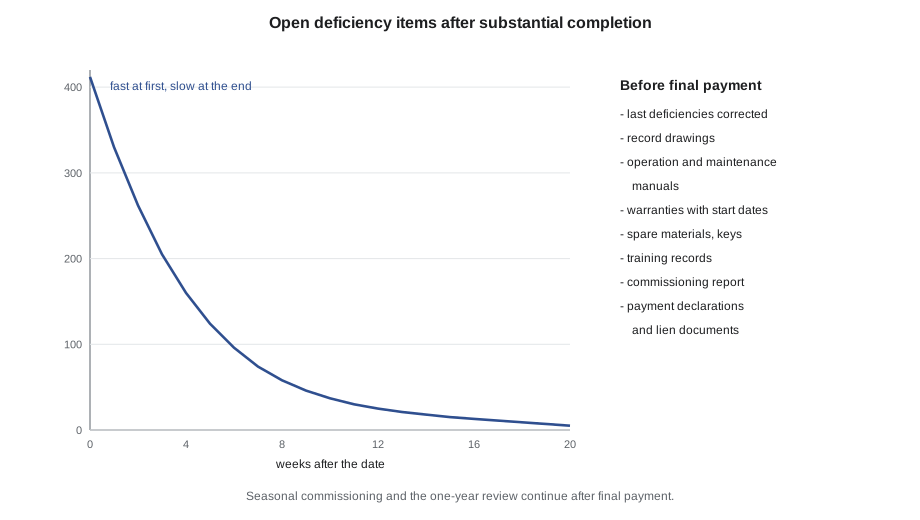
Final completion requires more than finished work. The contract lists the closeout submittals: record drawings showing the work as built; operation and maintenance manuals; warranties and guarantees, with their start dates; spare materials and attic stock; keys and access cards; training records for the city's staff; the commissioning report; and, before final payment, the contractor's affidavit of payment of debts and claims on G706, releases or waivers of liens from the contractor and its subcontractors, often on G706A, and the surety's consent to final payment on G707. When all of these are received and the last items corrected, the architect issues the final certificate for payment.
Commissioning deserves its own word. Kofi Mensah, the mechanical engineer, has been working with the city's commissioning agent since design, and the functional tests of the heat pumps, the ventilation units, the controls and the lighting are the last major step before the building is handed over. The tests often reveal problems that no single trade owns: a sequence of operation written one way and programmed another, a sensor in the wrong place, a valve installed backwards. Some commissioning, such as seasonal tests of heating and cooling, must happen after occupancy, and the contract should say so, with the contractor's obligations continuing until it is done.
The year after completion is part of the job too. The contractor must correct defects that appear in the one-year warranty or correction period, and the architect usually reviews the building with the owner and contractor about a month before the period ends, to list anything that has appeared. Ingrid adds a date to her calendar for eleven months after the takeover.
Worked problem
Separating the deficiency list
From the list, classify these items: the fire alarm has not been verified; three doors in the classrooms need their closers adjusted; the commissioning report for the heat pumps is incomplete because the cooling test cannot be done in winter; the city's furniture has not arrived; the occupancy permit has not been issued.
Show solution
- The fire alarm verification and the occupancy permit prevent use and must be complete before substantial completion.
- The door closers are small deficiencies to be corrected after the date and listed with a completion date.
- The seasonal cooling test cannot be done until summer; it is listed as a deferred commissioning item with the contractor's obligation continuing, and does not hold up the date.
- The furniture is the owner's own work and has no bearing on the contractor's completion.
Answer: Only items that prevent use hold up the date; everything else is listed, priced and tracked to completion.
Exercise 11: closing the job
- Prepare the certificate of substantial completion for the Rail Yard Commons, with the date, the attached list and the responsibilities of each party after the date.
- Calculate the amount held back at substantial completion, the amount releasable and the date it may be released, citing the contract and the statute.
- Write a closeout checklist of every document required before final payment and assign each to a party.
- Plan the review before the end of the one-year period.
Self-check
- Have I separated items that prevent use from those that do not?
- Is my certificate dated and supported by what I observed?
- Do I know the current statutory limits for retainage and prompt payment?
- Have I received every closeout document before recommending final payment?
Occupancy and the building official
Nadia Kostyshyn, the former plans examiner who reviewed the permit drawings in the last course, explains the city's side of completion. Before the building can be occupied, the building official must be satisfied that it meets the code: the fire alarm and sprinklers tested and accepted, exits and emergency lighting complete, the elevators inspected under the state's elevator program, and the conditions on the permit closed. The architect and engineers usually provide letters confirming that the work in their disciplines was observed and is in general conformance, and the city may issue a temporary certificate of occupancy for part of a building while the rest is completed. Kostyshyn's advice is to start the conversation two months before the target date, with a list of the official's requirements and who will provide each one, rather than to discover them the week before opening.
Natarajan adds the owner's side. Taking over a building means taking over its risks: the city's insurer must cover it from the takeover date, its security staff must have keys and alarm codes, its maintenance staff must know how to run the heat pumps and the building automation system, and its librarians and program staff need time to move in before the public arrives. The contract's training requirements are therefore not a formality. The city schedules three weeks between the takeover and the public opening, and asks for the training sessions to be recorded so that staff hired later can watch them.
Common mistakes
MistakeRefusing substantial completion until every item is finished.
InsteadApply the test of use, and list the remaining items with completion dates.
MistakeCertifying the date before life safety systems and occupancy approval are in place.
InsteadHold the date until the items that prevent use are complete.
MistakeHolding retainage longer or in larger amounts than the statute allows.
InsteadKeep no more than the statute allows and release it within the stated time.
MistakeIssuing final payment before the closeout documents arrive.
InsteadMake final payment conditional on the documents the contract lists.
MistakeForgetting the end of the warranty period.
InsteadReview the building with the owner and contractor before the period expires.
Summary and key terms
- Under A201, substantial completion is when the owner can occupy or use the work for its intended use, certified on G704.
- The test is about use: items that prevent use hold up the date, others are listed and completed after it.
- Retainage, limited to 5% in Minnesota, secures completion and is released after substantial completion as the statute and contract allow.
- Final completion requires the remaining work and the closeout documents, including record drawings, manuals, warranties and payment declarations.
- Commissioning and the warranty period extend the job beyond the handover.
- Substantial completion
- The stage at which the owner can occupy or use the work for its intended use.
- Retainage
- The share of each payment kept by the owner as security until completion.
- Deficiency list
- The list of work to be completed or corrected after substantial completion.
- Record drawings
- Drawings updated to show the work as actually built.
- Closeout documents
- The documents the contract requires before final payment.
Practice problems
Work each problem on paper first, then reveal the answer to check.
Why is retainage released after substantial completion?
Show answer
Because the owner can now use the work, and only the remaining items need to be secured.
Why did the fire alarm hold up the date but the door closers did not?
Show answer
The fire alarm prevents use of the building; the closers are small items that can be corrected later.
What does the architect's certificate for payment state?
Show answer
That the work has progressed as indicated and is in general accordance with the documents, to the best of its knowledge.
What must happen to seasonal commissioning tests?
Show answer
They are listed as deferred items, with the contractor's obligation continuing until they are done.
When should the review before the end of the warranty period take place?
Show answer
About a month before the period ends.
Lesson quiz · 5 questions
Score 60% or more to complete this lesson.
Create a free account to save your progress, take quizzes and earn a certificate.