
ARCH-340 · Lesson 10 of 12 · 19 min
Community engagement
The first open house for the greenway framework is a disappointment. The students spend two days preparing boards, a model and comment cards, and the hub's hall is set up for a hundred people on a Thursday evening. Forty-one come. Ernest Kowalchuk counts them at the door: thirty-four homeowners, most of them over sixty, five people from the businesses on the avenue, and two renters. Nobody comes from the apartment blocks south of the greenway, where most of the district's renters, newcomer families and shift workers live. The comments are mostly about parking and traffic. 'You heard from the people who always come,' Kowalchuk tells the class the next week. 'They matter. I'm one of them. But if you want to hear from the woman who cleans offices at night and takes the 5 a.m. bus, you have to go where she is, at a time she can talk, in a language she is comfortable in. And you have to show her that it will make a difference.'
Why engage
Public engagement in planning and design has several purposes, and it helps to be clear which ones a process serves.
- Knowledge: residents know things designers do not: where the ice forms on a corner, which park the teenagers use, which store closed and why, where people feel unsafe.
- Legitimacy: decisions made with people affected by them are more likely to be accepted and to last.
- Fairness: people have a right to a say in decisions that shape their homes and neighborhoods, especially those who have been excluded in the past.
- Capacity: engagement can build relationships, networks and skills in a community that last beyond the project.
- Law: many planning decisions require public notice and hearings by law.
Engagement can also be done badly. Processes that ask people for their views after the decisions have been made, that ask the same people again and again, that use jargon and technical drawings people cannot read, or that promise more influence than they deliver, breed cynicism. The planner Sherry Arnstein warned of this in 1969 with her ladder of citizen participation, whose rungs rise from manipulation and therapy, through informing, consultation and placation, to partnership, delegated power and citizen control. She called the lower rungs non-participation and the middle rungs tokenism.
The spectrum of participation
The International Association for Public Participation (IAP2) describes a spectrum of participation with five levels, each defined by the promise made to the public.
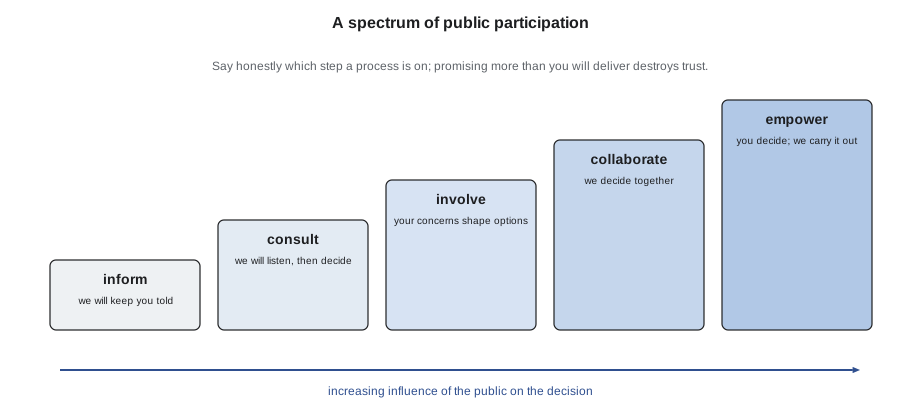
- Inform: provide balanced information to help people understand the problem and options.
- Consult: obtain feedback on analysis, options or decisions.
- Involve: work directly with the public throughout the process so their concerns and aspirations are understood and considered.
- Collaborate: partner with the public in each aspect of the decision, including developing alternatives and choosing the preferred solution.
- Empower: place final decision-making in the hands of the public.
No level is right for every decision. A water main replacement may need only informing; the design of a neighborhood park may be shaped through collaboration; a participatory budget may empower residents to choose among projects. What matters is honesty: telling people which level a process is at and keeping the promise. Desrosiers asks the students to place each part of their framework on the spectrum. The location of the stormwater park is largely fixed by the low land and the sewers, so it is at consult. The design of the park and the plaza can be at collaborate. A small fund for improvements chosen by residents of the apartment blocks south of the greenway could be at empower.
Methods
Engagement methods range from the familiar to the inventive. A good process uses several.
- Open houses and public meetings reach people who already follow local affairs; they are useful for informing and gathering comments but rarely reach others.
- Workshops and design charrettes bring residents, designers, officials and others together for intensive sessions, sometimes over several days, to develop and test options. The National Charrette Institute has codified a method for multi-day charrettes with feedback loops.
- Walking tours and site visits let people show designers their district and talk while they walk.
- Pop-up engagement goes to where people already are: bus stops, grocery stores, school pick-ups, laundromats, festivals, places of worship.
- Surveys reach many people quickly but are easily biased in who answers.
- Online maps and tools let people mark places and comments at any time, but exclude those without internet access or confidence.
- Design games, models and drawing tables let people manipulate options physically, which often works better than asking them to read plans.
- Youth engagement in schools and youth centers brings in voices that are almost never heard.
- Citizens' panels or assemblies select a representative group by lottery, inform them in depth and ask them to deliberate and recommend.
Barriers to participation include time, child care, transportation, language, disability, distrust of government and the feeling of not being an expert. Practical measures help: meetings at different times and places, food and child care, interpretation, accessible venues and materials, honoraria for people's time and expertise, partnering with trusted community organizations, and plain language and clear visuals. Kowalchuk suggests the students hold their next session in the laundry room of the largest apartment building on Aldous Street on a Saturday morning, with coffee and doughnuts. Nearly sixty people come.
Listening to whom?
Surveys are a common tool, but their results are only as good as the sample. The greenway framework's online and paper survey received 412 responses. The students check its margin of error and who answered.
# Engagement survey: margin of error and who answered
import math
n = 412                                    # responses
p = 0.58                                   # share supporting the greenway plaza
moe = 1.96 * math.sqrt(p * (1 - p) / n)
print(f"support {p:.0%} +/- {moe:.1%} (95% confidence, if the sample were random)")
groups = {  # share of residents (census) and share of respondents
    "renters": (0.62, 0.38),
    "owners": (0.38, 0.62),
}
support = {"renters": 0.71, "owners": 0.50}
raw = sum(groups[g][1] * support[g] for g in groups)
weighted = sum(groups[g][0] * support[g] for g in groups)
print(f"raw support {raw:.0%}; weighted to the census {weighted:.0%}")
for g, (pop, resp) in groups.items():
print(f"{g:<8} residents {pop:.0%} respondents {resp:.0%} representation ratio {resp / pop:.2f}")support 58% +/- 4.8% (95% confidence, if the sample were random) raw support 58%; weighted to the census 63% renters residents 62% respondents 38% representation ratio 0.61 owners residents 38% respondents 62% representation ratio 1.63
The formula gives a margin of about five points, but only if the respondents are a random sample of residents, and they are not. Renters make up 62% of the district's households but only 38% of the respondents; homeowners are heavily over-represented. Because renters support the plaza more strongly than owners, weighting the results to match the census raises support from 58% to 63%. Weighting can correct for known imbalances in who answered, but not for the views of groups that did not answer at all. Desrosiers's rule is to report who answered alongside what they said, and never to present a survey of volunteers as the voice of a community.
Indigenous engagement
In North America, all cities are on Indigenous lands. Minneapolis is on Dakota homelands; the confluence of the Mississippi and Minnesota rivers nearby, Bdote, is a place of origin for the Dakota people. The city also has one of the largest urban American Indian communities in the country, centered on the American Indian Cultural Corridor along Franklin Avenue. Engagement with Indigenous nations and communities is not the same as general public engagement. Nations are governments with rights and their own decision-making processes; urban Indigenous organizations represent many residents of different nations.
In the United States, tribal nations are sovereign governments with a government-to-government relationship with the federal government, and federal law requires tribal consultation on many projects. Cities are increasingly engaging tribal nations and urban Indigenous organizations early in major plans. Good practice includes building relationships before a project begins, engaging nations as governments rather than stakeholders, respecting their timelines and protocols, compensating knowledge keepers, and asking how a place's Indigenous history and presence should be recognized in its design, not just in a plaque.
In the greenway district, the students learn that the creek which once ran through the rail yard, now buried in a pipe, was used by Indigenous people for travel and gathering long before the railway. With the guidance of an Indigenous advisor at the university, they propose that the stormwater park daylight a short stretch of the creek and that its design, naming and planting be developed with Indigenous partners.
The charrette weekend
The options round becomes a two-day charrette in the hub in early April. The students prepare a large base model of the district at 1 in = 80 ft with removable blocks, three option plans and a table of facts: homes, jobs, trees, parks, parking and costs. Residents work at four tables with a student at each, moving blocks, drawing on trace and arguing. A youth table, run with the school's ninth-grade class, produces the most surprising idea: a covered skate and basketball court under the transit plaza's canopy, lit until ten at night, which the teenagers say would give them a place to be that is not someone's parking lot. The tenants' group asks that the first new buildings on the rail yard be rental homes for families, not condominiums, and that existing tenants on Aldous Street get first chance at them. Shop owners on the avenue ask how they will survive two years of street construction.
At the end of each day the students pin up what they heard, sorted into three columns: ideas the framework will include, ideas it will study further and ideas it will not include, with reasons. Kowalchuk, who had warned them about the open house, reads the columns slowly and says the third one is the most important. 'People can live with no,' he says, 'if you tell them why.' The skate court goes into the first column; the request for construction help for businesses goes into the second, with a promise to come back with options; a proposal to widen the avenue for more parking goes into the third, with the reason written beside it.
Designing the process
An engagement plan for a district framework sets out the decisions to be made, the level of participation for each, the groups to reach and how, the timeline, the methods, how results will be recorded and reported, and how participants will hear what difference their input made. Reporting back is the step most often skipped and the one that builds trust most. The students' plan has four rounds: listening (walks, pop-ups and the laundry room sessions), options (a weekend charrette in the hub with design tables and models), a draft framework (open house, survey and youth workshop at the school) and a final framework with a 'what we heard and what we did' report. Each round is held in at least three places and at different times of day.
Exercise 10: an engagement plan
- For a district project, list the decisions to be made and place each on the IAP2 spectrum.
- Identify the groups most affected and the barriers each faces to taking part.
- Design three engagement activities for groups who are rarely heard, with time, place, method and support.
- Draft a short survey and describe how you will check and report who answered.
- Explain how Indigenous nations and communities will be engaged, and when.
Ethics of engagement
Desrosiers closes the lesson with a short list of ethical commitments that the students adopt for their process. Be clear about what is open to change and what is not. Pay people for their time when you are asking for their expertise, especially people on low incomes who give up paid work to attend. Protect privacy: do not record or publish names, faces or stories without consent. Do not ask people to relive painful histories, such as displacement or racism, unless they choose to share them and there is a reason that will benefit them. Report back to everyone who took part, not only to the decision makers. And admit what you do not know. Kowalchuk adds one more from his own experience: never hold a meeting about a neighborhood that the neighborhood did not know about.
Common mistakes
MistakeHolding one evening open house and calling it engagement.
InsteadUse several methods, places and times, and go to where people are.
MistakePromising influence the process cannot deliver.
InsteadState honestly which level of the spectrum each decision is at.
MistakePresenting a survey of volunteers as the community's view.
InsteadReport who answered, compare with the census and weight with care.
MistakeTreating Indigenous nations as one stakeholder among many.
InsteadEngage nations as governments, early, on their terms.
MistakeNot reporting back.
InsteadTell participants what was heard and what changed as a result.
Summary and key terms
- Engagement brings local knowledge, legitimacy, fairness and capacity, and is often required by law.
- Arnstein's ladder and the IAP2 spectrum describe levels of participation; honesty about the level matters most.
- Methods range from open houses to charrettes, pop-ups, design games and citizens' panels; several are needed.
- Barriers of time, language, child care, disability and distrust must be removed deliberately.
- Survey results depend on who answered; report and weight carefully.
- Indigenous nations are governments and must be engaged as such, early and on their terms.
- Ladder of citizen participation
- Arnstein's 1969 model of participation, from manipulation to citizen control.
- IAP2 spectrum
- A model of five levels of public participation: inform, consult, involve, collaborate and empower.
- Charrette
- An intensive, collaborative design workshop, often over several days, with feedback from participants.
- Pop-up engagement
- Engagement held where people already are, such as bus stops, stores and events.
- Margin of error
- The likely range of sampling error in a survey result, valid only for random samples.
- Participatory budgeting
- A process in which residents decide how to spend part of a public budget.
Practice problems
Work each problem on paper first, then reveal the answer to check.
With 400 responses and 50% support, what is the approximate margin of error at 95% confidence?
Show answer
About 1.96 × √(0.25/400) ≈ 0.049, or about 5 points, if the sample were random.
Name three barriers that keep renters and shift workers from public meetings.
Show answer
Time of day, child care, transportation, language, distrust or feeling unwelcome.
At which IAP2 level is a participatory budget?
Show answer
Empower: residents make the final decision.
Why is reporting back important?
Show answer
It shows participants their input mattered and builds trust for future engagement.
How does engaging an Indigenous nation differ from engaging the general public?
Show answer
The nation is a government with rights and its own processes; engagement should be government to government, early and on its terms.
Lesson quiz · 5 questions
Score 60% or more to complete this lesson.
Create a free account to save your progress, take quizzes and earn a certificate.