
APT-110 · Lesson 6 of 12 · 25 min
Hazard Communication and hazardous materials
▶ Video coming soon A video version of this lesson is on the way.
On Wednesday, September 16, 2026, Talia's third day, Imani took her through the dealership's Hazard Communication training in the morning and then spent the afternoon showing her where it applied in the parts department. The training covered the labels, the pictograms and the safety data sheets. The afternoon covered the products: a shelf of brake cleaner aerosols, cases of antifreeze and windshield washer fluid, brake fluid, engine oil and transmission fluid, battery acid in the battery cage, refrigerant cans, adhesives and sealers for the body shop, and a locked cabinet of flammable paint products. "Most of what we sell will hurt you if you use it wrong," Imani said. "The label and the SDS tell you how not to."
A parts department stores and sells far more hazardous products than most workplaces of its size. Workers handle them every day, and customers rely on the parts counter to sell them in safe containers with the right information. This lesson covers the system that tells workers about chemical hazards, how to read labels and safety data sheets, the basic rules for storing and handling hazardous products, what to do after a spill or exposure, and an introduction to the separate rules for shipping them. Lesson 7 then looks closely at batteries, fluids and other hazardous parts.
What Hazard Communication is
OSHA's Hazard Communication standard, 29 CFR 1910.1200, often called HazCom or the right-to-know standard, is the US system for communicating the hazards of chemicals used at work. Since 2012 it has been aligned with the United Nations Globally Harmonized System of Classification and Labeling of Chemicals (GHS), and a 2024 update aligned it with a newer revision of the GHS. OSHA extended the update's compliance dates by four months: chemical manufacturers, importers and distributors had to reclassify substances by May 19, 2026, and employers must update their workplace labels, hazard communication program and training for those substances by November 20, 2026, with later dates in 2027 and 2028 for mixtures.
HazCom has four main parts: a written hazard communication program, labels on hazardous chemicals, safety data sheets (SDSs) that give detailed information about each chemical, and employee information and training. An employer must keep a list of the hazardous chemicals in the workplace, make sure each container is properly labeled, keep a current SDS for each chemical readily available to employees on every shift, and train employees before their first assignment and whenever a new hazard is introduced.
Consumer products sold to the public, such as a can of brake cleaner on a retail shelf, carry consumer labels under consumer product law. But when the same products are stored, handled and used in the workplace, the workplace rules still require workers to have the hazard information and training. A parts department is both a workplace and a store, so it deals with both kinds of label.
Pictograms and hazard classes
The GHS sorts hazards into physical hazards, such as flammable, explosive, oxidizing, gases under pressure and corrosive to metals, and health hazards, such as acute toxicity, skin corrosion, eye damage, sensitization, cancer, reproductive toxicity and organ damage. Each hazard class is shown on labels by a pictogram: a black symbol on a white background inside a red diamond border.
| Pictogram | Main meaning | Examples in a parts department |
|---|---|---|
| Flame | Flammable liquids, gases, aerosols and solids | Brake cleaner, carburetor cleaner, paint, gasoline additives |
| Corrosion | Corrosive to skin, eyes or metals | Battery acid, some rust removers and wheel cleaners |
| Gas cylinder | Gas under pressure | Refrigerant cans, aerosol propellants, nitrogen cylinders |
| Exclamation mark | Irritant, harmful, sensitizer, narcotic effects | Many cleaners, some adhesives |
| Health hazard | Cancer, reproductive, organ or breathing hazard | Some solvents, used engine oil, some sealers |
| Skull and crossbones | Acute toxicity: can kill in small amounts | Some antifreeze concentrates, methanol washer fluid concentrate |
| Flame over circle | Oxidizer | Some pool and cleaning chemicals |
| Exploding bomb | Explosive or self-reactive | Some airbag and pretensioner components, as shipped |
| Environment | Hazardous to aquatic life | Many oils and fuels |
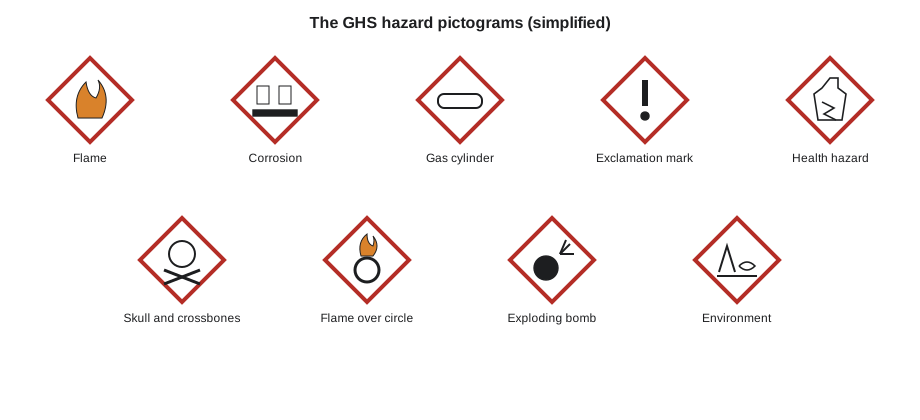
A product can carry several pictograms. Brake cleaner, for example, typically shows the flame (it is an extremely flammable aerosol), the gas cylinder or exclamation mark, and the health hazard pictogram if it contains solvents that harm the nervous system with repeated exposure.
Reading a supplier label
The label that comes on a hazardous product from its supplier must contain set information, arranged however the supplier chooses but always including:
- Product identifier: the product name, matching the SDS.
- Pictograms for each hazard class.
- Signal word: "Danger" for the more severe hazards, "Warning" for the less severe.
- Hazard statements: standard sentences describing the hazard, such as "Extremely flammable aerosol" or "Causes severe skin burns and eye damage".
- Precautionary statements: standard sentences on prevention, response, storage and disposal, such as "Keep away from heat, sparks and open flames" or "Wear protective gloves and eye protection".
- Supplier identifier: the name, address and phone number of the supplier.
HazCom labels must be in English, and employers may add other languages.
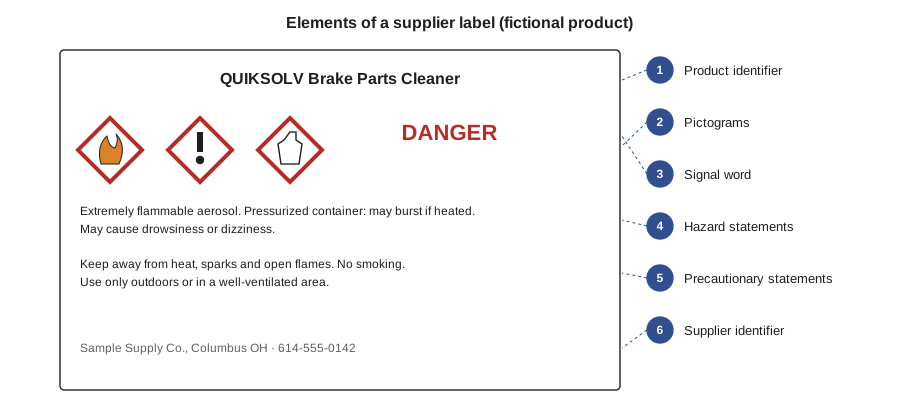
When a product is moved into a different container in the workplace, such as windshield washer fluid poured from a drum into a jug, the new container needs a workplace label. A workplace label must give at least the product name, safe handling information and a reference to the SDS. Linmore Tessaro prints workplace labels from its SDS system, and Imani showed Talia how to make one for the shop's spray bottles of diluted wheel cleaner.
Worked problem
Decoding a label at the counter
A customer asks Talia whether a two-part body filler hardener is safe to keep in her garage beside the furnace. The hardener's label shows the flame and exclamation mark pictograms, the signal word "Warning", and the statements "Heating may cause a fire" and "Store away from combustible materials." What should Talia tell her?
Show solution
- The hardener is an **organic peroxide**. On this product the flame pictogram means it can catch fire or break down and release heat if it gets warm.
- The statement "Heating may cause a fire" means it must be kept cool.
- Beside a furnace is the wrong place: it is warm and near a source of ignition and combustible materials.
Answer: Talia told her to store the hardener in its closed container in a cool place away from the furnace, sunlight and other combustibles, and to read the storage section of the SDS, which she printed for her. She also suggested buying only as much as the job needed.
Safety data sheets
A safety data sheet gives much more detail than the label. Under the GHS format used on both sides of the border, every SDS has the same 16 sections in the same order, so workers can find the same information in any SDS:
| Section | Contents | Section | Contents |
|---|---|---|---|
| 1 | Identification | 9 | Physical and chemical properties |
| 2 | Hazard identification | 10 | Stability and reactivity |
| 3 | Composition and ingredients | 11 | Toxicological information |
| 4 | First-aid measures | 12 | Ecological information |
| 5 | Firefighting measures | 13 | Disposal considerations |
| 6 | Accidental release measures | 14 | Transport information |
| 7 | Handling and storage | 15 | Regulatory information |
| 8 | Exposure controls and personal protection | 16 | Other information, including the date of the last revision |
For day-to-day work, the most useful sections are 2 (what the hazards are), 4 (first aid), 6 (what to do in a spill), 7 (how to handle and store it) and 8 (what protective equipment to wear). Linmore Tessaro keeps its SDSs in an online system with a terminal at each counter and a printed binder in the parts office in case the network is down.
Storing and handling hazardous products
The SDS and the label say how each product should be stored. General rules in the parts department include:
- Keep flammable liquids and aerosols in approved flammable storage cabinets or a designated area away from heat, sparks and electrical equipment, and keep the quantity on the floor to what is needed.
- Keep corrosives, such as battery acid, below eye level and away from flammables and metals, with secondary containment such as a tray or bund.
- Keep oxidizers apart from flammables and combustible materials.
- Store gas cylinders and pressurized cans upright, secured, and away from heat.
- Store heavy liquids on low shelves, and never stack drums or pails higher than the manufacturer allows.
- Keep containers closed when not in use, and check for leaks, dents and damaged labels during the daily walk.
- Wear the protective equipment the SDS calls for: usually safety glasses and chemical-resistant gloves, and a face shield for pouring corrosives.
Spills and exposures
Every parts department needs a spill kit near where liquids are stored, with absorbent pads and granules, gloves, goggles, bags and a neutralizer for battery acid. For a small spill of a product the worker has been trained to clean up, the procedure is: warn others, put on protective equipment, stop the source if it is safe to do so, contain the spill with absorbent, clean it up, bag the waste and label it, and report it. A large spill, a spill of an unknown product, or a spill with strong vapors means evacuate the area and call for help.
If a chemical gets into someone's eyes, the first aid is to flush the eyes with clean water immediately and keep flushing for at least 15 minutes, holding the eyelids open, then get medical help. Corrosives such as battery acid need longer flushing, as the SDS advises. Linmore Tessaro has a plumbed eyewash station in the battery area and a portable one on the dock.
Worked problem
Sizing a portable eyewash
A common industry standard for emergency eyewash (ANSI Z358.1) calls for a flow of at least 0.4 gal/min for 15 minutes. How much water must a self-contained portable eyewash hold?
Show solution
- Water needed:
- \[0.4 \times 15 = 6\ \text{gal}\]
Answer: The unit must deliver at least 6 gal. A small squeeze bottle is only for an immediate rinse on the way to a proper eyewash, never a substitute for one. The dock's portable unit is checked monthly and its water or additive changed on the maker's schedule.
Shipping hazardous materials: an introduction
HazCom covers hazardous chemicals in the workplace. When the same products are transported, a different set of rules applies: the US Department of Transportation's Hazardous Materials Regulations, 49 CFR Parts 171 to 180, administered by PHMSA. They classify hazardous materials into nine classes, require markings, labels and placards, set out shipping papers, and require that every hazmat employee who prepares, loads or transports hazardous materials be trained and tested, with refresher training at least every three years. Many parts shipments, such as small aerosols and automotive fluids, qualify for limited quantity relief, but someone still has to know the rules to know when the relief applies. Gideon and Sasha are trained hazmat employees; Talia will be trained before she ships anything. APT-220 covers shipping in detail.
Selling hazardous products to the public
A parts counter sells hazardous products to the public every day, and the counter staff are often the last people to talk to the customer before the product is used. Good practice at the counter includes:
- Selling products only in their original, labeled containers, never decanted into unmarked jugs or bottles.
- Pointing out the main hazard on the label when a customer seems unfamiliar with a product, such as the flammability of brake cleaner or the toxicity of coolant to pets.
- Printing the safety data sheet for a trade customer who asks for it, as professional shops often need it for their own workplace records.
- Bagging corrosive and flammable products separately from food or clothing a customer may also be carrying.
- Refusing to sell a product in a damaged or leaking container, and setting it aside for return.
Talia found that most customers welcomed a short, practical comment. When a customer bought a jug of concentrated washer fluid on a cold October afternoon, she mentioned that the concentrate is poisonous and should be stored where children cannot reach it, and the customer thanked her: she had young children and had not thought about it.
Worked problem
Checking a flammables cabinet's capacity
The flammables cabinet behind the front counter is rated for 30 gal of flammable liquids. Its shelves hold 36 cans of carburetor cleaner of 13.5 fl oz each and 24 bottles of a fuel additive of 12 fl oz each. How much of the cabinet's rated capacity is used?
Show solution
- Carburetor cleaner:
- \[36 \times 13.5 = 486\ \text{fl oz}\]
- Fuel additive:
- \[24 \times 12 = 288\ \text{fl oz}\]
- Total:
- \[486 + 288 = 774\ \text{fl oz} \approx 6.0\ \text{gal}\]
- Share of capacity:
- \[6.0 \div 30 = 0.20\]
Answer: About 6 gal, or 20 in 100 of the cabinet's rating, so there is plenty of room. The fire code and the cabinet's label set the limits; aerosols are counted under their own rules.
Common mistakes
MistakePouring a product into an unmarked spray bottle.
InsteadPut a workplace label with the product name, safe handling information and SDS reference on every secondary container.
MistakeReading only the product name on a label.
InsteadRead the pictograms, signal word and hazard and precautionary statements too.
MistakeStoring battery acid on a top shelf beside aerosols.
InsteadKeep corrosives low, contained and away from flammables and metals.
MistakeRinsing an eye splash for a few seconds and going back to work.
InsteadFlush for at least 15 minutes, longer for corrosives, and get medical help.
MistakeAssuming workplace hazard training also covers shipping.
InsteadShipping dangerous goods needs separate training under the transport rules.
Summary and key terms
- OSHA's HazCom standard, aligned with the GHS, communicates hazards through a written program, labels, safety data sheets and training; its 2024 update has compliance dates in 2026 to 2028.
- Pictograms in red diamonds show hazard classes such as flammable, corrosive, gas under pressure, toxic and health hazard.
- Supplier labels give the product identifier, pictograms, signal word, hazard and precautionary statements and supplier identifier.
- Secondary containers in the workplace need a workplace label.
- Safety data sheets have 16 standard sections; sections 2, 4, 6, 7 and 8 matter most day to day.
- Flammables, corrosives, oxidizers and pressurized containers are stored apart with the right cabinets and containment.
- Small spills are contained and cleaned with a spill kit; eye exposures are flushed for at least 15 minutes.
- Transporting hazardous materials falls under DOT's Hazardous Materials Regulations, which require hazmat employee training.
- HazCom
- OSHA's Hazard Communication standard, 29 CFR 1910.1200.
- GHS
- The Globally Harmonized System of Classification and Labeling of Chemicals.
- Pictogram
- A symbol in a red diamond border showing a hazard class on a label.
- Signal word
- "Danger" or "Warning", showing the relative severity of a hazard.
- Safety data sheet
- A 16-section document giving detailed hazard, handling, first-aid and emergency information for a product.
- Workplace label
- A simplified label for a product transferred to another container in the workplace.
- Limited quantity
- A small amount of a dangerous good in a package that qualifies for reduced shipping requirements.
Practice problems
Work each problem on paper first, then reveal the answer to check.
Name the six elements of a supplier label.
Show answer
Product identifier, pictograms, signal word, hazard statements, precautionary statements and supplier identifier.
Which SDS section tells you what protective equipment to wear?
Show answer
Section 8, exposure controls and personal protection.
What does the flame-over-circle pictogram mean?
Show answer
An oxidizer, which can start or feed a fire.
How much water must a portable eyewash deliver to meet a 0.4 gal/min flow for 15 minutes?
Show answer
6 gal.
What must be on a workplace label?
Show answer
The product name, safe handling information and a reference to the SDS.
Lesson quiz · 5 questions
Score 60% or more to complete this lesson.
Create a free account to save your progress, take quizzes and earn a certificate.