
APT-110 · Lesson 5 of 12 · 23 min
Forklifts and powered equipment
▶ Video coming soon A video version of this lesson is on the way.
On Tuesday and Wednesday, September 22 and 23, 2026, Talia and two new warehouse hires spent two days in the dealership's training room and the empty back lot with Delphine Ashworth, an instructor from Steelport Lift Truck Training. The first morning was all classroom: how a counterbalanced forklift works, why it tips, what the capacity plate means, and what the law requires. The afternoon was walking around a truck doing the daily check. The second day was driving: forward and reverse through a cone course, picking up and setting down empty pallets, then loaded ones, then stacking on a practice rack. At the end of the day Delphine watched each of them complete a set of tasks and signed off on their skills. "This is the beginning, not the end," she said. "You're competent on this truck, in this yard, with these loads. Everything else you'll learn under supervision."
Forklifts are the most dangerous equipment in most parts warehouses. They are heavy, often weighing more than the loads they carry, they steer from the rear, they can tip over, and they share space with people on foot. This lesson covers how forklifts work and why they tip, the capacity plate, the training the law requires, the daily check, and the rules for driving safely. Only trained and authorized people may operate a forklift; reading this lesson does not make anyone a forklift operator.
Types of powered equipment in a parts warehouse
Linmore Tessaro's warehouse has four kinds of powered equipment:
- A counterbalanced forklift, electric and battery-powered, rated for 5,000 lb, used on the dock and for the lower levels of the racking. A heavy counterweight at the back balances the load carried on the forks at the front.
- A narrow-aisle reach truck, which extends its forks forward to reach into the racking and works in narrower aisles than the counterbalanced truck.
- An order picker, which lifts the operator on a platform with the forks so they can pick small parts from the top levels by hand.
- A powered pallet jack with a walk-behind handle, used for moving pallets on the level.
Each type has its own controls, hazards and training. Being trained on one does not qualify someone to operate another. At larger dealerships and distribution centers there may also be powered tuggers, conveyors and automated storage systems.
Why forklifts tip over: the stability triangle
A counterbalanced forklift rests on three points: the two front wheels and the center of the rear axle, which pivots. Joining these points makes a triangle, called the stability triangle. The truck stays upright as long as its combined center of gravity, the balance point of the truck and its load together, stays inside that triangle. Anything that moves the combined center of gravity toward an edge of the triangle makes the truck less stable, and if it moves outside, the truck tips.
The load moves the center of gravity forward. A heavier load, a load carried further out on the forks, or a load raised high moves it further forward and up, and a truck can tip forward onto its mast if it is overloaded or the load is raised too high while moving. Turning moves the center of gravity sideways. A truck that turns too fast, especially with the load raised or on a slope, can tip onto its side. Sideways tip-overs are the most common cause of forklift deaths, often because the operator jumps and is crushed by the overhead guard.
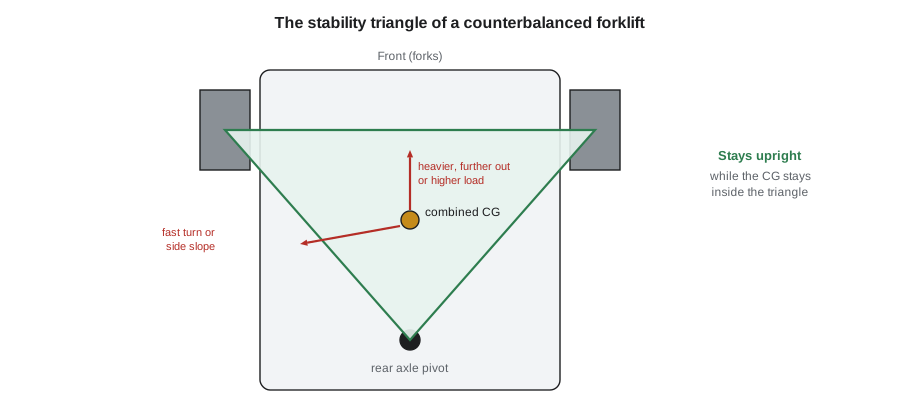
This is why the rules for driving a forklift exist: travel with the load low and tilted back, turn slowly, never turn on a ramp, keep heavy loads within capacity, and wear the seat belt. If a forklift does begin to tip, the operator should stay in the seat, hold the steering wheel firmly, brace the feet and lean away from the direction of the fall. The overhead guard and the seat belt are designed to protect an operator who stays in the truck.
The capacity plate and load center
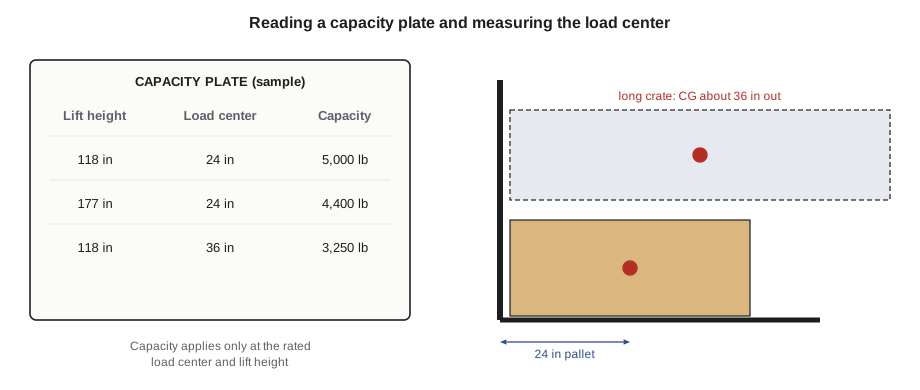
Every forklift carries a capacity plate, also called a data plate or nameplate, fixed where the operator can see it. It gives the truck's model and serial number, its weight, and its rated capacity: the maximum load it can lift to a stated height with the load's center of gravity at a stated distance from the face of the forks. That distance is the load center. For most warehouse trucks the rated load center is 24 in, which assumes a load on a pallet about 48 in deep with its weight evenly spread.
If a load's center of gravity is further out than the rated load center, because the load is long, unevenly packed or not pushed fully back on the forks, the truck can safely lift less than its rated capacity. Capacity also falls as the forks are raised higher, and attachments such as a fork extension or a drum clamp reduce it further. The capacity plate, or the manufacturer's capacity chart for the truck, is the only reliable source for the actual capacity under those conditions.
Worked problem
Estimating capacity for a long crate
The counterbalanced forklift's plate gives 5,000 lb at a 24 in load center up to 10 ft. Sasha needs to move a crated remanufactured engine weighing 3,100 lb whose center of gravity is about 36 in from the fork face, and set it on a level 4 ft high. A common rule of thumb for a first estimate scales the capacity by the ratio of load centers. Estimate whether the truck can handle the crate.
Show solution
- Estimated capacity at the longer load center:
- \[5{,}000 \times \dfrac{24}{36} \approx 3{,}333\ \text{lb}\]
- Compare with the load:
- \[3{,}100 \le 3{,}333\]
- Margin:
- \[3{,}333 - 3{,}100 = 233\ \text{lb}\]
Answer: The rough estimate suggests about 3,330 lb, leaving a margin of about 230 lb, and the lift height is within the plate's 10 ft. But the estimate is only a rule of thumb; the truck's own capacity chart governs. Sasha checked the chart, which gave 3,250 lb at 36 in, so the lift could go ahead with the crate pushed fully back against the carriage. A heavier crate, or a higher placement, would have needed a bigger truck.
Training and authorization
OSHA's standard for powered industrial trucks, 1910.178, requires that every operator be trained and evaluated before operating a truck. Training must combine formal instruction, practical training and an evaluation of the operator's performance in the workplace, and must cover the specific truck types and the specific workplace hazards. The employer must certify that each operator has been trained and evaluated, recording the operator's name, the training date, the evaluation date and the name of the person who did it. Each operator's performance must be evaluated at least once every three years, and refresher training is required after an accident or near miss, when an operator is seen driving unsafely, when an evaluation shows a need, when the operator is assigned a different type of truck, or when workplace conditions change. Operators must be at least 18 years old under federal child labor rules for most industries. Linmore Tessaro gives each operator a wallet card and keeps the certification in the training file.
Being trained is not the same as being authorized. At Linmore Tessaro, only people whose names are on Rolf's posted list may operate each truck, and the keys are kept in the parts office. Talia was authorized for the counterbalanced truck and the powered pallet jack after her training; she would be trained on the reach truck and order picker later in the year.
The daily check
Before the first use of each shift, the operator checks the truck and records the check on a form kept with the truck. A truck that fails any safety item is tagged out of service and the key is returned to the office until it is repaired. Linmore Tessaro's checklist, based on the manufacturer's instructions, includes:
- Visual, truck off: forks for cracks, bends or wear; mast chains and hoses for damage and leaks; tires for cuts and wear; overhead guard and load backrest; capacity plate present and legible; fluid leaks under the truck; battery connector and cables.
- Operational, truck on: horn, lights and backup alarm; steering; service and parking brakes; lift, lower and tilt controls; seat belt and seat switch; gauges and battery charge.
- For an electric truck, the battery's charge level and the charging connector. For a propane truck, the cylinder's mounting, valve and hose.
Electric forklift batteries are charged in a designated area with ventilation, eyewash nearby and no smoking or open flames, because lead-acid batteries give off hydrogen while charging. Only trained people change or water batteries. Lesson 7 covers battery hazards in more detail.
Worked problem
Planning battery charging
The counterbalanced truck's battery lasts about one 8-hour shift and takes about 8 hours to charge, followed by about 8 hours to cool before it should be used again, a common pattern for lead-acid traction batteries. The warehouse runs one shift, from 7:00 a.m. to 5:00 p.m. If the truck goes on the charger at 5:00 p.m., when is it ready?
Show solution
- Charging ends:
- \[5{:}00\ \text{p.m.} + 8\ \text{h} = 1{:}00\ \text{a.m.}\]
- Cooling ends:
- \[1{:}00\ \text{a.m.} + 8\ \text{h} = 9{:}00\ \text{a.m.}\]
Answer: On that pattern the battery would not be ready until 9:00 a.m., two hours into the next shift. Linmore Tessaro's charger uses a shorter cooling period recommended by the battery maker, so the truck is ready by 7:00 a.m.; the point of the calculation is that charging must be planned, not left to chance. The times here are typical values; the battery maker's instructions govern.
Driving rules
Linmore Tessaro's driving rules are posted at the charging station and repeated at every refresher:
- Wear the seat belt. Keep arms, legs and head inside the truck.
- Travel with the forks low, about 4 to 6 in off the floor, and the mast tilted back.
- Drive at walking speed in the warehouse, slow down at corners, and sound the horn at aisle ends, doorways and blind spots.
- Look in the direction of travel. If the load blocks your view, drive in reverse or use a spotter.
- Yield to pedestrians, and never let anyone walk or stand under raised forks.
- Never carry passengers, and never lift a person on the forks or on a pallet.
- On ramps, drive with the load upgrade: forward going up, in reverse coming down. Never turn on a ramp.
- Before entering a trailer, confirm the wheels are chocked or the restraint is engaged, the dock leveler is secure and the trailer floor is sound.
- When leaving the truck, lower the forks flat to the floor, set the parking brake, put the controls in neutral and turn the truck off. If you will be more than 25 ft away or out of sight, take the key.
The order picker has its own rules. Its operator stands on a platform that rises with the forks, so the operator must wear a full-body harness and lanyard attached to the anchor point the manufacturer provides, and must never climb out of the platform onto the racking.
Pedestrians and powered equipment
Most forklift injuries happen to people who are not driving: pedestrians struck in aisles, crushed against racking or caught under falling loads. Lesson 3 described the walkways and crossings that keep them apart. Linmore Tessaro adds two more measures in the busy first hour: a blue spotlight on the front of each truck that shines on the floor ahead at aisle ends, and a rule that only one truck works in an aisle while people are picking in it. Talia, now a trained operator, found that the rules looked different from the driver's seat: from there, she could see how little of the floor near the truck was visible, and how easily someone stepping out from an aisle could be missed.
Common mistakes
MistakeTurning sharply with the load raised to save time.
InsteadTravel with the load low and tilted back, and turn slowly.
MistakeLifting a long crate because it weighs less than the rated capacity.
InsteadCheck the load center and lift height against the truck's capacity chart.
MistakeJumping off a forklift that starts to tip.
InsteadStay in the seat, belted, hold on, brace and lean away from the fall.
MistakeSkipping the daily check because the truck was fine yesterday.
InsteadCheck and record it before the first use of every shift; tag it out if a safety item fails.
MistakeDriving a different type of truck after training on one.
InsteadOperate only the truck types you have been trained and authorized on.
Summary and key terms
- Forklifts are heavy, steer from the rear and share space with pedestrians, so only trained and authorized people may operate them.
- A counterbalanced forklift stays upright while the combined center of gravity stays inside the stability triangle.
- Rated capacity applies only at the rated load center and lift height; longer loads, higher lifts and attachments reduce it.
- OSHA 1910.178 requires training, evaluation, certification, refresher training when needed and evaluation at least every three years.
- A daily check before first use catches defects; a truck that fails is tagged out of service.
- Driving rules include belts, low forks, slow turns, horns at corners, load upgrade on ramps and no passengers.
- Batteries are charged in a ventilated area away from flames because of hydrogen.
- Counterbalanced forklift
- A forklift with a heavy counterweight behind the rear axle to balance the load on the forks.
- Stability triangle
- The triangle formed by a forklift's front wheels and rear axle pivot, inside which the combined center of gravity must stay.
- Combined center of gravity
- The balance point of the forklift and its load together.
- Capacity plate
- The plate on a forklift giving its rated capacity, load center, lift height and other data.
- Load center
- The distance from the face of the forks to the load's center of gravity.
- Reach truck
- A narrow-aisle forklift whose forks extend forward into the racking.
- Tag out
- To attach a tag to equipment that must not be used until repaired, and remove its key.
Practice problems
Work each problem on paper first, then reveal the answer to check.
What is the stability triangle?
Show answer
The triangle joining a counterbalanced forklift's front wheels and rear axle pivot; the combined center of gravity must stay inside it.
Estimate the capacity of a truck rated 5,000 lb at 24 in for a load center of 36 in.
Show answer
About 3,333 lb by the rule of thumb; the truck's chart governs.
What should an operator do if a forklift starts to tip?
Show answer
Stay in the seat with the belt on, hold the wheel, brace the feet and lean away from the fall.
How should you drive a loaded forklift down a ramp?
Show answer
In reverse, with the load upgrade, and never turn on the ramp.
What must happen to a truck that fails a safety item on the daily check?
Show answer
It is tagged out of service and the key returned until it is repaired.
Lesson quiz · 5 questions
Score 60% or more to complete this lesson.
Create a free account to save your progress, take quizzes and earn a certificate.