
APT-110 · Lesson 11 of 12 · 23 min
Your apprenticeship and career path
▶ Video coming soon A video version of this lesson is on the way.
On Monday, October 5, 2026, three weeks after she started, Talia sat with Rolf in his office and went through her training plan. Linmore Tessaro would pay for her manufacturer parts training online and at the regional training center, Imani would mentor her on the job, and her hours and skills would be recorded in the dealership's training file. The goal was to sit the ASE P2 Automobile Parts Specialist test once she had the two years of counter experience that ASE requires for certification. "This is the start," Rolf said. "After that, it's up to you how far you go."
Lesson 1 described how the trade is recognized. This lesson looks at the path in more detail: how training is structured, how progress is recorded, what the certification exam looks like, and where a parts career can lead. The general apprenticeship course, TRD-107, covers registration, wages, funding and exams for all trades; this lesson focuses on what is specific to parts.
Training paths for US parts specialists
In the United States there is no single required apprenticeship for parts work. Parts specialists typically follow one or more of these paths:
- on-the-job training with an employer, often organized by a mentor and recorded in the employer's training file;
- manufacturer or distributor training programs, online and at training centers, that cover catalogs, systems and product lines;
- registered apprenticeships offered by some employers and unions and recognized by the US Department of Labor or a state apprenticeship agency, though these are less common in parts than in the repair trades; and
- ASE certification, which combines passing a test with at least two years of relevant work experience.
Employers often pay for training and test fees, and some pay a bonus or raise for each ASE certification earned. Community colleges in many states offer parts and warehouse courses, sometimes as part of an automotive program.
Worked problem
Planning for the ASE P2 test
The ASE P2 test has 75 scored questions and 10 unscored research questions, and candidates have 90 minutes. About how much time is available for each question, and when will Talia meet the two-year experience requirement if she started on September 14, 2026?
Show solution
- Total questions:
- \[75 + 10 = 85\]
- Time for each question:
- \[90 \div 85 \approx 1.06\ \text{min}\]
- Two years after September 14, 2026: September 14, 2028.
Answer: About a minute per question, so pacing matters. Talia can take the test before then, but she will be certified only once she also has two years of parts counter experience, from September 2028; her plan is to sit the test in the spring of 2028.
What parts training covers
ASE's test specifications and most employer training programs cover the same main areas: general operations and safety, customer relations and sales, vehicle systems knowledge, parts identification and catalog use, inventory management, and receiving, shipping and returns. Linmore Tessaro's training file lists the skills Talia must demonstrate in each area, and Imani signs off a skill only after Talia has done it correctly on three separate occasions.
The courses in this program follow the same areas. Level 1 covers the trade and safety (this course), parts identification (APT-120), counter sales (APT-130) and an automotive systems course (AUTO-110). Level 2 adds inventory control, receiving and shipping, and mechanical systems. Level 3 covers electrical and electric vehicle systems, heavy and industrial parts, management, and exam preparation.
The certification exam
ASE publishes the content of each parts test in its study guide. The P2 Automobile Parts Specialist test has 75 scored questions plus 10 unscored research questions, with 90 minutes allowed. The questions are multiple choice, and many describe a counter situation and ask what the parts specialist should do. ASE also offers other parts tests, including one for medium and heavy truck dealership parts, and certification must be renewed every five years by retesting.
As with any certification test, the best preparation is real experience plus a review of the published task list, and practice questions written to the same style. The final course in this program prepares for the test in detail.
ASE tests are taken by appointment at testing centers, and results are reported shortly after the test.
Where a parts career can lead
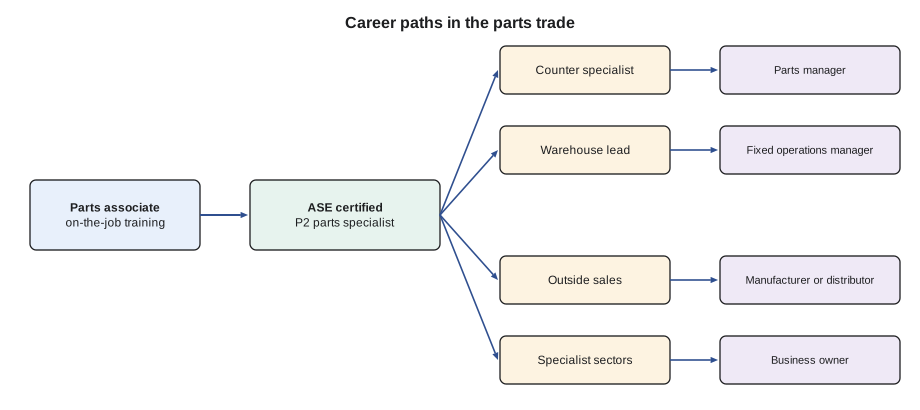
Parts work offers more variety of career paths than many people expect. Rolf's own career had gone from a summer job in an aftermarket store, to a dealership counter, to warehouse lead, to assistant manager and then parts manager. Imani had worked for an industrial distributor before coming to Linmore Tessaro, and planned to move into a fixed operations role covering both parts and service. Some of the paths open to an experienced parts technician are:
- Counter specialist in a dealership, aftermarket store, heavy equipment dealer or industrial distributor.
- Warehouse lead or supervisor, running receiving, inventory and shipping.
- Parts manager, responsible for the department's staff, inventory, sales and profit.
- Fixed operations manager or service and parts director, overseeing both departments in a dealership.
- Wholesale or outside sales representative, visiting body shops, garages and fleets.
- Manufacturer or distributor roles, such as a district parts manager, distribution center supervisor or catalog specialist.
- Purchasing and inventory planning for a fleet, utility, mine or factory.
- Owning a parts business, such as an aftermarket store or a specialty parts supplier.
Building your record
Whatever path an apprentice takes, a few habits make the journey smoother. Keep your own copy of your hours and the skills you have been signed off on, in case records are lost or you change employers. Take every training course the employer and the manufacturer offer, and keep the certificates. Ask to rotate through all the areas of the department: receiving, warehouse, back counter, front counter, wholesale and returns. Learn the vehicles: ride along with the technicians when you can, ask them to show you how parts fit, and take the automotive systems courses seriously. And look after your body and your safety record, because the habits from lessons 3 to 8 are what let a parts technician work a full career.
Talia started her own notebook on the day she signed her agreement. On the first page she wrote three goals for her first year: be able to work the back counter alone, learn the forklift and reach truck, and never send out a wrong part because she guessed.
A rotation plan for the first year
Rolf builds every apprentice's first year around a rotation plan, so that the apprentice sees every part of the department and the logbook fills in a sensible order. Talia's plan, written on October 5, gave her roughly two months in each area, with the order chosen so that each area prepares her for the next:
| Months | Area | Main skills to be signed off |
|---|---|---|
| September to October 2026 | Receiving and warehouse | Safe handling, receiving against a packing slip, put-away, locations, cycle counts |
| November to December 2026 | Back counter | Repair order parts, catalog lookup by VIN, returns from the shop |
| January to February 2027 | Front counter | Retail and wholesale sales, quoting, cores, invoicing |
| March to April 2027 | Wholesale and shipping | Phone and online orders, delivery runs, shipping documents |
| May to June 2027 | Ordering and returns | Stock and special orders, supplier returns, warranty parts |
| July to August 2027 | Review and gaps | Any skills not yet signed off; preparation for the first in-school level |
The plan is not rigid. When the back counter is short-staffed, an apprentice from the warehouse may help there for a day, and an apprentice who learns quickly may move on early. But having a written plan means nothing is left out, and it gives both the apprentice and the sponsor a way to measure progress.
Worked problem
Tracking progress through the logbook
Talia's logbook lists 148 skills to be signed off over the whole apprenticeship. By the end of October 2026 she had 17 signed off, all in safety, receiving and warehouse. If she kept that pace, about how many months would it take to sign off all 148, and what does that suggest about the plan?
Show solution
- Skills signed off per month (September and October):
- \[17 \div 2 = 8.5\]
- Months to sign off 148 skills at that pace:
- \[148 \div 8.5 \approx 17.4\]
Answer: About 17 or 18 months, well inside the three-year apprenticeship. Rolf pointed out that the early skills come quickly because they are practiced every day, and that the later skills, such as stock ordering and warranty claims, take longer to demonstrate because they come up less often. The rotation plan schedules those later on purpose. The logbook count of 148 is a sample figure for this course.
Learning from a mentor
Most of a parts apprenticeship is learned from people, not books. A good mentor shows how a task is done, explains why, watches the apprentice do it, and corrects mistakes before they become habits. Imani's approach with Talia followed a simple pattern that many trades use: I do, we do, you do. First Imani did the task while Talia watched and asked questions; then they did it together, with Talia doing more each time; then Talia did it alone while Imani checked the result. Only after Talia had done it correctly on her own several times did Imani sign it off.
Apprentices get the most from a mentor when they come prepared. Talia kept a small notebook in her back pocket for part numbers, questions and things she wanted to look up later, and once a week she sat down with Imani for fifteen minutes to go through it. Imani said that the questions told her more about how Talia was doing than any test could. Apprentices also learn from everyone else in the building: Sasha in the warehouse, Gideon on the delivery runs, and especially the technicians, who can show how a part fits, what fails and why a particular gasket or bolt matters.
Other certificates along the way
Alongside the main certification, a parts technician collects a set of shorter certificates and training records that employers expect. Talia's first-year list included:
- Hazard Communication training, refreshed whenever new hazardous chemicals arrive and reviewed every year.
- Lift truck training for each type of truck she would operate, with the employer's assessment and record.
- DOT hazmat employee training, before she ships any hazardous materials, with refresher training every three years.
- First aid and CPR, which the dealership offers to volunteers from each department.
- Manufacturer parts training courses on the catalog, the ordering portal, warranty parts and new models.
- Safety committee training for members such as Imani, and any training the employer requires for emergency roles.
Each of these has a renewal date. Talia's notebook has a page listing them all with their expiry dates, which she checks at the start of every month.
Moving between employers and provinces
Because ASE certification is national, a certified parts specialist's credential is recognized by employers across the United States, and it moves with the person when they change employers or states. Training records from one employer are not automatically accepted by the next, so it is worth keeping copies of every certificate and training record. A specialist who moves into another sector, such as heavy trucks, can add the matching ASE parts test.
Preparing for the certification exam
Talia plans to start preparing for the P2 test about three months before she has her two years of experience. Rolf's advice is to begin with ASE's study guide, which lists the content areas and the number of questions in each, and to spend study time in the same proportions, with extra time on any area where her training record shows little practice. Practice questions help her get used to the format and the 90-minute time limit, but the real preparation is the daily work: looking up parts, receiving and shipping, counting stock and serving customers. She will also review the safety and hazardous materials rules from this course, because those questions are easy marks for a well-prepared candidate and costly ones for a careless one. The test is taken by computer at a testing center, and the result arrives right after the session, so she has booked a date that leaves time for a retake before her review if she needs one.
Common mistakes
MistakeThinking parts work needs no formal training because the trade is voluntary.
InsteadUse the apprenticeship or certification path; it is the recognized proof of skill.
MistakeGetting a skill signed off after watching it once.
InsteadDemonstrate each skill correctly several times before it is signed off.
MistakeRelying on the employer's records alone.
InsteadKeep your own copy of hours, skills and training certificates.
MistakeStaying in one area of the department for the whole apprenticeship.
InsteadAsk to rotate through receiving, warehouse, counters, wholesale and returns.
MistakeAssuming the only promotion is to parts manager.
InsteadConsider sales, distribution, purchasing, other sectors and business ownership too.
Summary and key terms
- US parts specialists train on the job and through manufacturer and distributor programs, and earn ASE certification by passing a test and having two years of experience.
- Employers record skills in a training file, signed off when they have been demonstrated.
- The ASE P2 test has 75 scored and 10 unscored questions in 90 minutes, and certification is renewed every five years.
- Career paths include counter specialist, warehouse lead, parts and fixed operations manager, outside sales, manufacturer and distributor roles, purchasing and business ownership.
- Good habits include keeping your own records, taking every training course, rotating through the department and learning the vehicles.
- Training plan
- A written plan, agreed between a new parts specialist and the employer, listing the skills to learn and who will teach them.
- ASE certification
- Certification from the National Institute for Automotive Service Excellence, based on a test and work experience.
- P2 test
- The ASE test for automobile parts specialists.
- Recertification
- Retaking an ASE test every five years to keep the certification current.
- Fixed operations
- A dealership's service, parts and body shop departments together.
Practice problems
Work each problem on paper first, then reveal the answer to check.
What does ASE require for P2 certification besides passing the test?
Show answer
Two years of relevant work experience.
How long does the P2 test allow, and about how many minutes is that per question?
Show answer
90 minutes for 85 questions, about 1.06 minutes a question.
How often must ASE certification be renewed?
Show answer
Every five years, by retaking the test.
Name three career paths open to an experienced parts specialist.
Show answer
Any three of: counter specialist, warehouse lead, parts manager, fixed operations manager, outside sales, manufacturer or distributor roles, purchasing, business owner.
Why keep your own record of training and skills?
Show answer
So you can show employers what you have learned, especially when you change employers.
Lesson quiz · 5 questions
Score 60% or more to complete this lesson.
Create a free account to save your progress, take quizzes and earn a certificate.