
APT-110 · Lesson 9 of 12 · 26 min
Computers and business systems in the parts department
▶ Video coming soon A video version of this lesson is on the way.
On Thursday, October 1, 2026, Imani gave Talia her own login to the dealership's systems: a user name for the dealer management system, the software that runs almost everything in the dealership; access to the Tessaro electronic parts catalog; a login to the manufacturer's parts ordering portal; and a handheld barcode scanner with her name on a label. Rolf made her read and sign the dealership's acceptable-use and privacy policy first. "You can now see customers' names, addresses, phone numbers and what they bought," he said. "That's private. You look up what you need for the job, nothing else."
Modern parts work is computer work. A parts technician may spend more of the day looking at a screen than at a shelf: identifying parts, checking stock, placing orders, invoicing, receiving shipments and answering emails. This lesson introduces the main systems a parts department uses, how they connect, and the habits that keep the information in them accurate and secure. Later courses go deeper: APT-120 covers parts lookup, APT-210 inventory control and APT-220 receiving and shipping.
The dealer management system
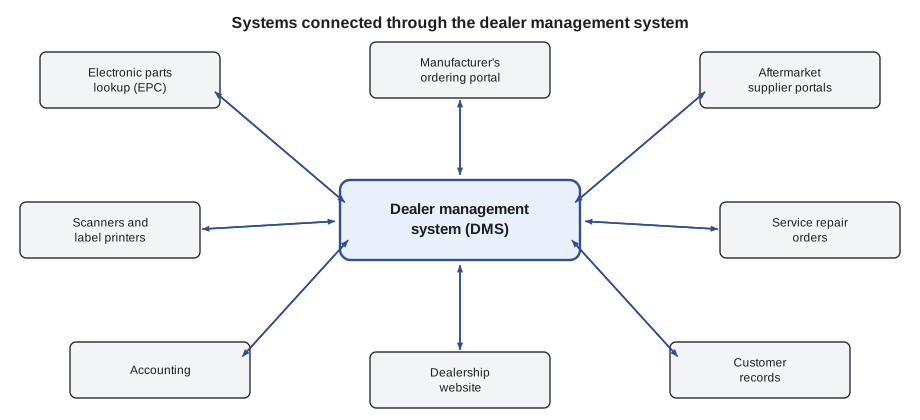
A dealer management system (DMS) is the central software of a dealership. One system holds the records for sales, service, parts, accounting and customers, so that information entered in one department is available in the others. When a service advisor writes a repair order, the parts department sees it; when a parts technician charges a part to the repair order, the service department's invoice and the accounting records update; when the parts department receives a shipment, the inventory and the accounts payable update together.
The parts side of a DMS usually handles:
- Inventory records: every part number the department stocks, with its description, location in the warehouse, quantity on hand and on order, cost, selling prices and sales history.
- Point of sale: counter invoices for retail and wholesale customers, with prices drawn from the customer's account.
- Repair order parts: charging parts to the service shop's repair orders.
- Ordering: suggested stock orders based on sales history, special orders for customers, and transmission of orders to suppliers.
- Receiving: matching shipments against orders and updating stock.
- Reporting: sales, gross profit, inventory value, turns, fill rate and other figures for the manager.
There are several DMS vendors, and every dealership's screens look a little different, but the ideas are the same everywhere. A good parts technician learns the logic of the system, not just the keystrokes, so that a change of software is a nuisance rather than a disaster.
Electronic parts catalogs
An electronic parts catalog (EPC) shows every part for a vehicle, organized by system and illustrated with exploded diagrams. The parts technician enters the vehicle identification number, and the catalog filters the parts to those that fit that particular vehicle's build: engine, transmission, trim, options and production date. Selecting a part in the diagram gives its part number, description, quantity used, and notes about which vehicles it fits, and often links to the DMS to show stock and price. Aftermarket catalogs work in a similar way but cover many brands, and usually show several makes and price levels for each part.
Catalogs are updated constantly as parts are revised and new models are added, so the catalog on the screen is more reliable than a part number remembered from last year. APT-120 covers catalog lookup in detail, including vehicle identification numbers and exploded views.
Ordering portals and supplier systems
The manufacturer's parts ordering portal lets the department place stock and emergency orders, check whether a part is available at the distribution center, track shipments and handle returns and warranty parts. Aftermarket suppliers have their own portals, and many shops now order from Linmore Tessaro electronically too, through the dealership's wholesale ordering system. Each portal has its own login, cut-off times and rules. At Linmore Tessaro, the nightly stock order must be submitted to the manufacturer by 5:00 p.m. for next-morning delivery, and emergency orders placed before 2:00 p.m. can come on the afternoon truck from the regional distribution center.
Barcodes, scanners and labels
Almost every part box carries a barcode encoding its part number, and many also carry a two-dimensional code with more information. The warehouse's shelf locations have barcode labels too. Scanning a part and its location when it is put away, picked or counted removes most of the errors that come from reading and typing numbers by hand. Linmore Tessaro's handheld scanners talk to the DMS over the warehouse Wi-Fi, so a scanned receipt updates stock at once.
Worked problem
How much scanning reduces errors
Before the department used scanners for picking, Rolf's records showed about 9 wrong parts sent out for every 1,000 lines picked by reading and typing the number. After scanning was introduced, the rate fell to about 1.5 per 1,000. In September 2026 the department picked 8,600 lines. How many wrong parts would each method be expected to produce in that month?
Show solution
- By reading and typing:
- \[8{,}600 \times 9 \div 1{,}000 = 77.4\]
- By scanning:
- \[8{,}600 \times 1.5 \div 1{,}000 = 12.9\]
- Difference:
- \[77.4 - 12.9 = 64.5\]
Answer: Scanning would be expected to prevent about 65 wrong parts a month. Each wrong part means a frustrated customer, a return, often freight, and staff time, so scanning pays for itself quickly. The rates are sample figures for this course.
Key measures the system reports
The DMS produces many reports. Two that every parts technician should understand from the start are fill rate and inventory accuracy.
Fill rate is the share of requests that the department can fill from its own stock at the time of the request, without having to order the part. A high fill rate means technicians and customers get their parts at once; a low one means waiting and lost sales. Dealership parts departments often aim for a fill rate of about 90 in 100 or better on the shop's requests.
Worked problem
Calculating a fill rate
In the week of October 19, the back counter received requests for 412 part lines on repair orders. It filled 371 from stock; the rest had to be ordered. What was the fill rate?
Show solution
- Fill rate:
- \[371 \div 412 \approx 0.900\]
Answer: The fill rate was about 90 in 100. Rolf reviews the 41 lines that had to be ordered each week to decide whether any should be added to stock.
Inventory accuracy is how closely the quantities in the DMS match what is actually on the shelves. Every time a part is taken without being scanned, put back in the wrong place, or received without being entered, the records drift from reality. Then the system says a part is in stock when it is not, or orders a part the shelf already has. Accurate records depend on every person following the procedures every time: scan it, record it, put it where the system says it is. APT-210 covers cycle counting and inventory accuracy in detail.
Email, phone and online orders
Much of the counter's business now arrives by email, through online ordering, and by text from regular customers, as well as by phone. Each order needs the same care as a counter sale: identify the vehicle, confirm the part, confirm price and availability, and record it in the DMS so it is not forgotten. Linmore Tessaro's rule is that no order exists until it is in the system: a part promised in a hallway conversation or written on a sticky note is a part that will be forgotten.
Written communication is part of the job's professionalism. Emails to customers and suppliers should be short, polite and clear, with the part numbers, quantities and dates written out, and should never include customers' private information that the recipient does not need. Lesson 10 covers professional communication more generally.
Privacy and data security
A parts department's systems hold personal information: customers' names, addresses, phone numbers, email addresses, vehicle details and purchase histories, and sometimes payment details. In the United States, car dealers that arrange financing are covered by the Federal Trade Commission's Safeguards Rule under the Gramm-Leach-Bliley Act, which requires them to have a written information security program, protect customer data and report certain security breaches; card payment data is also protected by the card industry's security standard. Looking up a neighbor's or a celebrity's record out of curiosity is a breach of the dealership's policy, and can cost someone their job.
Dealerships are also targets for cyberattacks. In June 2024, a ransomware attack on one of the largest DMS providers shut down systems at thousands of North American dealerships for about two weeks, and many parts departments went back to paper invoices and phone orders. The everyday habits that protect a dealership are simple:
- Use your own login, never share passwords, and lock the screen when you step away from the counter.
- Be suspicious of unexpected emails asking you to click a link, open an attachment, change a supplier's bank details or log in somewhere. Report them to the manager or IT.
- Do not plug unknown USB drives into dealership computers.
- Keep printed invoices and reports with customer information out of public view, and shred them when no longer needed.
- Know the backup procedure: how to write a paper invoice and record a sale if the system is down, so that it can be entered later.
On October 1 Talia also practiced the paper backup: Imani gave her a pad of numbered manual invoices and had her write up three sample sales, with part numbers, quantities, prices and tax, ready to be keyed in when the system came back. "If the system goes down on a Saturday morning," Imani said, "the customers are still standing at the counter."
Barcodes, labels and bin locations
Scanning only works when the labels are right. Every bin in the Linmore Tessaro warehouse has a location code built from its aisle, bay, level and position, such as 04-12-C-3: aisle 4, bay 12, level C, position 3. The location appears on the bin label as text and as a barcode, and the dealer management system knows which part numbers live in each location. When a picker scans the bin and then the part, the system checks that they match before the line is marked picked.
Labels wear out, fall off and get covered by tape, and a missing or wrong label is one of the main causes of picking errors. Sasha's team replaces any damaged label as soon as it is found, prints labels from the system rather than writing them by hand, and never moves a part to a new bin without updating its location in the system first. Moving parts around without updating the system is called a silent move, and it creates parts that the system says are on hand but that nobody can find.
Worked problem
Finding the cost of unlabeled bins
During the October cycle count, Sasha's team found 42 bins in aisle 6 with missing or unreadable labels. Each bin took an average of 3.5 minutes extra to identify and count. How much extra time did the missing labels cost, and how long would relabeling them take at about 1.5 minutes per label?
Show solution
- Extra counting time:
- \[42 \times 3.5 = 147\ \text{min} \approx 2.45\ \text{h}\]
- Time to relabel:
- \[42 \times 1.5 = 63\ \text{min}\]
Answer: The missing labels cost about two and a half hours in one count, while relabeling takes about an hour and prevents the same delay in every count and every pick that follows.
Keeping the catalog current
The electronic catalog is only as good as its latest update. Manufacturers release updates that add new models, supersede old part numbers with new ones and correct errors. A superseded part number has been replaced, and the system should point from the old number to the new one; ordering the old number can bring back the wrong part or nothing at all. Parts specialists check the catalog's update date when something looks wrong, report errors to the manufacturer through the dealer support channel, and never copy part numbers from an old printed list or an online forum.
Systems also fail. When the dealer management system or the network goes down, the department falls back on a written plan: a paper counter ticket book, a printed list of the day's special orders, and a rule that every sale written on paper is entered into the system as soon as it returns, with the ticket numbers checked so none are missed. Rolf runs a short practice of the downtime plan twice a year, so the counter can keep serving customers instead of turning them away.
Passwords and shared terminals
Each person logs in under their own account, so the system records who sold, received or adjusted each part. Sharing a login hides who did what and makes it impossible to trace an error or a theft. Counter terminals lock automatically after a few minutes, and people lock them themselves when they step away. Passwords are never written on the monitor or under the keyboard, and a request to share a password, whether it comes from a caller claiming to be from the software vendor or from a co-worker in a hurry, is refused and reported.
Common mistakes
MistakeTaking a part from the shelf without scanning or recording it.
InsteadScan or record every part that moves, so the DMS matches the shelf.
MistakePromising a part to a customer without entering the order.
InsteadEnter every order in the system at once; an unrecorded promise is easily forgotten.
MistakeLooking up a customer's record out of curiosity.
InsteadAccess only the information you need for the job in front of you.
MistakeClicking a link in an unexpected email about a supplier's new bank account.
InsteadReport it; confirm any payment change by phone using a known number.
MistakeRelying on a part number remembered from last year.
InsteadCheck the current catalog, because parts are revised and superseded.
Summary and key terms
- A dealer management system connects parts, service, sales, accounting and customer records.
- Its parts functions include inventory records, point of sale, repair order parts, ordering, receiving and reporting.
- Electronic parts catalogs filter parts by the vehicle's VIN and show exploded diagrams, part numbers and fitment notes.
- Ordering portals connect the department with the manufacturer and suppliers, each with its own cut-off times and rules.
- Barcode scanning of parts and locations greatly reduces picking and receiving errors.
- Fill rate is the share of requests filled from stock; inventory accuracy depends on every movement being recorded.
- Customer information is protected under the FTC Safeguards Rule, card security standards and dealership policy; use only what the job needs.
- Strong security habits and a paper backup procedure protect the department when systems are attacked or fail.
- Dealer management system
- The central software that runs a dealership's sales, service, parts, accounting and customer records.
- Electronic parts catalog
- Software that shows the parts for a vehicle in exploded diagrams, filtered by its VIN.
- Point of sale
- The part of a system that records sales and produces invoices at the counter.
- Fill rate
- The share of part requests filled from stock at the time of the request.
- Inventory accuracy
- How closely recorded stock quantities match what is on the shelves.
- Barcode
- A machine-readable code on a part or location label, read by a scanner.
- Phishing
- A fake email or message that tries to trick the reader into revealing information or making a payment.
Practice problems
Work each problem on paper first, then reveal the answer to check.
Name three things the parts side of a DMS handles.
Show answer
Any three of: inventory records, point of sale, repair order parts, ordering, receiving, reporting.
The back counter filled 371 of 412 requested lines from stock. What was the fill rate?
Show answer
About 0.90, or 90 in 100.
How many wrong parts would 8,600 lines produce at 1.5 errors per 1,000?
Show answer
About 13.
Why is the electronic catalog more reliable than a remembered part number?
Show answer
Parts are revised and superseded, and the catalog is updated constantly.
What should you do if the DMS goes down while customers are waiting?
Show answer
Use the paper backup procedure, with manual invoices to be entered when the system returns.
Lesson quiz · 5 questions
Score 60% or more to complete this lesson.
Create a free account to save your progress, take quizzes and earn a certificate.