
APT-110 · Lesson 8 of 12 · 26 min
Housekeeping and fire safety
▶ Video coming soon A video version of this lesson is on the way.
At 10:12 a.m. on Wednesday, October 21, 2026, the fire alarm sounded at Linmore Tessaro. Talia was halfway up the mezzanine stairs with a tote of wiper blades. She set the tote down on the landing, out of the way, walked down the stairs and out through the nearest exit beside the receiving dock, and joined the parts staff at their assembly point at the far corner of the back lot, where Rolf was counting heads. It took the whole dealership four minutes and ten seconds to get out. It was a planned drill, but Rolf's debrief afterwards found two problems: a pallet of returned cores had been left partly blocking the dock exit, and one of the newer counter staff had gone back for her phone. "Next time it might not be a drill," Rolf said.
Fire is one of the most serious risks in a parts department, which stores flammable aerosols and liquids, oils, tires, cardboard, plastics and batteries, often in tall stacks, close to people. Good housekeeping prevents many fires and most trips and falls, and good fire preparation limits the harm when something does go wrong. This lesson covers both.
Housekeeping
Housekeeping means keeping the workplace clean, orderly and free of things that do not belong there. In a parts warehouse it is the single cheapest safety measure, and it also makes the department faster: parts that are where they belong are found in seconds. Good housekeeping means:
- Clear floors, aisles, stairs and exits. Nothing is stored in walkways, in front of exits, electrical panels, fire extinguishers, eyewash stations or sprinkler risers.
- Packaging under control. Cardboard, plastic wrap, banding and foam go straight into the recycling and waste containers. Linmore Tessaro bales its cardboard, and only trained adults operate the baler.
- Spills cleaned at once, with the source found and fixed.
- Everything in its place. Parts in their locations, tools on their boards, pallets in the pallet stack, carts parked out of the aisles.
- Damaged and returned goods kept in their designated areas, not on the floor near the dock.
- Lighting working. Burned-out lights in an aisle are reported, because a dark aisle hides trips and makes labels hard to read.
Many warehouses use a structured approach often called 5S, after five Japanese words usually translated as sort, set in order, shine, standardize and sustain. The idea is to remove what is not needed, give everything that is needed a marked place, clean regularly, make the standard visible with labels and floor markings, and keep checking. Linmore Tessaro adopted a simple version of it after the parts department moved into its current building: the floor markings, labeled shelf locations and the 11:30 tidy-up described in lesson 3 all come from it.
Worked problem
Measuring housekeeping with an inspection score
The safety committee's monthly inspection checklist has 40 housekeeping items. In August the parts department passed 31; in October, after the daily tidy-up was introduced, it passed 37. What was the score each month, and by how much did it improve?
Show solution
- August score:
- \[31 \div 40 = 0.775\]
- October score:
- \[37 \div 40 = 0.925\]
- Improvement:
- \[0.925 - 0.775 = 0.15\]
Answer: The score rose from about 78 in 100 to about 93 in 100, an improvement of 15 points. The three items still failing in October included the pallet of cores near the dock exit that the fire drill also found.
How fires start and spread
A fire needs three things, often drawn as the fire triangle: fuel, heat and oxygen. A fourth element, the chemical chain reaction that keeps the fire burning, makes it a fire tetrahedron. Remove any one and the fire goes out: cooling removes heat, smothering removes oxygen, taking away the fuel starves it, and some extinguishing agents break the chain reaction.
In a parts department, the fuels are everywhere: cardboard, paper, plastic packaging, rubber, tires, oils, aerosols, flammable liquids and lithium-ion batteries. Common sources of ignition include electrical faults in chargers, extension cords and overloaded outlets; battery charging; damaged lithium batteries; heaters; smoking; and hot work such as welding or cutting near storage. Fires in tall storage spread upward quickly, which is why sprinklers and the clearance below them matter.
Fire prevention in the parts department comes down to a few rules: no smoking anywhere in the building or near the dock; flammables kept in their cabinets and in limited quantities; chargers and battery charging in their designated places; no extension cords used as permanent wiring; electrical panels kept clear; damaged lithium batteries isolated outdoors; and any hot work, such as a welder repairing racking, done only under a hot work permit with a fire watch.
Ohio's Fire Code, based on the International Fire Code, sets requirements for fire safety in buildings, including the storage of flammable liquids and other hazardous materials, portable extinguishers and the maintenance of sprinkler and alarm systems, and the local fire department enforces it. OSHA also requires employers to have an emergency action plan (1910.38) and, where required, a fire prevention plan (1910.39). Storage must be kept a safe distance below sprinkler heads, commonly at least 18 in, so the spray is not blocked.
Classes of fire and extinguishers
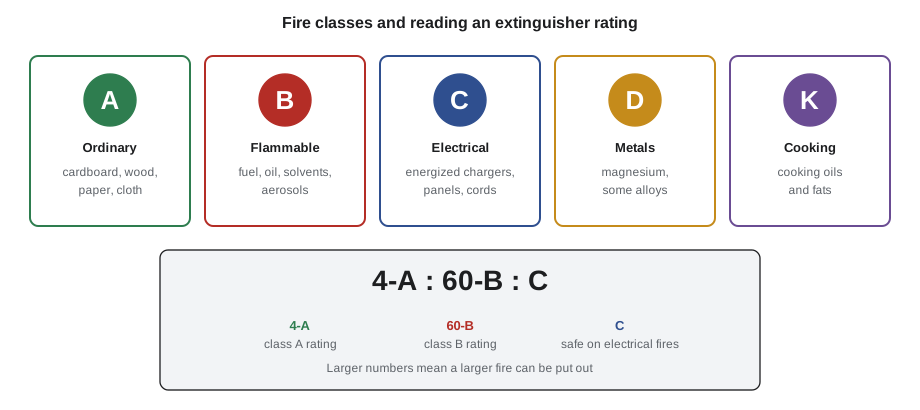
Fires are grouped into classes by what is burning, and portable extinguishers are rated for the classes they can put out. The same letter classes are used in Canada and the United States:
| Class | What is burning | Examples in a parts department | Suitable extinguishers |
|---|---|---|---|
| A | Ordinary combustibles | Cardboard, paper, wood pallets, rubber, plastics | Water, foam, multipurpose dry chemical (ABC) |
| B | Flammable liquids and gases | Brake cleaner, fuel additives, oils, paint | Dry chemical (ABC or BC), carbon dioxide, foam |
| C | Energized electrical equipment | Chargers, computers, electrical panels | Dry chemical, carbon dioxide; never water |
| D | Combustible metals | Magnesium or aluminum shavings (rare in parts) | Special dry powder for the metal |
| K | Cooking oils and fats | Staff kitchen | Wet chemical |
Most extinguishers in a parts department are multipurpose dry chemical extinguishers rated for classes A, B and C. Their label shows a rating such as 4-A:60-B:C: the number before A is a relative measure of its capacity on ordinary combustibles, the number before B a measure of its capacity on flammable liquids, and C shows that the agent does not conduct electricity. A bigger number means a bigger fire it can tackle, in trained hands.
Extinguishers must be mounted where they can be seen and reached, with nothing in front of them. They are inspected monthly to check that they are in place, charged and undamaged, and serviced at least yearly by a qualified technician, following the extinguisher standard used by both countries' fire codes (NFPA 10). A key point in that standard is the maximum travel distance to an extinguisher: for ordinary combustibles, nobody should have to travel more than about 75 ft to reach one.
Worked problem
Placing extinguishers along an aisle
The main aisle along the back wall of the warehouse is 200 ft long, with no other route to an extinguisher. If no point in the aisle may be more than 75 ft from an extinguisher, how many are needed, and where?
Show solution
- Each extinguisher covers a length of twice the travel distance:
- \[2 \times 75 = 150\ \text{ft}\]
- Number needed:
- \[200 \div 150 \approx 1.3 \to 2\]
- Spacing two extinguishers evenly:
- \[200 \div 4 = 50\ \text{ft from each end}\]
Answer: Two extinguishers, one 50 ft from each end, keep every point within 50 ft of an extinguisher, well inside the limit. The fire protection plan sets the actual locations, often at exits and the ends of aisles, and the fire department's inspector may require more.
Using an extinguisher: PASS
Portable extinguishers are for small fires in their early stages, and only for people trained to use them. Before fighting a fire, make sure the alarm has been raised, the fire is small and not spreading, you have a clear way out behind you, and you have the right extinguisher. Then use the PASS method:
- Pull the pin.
- Aim the nozzle at the base of the fire, not the flames.
- Squeeze the handle.
- Sweep from side to side across the base of the fire.
A typical small dry chemical extinguisher empties in about 10 to 20 seconds. If the fire is not out by then, or grows, leave, close the door behind you if you can, and let the fire department deal with it. Never let a fire get between you and the exit.
Lithium-ion battery fires
A lithium-ion battery in thermal runaway produces heat, flames and toxic, flammable gases, and can reignite after it seems to be out. A small device such as a phone or a tool battery can sometimes be dealt with by trained staff using a large amount of water to cool it, or by moving it outdoors with tongs if that can be done safely. A larger battery, such as a vehicle module or a box of tool batteries, is a job for the fire department: raise the alarm, evacuate, and tell the firefighters where the batteries are and what kind they are. Linmore Tessaro's fire safety plan lists the battery cage and the damaged-battery container so that the fire department knows where to look.
Emergency plans, exits and drills
The dealership's emergency action plan, written as OSHA requires, sets out who does what in a fire or other emergency: how the alarm is raised, the evacuation routes, who accounts for each department at the assembly point, and who meets the firefighters. A fire prevention plan lists the major fire hazards, how they are controlled and who maintains the equipment. Drills are held regularly, and new staff learn the plans in their first week.
The rules for a real alarm are the same as for the drill. Stop what you are doing, make any equipment safe if it takes only seconds, such as setting down a load and lowering the forks of a forklift, and leave by the nearest safe exit. Do not use the goods lift. Do not go back for belongings. Go to the assembly point and report to the person taking the count, so that nobody is reported missing who is safe, and nobody missing is overlooked. Re-enter only when the fire department says it is safe.
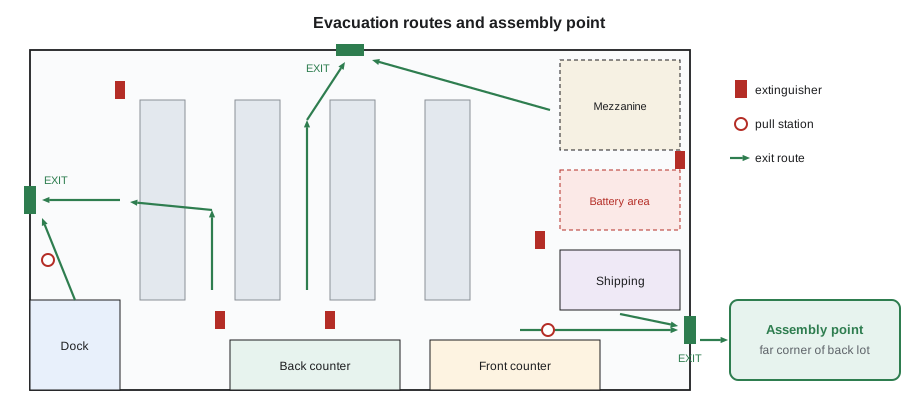
After the October drill, Rolf added two items to the department's daily close-down checklist: walk every exit route, and confirm nothing is stored within 3 ft of any exit door. The core pallet found blocking the dock exit was moved to a new marked area, and Rolf reminded everyone at the next morning meeting that belongings stay behind.
Electrical safety and hot work
Many warehouse fires start with electricity. Damaged extension cords, overloaded power bars, space heaters left near cardboard and chargers placed on combustible shelving are all common causes. The department's rules are simple: no extension cords as permanent wiring, no daisy-chained power bars, no personal space heaters, and every charger on a non-combustible surface with clear space around it. Electrical panels need clear space in front of them so they can be reached quickly in an emergency; a pallet of cores parked in front of the panel is as serious a fault as one parked in front of an exit.
Hot work, such as welding or cutting during a racking repair, is done only under a hot work permit. The permit names who is doing the work, checks that combustibles have been moved or covered, posts a fire watch with an extinguisher during the work, and requires a final check of the area some time after the work ends, because smoldering cardboard can take time to flare up.
Worked problem
Planning a fire watch
A contractor will weld new beam connectors in the back rack from 1:15 p.m. to 3:40 p.m. The dealership's hot work permit requires a fire watch during the work and for 60 minutes after it ends. How long must the fire watch stay in place, and when can it end?
Show solution
- Length of the welding:
- \[3{:}40 - 1{:}15 = 2\ \text{h}\ 25\ \text{min}\]
- Add the watch after the work:
- \[2\ \text{h}\ 25\ \text{min} + 60\ \text{min} = 3\ \text{h}\ 25\ \text{min}\]
Answer: The fire watch lasts about 3 hours 25 minutes and ends at 4:40 p.m., after a final check of the area. The 60-minute figure is the dealership's own rule; insurers and fire codes may set longer times.
Imani added one more line to the department's checklist after the October drill: the fire watch writes the start and end times on the permit, and the permit is filed with the inspection records so the safety committee can check it.
Common mistakes
MistakeLeaving a pallet in front of an exit "for a few minutes".
InsteadKeep exits, extinguishers, panels and eyewash stations clear at all times.
MistakeStacking cartons right up to the sprinkler heads.
InsteadKeep storage below the required clearance, commonly 18 in.
MistakeUsing a water extinguisher on a charger fire.
InsteadUse a dry chemical or carbon dioxide extinguisher rated for class C.
MistakeFighting a growing fire with a second extinguisher.
InsteadIf the first does not put it out, leave, close the door and let the fire department handle it.
MistakeGoing back into the building for a phone during an alarm.
InsteadGo straight to the assembly point and report to the person taking the count.
Summary and key terms
- Good housekeeping keeps floors, aisles, exits and equipment clear, controls packaging, cleans spills and puts everything in its place.
- A structured approach such as 5S helps keep housekeeping standards visible and sustained.
- Fire needs fuel, heat and oxygen; a parts department has many fuels and ignition sources.
- Fire classes A, B, C, D and K describe what is burning; most parts departments use multipurpose ABC dry chemical extinguishers.
- Extinguishers are inspected monthly, serviced yearly and placed so travel distance to one is limited, commonly about 23 m (75 ft) for ordinary combustibles.
- PASS: pull, aim at the base, squeeze, sweep; only for small fires with a clear exit behind you.
- Large lithium-ion battery fires are left to the fire department, who need to know where batteries are stored.
- In an alarm, leave by the nearest exit, do not go back, and report at the assembly point.
- Housekeeping
- Keeping a workplace clean, orderly and free of things that do not belong there.
- 5S
- A method of organizing a workplace: sort, set in order, shine, standardize and sustain.
- Fire triangle
- The three things a fire needs: fuel, heat and oxygen.
- Multipurpose extinguisher
- A dry chemical extinguisher rated for class A, B and C fires.
- Travel distance
- The walking distance from any point to the nearest fire extinguisher.
- PASS
- Pull, aim, squeeze, sweep: the steps for using a portable extinguisher.
- Assembly point
- The place outside where people gather after evacuating so they can be counted.
- Hot work
- Welding, cutting, grinding or other work that produces sparks or flame.
Practice problems
Work each problem on paper first, then reveal the answer to check.
What did the October fire drill find?
Show answer
A pallet of cores partly blocking the dock exit, and a worker who went back for her phone.
What does the C in an extinguisher rating of 4-A:60-B:C mean?
Show answer
The agent does not conduct electricity, so it is safe on energized electrical equipment.
What do the letters PASS stand for?
Show answer
Pull, aim, squeeze, sweep.
How many extinguishers are needed for a 60 m (200 ft) aisle with a 23 m (75 ft) travel limit?
Show answer
Two, placed about 15 m (50 ft) from each end.
The inspection score rose from 31 to 37 of 40 items. By how much did it improve?
Show answer
By 0.15, or 15 points in 100.
Lesson quiz · 5 questions
Score 60% or more to complete this lesson.
Create a free account to save your progress, take quizzes and earn a certificate.