
APT-110 · Lesson 4 of 12 · 23 min
Lifting, ladders and material handling
▶ Video coming soon A video version of this lesson is on the way.
Talia's back told her about the job before her supervisor did. By the Friday of her second week, after five days of pulling parts from low shelves and carrying cartons up the mezzanine stairs, she had a dull ache across her lower back that lasted into the weekend. On Monday, September 28, Imani noticed her bending stiffly at the waist to pick a box of brake rotors off the bottom shelf, and stopped her. "Show me how you just did that," she said, and then spent half an hour with Talia going through how to lift, where heavy parts should be stored, and when not to lift at all. By the end of the week the ache was gone.
Overexertion injuries, to backs, shoulders, knees and wrists, are the most common injuries in warehouse work. They rarely come from one dramatic lift; they build up from thousands of small ones done badly. This lesson covers how to assess a lift, how to lift well, how to use ladders and stock pickers, and the equipment that moves parts so people do not have to carry them.
Why lifting injures people
When you bend at the waist to pick up a load, your lower back acts like a lever. The muscles that hold you up are only a few centimeters from your spine, while the load in your hands may be half a meter or more in front of it, so the force on the spine is many times the weight of the load. The further the load is from your body, the lower you have to reach, the more you twist, and the more often you repeat the lift, the greater the strain. Fatigue makes it worse: muscles that are tired hold the spine less well, which is why many back injuries happen late in a shift.
Shoulders are injured by lifting above shoulder height and by reaching to the back of high shelves. Knees suffer from repeated squatting and kneeling on concrete. Wrists and hands are strained by gripping awkward or slippery boxes. All of these can be reduced by the same few changes: store heavy parts where they can be reached at waist height, keep loads close, avoid twisting, and use equipment instead of muscle.
Assessing a lift
Before lifting anything heavy or awkward, Imani taught Talia to ask four questions. How heavy is it? Most parts boxes show a weight; if not, tip a corner to test it. Where is it, and where is it going? A lift from floor level, from above the shoulders or from the back of a deep shelf is harder than one from waist height. Can I hold it close? A long, wide or awkward part, such as a bumper cover, a windshield or an exhaust pipe, holds the weight far from the body. Do I need to lift it at all? A hand truck, cart, pallet jack, lift table or second person may be the better answer.
For a quick benchmark, many occupational health programs use a load of about 51 lb as the most that most healthy workers can lift safely in ideal conditions: close to the body, from about waist height, with no twisting, and only occasionally. That figure is the starting point of the NIOSH lifting equation, a method published by the US National Institute for Occupational Safety and Health and used by ergonomists in both Canada and the United States. The equation reduces the benchmark for each way a real lift falls short of ideal. The result is the recommended weight limit for that particular lift.
Each multiplier is 1.0 for an ideal lift and smaller when conditions are worse:
- HM, horizontal: 10 divided by the distance in inches from the ankles to the hands.
- VM, vertical: 1 minus 0.0075 times how far the hands start from 30 in above the floor.
- DM, distance: 0.82 plus 1.8 divided by the vertical travel in inches.
- AM, asymmetry: less than 1.0 when the lift involves twisting.
- FM and CM, frequency and coupling: read from tables in the NIOSH guide, depending on how often the lift is repeated and how good the grip is.
Dividing the actual load by the recommended weight limit gives the lifting index. An index of 1.0 or less is considered acceptable for most workers; above 1.0, the risk of injury rises, and the lift should be redesigned.
Worked problem
Assessing the brake rotor lift
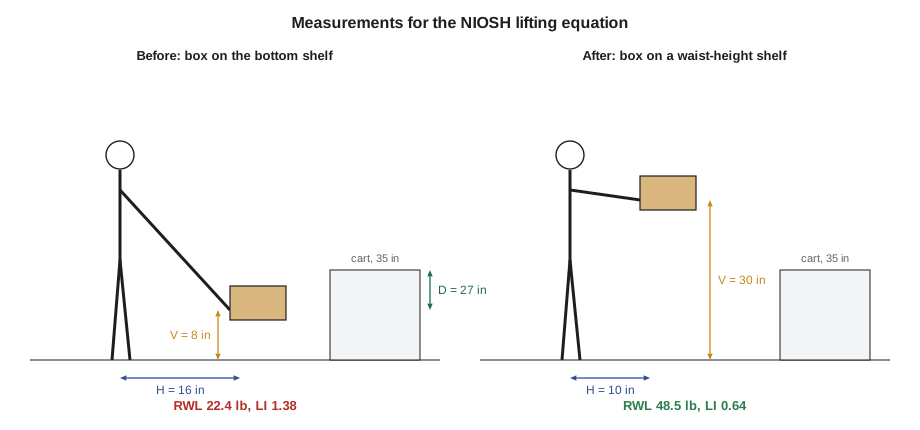
A box of brake rotors weighs 31 lb. Talia lifts it from the bottom shelf, with her hands starting 8 in above the floor and 16 in in front of her ankles, onto a cart at 35 in. She does not twist. She does this lift about once every five minutes for less than an hour, which gives a frequency multiplier of 1.0, and the box has cut-out handles of fair quality, giving a coupling multiplier of 0.95 (both from the NIOSH tables). What is the recommended weight limit, and what is the lifting index?
Show solution
- Horizontal multiplier:
- \[HM = 10 \div 16 = 0.625\]
- Vertical multiplier:
- \[VM = 1 - 0.0075 \times |8 - 30| = 0.835\]
- Distance multiplier (travel from start to cart):
- \[DM = 0.82 + 1.8 \div 27 \approx 0.887\]
- Recommended weight limit:
- \[\text{RWL} = 51 \times 0.625 \times 0.835 \times 0.887 \times 1 \times 1 \times 0.95 \approx 22.4\ \text{lb}\]
- Lifting index:
- \[LI = 31 \div 22.4 \approx 1.38\]
Answer: The recommended weight limit for this lift is only about 22 lb, so a 31 lb box gives a lifting index of about 1.4: too high. When Sasha moved the rotors to a shelf at 30 in, with the hands 10 in from the ankles, the horizontal, vertical and distance multipliers all became 1.0, the limit rose to 51 × 0.95 ≈ 48.5 lb and the index fell to about 0.64. Heavy, fast-moving parts belong at waist height.
The lesson Rolf drew from Talia's assessment was not about Talia's technique but about the warehouse: the heaviest fast-moving parts had been stored on the lowest shelves because that was where there was room. Over the next two weeks Sasha moved rotors, drums and batteries to waist-height locations and put light, slow-moving parts on the bottom and top shelves. The best lifting technique is the lift that is not needed.
Lifting well
When a lift has to be done by hand, good technique reduces the strain:
- Plan the route. Know where the load is going and clear the path before lifting.
- Get close. Stand with your feet apart, one slightly ahead of the other, as close to the load as you can.
- Bend your knees and hips, not your back. Keep your back in its natural curve and your head up.
- Get a good grip. Use handles or the bottom corners; wear gloves for sharp or slippery boxes.
- Lift smoothly with your legs, keeping the load close to your body. Do not jerk.
- Turn with your feet, not your waist. Twisting while holding a load is one of the worst things for the spine.
- Set it down the same way, bending your knees, and keep your fingers clear.
For long or awkward parts, such as bumper covers, hoods, windshields and exhaust pipes, use two people. One person leads and calls the moves: "Lift on three. Turning left. Setting down." Talia found that two people carrying a hood together was faster than one person struggling, as well as safer.
Ladders, step stools and stock pickers
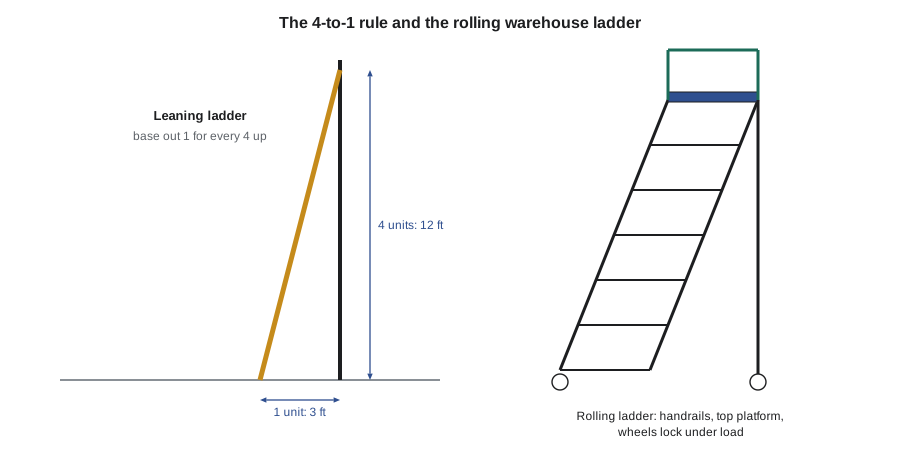
High shelves and the mezzanine mean climbing, and falls from ladders are among the most serious warehouse injuries. Linmore Tessaro uses three kinds of climbing equipment: rolling warehouse ladders with handrails, a platform at the top and wheels that lock when someone stands on the first step; step stools for the lower shelves; and an order picker, a powered truck that lifts the operator on a platform, used for the top levels of the racking. Leaning extension ladders are not used inside the warehouse at all.
OSHA's walking-working surfaces standard, 1910.23, sets requirements for ladders in general industry, including that they be inspected before use, used only for their designed purpose, kept free of oil and grease, and used with the user facing the ladder. Workers must be trained under 1910.30. Linmore Tessaro's rules follow the standard and the manufacturer's instructions:
- Inspect the ladder before using it: steps, rails, wheels, locks and handrails.
- Keep three points of contact at all times: two hands and a foot, or two feet and a hand.
- Face the ladder when climbing or descending, and do not carry parts in your hands while climbing. Use the ladder's tray, a tote with a strap, or pass the part down to someone.
- Do not overreach. Move the ladder instead; your belt buckle should stay between the rails.
- Never stand on a shelf, a box, a chair or the forks of a forklift.
On the rare occasions a portable leaning ladder is used, such as for changing a light outside, the 4-to-1 rule applies: the base should be one unit out from the wall for every four units of height to the point where the ladder rests, and the ladder should extend about 3 ft above a landing it is used to reach.
Worked problem
Setting up a leaning ladder
An extension ladder will rest against a wall at a point 12 ft above the ground. How far from the wall should its base be?
Show solution
- Base distance by the 4-to-1 rule:
- \[12 \div 4 = 3\ \text{ft}\]
Answer: The base should be about 3 ft from the wall.
Equipment that does the lifting
Most material in a parts warehouse should move on wheels, not in arms. The common equipment is:
- Hand trucks and dollies for cartons, batteries and tires. Tilt the load back onto the wheels and push; never ride the hand truck down the dock ramp.
- Carts with shelves, used for picking orders. A loaded cart should be pushed, not pulled, so you can see where you are going and use your body weight.
- Manual pallet jacks for moving pallets short distances on the level. Lower the forks fully before moving, push rather than pull, and never ride on the jack.
- Lift tables and scissor carts that raise a load to the height of a shelf or a vehicle.
- The mezzanine gate and lift: Linmore Tessaro's mezzanine has a pallet gate that is opened only from the mezzanine side, so there is never an open edge, and a small goods lift for cartons.
- Powered equipment such as forklifts and order pickers, covered in lesson 5.
Each of these has its own weight limit on a plate or label. A pallet jack rated for 4,500 lb on level concrete may be impossible to stop safely on a slope or a dock ramp with a much lighter load. When in doubt, ask Sasha.
Pushing, pulling and repetitive work
Lifting is not the only way to strain the body. Pushing and pulling heavy carts and pallet jacks, especially starting them moving, puts large forces through the shoulders and back. Keep wheels and casters maintained, because a cart with a seized wheel can take twice the force to push; push with both hands at about waist height; and get help or a powered pallet jack for heavy loads. Long picking sessions at a computer or a counter can strain the neck and wrists, so screens should be at eye level, keyboards and scanners within easy reach, and anti-fatigue mats provided where people stand for long periods.
Breaks and variety help too. Rolf rotates people between the counter, the warehouse and receiving during the day where he can, so nobody spends a whole shift lifting or a whole shift standing at a screen. Early signs of strain, such as aching, tingling, numbness or stiffness that lasts overnight, should be reported early, when a small change in the work can still fix them, rather than after they have become an injury.
Common mistakes
MistakeBending at the waist to lift a heavy box from the floor.
InsteadBend the knees and hips, keep the back in its natural curve and the load close.
MistakeStoring the heaviest fast-moving parts on the bottom shelf because there was room.
InsteadStore heavy, fast-moving parts at waist height; put light, slow movers high and low.
MistakeTwisting at the waist to put a box on a cart beside you.
InsteadTurn with your feet, or set the cart in front of you.
MistakeClimbing a ladder with a part in one hand.
InsteadKeep three points of contact; use a tray or tote, or pass the part down.
MistakePulling a loaded pallet jack behind you down an aisle.
InsteadPush it, so you can see ahead and control it.
Summary and key terms
- Overexertion injuries build up from many small lifts done badly, especially from low, high, far or twisted positions.
- The NIOSH lifting equation starts from a 51 lb benchmark and reduces it for distance, height, travel, twisting, frequency and grip.
- A lifting index above 1.0 means the lift should be redesigned, often by moving the part to waist height.
- Good technique keeps the load close, bends the knees and hips, avoids twisting and uses two people for long parts.
- Ladders are inspected, climbed facing the ladder with three points of contact, and never overreached from.
- Leaning ladders follow the 4-to-1 rule; rolling warehouse ladders and order pickers are used for most high work.
- Hand trucks, carts, pallet jacks and lift tables should do most of the lifting.
- Overexertion
- An injury caused by lifting, pushing, pulling or carrying beyond what the body can safely handle.
- Recommended weight limit
- The load that nearly all healthy workers could lift under given conditions without increased risk of back injury.
- Lifting index
- The actual load divided by the recommended weight limit; above 1.0 indicates increased risk.
- Three points of contact
- Two hands and a foot, or two feet and a hand, in contact with a ladder at all times.
- 4-to-1 rule
- A leaning ladder's base is one unit from the wall for every four units of height.
- Order picker
- A powered truck that lifts the operator on a platform to pick parts from high racking.
- Pallet jack
- A wheeled device with forks for lifting and moving pallets short distances.
Practice problems
Work each problem on paper first, then reveal the answer to check.
What four questions should you ask before a heavy lift?
Show answer
How heavy is it, where is it and where is it going, can I hold it close, and do I need to lift it at all?
What does a lifting index above 1.0 mean?
Show answer
The lift carries an increased risk of injury and should be redesigned.
How far from the wall should a ladder's base be if it rests 3.6 m (12 ft) up?
Show answer
About 0.9 m (3 ft).
Why should a loaded cart be pushed rather than pulled?
Show answer
You can see ahead, use your body weight and control it better.
What was the real fix for Talia's brake rotor lift?
Show answer
Moving the rotors to a waist-height shelf, which brought the lifting index below 1.0.
Lesson quiz · 5 questions
Score 60% or more to complete this lesson.
Create a free account to save your progress, take quizzes and earn a certificate.