
APT-110 · Lesson 12 of 12 · 25 min
A tour of a dealership parts department
▶ Video coming soon A video version of this lesson is on the way.
On Friday, November 13, 2026, two months after her own first day, Talia gave the tour. Linmore Tessaro had hired a second parts apprentice, Anouk Mendelsohn, who would start on the counter the following Monday, and Rolf asked Talia to walk her through the department on her pre-start visit, the way Imani had walked Talia through it in September. Imani came along and said almost nothing. Rolf had given Talia one instruction: "Show her the place the way you'd want to have seen it on your first day. Everything you've learned since September is in this building somewhere."
This lesson follows that tour, area by area, as a review of the whole course. At each stop it brings together what the earlier lessons covered: how the department works, its sectors and customers, its hazards and the habits that control them, and the systems and people that run it. A tour like this one is also a practical skill in its own right, since experienced parts technicians often show new staff, suppliers, inspectors and customers around.
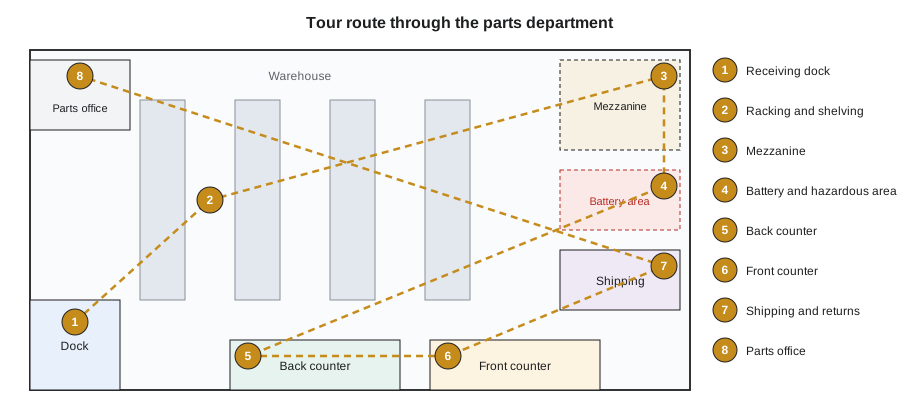
Stop 1: the receiving dock
Talia started where the parts start. She showed Anouk the locked overnight cage where the manufacturer's truck leaves its shipment at about 2 a.m., the dock door with its leveler and vehicle restraint, and the sign with the dock rules. She pointed out the yellow line 3 ft back from the dock edge and the stairs down to the lot, and explained why no one enters a trailer until the wheels are chocked or the restraint is engaged and the driver's keys are in the receiving lead's hand (lesson 3). She also showed her the new marked area for returned cores, moved there after the fire drill found them blocking the exit (lesson 8).
At the receiving bench, Sasha was checking the morning's aftermarket delivery against the packing slip with a scanner. Talia explained that every box is scanned in, so the dealer management system knows it has arrived and the counter can sell it at once (lesson 9). Damaged cartons, like the leaking battery in October, are set aside, photographed and recorded for a claim (lesson 7).
Stop 2: the warehouse
In the main warehouse, Talia walked Anouk down the pedestrian walkway and stopped at the marked crossing at the end of aisle 4. She pointed out the new upright, replaced after the October damage, and the load sign at the end of the bay, and explained how to check a level's load against it (lesson 3). She explained the warehouse's location system: every shelf and bin has a barcoded location, and every part in the DMS has a location, so that a part that is in its location can be found in seconds, and one that is not may never be found at all.
She showed her the heavy, fast-moving parts now stored at waist height, and told her the story of her own sore back in September and the lifting assessment that led to the move (lesson 4). She pointed out the rolling ladders with their locking wheels and handrails, and the rule of three points of contact. At the charging station she showed Anouk the counterbalanced forklift, its capacity plate and its daily check sheet, and explained that Anouk would not operate it, or any powered equipment, until she had been trained, assessed and put on Rolf's authorized list (lesson 5).
Worked problem
A quick look at the warehouse's numbers
Talia had learned some of the department's figures from Rolf. The warehouse holds about 11,800 different part numbers, with a stock value at cost of about 640,000 dollars. Over the last twelve months the department's cost of parts sold was about 3,840,000 dollars. How many times did the stock turn over in a year, and about how many days of sales does the stock represent? (These are sample figures.)
Show solution
- Inventory turns in a year:
- \[3{,}840{,}000 \div 640{,}000 = 6.0\]
- Days of sales held in stock:
- \[365 \div 6.0 \approx 61\]
Answer: The stock turns about 6 times a year, so the shelves hold roughly two months of sales. Talia explained to Anouk that keeping the right parts, not the most parts, is what makes a department fast and profitable, and that APT-210 covers turns and stocking decisions in detail.
Stop 3: the mezzanine
Upstairs on the mezzanine, where small and light parts are stored in bins, Talia showed Anouk the pallet gate that opens only from the mezzanine side, so there is never an open edge, and the goods lift for cartons. She pointed out the wobbly stair she had reported on September 29, fixed the next morning, and the hazard report forms at the top of the stairs (lesson 3). She explained that the mezzanine is where most picking errors happen, because many small parts look alike, and that scanning every pick is the department's defense against sending the wrong one (lesson 9).
Stop 4: the battery and hazardous materials area
At the battery cage, Talia showed Anouk the lead-acid batteries stored upright on low shelves with spill trays, the returned cores on their pallet, the plumbed eyewash, the spill kit and the bag of neutralizer, and explained the three hazards of a lead-acid battery: acid, hydrogen and weight (lesson 7). She showed her the separate cabinet for lithium-ion products, the airbag and pretensioner cabinet, and, through the side door, the damaged-battery container standing on its pad away from the building wall.
Next to the cage was the flammables cabinet and the shelving for fluids. Talia picked up a can of brake cleaner and walked Anouk through its label: the flame pictogram, the signal word, the hazard and precautionary statements. Then she showed her how to find its safety data sheet on the counter terminal and in the backup binder (lesson 6). She told her that Anouk's Hazard Communication training was booked for her second morning.
Stop 5: the back counter
The back counter was busy, as it always is mid-morning. Two technicians were waiting with repair orders, and Imani's colleague at the window was charging parts to them. Talia explained that the dealership's own shop is the department's biggest customer, about 46 in 100 of sales in September (lesson 1), and that technicians are often paid by the job, so every minute they wait matters. She showed Anouk the rule printed above the window, "No VIN, no part", and told her about the October review that found most wrong-part returns had been looked up without one (lesson 10).
She also showed her the bin where technicians return unused parts in their original packaging, and explained that a returned part must be checked and put back in its location, or the stock records will drift from reality (lesson 9).
Stop 6: the front counter
At the front counter, Talia showed Anouk the counter terminal with the electronic parts catalog, the point-of-sale screen and the card terminal, and the shelves of accessories, wiper blades, oils and filters that retail customers buy most. She explained the counter habits from lesson 10: greet every customer within seconds, listen first, ask for the VIN, confirm before selling, explain the choices, and close with the return policy and any core charge. She told Anouk the story of the mirror customer, and showed her where the pad of manual invoices is kept for when the system is down.
She also pointed out the chair beside the counter for customers who need to sit, and explained the dealership's policy on serving customers with disabilities under the ADA, which Anouk would also be trained on in her first week.
Stop 7: shipping and returns
In the shipping area, Gideon was loading the 10:00 wholesale run. Talia explained the three main customer groups and why the wholesale trade, body shops and independent garages, gets delivery (lesson 1), and showed Anouk the shelves where returns, cores and warranty parts wait to go back to suppliers, each kind in its own labeled place (lesson 7). She explained that shipping some products, such as batteries, airbag parts and some fluids, needs special training under the transport rules, and that only Sasha and Gideon ship them for now (lesson 6).
She mentioned the other branches too. Gideon's afternoon run would stop at Linmore Parts Supply, the aftermarket store, and the group's heavy truck and equipment branch, which she had visited in September (lesson 2). "It's all the same trade," she told Anouk, repeating what Rolf had told her. "Different parts, same skills."
Stop 8: the parts office and the paperwork of safety
The tour ended in Rolf's office, where Talia showed Anouk the safety notice board: the health and safety policy, the workplace violence and harassment policy, the minutes of the last safety committee inspection, the posted list of authorized forklift operators, the fire safety and emergency plan with the evacuation map, and the hazard reports and their answers. Talia explained the three things she wished someone had told her even more firmly on her first day: report every hazard, however small; ask before you guess; and never go back for your phone in a fire alarm.
Worked problem
Planning a new hire's first week
Rolf's onboarding checklist for a new parts apprentice lists 26 items for the first week. By the end of Anouk's pre-start visit, 7 had been completed: the tour, the safety boots and vest, the emergency plan and assembly point, the hazard reporting procedure, the policies, the uniform order and the computer login request. What share was done before her first day, and how many items remain for her first five days?
Show solution
- Share completed:
- \[7 \div 26 \approx 0.27\]
- Items remaining:
- \[26 - 7 = 19\]
- Items per day over five days:
- \[19 \div 5 = 3.8\]
Answer: About 27 in 100 of the checklist was done before Anouk's first day, leaving 19 items, about four a day, including her hazard communication training, the counter procedures and a first look at the catalog. Forklift training is not on the first-week list; it is scheduled once she has learned the warehouse on foot.
Anouk had one question at the end. "What's the hardest part?" Talia thought about it. "Remembering that the fast way and the right way are usually the same way," she said. Imani, who had said almost nothing for an hour, smiled.
Looking ahead
Talia's first two months covered the foundation: the trade and its sectors, the warehouse and its hazards, the safety rules for lifting, ladders, forklifts, hazardous products, batteries and fire, the systems that run the department, and the professional habits and career path of a parts technician. The next courses build on that foundation: identifying parts and using lookup systems (APT-120), serving customers at the counter (APT-130), and the automotive systems that every parts technician needs to understand (AUTO-110).
Questions a new employee should ask
Anouk asked good questions during her tour, and Talia keeps a list of the ones every new employee should ask in their first week, because the answers are not always on the tour:
- Who is my supervisor, and who do I go to when they are not here?
- Where are the first aid kit, the eyewash station, the spill kits and the fire extinguishers nearest my work area?
- Who are the safety committee members, and how do I report a hazard?
- What training do I need before I may use the forklift, the stock picker or the baler?
- What is the procedure if I am hurt at work, however minor the injury?
- How do I log in to each system, and who resets my password?
- What should I do if a customer or co-worker makes me feel unsafe?
A new employee who knows these answers by the end of the first week is far less likely to be hurt, and far more likely to become a confident member of the team.
Worked problem
Planning a first month of training
Anouk's onboarding plan has 26 items. She completed 7 on her first day, and the plan allows 20 working days in all. If she completes the remaining items evenly over the 19 days left, how many must she complete each day?
Show solution
- Items remaining:
- \[26 - 7 = 19\]
- Items per day:
- \[19 \div 19 = 1\]
Answer: One item a day, a steady pace that leaves time to practice each skill with a mentor before moving on. Items such as forklift training take longer than one day and are scheduled with the trainer.
Common mistakes
MistakeGiving a new hire a tour that skips the hazards to save time.
InsteadShow the hazards and the controls at each stop; that is the point of the tour.
MistakeLetting a new hire operate equipment because they have watched it used.
InsteadPowered equipment waits until training, assessment and authorization.
MistakeExplaining procedures without the reasons behind them.
InsteadGive the reason, ideally with a real example from the department.
MistakeTreating the paperwork on the notice board as optional reading.
InsteadPolicies, plans and authorized lists are part of working safely.
MistakeTelling a new hire to learn by guessing.
InsteadEncourage them to ask before they guess, from the first day.
Summary and key terms
- The parts flow runs from receiving through the warehouse and mezzanine to the counters and shipping, with returns flowing back.
- Each area has its own hazards and controls: dock rules, racking load signs, lifting and ladder rules, forklift authorization, hazardous products storage and fire safety.
- The dealer management system, catalog and scanners tie the department together, and accurate records depend on every movement being recorded.
- The dealership's own shop, wholesale customers and retail customers each need different service.
- Inventory turns show how many times stock is sold in a year; about 6 turns means about two months of stock.
- New hires learn the safety policies, emergency plan and hazard reporting before or on their first day; powered equipment comes later.
- The core habits: report every hazard, ask before you guess, and do it the right way even when busy.
- Onboarding
- The process of welcoming and training a new employee in their first days and weeks.
- Pre-start visit
- A visit before a new employee's first working day, used for a tour and basic safety information.
- Inventory turns
- The cost of parts sold in a year divided by the average stock value at cost.
- Location system
- The system of labeled shelf and bin locations that tells staff where each part is stored.
- Authorized operator list
- The posted list of people trained and permitted to operate each piece of powered equipment.
Practice problems
Work each problem on paper first, then reveal the answer to check.
What was the first stop on Talia's tour, and why?
Show answer
The receiving dock, because that is where parts enter the department.
The cost of parts sold is 3,840,000 dollars and the stock is 640,000 dollars at cost. What are the turns?
Show answer
6.0 turns a year, or about 61 days of stock.
Why will Anouk not operate the forklift in her first week?
Show answer
Only trained, assessed and authorized operators may use powered equipment.
What three things did Talia wish she had been told more firmly on her first day?
Show answer
Report every hazard, ask before you guess, and never go back for your phone in a fire alarm.
Seven of 26 onboarding items are done. What share is that?
Show answer
About 0.27, or 27 in 100.
Lesson quiz · 5 questions
Score 60% or more to complete this lesson.
Create a free account to save your progress, take quizzes and earn a certificate.