
WLD-340 · Lesson 1 of 12 · 18 min
How the Red Seal welder exam works
Devon Okafor has three months left in his apprenticeship. He has logged most of his hours, finished his third block of technical training and passed the in-school exams. What stands between him and a journeyperson certificate is one written exam: the interprovincial Red Seal examination for the Welder trade. Marta Kowalchuk, who wrote it eleven years ago, tells him it is not a test of whether he can weld. His hours and his CWB tests already show that. It is a test of whether he knows the trade well enough to work anywhere in the country, read any job's paperwork and make sound decisions without someone checking over his shoulder. This course is his preparation, and it is built the way Hartwell prepares every apprentice: understand the exam, plan the study, review each part of the trade with worked problems, and practise under exam conditions.
What the Red Seal is
The Red Seal Program sets a common standard for trades across Canada. Each province and territory runs its own apprenticeship system and issues its own certificate, but for the trades in the program it also offers the interprovincial exam. A journeyperson who passes it gets a Red Seal endorsement on the provincial certificate. The endorsement is recognized in every province and territory, so a welder certified in Alberta can work in Saskatchewan or Newfoundland and Labrador without writing another provincial exam. Employers and unions read it as proof that the welder meets the national standard for the trade.
In Alberta, Welder is a compulsory certification trade. An apprentice completes three periods, each with about 1,560 hours on the job and eight weeks of technical training, and writes a theory exam at the end of each period. In the final period the apprentice can choose to write the Red Seal exam, and passing it gives both the Alberta journeyperson certificate and the Red Seal endorsement. Welders who have worked in the trade without apprenticing can qualify through the trades qualifier route, which needs documented experience and both a theory and a practical exam. Kofi Mensah, who joined Hartwell with years of welding in another country, is looking at that route.
The shape of the exam
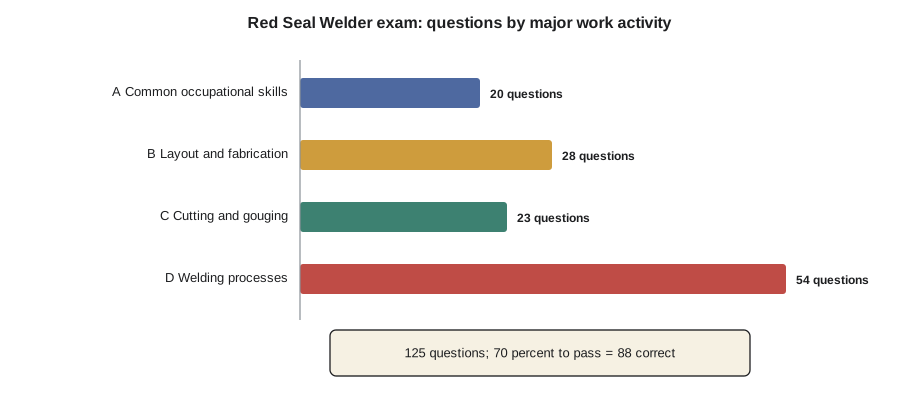
The Red Seal Welder exam has 125 multiple-choice questions, and the pass mark is 70 percent. The questions are written by working journeypersons and checked against the Red Seal Occupational Standard, the document that describes what a welder does. The standard groups the trade into major work activities, and the exam's questions are divided among them in fixed proportions. Every question has four options and one best answer. There is no penalty for a wrong answer beyond losing that mark, so an unanswered question is a wasted chance.
| Major work activity | Weighting | Questions |
|---|---|---|
| A Performs common occupational skills | 16% | 20 |
| B Performs layout and fabrication of components for welding | 22% | 28 |
| C Performs cutting and gouging | 18% | 23 |
| D Performs welding processes | 44% | 54 |
| Total | 100% | 125 |
The weighting tells Devon where the marks are. Welding processes carry 44 percent of the exam, and within that block shielded metal arc and the wire processes carry the most questions, with gas tungsten arc and submerged arc behind them. Layout and fabrication carries more than a fifth of the marks, which surprises apprentices who think of the exam as a welding test. Common occupational skills cover safety, tools, documents, rigging, communication and the trade's basic knowledge. Cutting and gouging, which apprentices often think they know, carries nearly a fifth.
How exam questions are written
Whatever the test, written questions in the trades follow a pattern. Each one has a stem, which is the question or the unfinished statement, and four options. One option is the best answer. The other three are distractors, and good distractors are wrong answers that a person with a gap in knowledge would choose. A distractor might be the right value in the wrong unit, a correct fact about a different process, a step done in the wrong order, or something that is true but does not answer the question asked. Knowing how distractors are built is not a trick for passing without knowledge; it is a way to notice when a question is testing something more specific than it first seems.
Questions also come in levels. A recall question asks for a fact: the colour of an acetylene hose, or the meaning of the last digit in an electrode classification. An application question gives a situation and asks what to do: a coupon is cracking at the start of each bead, so what should the welder change? An analysis question gives more information than you need and asks you to sort it: a drawing note, a procedure and a set of readings, and which reading is out of range. Experienced welders find recall questions the hardest, oddly, because they know how to do the job but have forgotten the textbook names. Apprentices fresh from school find application questions harder, because they know the names but have less experience deciding.
Worked problem
Reading a question for what it asks
A practice question reads: 'A welder is running E7018 in the overhead position on a structural job, and the electrodes have been out of the holding oven for six hours. What should the welder do first?' The options are: increase the amperage; switch to a smaller electrode; return the electrodes to the oven and use fresh ones from the oven; grind each bead before the next.
Show solution
- Find the key words: E7018 is a low-hydrogen electrode, six hours is the time out of the oven, and the question asks what to do first.
- Recall the rule from WLD-120 lesson 5: low-hydrogen electrodes have a limited exposure time out of the oven, commonly about four hours for this class under structural codes, after which they must be redried or discarded as the code allows.
- Check each option against the problem. Amperage and electrode size are about position, not hydrogen. Grinding does not remove absorbed moisture from the flux.
- Only one option deals with the actual problem: electrodes that have been exposed too long.
Answer: Return the electrodes and use fresh ones from the oven. The position and the job are background; the question is about exposure time.
Timing and pacing
The Red Seal exam is timed, and the time allowed is generous for a prepared candidate but not for one who works every question from first principles. Check the time stated in your province's exam information. A useful rule is to know your average pace: divide the time available by the number of questions, and keep a reserve for questions you mark to return to. Devon's practice exams show he takes about a minute on recall questions and up to three minutes on calculations. The code below works out his pace and tells him when he is behind.
# Pacing plan for a timed written exam
QUESTIONS = 125
MINUTES = 240
RESERVE = 20          # minutes kept back for marked questions and a final check

working = MINUTES - RESERVE
per_q = working / QUESTIONS
print(f"{QUESTIONS} questions in {MINUTES} min: work at {per_q:.2f} min per question, keep {RESERVE} min in reserve")
for done in (25, 50, 75, 100):
    if done <= QUESTIONS:
        print(f"  after question {done:>3}: about {done * per_q:5.0f} min should have passed")

# Devon's last practice set: (question type, count, average minutes each)
mix = [('recall', 70, 1.0), ('application', 40, 1.8), ('calculation', 15, 3.0)]
need = sum(n * m for _, n, m in mix)
print(f"his own pace needs {need:.0f} min for {sum(n for _, n, _ in mix)} questions")
print('on track' if need <= working else f'behind by {need - working:.0f} min: skip long calculations on the first pass')125 questions in 240 min: work at 1.76 min per question, keep 20 min in reserve after question 25: about 44 min should have passed after question 50: about 88 min should have passed after question 75: about 132 min should have passed after question 100: about 176 min should have passed his own pace needs 187 min for 125 questions on track
The time in the program is an example for planning; use the time your province states. With 220 working minutes for 125 questions, Devon has about 1.8 minutes a question, and his own mix of question types needs about 187 minutes, so he is on track with time to spare. The habit he takes from it is to move on from a long calculation on the first pass and come back to it, rather than spend ten minutes on one mark while easy marks wait at the end of the booklet.
On the day
The exam is written at a provincial apprenticeship office or an approved site. Bring the identification the office asks for and arrive early. Phones, cameras and other recording or communication devices are not allowed, and a candidate found with one is removed. The office says whether a basic calculator is supplied or allowed; never assume. A candidate who does not pass gets a breakdown of results by major work activity, which shows where to study, and can rewrite after the waiting period the province sets.
Marta's advice for any test is the same. Sleep properly the night before. Eat. Read every question, or every line of the procedure, to the end before you start answering. When two options look right, the question usually contains a word that makes one of them wrong: first, best, most likely, not, except. Do not change an answer you were sure of because the next three questions made you nervous; change it only if you find a fact that proves the first answer wrong.
What the exam is not
Apprentices arrive with myths about the Red Seal exam, and Marta spends a few minutes on them because each one costs study time. The exam is not written to trick people; the questions are reviewed by panels of welders, and a question that experienced welders keep missing for the wrong reasons is taken out. It does not test the textbook's wording; it tests the trade, so a question may describe a situation in shop language rather than the words of the course. It is not based on one province's rules; where provinces differ, questions stick to what is common or name the standard they rely on. And it does not reward memorizing old exam questions, because the question banks are large and kept confidential. What it rewards is understanding the trade broadly enough to handle any of hundreds of situations.
There is also a myth that experience alone is enough. Kofi has welded for fourteen years and is the most skilled stick welder in the study group, but his first practice set scored 61 percent, because he had never needed to name a joint by its code designation, decode an electrode classification or explain why a procedure limits heat input. Experience gives a welder the answer to a question asked on the shop floor in front of the work. A test asks the same question on paper, without the work in front of you, and that is a different skill that needs its own practice. Kofi's second set, three weeks later, scored 78 percent.
Finally, the exam is a step and not a verdict. A candidate who does not pass gets a result broken down by area, studies those areas and writes again. Several of Hartwell's best journeypersons needed two attempts. Marta tells the group that the result she cares about is not the first score but whether each of them knows the trade well enough to work safely and well without someone watching, and that a careful second attempt that gets there is worth more than a lucky first one.
Common mistakes
MistakeThinking the Red Seal exam is a practical welding test.
InsteadIt is a 125-question written exam; your welding skill is shown by your hours and tests.
MistakeStudying only the welding processes.
InsteadLayout, cutting and common skills carry more than half the marks together.
MistakeChoosing the first option that sounds true.
InsteadPick the option that answers the exact question asked; distractors are often true statements about something else.
MistakeSpending ten minutes on one hard question early.
InsteadMark it, move on and come back with the time kept in reserve.
MistakeChanging answers because of nerves.
InsteadChange an answer only when you find a fact that proves it wrong.
Summary and key terms
- The Red Seal endorsement shows a welder meets the national standard and is recognized across Canada.
- The Welder exam has 125 questions and a 70 percent pass mark.
- Questions are shared among four major work activities; welding processes carry 44 percent.
- Each written question has one best answer and three distractors built from likely mistakes.
- Questions test recall, application and analysis.
- Pace yourself and keep time in reserve for marked questions.
- Red Seal endorsement
- A national endorsement on a provincial certificate showing the holder passed the interprovincial exam.
- Occupational standard
- The document describing the tasks of a trade, on which the exam is based.
- Major work activity
- One of the large groups of tasks into which a trade standard is divided.
- Stem
- The question or unfinished statement at the start of a multiple-choice item.
- Distractor
- A wrong option written to attract a person with a specific gap in knowledge.
- Pass mark
- The score needed to pass a test.
Practice problems
Work each problem on paper first, then reveal the answer to check.
How many correct answers are needed to pass a 125-question exam at 70 percent?
Show answer
88, since 0.70 × 125 = 87.5 and part marks are not given.
Which major work activity carries the most questions?
Show answer
Performs welding processes, with about 54 of 125.
A question asks what to do first. Two options are good practice. How do you choose?
Show answer
Pick the one that deals directly with the problem in the stem before anything else.
Lesson quiz · 5 questions
Score 60% or more to complete this lesson.
Create a free account to save your progress, take quizzes and earn a certificate.