
WLD-340 · Lesson 2 of 12 · 17 min
Study strategy and the occupational standard
On the Monday after Devon books his exam date, Marta sits down with him, Aisha, Mateo and Jun in the lunchroom with a printout of the Red Seal Occupational Standard for the Welder trade. Aisha and Mateo are a year behind Devon and Jun is in his first period, but Marta wants them all in the study group, because teaching someone else is the fastest way to find out what you do not know. The printout is thick. Devon flips through it and says it looks like a list of everything he has done in four years. Marta says that is exactly what it is, and that the exam is written from it. The skill this lesson teaches is turning a document like that into a plan with hours, dates and checkpoints, and then sticking to the plan.
What the occupational standard contains
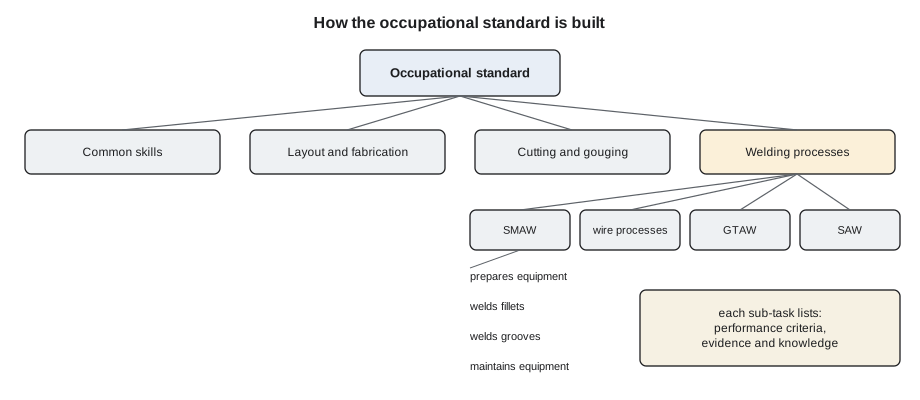
The Red Seal Occupational Standard, often shortened to RSOS, describes the Welder trade as it is practised across Canada. It is written by panels of working welders and reviewed by every province and territory. It divides the trade into major work activities, each made up of tasks, and each task made up of sub-tasks. For every sub-task it lists performance criteria, which describe how a competent welder does the work, and evidence of attainment, which is how you would show that you can. It also lists the knowledge needed: learning outcomes and the objectives behind them. The current standard for the trade dates from 2023.
The exam does not test every line of the standard equally. The weighting table in lesson 1 shows how many questions come from each major work activity, and the exam information breaks that down further by task. Common occupational skills cover safety, tools and equipment, documentation, communication and mentoring, rigging and hoisting, and the trade's basic knowledge. Layout and fabrication covers reading drawings, layout, fitting and assembly. Cutting and gouging covers oxyfuel, plasma and air carbon arc work and mechanical preparation. Welding processes cover shielded metal arc, the wire processes, gas tungsten arc and submerged arc welding.
Self-assessment before studying
The first step is an honest self-assessment. Marta hands out a sheet with every task on it and three columns: confident, need review, never done. Devon fills it in quickly and then, at her prompting, goes back and changes several of his confident marks. He has welded aluminum only once, on Wes Brandvold's water tank in WLD-310, and that was with gas tungsten arc. He has never run submerged arc, though he has watched the shop's tractor on the girder flanges. He can lay out a pipe miter on the floor, but he could not explain the trigonometry behind the ordinate table without looking at his notes from WLD-320. Those are the gaps a study plan should fill first.
Self-assessment works best with evidence. For each task marked confident, Marta asks for something: a coupon that passed, a procedure Devon has welded to, a calculation he can do on a blank page. If there is no evidence, the mark changes to need review. This is the same thinking the occupational standard uses, where each sub-task has evidence of attainment. The point is not to feel bad about the gaps but to spend study time where it changes the result. An hour spent on a topic you already know adds almost nothing; an hour on a topic you do not know can move several questions.
| Rating | What it means | How to study it |
|---|---|---|
| Confident, with evidence | You can do it and explain it | Short review and practice questions only |
| Confident, no evidence | You think you know it | Prove it with a practice set; reclassify if you miss more than one in five |
| Need review | You have done it but cannot explain it | Reread the course lesson, work the examples, then practice questions |
| Never done | No experience or study | Learn it from the lesson first, then ask a journeyperson to show you on the floor |
Building a study plan
A study plan is a budget. You have a number of hours between now and the exam, and you divide them among topics by two things: how many marks each topic carries, and how weak you are in it. A topic with many marks and a big gap gets the most time; a topic with few marks that you already know gets the least. Devon has ten weeks and can study about seven hours a week on top of work: one evening session with the group, two shorter sessions at home and an hour on Saturday morning. That is about seventy hours. The code below shares those hours among the major areas using the exam weights and his self-assessment.
# Share study hours by exam weight and by how weak each area is
HOURS = 70
# area: (share of the marks, self-rating 1 = strong ... 3 = weak)
areas = {'common occupational skills': (0.16, 1), 'layout and fabrication': (0.22, 3), 'cutting and gouging': (0.18, 1), 'SMAW': (0.144, 1), 'GMAW, FCAW and MCAW': (0.144, 2), 'GTAW': (0.104, 2), 'SAW': (0.04, 3)}
score = {a: w * r for a, (w, r) in areas.items()}
total = sum(score.values())
print(f"{'area':<34}{'marks':>6}{'rating':>8}{'hours':>7}")
for a, (w, r) in areas.items():
    h = HOURS * score[a] / total
    print(f"{a:<34}{w:>5.0%}{r:>8}{h:>7.1f}")
weekly = HOURS / 10
print(f"over 10 weeks that is about {weekly:.0f} h a week")area marks rating hours common occupational skills 16% 1 6.4 layout and fabrication 22% 3 26.2 cutting and gouging 18% 1 7.2 SMAW 14% 1 5.7 GMAW, FCAW and MCAW 14% 2 11.5 GTAW 10% 2 8.3 SAW 4% 3 4.8 over 10 weeks that is about 7 h a week
The weights in the program follow the exam's own breakdown, with the welding processes block split by the task counts in the exam information. Layout and fabrication gets the most hours, about 21, because it carries over a fifth of the marks and Devon rated himself weak in it. Submerged arc carries few marks, but he has never run it, so it still earns a few hours. Cutting and gouging carries almost as many marks as layout, yet because he is strong in it, it gets fewer hours than the wire processes.
How memory works, and how to use it
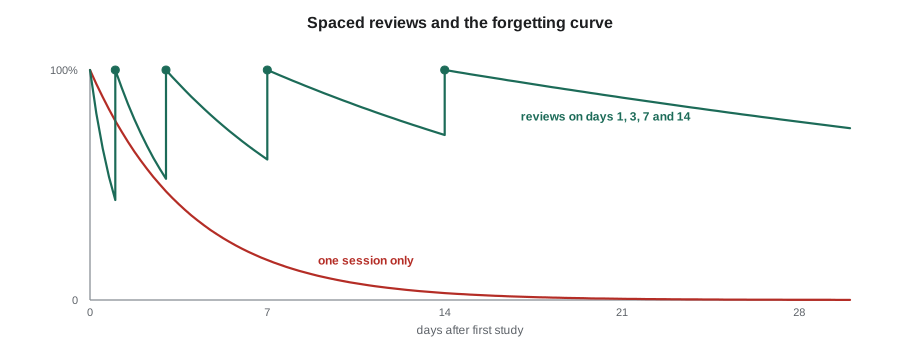
Reading a chapter twice feels like studying, but it is one of the weakest ways to learn. The material looks familiar the second time, and familiarity is easily mistaken for knowing it. The methods that work are harder and less comfortable. The first is retrieval practice: closing the book and trying to recall or work the answer, then checking. Every practice question is retrieval practice. The second is spacing: reviewing a topic several times with growing gaps between, rather than many times in one evening. Memory fades on a curve, and each review at the point where you are starting to forget resets the curve and makes it fade more slowly the next time.
The third method is interleaving: mixing topics in one session instead of doing forty questions on one process in a row. On the exam, a question on preheat follows one on drawing symbols, which follows one on plasma cutting. Practising that way trains the skill of recognizing what a question is about, which blocked practice never trains. The fourth is explaining: telling someone else how and why. In the study group, each person teaches one topic a week to the others, and the questions the others ask show the gaps the teacher did not know were there.
Flashcards are the simplest tool for spacing. Each card has a question on one side and the answer on the other. A card you get right moves to a box you will review later; a card you get wrong goes back to the first box, reviewed tomorrow. Over a few weeks, cards you know well come up rarely and cards you struggle with come up often, which is exactly where time should go. Devon writes his cards from the mistakes he makes in practice sets, not from the textbook, so his deck is a record of his own gaps.
# Leitner boxes: right answers move a card to a box reviewed less often
from datetime import date, timedelta
GAPS = [1, 3, 7, 14, 30]           # days until the next review for boxes 1..5
start = date(2026, 11, 9)
cards = {'low-hydrogen exposure time': 1, 'E4918 vs E7018 meaning': 1, 'acetylene withdrawal limit': 1,
         'fillet throat from leg': 1, 'AC balance on aluminum': 1}
# results of each review session: card -> right (True) or wrong (False)
sessions = [
    {'low-hydrogen exposure time': True, 'E4918 vs E7018 meaning': False, 'acetylene withdrawal limit': True,
     'fillet throat from leg': True, 'AC balance on aluminum': False},
    {'low-hydrogen exposure time': True, 'E4918 vs E7018 meaning': True, 'acetylene withdrawal limit': True,
     'fillet throat from leg': False, 'AC balance on aluminum': True},
    {'low-hydrogen exposure time': True, 'E4918 vs E7018 meaning': True, 'acetylene withdrawal limit': False,
     'fillet throat from leg': True, 'AC balance on aluminum': True},
]
for s in sessions:
    for card, ok in s.items():
        cards[card] = min(cards[card] + 1, len(GAPS)) if ok else 1
for card, box in sorted(cards.items(), key=lambda x: x[1]):
    due = start + timedelta(days=GAPS[box - 1])
print(f"{card:<30} box {box} next review {due}")acetylene withdrawal limit box 1 next review 2026-11-10 fillet throat from leg box 2 next review 2026-11-12 E4918 vs E7018 meaning box 3 next review 2026-11-16 AC balance on aluminum box 3 next review 2026-11-16 low-hydrogen exposure time box 4 next review 2026-11-23
After three sessions the cards Devon keeps getting right sit in box four and will not come up for two weeks, while the acetylene card he missed on the third session is back in box one for tomorrow. The dates in the program assume each session falls on the same day for simplicity; in practice the scheduler counts from the day of each review.
The weekly rhythm
Marta's plan for the group has the same shape every week. Monday evening, at the shop after the day shift, is the group session: forty-five minutes of the week's topic taught by one member, then a mixed set of twenty practice questions done in silence and marked together. Wednesday and Friday Devon studies alone for an hour: flashcards first, then the course lesson for whatever the practice set showed he was weakest in. Saturday morning is calculations, because those need a clear head and a table to spread out on. Every second week the group sits a longer timed set. Week nine is a full-length practice exam, and week ten is light review and rest.
The plan has checkpoints. After the first timed set Devon compares his score by topic with his self-assessment. If he missed more questions in a topic he rated confident, the rating changes and the hours move. Marta calls this steering: the plan is a starting guess, and the practice results are the instruments that show where it is wrong. A plan that never changes is either perfect, which it never is, or not being checked.
| Week | Group session topic | Timed set | Notes |
|---|---|---|---|
| 1 | Safety and shop practice | 20 questions | Self-assessment and plan |
| 2 | Cutting and gouging | 50 questions | First steering check |
| 3 | SMAW | 20 questions | |
| 4 | GMAW, FCAW and submerged arc | 50 questions | Submerged arc demonstration on the tractor |
| 5 | GTAW | 20 questions | |
| 6 | Metallurgy | 50 questions | Calculation review |
| 7 | Drawings, symbols and layout | 20 questions | Layout on the floor |
| 8 | Codes, inspection and qualification | 50 questions | Practice test plates begin |
| 9 | Full practice exam | Full length | Review every wrong answer |
| 10 | Light review | None | Rest the day before |
Studying with a full-time job
Apprentices study tired. Devon works ten-hour days on the girder package and some evenings he can barely read. Marta's rules for that are practical. Study at the same times every week so it becomes habit rather than a decision. Keep sessions short, forty-five minutes to an hour, with the phone in another room. Start each session with something easy, such as the flashcards, so that getting started is not the hardest part. Stop at a point where you know what comes next, so the next session starts quickly. And when a week goes badly, because of overtime or a sick child or a long shift on the turnaround, do not try to make up all the hours at once; drop the lowest-priority topic for that week and keep the rhythm.
Sleep matters more than most apprentices believe. Memory is consolidated during sleep, and an hour of study followed by a full night's sleep is worth more than three hours at midnight. The night before the exam is for rest, not cramming. Kofi, who has three children and works overtime most Saturdays, studies on his lunch break with flashcards on his phone and does one longer session on Sunday afternoon at the library. His plan has fewer hours than Devon's, so he puts nearly all of them into the topics where his self-assessment showed gaps, which for him are the code and documentation questions, because his experience is mostly from jobs where nobody wrote anything down.
Common mistakes
MistakeRereading notes and calling it studying.
InsteadUse retrieval: close the book, answer, then check.
MistakeStudying one topic for hours in a row.
InsteadSpace reviews over days and mix topics within a session.
MistakeGiving every topic equal time.
InsteadShare time by marks and by how weak you are in each area.
MistakeRating yourself confident without evidence.
InsteadBack every confident rating with a passed coupon, a procedure or a calculation done cold.
MistakeKeeping the same plan after practice results show gaps.
InsteadSteer: move hours to the topics where practice scores are low.
Summary and key terms
- The occupational standard divides the trade into major work activities, tasks and sub-tasks, and the exam is written from it.
- Begin with an honest self-assessment backed by evidence.
- Share study hours by the marks each area carries and by your weakness in it.
- Retrieval practice, spacing, interleaving and explaining are the methods that work.
- Flashcards in boxes give spaced review where it is needed.
- Keep a weekly rhythm with checkpoints, and steer the plan by practice results.
- RSOS
- Red Seal Occupational Standard: the national description of a trade.
- Performance criteria
- Statements of how a competent worker performs a sub-task.
- Retrieval practice
- Studying by recalling or working answers rather than rereading.
- Spacing
- Reviewing a topic several times with growing gaps.
- Interleaving
- Mixing different topics in one study session.
- Steering
- Changing the study plan when practice results show it is wrong.
Practice problems
Work each problem on paper first, then reveal the answer to check.
Devon has 70 hours. Layout carries 22 percent of the marks and he rates it 3; cutting carries 18 percent and he rates it 1. Which gets more time, and roughly by how much?
Show answer
Layout: its score is 0.66 against 0.18, so it gets more than three and a half times as many hours.
A card was in box 4 and Devon gets it wrong. Where does it go?
Show answer
Back to box 1, reviewed the next day.
Why mix topics in a practice set?
Show answer
The exam mixes them, and recognizing what a question is about is a skill that only mixed practice trains.
Lesson quiz · 5 questions
Score 60% or more to complete this lesson.
Create a free account to save your progress, take quizzes and earn a certificate.