
WLD-340 · Lesson 12 of 12 · 19 min
Capstone: a full practice exam and career planning
Week nine is the full practice exam. Lucia runs it in the lunchroom on a Saturday morning under the same rules as the real one: 125 questions, a fixed time, no phones, a basic calculator and a printed copy of nothing. The questions are Hartwell's own, written over the years by Marta, Lucia, Elena and Raj, checked against the occupational standard and weighted the way the exam is. None are copied from any real exam. Devon, Aisha and Mateo sit it; Jun and Kofi sit the first half. After it, Lucia marks every paper by topic, and the afternoon is spent on the part of the capstone that matters most: understanding every wrong answer. The second half of this lesson is about what comes after the certificate.
Running a practice exam properly
A practice exam only tells you something if it is taken under exam conditions. That means the full length, so fatigue in the last hour is part of the result; the real time limit; no notes; and a mix of questions in exam order rather than grouped by topic. It also means sitting it once, honestly. A candidate who looks up answers during a practice exam learns less than one who gets them wrong and studies why. Lucia keeps the answer key locked away until the papers are in, and she marks by topic as well as overall, because a total of 78 percent can hide a topic at 50 percent.
The program below is a small version of what Lucia does. It holds a handful of original practice questions, each tagged with a topic, scores a set of answers, and prints a report by topic with the ones below the pass mark flagged. The real bank has hundreds of questions; the logic is the same. Devon used it every week of his study with fresh questions, and by week nine the topic report was the first thing he looked at after every set.
# A tiny practice exam runner with a report by topic
bank = [
    ('safety',   'Which gas test is done first before confined space entry?', ['oxygen', 'flammable', 'toxic', 'temperature'], 0),
    ('cutting',  'Oxyfuel cutting works on which metal?', ['stainless steel', 'aluminum', 'carbon steel', 'copper'], 2),
    ('cutting',  'Strongly curved drag lines mean the travel was:', ['too slow', 'too fast', 'correct', 'stopped'], 1),
    ('SMAW',     'What does the 2 in E4924 mean?', ['all positions', 'flat and horizontal fillets', 'vertical down', 'DCEN only'], 1),
    ('SMAW',     'Which electrode must not be oven-dried hot?', ['E4918', 'E4310', 'E4918-1', 'E4916'], 1),
    ('wire',     'On a CV machine, current mainly follows:', ['voltage', 'wire feed speed', 'gas flow', 'cable size'], 1),
    ('GTAW',     'Aluminum GTAW uses which current?', ['DCEN', 'DCEP', 'AC', 'any'], 2),
    ('metallurgy', 'Hydrogen cracking needs hard structure, hydrogen and:', ['stress', 'argon', 'AC', 'slag'], 0),
    ('layout',   'A fillet symbol below the reference line is on the:', ['other side', 'arrow side', 'both sides', 'field'], 1),
    ('layout',   'Equal-leg fillet throat is the leg times:', ['0.5', '0.707', '1.0', '1.414'], 1),
    ('codes',    'In a code, should means:', ['required', 'recommended', 'permitted', 'forbidden'], 1),
    ('codes',    'Which NDE method is not used on austenitic stainless?', ['penetrant', 'magnetic particle', 'radiography', 'visual'], 1),
]
answers = [0, 2, 0, 1, 1, 1, 2, 0, 1, 2, 1, 1]   # Devon's answers in his first practice set
PASS = 0.70
by_topic = {}
for (topic, q, opts, key), a in zip(bank, answers):
    right, total = by_topic.get(topic, (0, 0))
    by_topic[topic] = (right + (a == key), total + 1)
score = sum(r for r, _ in by_topic.values()) / len(bank)
print(f"overall {score:.0%} ({'pass' if score >= PASS else 'below pass'})")
for topic, (r, t) in by_topic.items():
    flag = '' if r / t >= PASS else '   <- study'
print(f" {topic:<11} {r}/{t}{flag}")overall 83% (pass) safety 1/1 cutting 1/2 <- study SMAW 2/2 wire 1/1 GTAW 1/1 metallurgy 1/1 layout 1/2 <- study codes 2/2
Devon's early answers show the pattern from his self-assessment in lesson 2: a miss on drag lines in cutting, a miss on fillet throat in layout, the rest right. In the full practice exam in week nine the pattern has shifted. His layout score has climbed past the pass mark after Raj's floor session, and his weakest topic is now submerged arc, where he missed two of five. That is not a reason for alarm, because submerged arc carries few marks, but it is where his last week's flashcards go.
Reviewing wrong answers
Every wrong answer belongs to one of four kinds, and each needs a different fix. A knowledge gap means you did not know the fact or method: go back to the course lesson and learn it, then make a flashcard. A misread means you knew the answer but read the question wrongly, missing a not or except, or answering a question that was not asked: slow down on the stem and underline the key words. A calculation slip means the method was right but the arithmetic or units were wrong: redo it, and on the real exam check units before choosing. A second-guess means your first answer was right and you changed it: trust a first answer unless you find a fact that disproves it.
Lucia makes each of them sort their wrong answers into the four kinds. Devon's eleven wrong answers break down into five knowledge gaps, three misreads, two calculation slips and one second-guess. Aisha's are mostly misreads, which surprises her until she sees that four of them had the word not in the stem. Mateo has almost no misreads but several knowledge gaps in gas tungsten arc. The fix for each person is different, and that is the point of sorting.
| Kind of error | Example from the practice exam | Fix |
|---|---|---|
| Knowledge gap | Did not know submerged arc is limited to flat and horizontal | Reread lesson 6, make a flashcard, do five more questions on it |
| Misread | Missed the word NOT in a question about NDE methods | Underline not, except, first and best in every stem |
| Calculation slip | Used diameter instead of radius in a purge volume | Write the formula before the numbers; check units |
| Second-guess | Changed a correct answer on duty cycle | Change only when a fact disproves the first answer |
Worked problem
Working back from a wrong answer
A practice question: 'A welder runs a 6G test on 168 mm (NPS 6) pipe and passes. Which of these can he weld without further testing: (a) all positions on 60 mm (NPS 2) pipe, (b) all positions on plate, (c) only the 6G position, (d) only pipe of the same wall thickness.' Devon chose (a). The key is (b).
Show solution
- Find what the question tests: the ranges a welder qualification covers, from lesson 10 and WLD-330 lesson 5.
- Recall the facts: the 6G position qualifies all positions; plate is covered by a pipe test in the positions it qualifies; diameter ranges set a lower limit, so larger pipe does not cover small pipe.
- Find why (a) is wrong: 60 mm (NPS 2) pipe is below the diameter the 168 mm (NPS 6) test covers.
- Sort the error: Devon knew the diameter rule from WLD-320, but read the question too fast. It is a misread, not a knowledge gap.
Answer: The answer is (b). The fix is reading every option against the stem, not stopping at the first that looks right.
The final week
The last week before the exam is light. Devon does twenty mixed questions each evening, reviews the flashcards still in boxes one and two, rereads the summaries at the end of each lesson in this course and does nothing new. He checks the exam office's instructions: identification, arrival time, what to bring, what is not allowed. The night before, he puts his ID and two pencils by the door and goes to bed early. On the day he writes the 125 questions with time to spare, marks six to return to, changes one answer after finding a fact that disproves it, and leaves. Three weeks later the result comes: 84 percent. Devon is a journeyperson welder with the Red Seal.
Where the trade can lead
A certificate is a beginning. Marta's last session for the group, on the Monday after the exam, is about careers. Welding opens into many paths, and each builds on different strengths. Production and structural welders work in shops like Hartwell on steady schedules. Pipe welders, especially those qualified for high-pressure pipe and pipelines, earn more and often travel. Pressure welders on boilers and vessels work in power plants, refineries and pulp mills, often on shutdowns with long hours and short schedules. Specialty welders in stainless, aluminum, titanium or exotic alloys serve food, pharmaceutical, aerospace and research customers. Some welders move into fitting, fabrication or layout; others into supervision, inspection, teaching or sales.
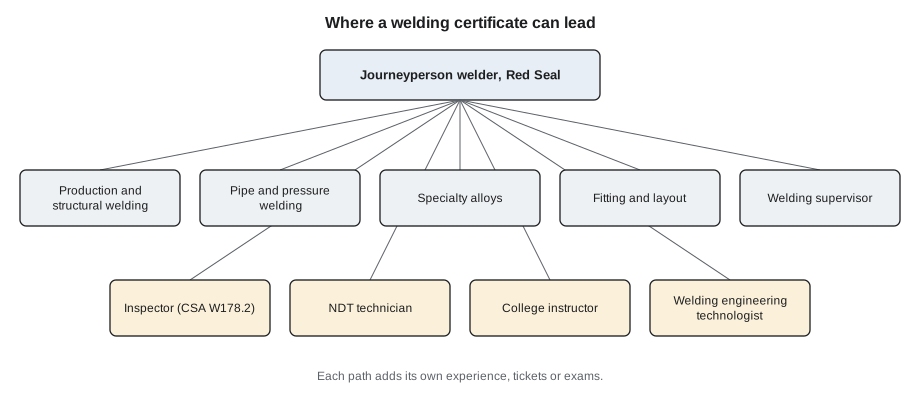
Inspection is a natural next step for many. In Canada the CWB certifies welding inspectors to CSA W178.2 in three levels, starting with experience requirements and an exam; Lucia started that way after twelve years on the tools. NDT is a separate path, certified by Natural Resources Canada. Supervision is another: the CWB recognizes welding supervisors under W47.1, and Glen Teskey moved from welder to supervisor that way. Teaching in a college apprenticeship program usually needs a journeyperson certificate with the Red Seal and several years of experience. And welding engineering technology diplomas open the door to procedure writing and quality roles.
# Comparing career paths over five years (illustrative numbers only)
paths = [('structural shop welder', 38.00, 2000, 'none', 0), ('pipe welder (shutdowns)', 48.00, 2300, 'often', 6000), ('pressure welder (plants)', 45.00, 2200, 'some', 3000), ('welding inspector', 44.00, 2000, 'some', 8000), ('college instructor', 42.00, 1800, 'none', 4000)]
YEARS = 5
for name, rate, hours, travel, training_cost in paths:
    income = rate * hours * YEARS - training_cost
    print(f"{name:<28} {rate:>6.2f}/h x {hours:>5} h/yr  ~{income:>10,.0f} over {YEARS} yr  travel: {travel}")
print('rates, hours and costs are invented for comparison; check current local data before deciding')structural shop welder 38.00/h x 2000 h/yr ~ 380,000 over 5 yr travel: none pipe welder (shutdowns) 48.00/h x 2300 h/yr ~ 546,000 over 5 yr travel: often pressure welder (plants) 45.00/h x 2200 h/yr ~ 492,000 over 5 yr travel: some welding inspector 44.00/h x 2000 h/yr ~ 432,000 over 5 yr travel: some college instructor 42.00/h x 1800 h/yr ~ 374,000 over 5 yr travel: none rates, hours and costs are invented for comparison; check current local data before deciding
The numbers in the program are invented to show the trade-offs, not to predict pay: the pipe welder's higher rate and longer hours come with travel and the cost of extra tickets, and the inspector's path has a training and certification cost up front. Real wage data for welders in Alberta comes from the province's occupational surveys and from union agreements, and it changes every year.
Keeping records and keeping current
Every career path rewards good records. A welder's own file should hold the certificate, every qualification and test record, continuity records, training certificates, the logbook of hours, safety tickets such as fall protection and confined space, and references. A record that can be shown on the first morning of a new job saves a retest and sometimes a week. Devon starts his file the day his result arrives, and the program below is the tracker he uses for hours and expiries, adapted from the continuity tracker in WLD-330.
# Personal record tracker: hours and expiries
from datetime import date, timedelta
today = date(2026, 12, 14)
hours = {'period 1': 1560, 'period 2': 1560, 'period 3': 1610}
print(f"total logged hours: {sum(hours.values()):,}")
items = [('CWB all-position SMAW', date(2026, 11, 20), 730), ('fall protection', date(2024, 3, 2), 1095), ('confined space entry', date(2025, 1, 15), 1095), ('first aid', date(2024, 2, 1), 1095), ('pressure welder card', date(2026, 6, 10), 365)]
for name, issued, valid_days in items:
    due = issued + timedelta(days=valid_days)
    left = (due - today).days
    status = 'EXPIRED' if left < 0 else 'renew soon' if left < 60 else 'current'
print(f"{name:<32} due {due} {status}")total logged hours: 4,730 CWB all-position SMAW due 2028-11-19 current fall protection due 2027-03-02 current confined space entry due 2028-01-15 current first aid due 2027-01-31 renew soon pressure welder card due 2027-06-10 current
The tracker shows his first aid due for renewal soon and everything else current. The validity periods in it are examples; each certificate states its own. Staying current also means learning. Codes change on their own cycles, processes change with the machines, and the welders who keep their careers longest are the ones who keep reading the box, the procedure and the code.
Marta's final session ends with a short speech. She tells the group that the exam tested whether Devon knew the trade, and that the trade will spend the next forty years testing whether he keeps learning it. Then she hands Aisha the occupational standard printout, because her exam is next year, and the study group starts again.
Common mistakes
MistakeTaking a practice exam with notes open.
InsteadSit it under real conditions or it measures nothing.
MistakeLooking only at the overall score.
InsteadMark by topic; a good total can hide a failing topic.
MistakeTreating every wrong answer the same.
InsteadSort errors into knowledge gaps, misreads, slips and second-guesses, and fix each kind its own way.
MistakeCramming new topics in the last week.
InsteadThe last week is light review and rest.
MistakeLetting certificates and qualifications lapse after certification.
InsteadKeep a personal record file and track every expiry.
Summary and key terms
- Practice exams must be full-length, timed and closed-book to be useful.
- Mark by topic and study the topics below the pass mark.
- Sort wrong answers into four kinds and apply the matching fix.
- Keep the final week light; rest before the exam.
- The Red Seal opens paths in pipe, pressure, specialty work, supervision, inspection and teaching.
- Keep a personal record of qualifications, continuity, tickets and hours, and keep learning.
- Practice exam
- A full-length, timed test taken under exam conditions to measure readiness.
- Topic report
- A breakdown of a practice score by subject.
- Misread
- A wrong answer caused by reading the question incorrectly.
- Knowledge gap
- A wrong answer caused by not knowing the fact or method.
- Second-guess
- Changing a correct first answer to a wrong one without new evidence.
- Record file
- A welder’s own collection of certificates, qualifications and records.
Practice problems
Work each problem on paper first, then reveal the answer to check.
A practice score is 80 percent overall, but 4 of 9 in GTAW. What should the study plan do?
Show answer
Move hours to GTAW; 44 percent is well below the pass mark.
You changed an answer from B to C and C was wrong. What kind of error is it, and what is the rule?
Show answer
A second-guess; change only when a fact disproves the first answer.
Name three career paths that build on a welder's journeyperson certificate.
Show answer
Pipe or pressure welding, inspection, supervision, teaching or specialty welding.
Lesson quiz · 5 questions
Score 60% or more to complete this lesson.
Create a free account to save your progress, take quizzes and earn a certificate.