
WLD-340 · Lesson 7 of 12 · 19 min
GTAW review
Week five is gas tungsten arc, and Aisha teaches it with Rob Haldane, who ran the aluminum block in WLD-310 and still talks about trailer frames he welded twenty years ago. The exam gives gas tungsten arc about thirteen questions. Devon's self-assessment had it as need review: he passed his stainless pipe test and welded the Coldwater injection line, but he has done aluminum only once, and his practice set showed he could not explain AC balance. Rob starts by turning the tungsten grinder on and off again. Grinding rules, he says, are where the trade changed most in his working life, and the exam has kept up.
How GTAW works
Gas tungsten arc welding runs an arc between a tungsten electrode that does not melt and the work. An inert gas, usually argon, flows through the torch's cup and shields the tungsten, the arc and the puddle. Filler metal, when used, is added by hand from a rod or by a wire feeder, separately from the arc. Because heat input and filler are controlled separately, GTAW gives the most control of any arc process and the cleanest welds: no slag, no spatter and very little fume. It is used for roots on pipe, thin material, stainless steel, aluminum and reactive metals, and wherever appearance and soundness matter. Its weakness is speed: deposition is low, and it needs clean metal and a steady hand.
The power source is constant current, for the same reason as stick welding: the welder controls arc length by hand, and the current must not swing with it. Most machines start the arc with high-frequency or a lift start rather than scratching the tungsten on the work, which would contaminate both. A foot pedal or fingertip control lets the welder change current during the weld, tapering at the end to fill the crater and avoid crater cracks. Post-flow keeps gas on the hot tungsten and the end of the weld after the arc stops. WLD-310 lessons 1 to 3 cover the equipment.
Polarity and AC
With direct current electrode negative, about two thirds of the heat goes into the work and one third into the tungsten. That gives deep, narrow penetration and lets a small tungsten carry a lot of current. DCEN is used for carbon steel, stainless steel, copper, nickel alloys and titanium. With electrode positive, most of the heat goes into the tungsten, which would melt at any useful current, so DCEP is hardly used for GTAW. But the positive half of the cycle does one valuable thing: it breaks up surface oxide. That is why aluminum and magnesium, whose tough oxides melt at far higher temperatures than the metal, are welded with alternating current. The electrode-positive half cleans the oxide; the electrode-negative half gives penetration.
Modern inverter machines let the welder adjust the AC wave. Balance is the share of each cycle spent electrode negative. More electrode-negative time gives deeper penetration, a narrower bead and a cooler tungsten; more electrode-positive time gives more cleaning action, seen as a frosty band beside the bead, and a hotter tungsten. A typical starting setting is about 70 to 75 percent electrode negative. Frequency is the number of cycles a second: a higher frequency narrows and stiffens the arc for fillet roots and tight corners, while a lower frequency widens it. Exam questions test the direction of each change. Rob's way to remember it: negative for nuts, the depth; positive for polish, the cleaning.
Worked problem
Adjusting AC on an aluminum fillet
Devon is welding a 5 mm (3/16 in) 5052 aluminum fillet. The weld is not wetting into the root, and a wide frosty band shows on both sides of the bead. The tungsten end is balling large. Balance is set at 60 percent electrode negative and frequency at 80 hertz. What should he change?
Show solution
- The wide cleaning band and large ball show too much electrode-positive time.
- Poor root penetration also points to too little electrode-negative time.
- Raising balance towards 70 to 75 percent electrode negative narrows the cleaning band, cools the tungsten and deepens penetration.
- Raising frequency to around 120 hertz focuses the arc into the root of the fillet.
Answer: Increase the electrode-negative share to about 72 percent and raise the frequency. Keep enough cleaning to break the oxide; if the puddle looks dirty, he has gone too far.
Tungsten electrodes
Tungsten electrodes are classified by what is added to the tungsten, and the classification is shown by a colour band. Pure tungsten, EWP, was used for AC on older transformer machines and balls readily. Thoriated tungsten, EWTh-2 with about two percent thorium oxide, starts well and carries high current on DC, but thorium is radioactive. The hazard is not handling the electrode; it is breathing the dust from grinding it. Ceriated, EWCe-2, and lanthanated, EWLa-1.5 and EWLa-2, tungstens perform as well or better on DC and on inverter AC and are not radioactive, so many shops, Hartwell among them since WLD-310, have replaced thoriated tungsten altogether. Zirconiated tungsten, EWZr-1, holds a ball well on transformer AC.
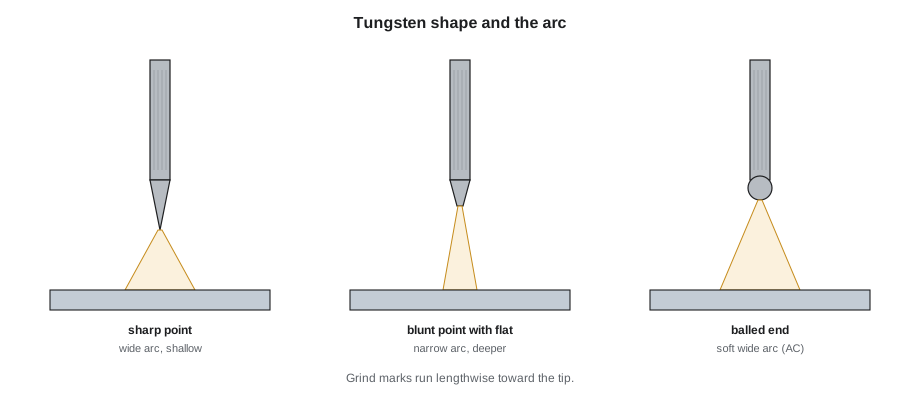
Preparation matters as much as type. For DC, the tungsten is ground to a point with the grind marks running lengthwise, toward the tip, so the arc leaves cleanly from the end. The included angle sets the arc: a sharp point gives a wide arc and shallow penetration; a blunter angle gives a narrower arc and deeper penetration and lasts longer. A small flat, or truncation, at the tip stops the point from melting off into the weld. For inverter AC, a point or a blunt point is common; for transformer AC, a balled end. Grinders for tungsten are kept for tungsten only, with dust extraction. A tungsten dipped into the puddle is contaminated and must be broken back and reground, never just restruck.
| Classification | Colour (common) | Main use |
|---|---|---|
| EWP | Green | AC on transformer machines; balls easily |
| EWCe-2 | Grey or orange (check the box) | DC and inverter AC; good low-current starts |
| EWLa-1.5 | Gold | DC and AC; a common substitute for thoriated |
| EWLa-2 | Blue | DC and AC; high current |
| EWTh-2 | Red | DC; radioactive, grinding dust must be controlled |
| EWZr-1 | Brown | AC on transformer machines; holds a ball |
# GTAW review: tungsten current range, pulsed average current, purge volume, heat input
import math
# 1. Approximate DCEN current ranges for ceriated or lanthanated tungsten
ranges = {'1.6 mm': (70, 150), '2.4 mm': (150, 250), '3.2 mm': (250, 400)}
for size, (lo, hi) in ranges.items():
    print(f"tungsten {size}: about {lo}-{hi} A on DCEN")

# 2. Pulsed current: average of peak and background weighted by on-time
peak, back, on = 150, 50, 0.40
avg = peak * on + back * (1 - on)
print(f"pulsed {peak}/{back} A at {on:.0%} on-time averages {avg:.0f} A")

# 3. Purge volume for a pipe between dams, five volume changes
d_in = 102                 # pipe inside diameter
length = 600                # distance between purge dams
vol = math.pi * d_in ** 2 / 4 * length
changes = 5
flow = 15                  # purge flow per minute
need = vol * changes
print(f"purge space {vol / 1000000.0:.1f} L; five changes {need / 1000000.0:.1f} L take {need / 1000000.0 / flow:.1f} min at {flow} L/min")

# 4. Heat input with arc efficiency
E, I, v, eff = 12, 110, 80, 0.6
print(f"arc energy {60 * E * I / (1000 * v):.2f} kJ/mm, heat input {eff * 60 * E * I / (1000 * v):.2f} kJ/mm with efficiency {eff}")tungsten 1.6 mm: about 70-150 A on DCEN tungsten 2.4 mm: about 150-250 A on DCEN tungsten 3.2 mm: about 250-400 A on DCEN pulsed 150/50 A at 40% on-time averages 90 A purge space 4.9 L; five changes 24.5 L take 1.6 min at 15 L/min arc energy 0.99 kJ/mm, heat input 0.59 kJ/mm with efficiency 0.6
The pulsed example shows why pulsing helps on thin or out-of-position work: a 150 A (150 A) peak gives good fusion, but the average of 90 A (90 A) keeps the puddle small. The purge result is a typical exam calculation: the volume between the dams, times five changes, divided by the flow. Heat input codes may or may not apply an efficiency factor for GTAW; the procedure states which, and Elena reminded the group in WLD-310 that the factor lowers the number but not the actual heat in the joint. The tungsten ranges are approximate and depend on the tungsten type and the machine.
Shielding, purging and filler
Argon is the standard shielding gas. Helium or argon-helium mixes give a hotter arc and faster travel on thick aluminum and copper. Small hydrogen additions to argon help on austenitic stainless steel only and must not be used on carbon steel or aluminum, where hydrogen causes porosity or cracking. Gas lenses smooth the flow so the cup can be held farther from the work with better coverage. The cup size should match the tungsten and the job; too large a cup for the flow wastes gas, too small gives poor coverage. Draughts as light as a fan can blow the shield away, which is the most common cause of porosity in shop GTAW.
Stainless and reactive metals also need the back of the weld protected. Back purging fills the inside of the pipe or the back of the joint with argon or nitrogen-hydrogen mixes allowed by the procedure, so the root does not oxidize into a rough, grey, sugary surface. The oxygen level at the root is checked with an oxygen meter before welding, with targets often well below one percent, and the colour of the inside of the finished weld is compared against a tint chart. WLD-310 lessons 5 and 8 and WLD-320 lesson 6 cover purging.
Filler metal follows the base metal: ER70S-2 or ER70S-6 rods for carbon steel, with the -2 having extra deoxidizers that help on dirtier steel; ER308L for 304 stainless and ER316L for 316; ER4043 or ER5356 for aluminum, with 5356 for high-magnesium alloys such as 5052 and 5083 and where colour matching after anodizing matters. The hot end of the rod must stay inside the gas shield, or it oxidizes and carries the oxide into the next dab. Rods are kept clean and labelled; a bare rod with no stamp is a common cause of the wrong filler going into a joint.
Defects and quality
GTAW defects have their own pattern. Tungsten inclusions, seen as bright white spots on a radiograph, come from dipping the tungsten, touch starts, too high a current for the tungsten size, or a tip that melts off. Porosity comes from poor gas coverage, draughts, contaminated filler or base metal, moisture or a leak in the torch hose. Oxidized, sugared roots on stainless come from poor purging. Lack of fusion at the sidewall comes from a cold puddle or poor torch angle, and crater cracks from stopping the arc abruptly without tapering. On aluminum, porosity also comes from hydrogen in moisture, oil and the hydrated oxide, so aluminum is cleaned with a solvent and a stainless brush kept for aluminum only, just before welding.
Rob's session ends with the group grinding three tungstens each, setting a machine for aluminum from scratch, and answering five questions on AC. Devon gets all five. He says the trick was Rob's phrase about nuts and polish, and he writes it on a flashcard.
Setting up for a GTAW job
Rob gives the group a set-up routine that works for any GTAW job, because written questions often describe a set-up and ask what is wrong. Choose polarity for the metal: DCEN for steels, AC for aluminum. Choose the tungsten type and size for the current range, and grind it for the job. Choose the cup size and whether to use a gas lens. Set the gas flow for the cup, typically in the range of 7 to 12 L/min (15 to 25 cfh) for common cups, more with a large gas lens, and check it at the torch with the flowmeter, not by sound. Set pre-flow and post-flow, with post-flow long enough to protect the tungsten as it cools, about one second for every ten amperes as a rule of thumb. Set the current or the pedal range. Clean the base metal and the filler. Set up the purge if the back of the weld needs it, and check the oxygen level before striking.
Then, before welding the job, run a test bead on scrap of the same metal and thickness. Look at the tungsten after the bead: a bright silver tip means good shielding; a blue or black tip means the gas coverage or post-flow is short. Look at the bead colour on stainless: straw to light gold is usually fine, blue and dark grey mean too much heat or poor shielding. A minute on scrap saves an hour of cutting out a bad weld, and it is a habit inspectors notice.
Common mistakes
MistakeUsing DCEP for GTAW of steel.
InsteadSteel is welded on DCEN; electrode positive overheats the tungsten.
MistakeRaising electrode-positive time to deepen penetration on aluminum.
InsteadElectrode-negative time gives penetration; positive time gives cleaning.
MistakeGrinding tungsten across the electrode.
InsteadGrind lengthwise toward the tip so the arc leaves cleanly.
MistakeRestriking after dipping the tungsten.
InsteadBreak off the contaminated end and regrind.
MistakeAdding hydrogen to the shielding gas for aluminum.
InsteadHydrogen additions are for austenitic stainless steel only.
Summary and key terms
- GTAW uses a non-consumable tungsten, inert gas and separate filler, giving control and clean welds.
- DCEN for steels, stainless, copper and titanium; AC for aluminum and magnesium.
- AC balance: more negative for penetration, more positive for cleaning; higher frequency narrows the arc.
- Ceriated and lanthanated tungstens replace thoriated, whose grinding dust is radioactive.
- Back purging protects stainless and reactive roots; check oxygen before welding.
- Tungsten inclusions, porosity and oxidized roots are the typical GTAW defects.
- Non-consumable electrode
- An electrode, such as tungsten, that does not melt into the weld.
- AC balance
- The share of each AC cycle spent electrode negative.
- Cleaning action
- The removal of surface oxide during the electrode-positive half cycle.
- Gas lens
- A screen in the torch that smooths the shielding gas flow.
- Back purge
- Inert gas on the back of a weld to prevent oxidation of the root.
- Tungsten inclusion
- A particle of tungsten trapped in the weld.
Practice problems
Work each problem on paper first, then reveal the answer to check.
A pulsed setting has a 180 A peak, 60 A background and 30 percent on-time. What is the average current?
Show answer
96 A: 180 × 0.3 + 60 × 0.7.
A 76 mm inside diameter pipe has dams 500 mm apart. How much argon is five volume changes?
Show answer
About 11.3 L: π × 76² / 4 × 500 = 2.27 L, times 5.
Which filler would you choose for 5083 aluminum?
Show answer
ER5356, matched to the high-magnesium alloy.
Lesson quiz · 5 questions
Score 60% or more to complete this lesson.
Create a free account to save your progress, take quizzes and earn a certificate.