
WLD-340 · Lesson 1 of 12 · 18 min
How welder certification tests work
Devon Okafor has three months left in his apprenticeship. He has logged most of his hours, finished his last block of classes and passed the school's tests. What stands between him and the journey-level card Hartwell gives at the end of its registered apprenticeship is a set of performance tests: AWS Certified Welder tests at an accredited test facility, plus the plate and pipe qualifications the shop's codes require. Marta Kowalchuk, who took her first AWS tests eleven years ago, tells him the tests are not about luck. They show whether he can follow a procedure, set up his own coupon, manage his time and produce a sound weld while someone watches. This course is his preparation, and it is built the way Hartwell prepares every apprentice: understand the tests, plan the study, review each part of the trade with worked problems, and practice under test conditions.
What a welder certification is
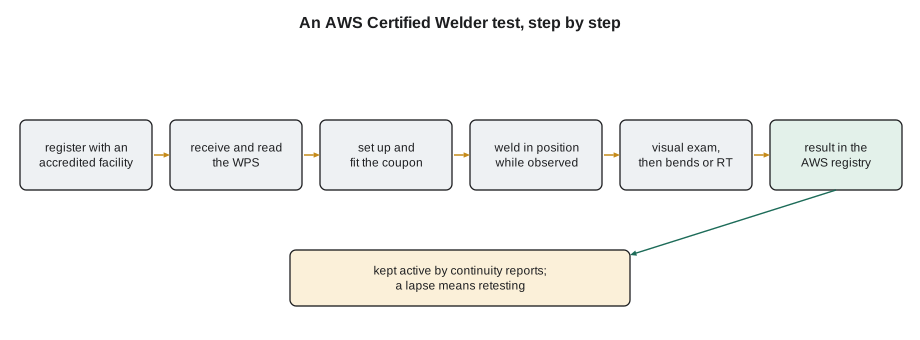
In the United States there is no single national welder license. What employers trust is evidence that a welder has passed a test to a recognized code or specification, witnessed and recorded properly. The American Welding Society runs the most widely known program, the AWS Certified Welder program, under its specification QC7 and the related standard QC47. A welder tests at an AWS Accredited Test Facility, welds a coupon to a welding procedure specification, and a Certified Welding Inspector evaluates it. Passing tests are recorded in AWS's national registry, so another employer can look them up.
The AWS program has no written exam and no required courses. It is performance-based: you weld, the coupon is tested, and the result is recorded. That makes it different from the AWS Certified Welding Inspector exam, which is a long written test that Devon may take years from now. Hartwell's own apprenticeship, registered with the state and the US Department of Labor, does have written tests in its classes, and the shop's code qualifications under D1.1 and ASME Section IX are separate again. Kofi Mensah, who joined Hartwell with years of welding in another country, wants AWS certifications because they travel with him from employer to employer.
The shape of the tests
An AWS Certified Welder test is usually a single groove or fillet coupon welded to a stated procedure, in a stated position, on a stated thickness. Typical tests are a groove weld on plate in the vertical or overhead position, or a fixed pipe test at 45 degrees, the 6G. The coupon is examined visually and then by bend tests or radiography, as the procedure requires. A test either passes or fails; there is no partial credit. The facility schedules the test, sets the fee and supplies or approves the procedure, which can be an AWS standard procedure, an industry specification or a procedure a company provides.
| Kind of test | Who evaluates it | What the result means |
|---|---|---|
| AWS Certified Welder test at an accredited facility | AWS Certified Welding Inspector | Recorded in AWS's registry; kept active by continuity |
| Employer qualification under D1.1 | The employer's inspector | Lets the welder work on that employer's D1.1 jobs |
| Employer qualification under ASME Section IX | The employer, reviewed by the authorized inspector | Lets the welder work on that employer's pressure jobs |
| SENSE school assessments | The school, under AWS's education program | Shows the skills an entry-level welder needs |
Kofi asks whether the written side matters at all. Marta says it does, in three ways. Every test starts with a procedure the welder must read and follow. The shop's own apprentices take written tests at school and at the end of their term. And the knowledge behind a passing coupon, from preheat to joint preparation to cleaning between passes, is exactly what a written exam checks. This course reviews that knowledge with practice questions in the same multiple-choice style an inspector's exam or a school test would use, because a welder who understands why a weld passes is the one who passes again.
How exam questions are written
Whatever the test, written questions in the trades follow a pattern. Each one has a stem, which is the question or the unfinished statement, and four options. One option is the best answer. The other three are distractors, and good distractors are wrong answers that a person with a gap in knowledge would choose. A distractor might be the right value in the wrong unit, a correct fact about a different process, a step done in the wrong order, or something that is true but does not answer the question asked. Knowing how distractors are built is not a trick for passing without knowledge; it is a way to notice when a question is testing something more specific than it first seems.
Questions also come in levels. A recall question asks for a fact: the color of an acetylene hose, or the meaning of the last digit in an electrode classification. An application question gives a situation and asks what to do: a coupon is cracking at the start of each bead, so what should the welder change? An analysis question gives more information than you need and asks you to sort it: a drawing note, a procedure and a set of readings, and which reading is out of range. Experienced welders find recall questions the hardest, oddly, because they know how to do the job but have forgotten the textbook names. Apprentices fresh from school find application questions harder, because they know the names but have less experience deciding.
Worked problem
Reading a question for what it asks
A practice question reads: 'A welder is running E7018 in the overhead position on a structural job, and the electrodes have been out of the holding oven for six hours. What should the welder do first?' The options are: increase the amperage; switch to a smaller electrode; return the electrodes to the oven and use fresh ones from the oven; grind each bead before the next.
Show solution
- Find the key words: E7018 is a low-hydrogen electrode, six hours is the time out of the oven, and the question asks what to do first.
- Recall the rule from WLD-120 lesson 5: low-hydrogen electrodes have a limited exposure time out of the oven, commonly about four hours for this class under structural codes, after which they must be redried or discarded as the code allows.
- Check each option against the problem. Amperage and electrode size are about position, not hydrogen. Grinding does not remove absorbed moisture from the flux.
- Only one option deals with the actual problem: electrodes that have been exposed too long.
Answer: Return the electrodes and use fresh ones from the oven. The position and the job are background; the question is about exposure time.
Timing and pacing
Performance tests are timed too, usually by the facility rather than by a code, and a welder who rushes the fit-up or skips cleaning between passes to save time is trading the test for a few minutes. Written tests at school and the inspector exams Devon may take later are strictly timed. A useful rule for any written test is to know your average pace: divide the time available by the number of questions, and keep a reserve for questions you mark to return to. Devon's practice exams show he takes about a minute on recall questions and up to three minutes on calculations. The code below works out his pace and tells him when he is behind.
# Pacing plan for a timed written exam
QUESTIONS = 100
MINUTES = 180
RESERVE = 20          # minutes kept back for marked questions and a final check

working = MINUTES - RESERVE
per_q = working / QUESTIONS
print(f"{QUESTIONS} questions in {MINUTES} min: work at {per_q:.2f} min per question, keep {RESERVE} min in reserve")
for done in (25, 50, 75, 100):
    if done <= QUESTIONS:
        print(f"  after question {done:>3}: about {done * per_q:5.0f} min should have passed")

# Devon's last practice set: (question type, count, average minutes each)
mix = [('recall', 55, 1.0), ('application', 30, 1.8), ('calculation', 15, 3.0)]
need = sum(n * m for _, n, m in mix)
print(f"his own pace needs {need:.0f} min for {sum(n for _, n, _ in mix)} questions")
print('on track' if need <= working else f'behind by {need - working:.0f} min: skip long calculations on the first pass')100 questions in 180 min: work at 1.60 min per question, keep 20 min in reserve after question 25: about 40 min should have passed after question 50: about 80 min should have passed after question 75: about 120 min should have passed after question 100: about 160 min should have passed his own pace needs 154 min for 100 questions on track
The program uses a 100-question, three-hour test as an example, the kind of length a school final or an inspector's module might have. Devon's mix needs about 159 minutes against 160 working minutes, so he is just on track. The habit he takes from it is to move on from a long calculation on the first pass and come back to it, rather than spend ten minutes on one mark while easy marks wait at the end.
On the day
On test day the facility checks your identification and gives you the procedure. You bring your own personal protective equipment and usually your own hand tools; the facility tells you what is supplied. Read the procedure before you touch the coupon: process, filler, position, preheat, interpass temperature and cleaning rules are all there. The inspector watches the whole test, checks the coupon's position and marks, and stops a test if the procedure is not followed. A welder who fails can retest; AWS sets no limit on attempts, but each test costs time and money, so failing should mean learning something.
Marta's advice for any test is the same. Sleep properly the night before. Eat. Read every question, or every line of the procedure, to the end before you start answering. When two options look right, the question usually contains a word that makes one of them wrong: first, best, most likely, not, except. Do not change an answer you were sure of because the next three questions made you nervous; change it only if you find a fact that proves the first answer wrong.
What the exam is not
Apprentices arrive with myths about welder testing, and Marta spends a few minutes on them because each one costs practice time. A test is not passed by a perfect-looking cap; the bends see inside the weld, and a beautiful cap over a slag line fails. It is not judged by the inspector's mood; the acceptance criteria are written in the specification and apply to everyone. A procedure is not a suggestion; welding outside its ranges voids the test even if the coupon would have bent cleanly. And one passing coupon is not the end; continuity reports keep a certification active, and a welder who stops using a process loses it. What the tests reward is preparation and routine that hold up under pressure.
There is also a myth that experience alone is enough. Kofi has welded for fourteen years and is the most skilled stick welder in the study group, but his first practice set scored 61 percent, because he had never needed to name a joint by its code designation, decode an electrode classification or explain why a procedure limits heat input. Experience gives a welder the answer to a question asked on the shop floor in front of the work. A test asks the same question on paper, without the work in front of you, and that is a different skill that needs its own practice. Kofi's second set, three weeks later, scored 78 percent.
Finally, the exam is a step and not a verdict. A candidate who does not pass gets a result broken down by area, studies those areas and writes again. Several of Hartwell's best journeypersons needed two attempts. Marta tells the group that the result she cares about is not the first score but whether each of them knows the trade well enough to work safely and well without someone watching, and that a careful second attempt that gets there is worth more than a lucky first one.
Common mistakes
MistakeThinking an AWS test is a written exam.
InsteadIt is a performance test; you weld a coupon to a procedure and it is examined.
MistakeStudying only the welding processes.
InsteadEvery test depends on reading the procedure, fitting the coupon and following the rules for cleaning and temperature.
MistakeChoosing the first option that sounds true.
InsteadPick the option that answers the exact question asked; distractors are often true statements about something else.
MistakeSpending ten minutes on one hard question early.
InsteadMark it, move on and come back with the time kept in reserve.
MistakeChanging answers because of nerves.
InsteadChange an answer only when you find a fact that proves it wrong.
Summary and key terms
- AWS Certified Welder tests are performance tests at accredited facilities, recorded in a national registry.
- Employer code qualifications under D1.1 and Section IX are separate from AWS certification.
- A test passes or fails on visual examination and bends or radiography.
- Each written question has one best answer and three distractors built from likely mistakes.
- Questions test recall, application and analysis.
- Pace yourself and keep time in reserve for marked questions.
- AWS Certified Welder
- A welder whose test at an accredited facility is recorded in the AWS registry.
- Accredited Test Facility
- A facility AWS has approved to give Certified Welder tests.
- Continuity
- Regular reports showing a certified welder still uses the process, which keep the certification active.
- Stem
- The question or unfinished statement at the start of a multiple-choice item.
- Distractor
- A wrong option written to attract a person with a specific gap in knowledge.
- Pass mark
- The score or result needed to pass a test.
Practice problems
Work each problem on paper first, then reveal the answer to check.
What evaluates an AWS Certified Welder test coupon?
Show answer
A Certified Welding Inspector, using visual examination and then bends or radiography.
Is an AWS certification the same as an employer's D1.1 qualification?
Show answer
No; the employer qualifies welders for its own code work, though it may accept AWS records where the code allows.
A question asks what to do first. Two options are good practice. How do you choose?
Show answer
Pick the one that deals directly with the problem in the stem before anything else.
Lesson quiz · 5 questions
Score 60% or more to complete this lesson.
Create a free account to save your progress, take quizzes and earn a certificate.