
WLD-340 · Lesson 6 of 12 · 19 min
GMAW, FCAW and submerged arc review
Week four's session is Jun's, and he is nervous: he is in his first period and has run flux-cored wire for only a few months. Marta pairs him with Elena Marchetti, the shop's welding engineer, who brings the submerged arc tractor's procedure and a bag of flux. The wire processes, gas metal arc, flux-cored and metal-cored arc welding, take about eighteen Red Seal questions, as many as stick welding, and submerged arc adds about five more. Devon has never run the tractor. Elena promises that by the end of the evening he will be able to answer any exam question on it and set it up under supervision.
The common ground of the wire processes
Gas metal arc, flux-cored arc and metal-cored arc welding all feed a continuous wire electrode through a gun, from a wire feeder, at a set wire feed speed. All usually run on a constant-voltage power source with direct current electrode positive. The welder sets the voltage at the machine and the wire feed speed at the feeder; the current follows from the wire feed speed, the wire's size and the stickout, which is the length of wire between the contact tip and the arc. That is the core idea, and exam questions test it in several forms: what controls the current in GMAW, what happens when stickout increases, why a constant-voltage machine is used.
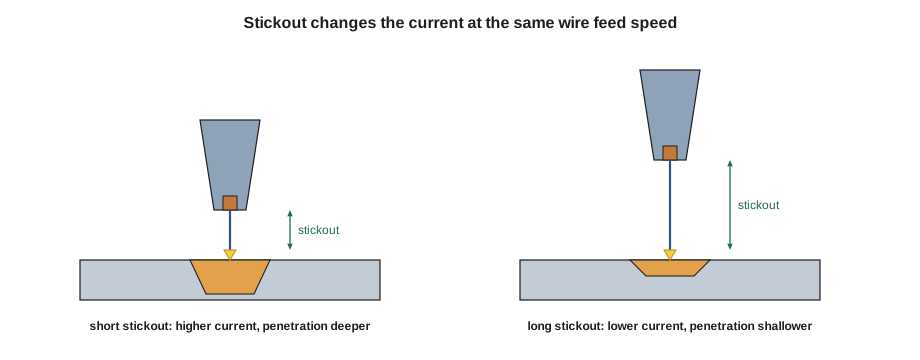
The constant-voltage machine regulates arc length by itself. If the gun moves closer to the work, the arc shortens, the current rises, the wire melts faster and the arc returns to its length. If the gun moves away, the current falls and the wire melts more slowly until the arc shortens again. This self-regulation is why a wire process is easier to run steadily than stick. Stickout matters because the wire between tip and arc is heated by the current passing through it: a longer stickout preheats the wire more, so less current is needed to melt it, and at the same wire feed speed the current falls and penetration drops. WLD-210 lesson 8 covers settings.
Transfer modes
How metal crosses the arc depends mostly on current, voltage and shielding gas. In short-circuit transfer, at low current and voltage, the wire touches the puddle many times a second, shorting the arc and transferring a drop each time. It gives a small, cool puddle for thin sheet and out-of-position work, but it can leave lack of fusion on thick metal, which is why structural codes do not prequalify it. Globular transfer, at higher current with carbon dioxide shielding, moves large irregular drops with spatter. Spray transfer, above a transition current with argon-rich gas, moves a fine stream of small drops with a stable, hot arc and deep penetration, but the large fluid puddle limits it to flat and horizontal work. Pulsed spray switches between a peak and a background current to get spray transfer at a lower average current, so it can weld out of position.
Worked problem
Picking the transfer mode
Hartwell needs to weld the flange-to-web fillets on a heavy girder in the flat position, and also tack thin cover sheets on a guard. The gas on hand is 90 percent argon and 10 percent carbon dioxide, and the wire is 1.2 mm (0.045 in) solid ER70S-6. Which modes suit each job?
Show solution
- The girder fillets are heavy, in the flat position, and need full fusion: spray transfer, with the current above the transition for that wire and gas, gives deep penetration and high deposition.
- The cover sheets are thin and need low heat: short-circuit transfer at low voltage and wire feed speed avoids burn-through.
- Check the procedure before using short-circuit on any structural joint, because it is not prequalified.
- If the girder later needs vertical welds, pulsed spray or flux-cored wire would be used, not spray.
Answer: Spray for the flat girder fillets; short-circuit for the thin guard sheet, which is not a code joint.
Shielding gases
Gas choice is a frequent exam topic. Carbon dioxide alone is cheap and gives deep penetration on steel, but it cannot produce spray transfer and gives more spatter. Argon with carbon dioxide, commonly 75/25 for short-circuit and 90/10 or less carbon dioxide for spray, gives a smoother arc and spray capability on carbon steel. Argon with a little oxygen, one to five percent, is used for spray on carbon and stainless steel. Pure argon is used for aluminum, never for carbon steel, where it gives a poor bead shape and lack of fusion at the toes. Stainless steel uses argon-rich mixtures with small additions of carbon dioxide or helium. Gas flow is set to give coverage without turbulence; too much flow can draw air into the shield just as too little can.
Gas questions also come from the hardware. Cylinders of mixed gas are read by pressure. Carbon dioxide is stored as a liquid, so its pressure stays almost constant until the liquid is gone, and its contents are found by weight. Regulators and flowmeters must suit the gas; carbon dioxide regulators may need a heater at high flow because the expanding gas chills and can freeze the regulator. WLD-210 lesson 4 covers gases.
Flux-cored and metal-cored wires
Flux-cored wire has a tubular sheath filled with flux. Gas-shielded flux-cored wire, such as an E71T-1 class, uses carbon dioxide or an argon mixture plus the flux; it gives a fast-freezing slag that holds the puddle, making it the shop's workhorse for all-position structural work. Self-shielded flux-cored wire, such as an E71T-8 class, makes its own shield from the flux and needs no gas, so it is used outdoors in wind; it usually runs on electrode negative and needs careful technique for good toughness. Metal-cored wire is filled with metal powder rather than flux and behaves like solid wire with higher deposition and little slag. Questions often ask which wire works in a wind, which needs no gas, which leaves the most slag and which runs on DCEN.
Classifications follow a pattern you can read. In the AWS form, E71T-1C: E for electrode, 7 for 70 ksi tensile, 1 for all positions (0 would mean flat and horizontal), T for tubular, 1 for the usability type, and C for carbon dioxide shielding (M for an argon mixture). The CSA W48 designations use metric strength and an open system that spells out the shielding gas, impact properties and hydrogen level, such as E491T1-M21A4-CS2. The box shows both systems. WLD-210 lesson 3 has the details, and the trap on exams is the position digit, which is the third character, not the last.
# Wire process review: deposition, gas use and a transfer-mode check
import math
# 1. Deposition rate from wire feed speed
d = 1.2                      # wire diameter
wfs = 9000                  # wire feed speed per minute
rho = 7.85e-06                  # steel density
eff = 0.92                   # deposition efficiency for solid wire in spray
area = math.pi * d * d / 4
melt = area * wfs * 60 * rho
print(f"wire melted {melt:.2f} kg/h, deposited about {melt * eff:.2f} kg/h")

# 2. Gas cylinder life at a flow rate
cyl = 8500                  # usable gas in the cylinder
flow = 900                # flow rate per hour of arc time
arc_factor = 0.35            # fraction of the shift with the arc on
hours = cyl / flow
print(f"cylinder lasts {hours:.1f} arc-hours, about {hours / arc_factor / 10:.1f} ten-hour shifts")

# 3. Rough transfer-mode check for solid steel wire in argon-rich gas
transition = 220            # approximate spray transition current for this wire and gas
for amps in (150, 230, 300):
    mode = 'spray' if amps > transition else 'short-circuit or globular'
print(f" {amps} A with this wire: {mode}")wire melted 4.79 kg/h, deposited about 4.41 kg/h cylinder lasts 9.4 arc-hours, about 2.7 ten-hour shifts 150 A with this wire: short-circuit or globular 230 A with this wire: spray 300 A with this wire: spray
The deposition result, about 4.4 kg (8.7 lb) deposited an hour at full arc time, explains why a spray fillet on a girder flange goes so much faster than stick. The cylinder calculation is the one supervisors ask apprentices to do before a long job, so the welder does not run out of gas halfway through a weld. The transition current in the program is approximate; real values depend on wire size, gas and the machine, and the wire maker's data gives them.
Submerged arc welding
In submerged arc welding the arc runs between a continuous wire and the work under a blanket of granular flux. The arc is hidden; there is no visible light, little fume and no spatter. The flux melts into a slag that protects the weld, and the unmelted flux is recovered and reused after sieving. The process runs at high currents, often several hundred amperes and sometimes over a thousand with multiple wires, and gives very high deposition and deep penetration. It is used for long straight seams and circumferential welds in the flat position or on horizontal fillets: girder flange-to-web welds, pressure vessel shells, pipe mills and wind tower sections. It is mechanized, run from a tractor, a column and boom, or a fixed head, by a welding operator.
Elena runs through what the exam asks about submerged arc. The positions: flat and horizontal fillets, because the flux must stay in place. The power: constant voltage for small wires and fast feed, constant current for large wires and slower feeds, with DCEP, DCEN or AC depending on the job. The flux types: fused fluxes, which are glassy and absorb little moisture, and agglomerated fluxes, which can add alloy but must be kept dry and are often redried before use. The classification: wire and flux are classified together, because the same wire gives different weld metal under different fluxes. The person: a welding operator qualified for mechanized welding rather than a manual welder. And the defects: porosity from damp flux or contaminated joints, slag inclusions from poor cleaning between passes, and centreline cracking from deep, narrow beads.
The classification follows the same idea as the other processes. An AWS A5.17 classification such as F7A2-EM12K names the flux and wire together: F for flux, 7 for 70 ksi tensile, A for as-welded testing, 2 for impact properties at minus 20 °F, then the wire classification EM12K, a medium-manganese killed wire. The CSA W48 equivalents use metric values. The point an exam tests is that the classification belongs to the combination, not to the wire alone.
| Process | Shielding | Positions | Typical use at Hartwell |
|---|---|---|---|
| GMAW short-circuit | Gas (75/25 or CO2) | All | Thin sheet, guards, tacking; not prequalified for structural joints |
| GMAW spray | Argon-rich gas | Flat and horizontal | Heavy shop fillets and grooves |
| GMAW pulsed spray | Argon-rich gas | All | Stainless and out-of-position shop work |
| FCAW gas-shielded | Gas plus flux | All (with a 1 position digit) | Structural work in all positions |
| FCAW self-shielded | Flux only | All (with a 1 position digit) | Field erection in wind |
| Metal-cored | Gas | Flat and horizontal mostly | High-deposition shop welds with little slag |
| Submerged arc | Granular flux | Flat, horizontal fillets | Long girder seams and vessel shells |
Devon gets his chance on the tractor at the end of the evening, on a scrap plate. Elena sets the voltage and wire feed speed from the procedure, Devon checks the flux hopper, the wire alignment on the seam and the travel speed, and the bead comes out smooth under a crust of slag that peels off in one piece. He writes three flashcards on the way home: flat or horizontal only, flux and wire classified together, and keep agglomerated flux dry.
Wire feeding problems
Many wire process faults are not welding faults at all but feeding faults, and they show up as an erratic arc, a burn-back to the contact tip or a bird's nest of wire at the drive rolls. The checks run from the spool to the tip. Is the spool brake set so the spool does not overrun? Are the drive rolls the right type and size for the wire, V-groove for solid wire and knurled or U-groove for flux-cored and aluminum, with the tension just enough to feed without crushing? Is the liner the right size, clean and not kinked, and is the gun cable straight rather than coiled? Is the contact tip the right size for the wire and not worn oval? Aluminum wire, which is soft, often needs a push-pull gun or a spool gun. A worn tip is the commonest cause of an erratic arc in the shop, and the cheapest to fix.
Common mistakes
MistakeSetting the current directly on a constant-voltage wire machine.
InsteadSet voltage and wire feed speed; the current follows from wire feed speed and stickout.
MistakeThinking longer stickout raises penetration.
InsteadLonger stickout lowers the current at the same wire feed speed, so penetration drops.
MistakeUsing pure argon on carbon steel.
InsteadCarbon steel needs carbon dioxide or oxygen in the mix; pure argon is for aluminum.
MistakeReading the last digit of an FCAW classification as the position.
InsteadThe position digit is the third character, after the strength digit.
MistakeTrying submerged arc in the vertical position.
InsteadThe flux must stay in place: flat and horizontal fillets only.
Summary and key terms
- Wire processes use constant-voltage machines; voltage and wire feed speed are set, and current follows.
- Longer stickout lowers current and penetration at the same wire feed speed.
- Short-circuit, globular, spray and pulsed spray transfer depend on current, voltage and gas.
- Carbon steel uses CO2 or argon mixes; aluminum uses pure argon.
- Gas-shielded flux-cored wire is the all-position workhorse; self-shielded wire works in wind.
- Submerged arc runs under flux in flat and horizontal positions; flux and wire are classified together.
- Stickout
- The length of wire between the contact tip and the arc.
- Self-regulation
- The way a constant-voltage arc returns to its length when the gun moves.
- Spray transfer
- A fine stream of small droplets across the arc above the transition current.
- Transition current
- The current above which spray transfer begins for a wire and gas.
- Self-shielded wire
- Flux-cored wire that makes its own shield and needs no gas.
- Welding operator
- A person who runs mechanized or automatic welding equipment.
Practice problems
Work each problem on paper first, then reveal the answer to check.
A 1.2 mm wire is fed at 8 m/min. Roughly how much steel wire melts in an hour of arc time?
Show answer
About 4.3 kg: area 1.13 mm² × 8,000 mm × 60 × 7.85 × 10⁻⁶ kg/mm³.
What two gases are most common for spray transfer on carbon steel?
Show answer
Argon with a small amount of carbon dioxide or oxygen.
Why is self-shielded wire used on the bridge abutments?
Show answer
It needs no shielding gas, so wind does not blow the shield away.
Lesson quiz · 5 questions
Score 60% or more to complete this lesson.
Create a free account to save your progress, take quizzes and earn a certificate.