
WLD-330 · Lesson 4 of 12 · 17 min
Welding procedures: WPDS, WPS and CWB acceptance
Devon has followed welding procedures since his first week, reading the sheet taped to the booth wall and setting the machine inside its ranges. In this lesson he learns how those sheets are written, what stands behind them, and who has to sign them before anyone may weld to them. Elena gives him a project for the week: take one real joint on the Coldwater skid, a flange-to-pipe butt weld in the injection line, and trace its procedure back to the test that proved it. By Friday he has the procedure in one hand, the test record in the other, and a list of every number on the first that the second has to support.
Why a written procedure
A welding procedure is a set of instructions that, followed by a qualified welder, produces a weld with the properties the design needs. Writing it down does three things. It makes the weld repeatable, because every welder on every shift uses the same variables. It makes the weld checkable, because an inspector can compare what is happening at the booth with what is written. And it makes the weld defensible, because the procedure can be traced to a test or to the code's prequalified limits, so that the shop can show why the weld can be trusted. A weld made without a procedure may be sound, but nobody can prove it.
The documents and their names
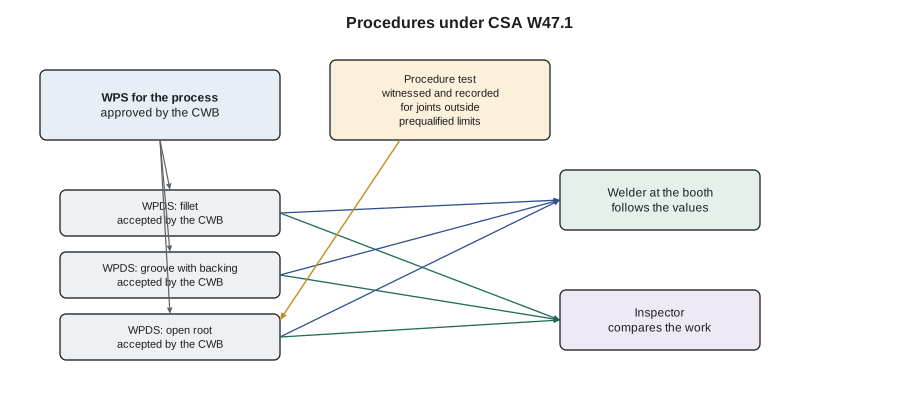
Canadian structural practice under CSA W47.1 uses two levels of procedure document. The welding procedure specification, or WPS, is the company's general document for a process: it describes how the company welds with that process, the base metals and filler metals it uses, its preheat practice, its joint preparation and cleaning, its inspection, and the conditions under which the detailed sheets apply. The CWB approves the WPS. Under it sit welding procedure data sheets, or WPDSs, one for each joint or family of joints, which give the specific joint detail, passes, electrode sizes, current, voltage, travel speed and other values the welder uses. The CWB accepts each WPDS before it is used in production. The welder at the booth works from the WPDS; the inspector checks the WPDS against the approved WPS.
The difference between the instruction and the record is the most important idea in this lesson. The procedure sheet tells the welder what to do and gives ranges. The test record tells the inspector what was proved and gives the single values that were actually used. Every range on the procedure sheet must fall within what the code allows the test to support. A procedure sheet can be revised; a test record cannot, because it records a test that has already happened.
Prequalified procedures
For the commonest structural joints, CSA W59 lists prequalified joint details: square, bevel, V, J and U grooves and fillets, with their root openings, root faces, bevel angles and tolerances, for the processes and positions it accepts. A WPDS that uses a prequalified joint with a matching filler, the required preheat and the other limits in W59 does not need a procedure test; Elena writes it, signs it, and submits it to the CWB for acceptance. Most of Hartwell's structural WPDSs are of this kind.
Prequalification is a privilege the code grants for well-proven combinations, and its limits are firm. Every variable must be within them: the process, the transfer mode, the filler classification and size, the steel group, the joint detail and its tolerances, the position, the preheat, the bead width and thickness of each layer, and the heat input where it is limited. A procedure that moves outside any one of them, such as a wider root opening than the figure allows, a filler that is not in the matching table, or a process the code does not prequalify, must be qualified by test.
Qualifying a procedure by test
A procedure qualification test is planned like an experiment. Elena writes a preliminary procedure with the values she intends to use. A welder welds a test coupon of the right material, thickness and joint, in the right position, while someone records the actual values: current, voltage, travel speed, wire feed, gas, preheat, interpass temperature and the sequence of passes. The coupon is then examined and tested as the code requires: visually, and often by radiography or ultrasonics, and then cut into specimens for tensile tests, bend tests, macro-etch sections, and impact or hardness tests if the job needs them. If every test passes, the recorded values become the procedure test record, and the production procedure is written with ranges that the code allows the test to support.
Under W47.1 the CWB witnesses procedure qualification tests or accepts results from approved testing, and the record of the test supports the WPDS when it is submitted. Elena did this for the Riverside flange splices, where the specification called for flux-cored welding with Charpy requirements that went beyond the prequalified details. The first plate failed for a slag line; the second passed every test, and the WPDS was accepted with production ranges drawn from it.
Section IX works the same way for pressure work, with its own test requirements. A groove weld procedure test on plate or pipe needs two tensile specimens and four bend specimens, face and root bends for thinner coupons and side bends for thicker ones, plus any toughness testing the construction code demands. The PQR lists every essential variable as it was in the test, and the WPS that refers to it may use the ranges Section IX allows for each variable.
Essential variables and ranges
Not every number on a procedure needs a test behind it. Each code classifies variables by how much they can change the weld's properties. A change in the base metal group, the filler metal classification, the process, a big change in preheat, or, when impact tests are required, a big increase in heat input, can change strength or toughness, so it needs a new test. Changes in things like the cleaning method or the electrode angle generally do not. Structural codes list the variables whose change requires requalification and the amount of change allowed; Section IX lists essential, supplementary essential and nonessential variables for each process.
Ranges come from those rules. If the test was welded at a certain current, the code may allow production within a band around it. If the test coupon was a certain thickness, the procedure covers the thickness range in the table. If the test was welded with preheat, production preheat may not be lower than the tested value by more than the allowed margin. Elena's job, when she writes the production procedure, is to put on it ranges that are both useful to the welder and inside what the test supports.
# Check the ranges on a production procedure against what its test record supports
# (illustrative rules of the kind the codes use; Elena takes the real ones from the edition in force)
pqr = {'process': 'GTAW+SMAW', 'p_no': 8, 'f_no_root': 6, 'f_no_fill': 5,
       'thickness': 12, 'preheat_min': 10, 'interpass_max': 175, 'heat_input': 1.6}
wps = {'process': 'GTAW+SMAW', 'p_no': 8, 'f_no_root': 6, 'f_no_fill': 5,
       'thick_range': (5, 24), 'preheat_min': 10, 'interpass_max': 175, 'heat_input_max': 1.8}

checks = []
checks.append(('process', wps['process'] == pqr['process']))
checks.append(('base metal group', wps['p_no'] == pqr['p_no']))
checks.append(('filler groups', (wps['f_no_root'], wps['f_no_fill']) == (pqr['f_no_root'], pqr['f_no_fill'])))
lo, hi = wps['thick_range']
checks.append(('thickness range', lo >= 5 and hi <= 2 * pqr['thickness']))
checks.append(('preheat not below test minus 55', wps['preheat_min'] >= pqr['preheat_min'] - 55))
checks.append(('interpass not above test plus 55', wps['interpass_max'] <= pqr['interpass_max'] + 55))
checks.append(('heat input not above test (impact tested)', wps['heat_input_max'] <= pqr['heat_input']))
for name, ok in checks:
    print(f"{name:<44} {'supported' if ok else 'NOT SUPPORTED'}")
print('procedure OK' if all(ok for _, ok in checks) else 'revise the procedure or run a new test')process supported base metal group supported filler groups supported thickness range supported preheat not below test minus 55 supported interpass not above test plus 55 supported heat input not above test (impact tested) NOT SUPPORTED revise the procedure or run a new test
Devon's check on the Coldwater flange weld finds one problem. The production procedure allows a maximum heat input of 1.8 kJ/mm (45.7 kJ/in), but the test record shows 1.6 kJ/mm (40.6 kJ/in), and because the line is impact tested, production heat input may not exceed the tested value. Elena revises the procedure to the tested value and issues the new revision; she does not touch the test record. Lucia removes the old revision from the booth the same afternoon.
Reading a procedure sheet
A procedure sheet has a standard layout, and Devon learns to read it from top to bottom. The heading gives the procedure number, revision, date and the documents that support it. Then come the joint: type, sketch, groove angle, root opening, root face, backing, and the passes. The base metals and thickness range. The filler: classification, size and any supplementary requirements. Position and progression. Preheat and interpass limits. The electrical characteristics: current type and polarity, and the ranges for amperage, voltage and travel speed for each pass and size. Technique: stringer or weave, cleaning between passes, back-gouging, peening. Post-weld heat treatment if any. Signatures and the approval or acceptance stamp.
Two habits help at the booth. Read the whole sheet before striking the first arc, not just the amperage. And check the revision against the controlled copy list in the office; a procedure that has been superseded may still be taped to a wall somewhere. Lucia's inspection rounds include checking that the revision at each booth is current, and she pulls any copy that is not.
Controlling procedures
Hartwell's quality manual describes how procedures are controlled. Elena drafts and signs each WPDS; the CWB accepts it, and the accepted copy is filed with its supporting test records. Controlled copies go to the shop with a revision number and a list of where they are posted. When a WPDS is revised, the new revision must be accepted before use and the old copies are withdrawn and marked superseded. The CWB's auditor checks this system on each visit, comparing the WPDSs in use with the accepted list.
Procedures also link to everything else in the quality system. Each welder's qualification must cover the procedure's process, position and ranges. Each filler on the procedure must be in stock with its certificates. Each weld on a weld map or inspection record names the procedure used. If a procedure is revised, the inspector checks whether any work in progress was made under the old revision and whether that matters.
Standard procedures and procedures from others
Some procedures come from outside the shop. Standard welding procedure specifications, published by AWS and accepted by ASME for Section IX work within their limits, let a shop use a procedure backed by tests done by others, provided it follows the standard procedure exactly and meets the conditions of use. Pipeline companies issue their own procedures to contractors. A customer may supply procedures for its own equipment. In each case the shop must check that the procedure is valid for the work, that it is the current revision, and that its welders are qualified for it, and the quality manual says how such procedures are accepted into the shop's system.
Procedures on the shop floor
A procedure is only useful if it reaches the person holding the torch. Hartwell posts a laminated controlled copy at each booth for the joints welded there, and the travellers that go with each assembly name the procedure for every weld. Before a welder starts a new joint, the foreman or the inspector checks that the welder has the right sheet and has read it. During welding, Lucia's rounds include a quick comparison: the current on the clamp meter, the voltage on the machine, the filler on the rod oven label and the preheat crayon mark, each against the sheet. If a value is outside the range, the welder stops, the cause is found, and any welds made outside the range go on the nonconformance log for review.
Devon notices that the best welders treat the procedure as a tool, not a nuisance. Marta reads every new sheet twice and asks Elena about anything that looks odd, and twice in Devon's time she has found a typing error, once a current range that did not match the electrode size, once a preheat written in the wrong units. Both were fixed by a revision the same day. A procedure that nobody reads cannot be corrected, and a welder who reads it carefully is part of the shop's quality system.
Common mistakes
MistakeRevising a test record to match the production procedure.
InsteadTest records are never changed; revise the procedure to fit the test or run a new test.
MistakeAssuming a standard joint is prequalified whatever the process.
InsteadEvery variable, including the process and transfer mode, must be in the prequalified limits.
MistakeReading only the amperage on the sheet.
InsteadRead the whole procedure, including preheat, interpass, technique and filler.
MistakeWelding to a superseded revision.
InsteadCheck the revision against the controlled copy list.
MistakePutting wider ranges on a procedure than the test supports.
InsteadEach range must fall within what the code allows the test to cover.
Summary and key terms
- Under W47.1 the CWB approves the company's WPS and accepts the WPDS for each joint.
- The procedure is an instruction with ranges; the test record is a record of single values that were proved.
- Prequalified procedures must keep every variable within the code's limits.
- A procedure test is planned, welded with recorded values, and tested to the code.
- Essential variables need a new test when changed beyond their range; others can be revised.
- Procedures are controlled documents with revisions, approval and withdrawal of old copies.
- WPS
- The company document approved by the CWB that describes how it welds with a process.
- WPDS
- A welding procedure data sheet giving the detailed values for a joint, accepted by the CWB.
- Procedure qualification test
- A test coupon welded with recorded values and tested to prove a procedure.
- Prequalified joint
- A joint detail the code accepts without a procedure test when used within its limits.
- Essential variable
- A variable whose change beyond its range needs a new procedure test.
- Controlled copy
- A numbered copy of a procedure whose location is recorded so it can be withdrawn.
Practice problems
Work each problem on paper first, then reveal the answer to check.
Who accepts a WPDS before it is used in production?
Show answer
The CWB.
Can the values on a procedure test record be changed later?
Show answer
No; it records what was done. Revise the WPDS or run a new test.
A WPDS uses a process the code does not prequalify. What is needed?
Show answer
A procedure qualification test before the WPDS can be accepted.
Lesson quiz · 5 questions
Score 60% or more to complete this lesson.
Create a free account to save your progress, take quizzes and earn a certificate.