
WLD-330 · Lesson 10 of 12 · 16 min
Inspection personnel and certification
Codes trust inspectors with judgements that can stop a job, so they insist that inspectors prove their competence. Devon has worked beside Lucia for three years and has met the owner's inspectors, the NDE technicians, the radiographers and the pressure equipment inspectors who visit Hartwell. In this lesson he learns how each of them is certified, what their certification lets them do, and how a welder might one day become one. Lucia, who started as a welder herself, tells the class that the best inspectors she knows were good welders first, because they know where a weld goes wrong and how hard it is to make it go right.
Why inspectors are certified
A weld inspector makes decisions that cost money and affect safety. Reject a good weld and the shop pays for a repair that adds heat and risk for nothing; accept a bad weld and it goes into a bridge or a refinery. Codes therefore require that the people who inspect, and the people who perform non-destructive testing, be qualified by training, experience and examination, and that their qualifications be documented. Certification schemes provide the documentation, and they also set rules of conduct: inspectors must be impartial, report what they find, and not inspect work they have a personal stake in.
There are two broad kinds of certification. Central or third-party certification is granted by an independent body after examination, and the certificate belongs to the person; it travels with them from employer to employer. Employer-based certification is granted by the employer under a written practice, often using examinations designed or approved by a senior specialist, and it lasts only while the person works for that employer. Both are accepted by codes, depending on the country and the code, and some schemes combine them.
Welding inspectors
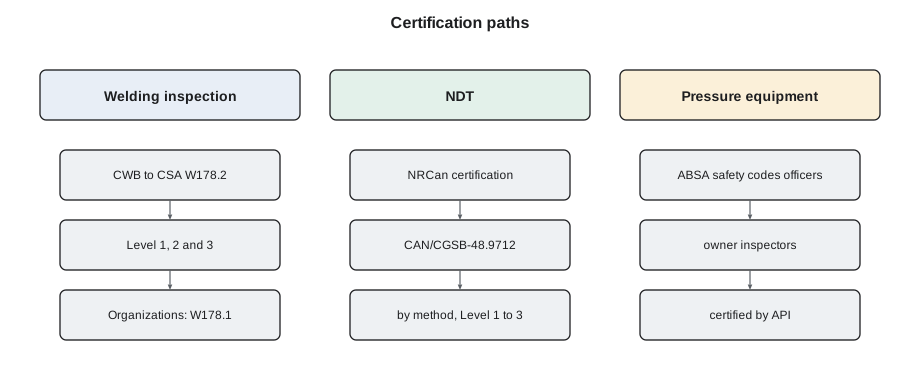
In Canada, welding inspectors are certified by the CWB to CSA W178.2, Certification of welding inspectors, at three levels. A Level 1 inspector has at least a year of experience in welding or related work, or six months with recognized courses, and has passed the CWB's theory and practical examinations in visual inspection. A Level 2 inspector has worked at least two years as a certified Level 1 under qualified supervision and has passed further examinations; Level 2 inspectors can inspect and accept work to the code. A Level 3 inspector has at least four years as a certified Level 2 and takes responsibility for an inspection program. The CWB also certifies visual welding inspectors under a separate scheme. Lucia is a CSA W178.2 Level 2 inspector.
Inspection organizations are certified too. CSA W178.1 covers the certification of welding inspection organizations: an organization that offers inspection services for structural steel to W59 must be certified by the CWB under W178.1, with certified inspectors, written procedures and a quality system. The owner's inspection firm on the Riverside bridge holds W178.1 certification, and its inspectors are certified to W178.2.
NDT technicians
NDT certification in Canada is central. Natural Resources Canada's certification body certifies technicians under CAN/CGSB-48.9712, the Canadian version of ISO 9712, for each method separately, such as ultrasonic, radiographic, magnetic particle, penetrant, eddy current and visual testing, at Levels 1, 2 and 3. Candidates complete training hours and supervised experience for the method and level, then pass general, specific and practical examinations. The certificate belongs to the technician and is renewed at intervals by showing continued work in the method and, at the end of the full cycle, by re-examination. When the federal standards board stopped publishing standards, NRCan confirmed that its certification program would continue unchanged.
Levels mean roughly the same everywhere. A Level 1 can carry out specific calibrations and tests under supervision, following written instructions, and record results, but does not evaluate them alone. A Level 2 can set up and calibrate equipment, carry out and supervise tests, interpret and evaluate results against codes and specifications, and write instructions. A Level 3 can establish techniques and procedures, interpret codes, designate the methods to be used and train and examine others. Annika is a Level 2 in three methods; her company's Level 3 approves her procedures.
Vision matters for every method. Certification schemes require a near-vision acuity test at least once a year for NDT personnel and a colour perception test where the method needs it, such as colour-contrast penetrant. An inspector whose glasses prescription has changed must retest before inspecting.
Pressure equipment inspectors
For pressure equipment in Alberta, ABSA's safety codes officers inspect new construction and repairs at the hold points required by the quality program and the codes, review welding procedures and pressure welder records, witness pressure tests and register the equipment. They are employees of the authority, not of the shop or the owner. Large owners such as refineries also have their own in-service inspectors, often certified by the American Petroleum Institute as pressure vessel or piping inspectors, and in Alberta an owner with an accepted integrity management program can do much of its own in-service inspection under ABSA's oversight.
The independence of these inspectors is the point of their job. They do not work for the shop, and they cannot be told to accept work. A shop that has a disagreement with an authorized inspector or a safety codes officer raises it through the channels the jurisdiction provides, never by pressure on the inspector.
Records and renewals
Every certification has an expiry and conditions for keeping it. Inspectors renew by showing continued work, by re-examination or both, and by passing vision tests at set intervals. A shop that relies on inspectors' certifications must check that they are current, and an auditor will ask to see them. Hartwell keeps a list of every certified person who inspects or tests its work, with the certificate number, method, level, expiry and last vision test.
# Certification register for people who inspect or test Hartwell's work
from datetime import date
today = date(2026, 11, 2)
register = [
    # name, certification, method or scope, expiry, last near-vision test
    ('Lucia Ferreira', 'welding inspector', 'visual, all codes', date(2028, 4, 30), date(2026, 3, 12)),
    ('Annika Sorensen', 'NDT Level 2', 'UT', date(2027, 1, 15), date(2025, 10, 20)),
    ('Annika Sorensen', 'NDT Level 2', 'MT', date(2029, 6, 1), date(2025, 10, 20)),
    ('Annika Sorensen', 'NDT Level 2', 'PT', date(2026, 12, 1), date(2025, 10, 20)),
    ('contract radiographer', 'NDT Level 2', 'RT', date(2027, 8, 9), date(2026, 7, 2)),
]
for name, cert, scope, expiry, vision in register:
    notes = []
    if (expiry - today).days < 0:
        notes.append('EXPIRED')
    elif (expiry - today).days < 60:
        notes.append(f'expires in {(expiry - today).days} days')
    if (today - vision).days > 365:
        notes.append('near-vision test overdue')
print(f"{name:<22} {cert:<18} {scope:<18} {'; '.join(notes) if notes else 'current'}")Lucia Ferreira welding inspector visual, all codes current Annika Sorensen NDT Level 2 UT near-vision test overdue Annika Sorensen NDT Level 2 MT near-vision test overdue Annika Sorensen NDT Level 2 PT expires in 29 days; near-vision test overdue contract radiographer NDT Level 2 RT current
The register shows that Annika's penetrant certification expires within the month and that her annual near-vision test is overdue for every method. Until she retests her vision, she cannot perform or sign any examination, even in methods whose certificates are current. Lucia sends the list to Annika's company the same day; she is retested that week and her renewal paperwork goes in. An auditor checking Hartwell's records would have found the same gap, which is why the shop checks first.
Ethics and independence
Certification schemes include a code of conduct, and the rules are simple to state. Inspect and report honestly, including findings that are inconvenient. Do not sign for inspection you did not do. Do not inspect your own work for acceptance when the code requires independent inspection. Do not accept gifts or favours from those whose work you inspect. Keep records accurate and complete. Work only within the scope and level of your certification. An inspector who breaks these rules can lose certification, and the welds they accepted may have to be reinspected at the shop's cost.
Lucia has two stories she tells new inspectors. The first is about a foreman, long gone from Hartwell, who asked her to sign off a batch of welds she had not seen because the truck was waiting; she did not sign, the truck waited two hours, and two of the welds were rejected. The second is about a welder who asked her to check his own suspicion about a root he had just run; she did, it was fine, and he became one of the best welders in the shop because he was never afraid to ask. Inspection, she says, is not the enemy of production; it is the reason the customer believes in it.
From welder to inspector
Many inspectors start as welders. A welder with a few years of experience can take the CWB's Level 1 course and examinations under W178.2, inspect under supervision, and work toward Level 2, often while still welding part of the time. NDT is a separate path through NRCan's method certifications, with its own training and supervised hours. Both paths reward the habits Devon has been building: keeping a notebook, reading the procedure before welding, and understanding why a weld fails as well as how to fix it.
Calibration of inspection equipment
A certified inspector with an uncalibrated gauge produces uncertain results. Codes and quality programs require that measuring and test equipment used for acceptance be calibrated at set intervals against standards traceable to national standards, and that each item carry a label or record showing when it was last calibrated and when it is next due. At Hartwell this covers fillet and cam gauges, tapes, thermometers and temperature-indicating crayons, clamp-on current meters and voltmeters used to check welding machines, light meters, ultrasonic instruments and their calibration blocks, magnetic particle yokes and test weights, and the pressure gauges used for hydrostatic tests.
Some checks are done every day rather than at long intervals. Annika checks her ultrasonic instrument against a reference block at the start and end of each shift and whenever the probe or cable is changed; if the final check shows a shift, every weld tested since the last good check is retested. The yoke lift test is done before use. The radiographers check their survey meters. These daily checks are recorded on the test report, and an auditor will look for them.
A day with the owner's inspector
On a Thursday Devon spends the day with the owner's inspector for the Riverside bridge, a quiet engineer-technologist named Farhan Qadir who has inspected bridges for twenty years. Farhan starts by reading Hartwell's inspection records for the week, then walks the shop to see the work they describe. He picks two splices that Lucia has accepted and asks Annika to scan them again while he watches. He checks the welders' qualifications for the girders he sees being welded, the procedure posted at each station, and the preheat on a thick flange with his own thermometer. At the end of the day he writes a short report for the city: work in progress, inspections witnessed, records reviewed, and one observation about a missing date on a preheat record, which Lucia corrects before he leaves.
Devon notices that Farhan does not repeat everything Lucia does. Verification inspection samples the fabricator's work and checks that the fabricator's system works; it is not a second complete inspection. When the samples agree, the owner gains confidence in the records for the rest; when they do not, the owner's inspector widens the sample and the fabricator may have to reinspect. The relationship works best when both inspectors are certified, honest and talk to each other, which on this job they do every morning over coffee.
Inspection reports that stand up
Whatever the certification, an inspector's value lies in reports that someone else can rely on months later. A good report identifies exactly what was inspected, by drawing, weld number and location; states the method, the procedure and its revision, and the acceptance criteria and their edition; records the equipment and its calibration; describes each indication found and how it was evaluated; gives a clear result; and carries the inspector's name, certification and level, signature and date. It is written at the time, not reconstructed later, and corrections are made by striking through and initialling, never by erasing.
Lucia keeps her reports to a standard form for each method, so that nothing is forgotten, and reviews each one before it leaves her desk. Devon learns to read them the way an auditor would: if the report did not say it, assume it was not done. That habit is what makes a certified inspector worth more than an experienced pair of eyes alone.
Common mistakes
MistakeAssuming any experienced welder may accept work.
InsteadCode acceptance requires a certified inspector at the right level.
MistakeIgnoring vision tests.
InsteadAn overdue near-vision test stops an inspector from working in every method.
MistakeTreating employer NDT certification as portable.
InsteadEmployer-based certification ends when the technician leaves; the new employer recertifies.
MistakeSigning for inspection not done.
InsteadSign only for work you inspected.
MistakePressuring an independent inspector.
InsteadRaise disagreements through the jurisdiction's channels.
Summary and key terms
- CSA W178.2 certifies welding inspectors at three levels; W178.1 certifies inspection organizations.
- NDT technicians are centrally certified by NRCan under CAN/CGSB-48.9712.
- Level 1 tests under supervision, Level 2 interprets and evaluates, Level 3 writes procedures and takes responsibility.
- Pressure equipment inspectors are independent of the shop and must accept work at hold points.
- Certifications expire and need renewal and vision tests; shops keep a register.
- Inspectors work under codes of conduct that demand honesty and independence.
- CSA W178.2
- The standard for certification of welding inspectors at Levels 1, 2 and 3.
- CSA W178.1
- The standard for certification of welding inspection organizations.
- CAN/CGSB-48.9712
- The Canadian adoption of ISO 9712 for certifying NDT personnel.
- Safety codes officer
- An inspector who works for the pressure equipment authority and accepts work.
- Level 2
- An NDT or inspection level able to set up tests, interpret results and evaluate them.
- Near-vision test
- An eyesight test inspectors and technicians must pass at set intervals.
Practice problems
Work each problem on paper first, then reveal the answer to check.
Who certifies welding inspectors to CSA W178.2?
Show answer
The CWB.
An NDT Level 2's near-vision test is 14 months old. Can she sign a UT report?
Show answer
No; the test must be redone first.
What does a Level 3 do that a Level 2 does not?
Show answer
Establishes techniques and procedures and takes technical responsibility.
Lesson quiz · 5 questions
Score 60% or more to complete this lesson.
Create a free account to save your progress, take quizzes and earn a certificate.