
WLD-330 · Lesson 3 of 12 · 16 min
Pressure and piping codes: ASME IX, B31 and pipeline codes
The other half of Hartwell's work holds pressure: the Unit 4 refinery spools, the stainless chemical injection lines on the Coldwater skids, small pressure vessels and the occasional boiler repair. Pressure work runs on a different set of books from structural work, and Devon has already welded to some of them without seeing how they fit together. Elena's third class lays them out: the construction codes that say what must be built and how it must be examined, ASME Section IX that says how welding procedures and welders are qualified, the piping codes in the ASME B31 series, and the pipeline codes used for gathering and transmission lines. She finishes with the people who must accept pressure work before it goes into service, which in Alberta means ABSA.
Construction codes and the welding qualification code
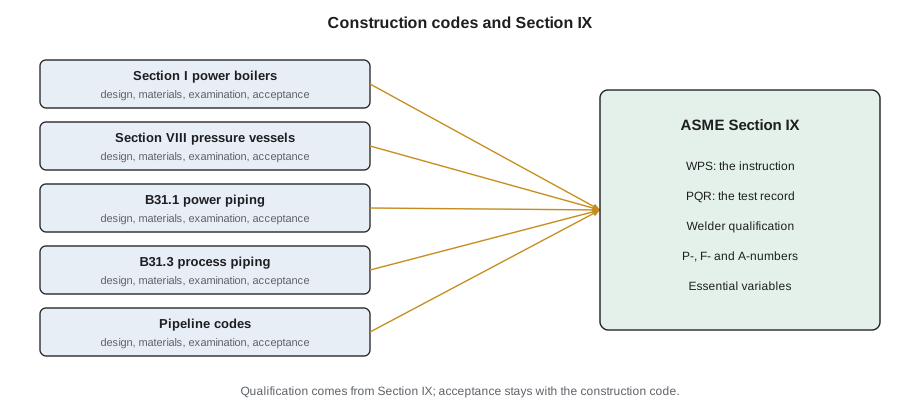
Pressure codes divide the work in a way that confuses newcomers. The construction codes, such as ASME Section I for power boilers, Section VIII for pressure vessels and the B31 piping codes, say what may be built, how it is designed, which materials may be used, what workmanship is required, how much examination is done and what acceptance criteria apply. They do not say how to qualify a welding procedure or a welder; for that they all refer to ASME Section IX, the Boiler and Pressure Vessel Code's section on welding, brazing and fusing qualifications. Section IX is a qualification standard, not a construction code: it tells you how to prove that a procedure produces sound welds and that a welder can make them, but not whether a weld in a vessel is acceptable.
This split means a pressure weld always has two sets of rules behind it. A butt weld in a refinery line is qualified under Section IX and examined and accepted under B31.3. If the construction code adds a requirement to Section IX, such as impact testing for low-temperature service or a limit on heat input, the construction code's requirement applies too. Elena's way of putting it: Section IX says the procedure and the welder are capable; the construction code says what this particular weld must be.
| Code | Covers | Hartwell work |
|---|---|---|
| ASME Section I | Power boilers and their external piping | Boiler tube and header repairs |
| ASME Section VIII, Division 1 | Pressure vessels | Small separators and receivers |
| ASME B31.1 | Power piping | Steam lines in a utility plant |
| ASME B31.3 | Process piping | Unit 4 refinery spools, Coldwater injection lines |
| CSA Z662 | Oil and gas pipelines | Gathering line tie-ins |
| ASME Section IX | Qualification of procedures and welders | Every pressure procedure and welder test |
How Section IX is organized
Section IX is arranged in parts with QW numbers for welding and QB numbers for brazing. The general part sets out the purpose and the documents: the welding procedure specification, or WPS, which tells the welder how to make the weld; the procedure qualification record, or PQR, which records what was actually done and tested to support it; and the welder or welding operator performance qualification record, often called the WPQ. Further parts cover procedure qualification, performance qualification, the data that may change and how much, and the test specimens and how they are judged.
The heart of Section IX is its list of variables for each process. Every variable is classed as essential, supplementary essential or nonessential. An essential variable is one that, if changed beyond its range, could change the mechanical properties of the weld, so the procedure must be requalified with a new PQR. A supplementary essential variable matters only when the construction code requires impact testing; then it is treated like an essential variable. A nonessential variable can be changed by revising the WPS without a new test. The same idea applies to welders: changing a performance essential variable beyond its range, such as a position or a process, needs a new test.
Grouping metals: P-numbers, F-numbers and A-numbers
If every steel needed its own procedure test, a shop would test forever. Section IX groups base metals with similar welding behaviour into P-numbers, and sometimes into group numbers within them for impact-tested work. Plain carbon steels are P-No. 1, carbon-molybdenum steels P-No. 3, the chromium-molybdenum steels P-No. 4 and 5A, and austenitic stainless steels P-No. 8, for example. A procedure qualified on one P-number generally covers other metals in the same P-number, and the code lists which combinations of P-numbers a test covers.
Filler metals are grouped the same way. F-numbers group electrodes and wires by how they handle for the welder, so that a welder qualified with one F-number electrode can use others in the same group: the common carbon steel electrodes fall into a few F-numbers by coating type, with low-hydrogen electrodes in one group and cellulosic electrodes in another. A-numbers group ferrous weld metals by their chemical analysis, so that a procedure qualified with one A-number deposit covers others of the same chemistry. The welder cares most about F-numbers; the procedure cares about both.
| Group | Examples | Why it matters |
|---|---|---|
| P-No. 1 | Carbon steel plate, pipe and fittings | Most of Hartwell's pressure work |
| P-No. 4 and 5A | Chromium-molybdenum steels | Preheat and heat treatment are stricter |
| P-No. 8 | Austenitic stainless steels | The Coldwater injection lines |
| F-No. 3 | Cellulosic electrodes such as E6010 | Open-root pipe roots |
| F-No. 4 | Low-hydrogen electrodes such as E7018 | Fill and cap on pressure work |
| F-No. 6 | Solid and cored wires and rods | GTAW roots and GMAW |
Thickness and diameter ranges
A procedure test on one thickness of plate or pipe qualifies a range of thicknesses for production. The idea is simple: a coupon of moderate thickness shows that the procedure can fuse and fill a joint of that size and somewhat thicker, but not much thicker, because cooling and heat buildup change. Section IX tabulates the ranges: the minimum and maximum base metal thickness qualified, and the maximum weld metal thickness each process in the coupon may deposit. Impact testing and heat treatment can narrow them. Welders have their own ranges for deposited thickness and for pipe diameter, which lesson 5 covers.
# Base metal thickness qualified by a groove weld procedure test (shape of the Section IX table; check the current edition)
U = 'mm'
def qualified_range(T):
    # T = coupon thickness; returns (minimum, maximum) qualified
    if T < 10:
        return (T, 2 * T)
    if T < 19:
        return (5, 2 * T)
    if T < 38:
        return (5, 2 * T)
    if T <= 150:
        return (5, 200)
    return (5, round(1.33 * T, 2))

for T in [6, 12, 25, 50]:
    lo, hi = qualified_range(T)
    print(f"coupon {T:>6} {U}: qualifies base metal from {lo} to {hi} {U}")

production = [('Unit 4 spool wall', 11.1), ('heavy flange neck', 28.6), ('vessel shell', 60.0)]
pqr_T = 12
lo, hi = qualified_range(pqr_T)
for name, t in production:
print(f"{name:<24} {t:>6} {U}: {'covered' if lo <= t <= hi else 'NOT covered: new PQR needed'}")coupon 6 mm: qualifies base metal from 6 to 12 mm coupon 12 mm: qualifies base metal from 5 to 24 mm coupon 25 mm: qualifies base metal from 5 to 50 mm coupon 50 mm: qualifies base metal from 5 to 200 mm Unit 4 spool wall 11.1 mm: covered heavy flange neck 28.6 mm: NOT covered: new PQR needed vessel shell 60.0 mm: NOT covered: new PQR needed
With a 12 mm (1/2 in) coupon, the PQR covers the spool walls and the heavier flange neck but not the thick vessel shell, which would need a test on a thicker coupon. The breakpoints in the program follow the shape of the Section IX table; Elena reads the actual values, and any narrowing from impact testing or heat treatment, from the edition Hartwell is certified to.
The piping codes
The B31 piping codes are the construction codes for piping. B31.1 covers power piping in electric generating stations, industrial plants and district heating. B31.3 covers process piping in refineries, chemical plants, pharmaceutical plants and similar facilities, and it is the one Hartwell meets most often. B31.4 covers pipelines for liquids such as crude oil and B31.8 covers gas transmission and distribution piping. Each sets design rules, material lists, fabrication and assembly requirements, examination requirements and acceptance criteria, and each sends the welder to Section IX for qualification, with some additions.
B31.3 sorts process piping into fluid service categories. Normal fluid service covers most lines. Category D covers non-flammable, non-toxic fluids at low pressure and moderate temperature, where less examination is needed. Category M covers fluids so toxic that a single small exposure could cause serious harm, where more is needed. High-pressure service and severe cyclic conditions have their own rules. The examination required depends on the category: for normal fluid service, the code requires at least five percent random radiography or ultrasonic examination of circumferential butt welds, chosen so that each welder's work is represented, and visual examination of a share of the rest. A rejected weld triggers the progressive examination Devon met in the pipe course.
The piping codes also set acceptance criteria that differ from the structural ones. B31.3 has a table that lists, for each kind of imperfection and each examination method, the limit for normal service and for the stricter categories. Cracks, lack of fusion and incomplete penetration are generally unacceptable in normal fluid service, and porosity, slag and undercut have stated limits. Lucia keeps the table taped inside the cover of her radiography folder.
Pipeline codes
Pipelines are different again. In Canada, oil and gas pipeline systems are built to CSA Z662, which has its own welding clause and its own procedure and welder qualification tests, written around field welding with cellulosic and low-hydrogen electrodes, mechanized welding and the large crews used on long lines. Provincial regulators such as the Alberta Energy Regulator and the federal Canada Energy Regulator adopt Z662 for the lines they oversee. Hartwell does little pipeline work, but its welders sometimes make tie-ins on gathering lines that feed the Coldwater skids, and those welds follow Z662, not B31.3.
A welder qualified under Section IX is not automatically qualified for pipeline work, and the reverse is also true. Rob Haldane, who spent years on pipeline crews before joining Hartwell, holds both: his pipeline qualifications are kept by the pipeline companies he works for, and his Section IX qualifications are kept by Hartwell. When he made a tie-in on the Coldwater gathering line, he welded to the pipeline company's procedure under its qualification, not Hartwell's.
Who accepts pressure work
In Alberta, pressure equipment is regulated under the province's Safety Codes Act and its pressure equipment safety regulation, which adopts CSA B51 and the ASME codes. ABSA, the pressure equipment safety authority, administers the program. A shop that builds or repairs pressure equipment must hold a certificate of authorization from ABSA, backed by a quality management system that ABSA has reviewed, and its welding procedures must be registered with ABSA before use. Pressure welders in Alberta hold ABSA performance qualification cards that list the processes, positions and ranges they are qualified for. A designer registers the design of a vessel or fitting and receives a Canadian registration number, and an ABSA safety codes officer inspects the work at the hold points before the equipment can be registered and stamped.
For piping, the owner plays a large part. On the Unit 4 job the refinery's own inspection department reviews Hartwell's procedures and welder records before work starts, selects the welds for radiography and witnesses the hydrostatic tests. The B31.3 code puts examination on the fabricator and inspection on the owner, and the refinery takes its part seriously. Devon learns to keep his welder number on every weld he makes, because the owner's inspector will trace the radiographs back to him.
Bringing the documents together
On a pressure job, the stack Elena puts on the table is different from the bridge job. The contract and the owner's piping specification name B31.3, the fluid service categories and the examination the owner wants beyond the code. The isometric drawings and weld maps show each weld with a number. Hartwell's quality manual, approved by the jurisdiction, describes how the shop controls materials, welding, examination, nonconformances and records. The welding procedure specifications are supported by their PQRs, the welders' qualification records show each welder's ranges, and the examination records tie every weld to its welder, its procedure and its result.
Common mistakes
MistakeLooking in Section IX for weld acceptance criteria.
InsteadSection IX qualifies procedures and welders; the construction code gives acceptance criteria.
MistakeAssuming a change in amperage needs a new procedure test.
InsteadCheck whether the variable is essential, supplementary essential or nonessential.
MistakeUsing one PQR for any thickness.
InsteadEach PQR qualifies a range; check the table for the coupon thickness.
MistakeTreating pipeline and plant piping qualifications as interchangeable.
InsteadPipeline codes have their own qualification tests and records.
MistakeForgetting the owner's role on piping jobs.
InsteadThe owner's inspector selects welds for examination and witnesses tests.
Summary and key terms
- Construction codes set design, examination and acceptance; Section IX sets qualification.
- Section IX variables are essential, supplementary essential or nonessential.
- P-numbers group base metals, F-numbers group fillers by usability and A-numbers by chemistry.
- Each PQR qualifies a thickness range, and each welder test qualifies its own ranges.
- B31.3 examination depends on the fluid service category; normal service needs at least five percent random examination of butt welds.
- Pipeline welding follows its own codes and qualifications.
- Section IX
- The ASME code for qualifying welding and brazing procedures and welders.
- Essential variable
- A variable whose change beyond its range requires requalifying the procedure.
- Supplementary essential variable
- A variable that becomes essential when impact testing is required.
- P-number
- A Section IX grouping of base metals with similar welding behaviour.
- F-number
- A Section IX grouping of filler metals by usability for the welder.
- Fluid service category
- A B31.3 classification of process piping that sets examination and acceptance.
Practice problems
Work each problem on paper first, then reveal the answer to check.
A WPS is qualified on a 12 mm coupon. Does it cover a 60 mm vessel shell?
Show answer
No; the coupon qualifies up to twice its thickness in this range, about 24 mm.
Which code gives the acceptance criteria for a radiographed weld in refinery piping?
Show answer
ASME B31.3.
What does F-No. 4 cover?
Show answer
Low-hydrogen electrodes such as E7018.
Lesson quiz · 5 questions
Score 60% or more to complete this lesson.
Create a free account to save your progress, take quizzes and earn a certificate.