
WLD-330 · Lesson 2 of 12 · 17 min
Structural welding codes: CSA W59 and W47.1
Most of what Hartwell welds is structural steel: the Riverside pedestrian bridge, the base frames for the Coldwater skids, platforms, pipe racks and the occasional farm repair. In Canada two CSA standards sit at the centre of that work. CSA W59 sets the rules for the welds themselves: design of welded connections, workmanship, procedures, inspection and acceptance. CSA W47.1 sets the rules for the company that makes them: who must be on staff, how procedures are accepted, and how welders and supervisors are qualified. The Canadian Welding Bureau, the CWB, runs the certification program under W47.1 and audits the companies in it. Elena's second class is a tour of both books, with the Riverside job open beside them.
What a structural welding code covers
Every structural welding code answers the same set of questions, in its own order and with its own numbers. Which steels and filler metals may be used, and how are they matched? How must welded connections be designed and detailed, including the sizes, lengths and effective throats of welds? How must a welding procedure be shown to work, either by using prequalified details or by testing? How must welders and operators be qualified, and how long does a qualification last? What workmanship is required in fit-up, preheat, sequence and finish? Who inspects, how, and against what acceptance criteria? How are defects repaired? The answers differ between codes in detail, but a welder who knows the questions can find the answers in any of them.
CSA W59, Welded steel construction, is the Canadian code for welding carbon and low-alloy steel structures by the common arc processes. It covers buildings, bridges, towers and other structures, and it separates requirements for statically loaded structures from those for cyclically loaded ones, where fatigue governs and the rules on details, profiles and inspection are stricter. Its sister standards deal with neighbouring work: CSA W59.2 for aluminum, CSA W186 for welding reinforcing bars, and CSA W48 for the filler metals themselves.
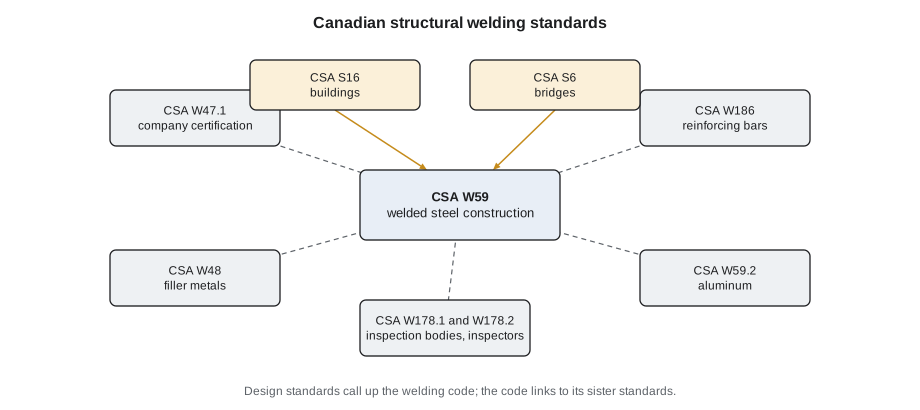
How the design standards call up the welding code
The engineer designing a steel building in Canada works to CSA S16, the design standard for steel structures, and a bridge engineer works to CSA S6, the Canadian Highway Bridge Design Code. Both require that welding be done to CSA W59 by a fabricator certified by the CWB to CSA W47.1, in the division the work calls for. The National Building Code and the Alberta Building Code adopt S16, so the chain from the law to the welder is unbroken: law, building code, steel design standard, welding code and company certification. When the specification for the Riverside bridge says “welding to CSA W59, fabricator certified to CSA W47.1 Division 1 or 2,” it is repeating what S6 already requires and making the division explicit.
The division matters to a fabricator. W47.1 recognizes companies with different levels of in-house engineering responsibility for welding. A company in the division with the most responsibility has a welding engineer, accepted by the CWB, who is responsible for its procedures and welding practice; companies in other divisions may rely on an engineer retained from outside, and the lowest division is for work where the welding design is done by others. Hartwell's certification is in the division that matches Elena's role, so she signs the procedures and the CWB accepts them. A contract that asks for a particular division is really asking who will take responsibility for the welding engineering.
Statically and cyclically loaded structures
A platform that carries people and equipment, a building frame or a pipe rack is mostly statically loaded: its loads change slowly and not many times. A crane runway, a bridge, a conveyor gallery or a vibrating screen frame is cyclically loaded: its stresses go up and down thousands or millions of times. Fatigue cracks start at small notches, so the code is stricter for cyclic structures. It limits undercut and porosity more tightly, requires smoother weld profiles at the toes, restricts certain details such as intermittent fillets and backing left in place across the stress, and usually calls for more non-destructive testing. The drawing or the specification tells the shop which category applies, and the inspector uses the matching acceptance criteria.
Lucia shows Devon two drawings side by side. The Coldwater base frame is statically loaded, so a fillet weld with an undercut of 0.8 mm (1/32 in) along part of its length can be accepted under the statically loaded criteria. The Riverside floor beams are cyclically loaded, and the same undercut perpendicular to the main stress would be rejected and repaired. “Same weld, same welder, different answer,” she says. “Always check which table you are in before you measure.”
Prequalified and qualified procedures
A structural code gives the shop two ways to show that a welding procedure works. The first is prequalification: if the joint geometry, process, filler, preheat and other variables are all within the limits the code lists, the procedure is accepted without testing, because the code's writers have already proved those combinations sound. The second is qualification by test, used for anything outside those limits. Under the Canadian system both routes run through the CWB: Hartwell writes welding procedure data sheets for its joints and the CWB accepts them, and a procedure outside the prequalified limits is tested and approved before use. Lesson 4 covers these documents in detail.
Prequalification has limits that matter on the shop floor. Some processes and transfer modes are not prequalified at all, such as short-circuit gas metal arc welding, because they can leave lack of fusion that the code's writers did not want to accept without testing. Prequalified joints must match the code's figures for root opening, bevel angle and root face within the listed tolerances, and the fit-up tolerances still apply in the shop. A joint that is fitted outside them is no longer prequalified until it is corrected, which is why Lucia's fit-up check matters even on simple joints.
Fillet weld sizes and effective throat
The structural codes set minimum fillet weld sizes based on the thickness of the thicker part joined, because a small weld on thick plate cools quickly and can crack. They also set maximum sizes along edges, so that the toe does not melt away the plate edge. The strength of a fillet comes from its effective throat, the shortest distance from the root to the face of the weld, which for an equal-leg fillet on a right-angle joint is about 0.707 times the leg. A weld that is undersize over part of its length is allowed only within the limits in the acceptance criteria, and a fillet in a skewed joint has a different throat for the same leg.
# Minimum fillet size check (values from a table like the code's; check the edition the job names)
import math
thick_unit = 'mm'
# (largest thickness of the thicker part, minimum fillet leg)
table = [(6, 3), (12, 5), (20, 6), (1000, 8)]
joints = [('stiffener to web S-14', 25, 5), ('base frame gusset', 12, 6), ('handrail post', 8, 5), ('lifting lug', 32, 10)]
for name, t_thick, leg in joints:
    need = next(m for limit, m in table if t_thick <= limit)
    throat = leg * math.cos(math.radians(45))
    status = 'ok' if leg >= need else 'UNDERSIZE: raise an RFI or use the code alternative'
print(f"{name:<26} thicker part {t_thick:>6} {thick_unit} leg {leg:>6} min {need:>6} throat {throat:.2f} {status}")stiffener to web S-14 thicker part 25 mm leg 5 min 8 throat 3.54 UNDERSIZE: raise an RFI or use the code alternative base frame gusset thicker part 12 mm leg 6 min 5 throat 4.24 ok handrail post thicker part 8 mm leg 5 min 5 throat 3.54 ok lifting lug thicker part 32 mm leg 10 min 8 throat 7.07 ok
The table in the program has the shape of the code's minimum fillet size table: the minimum leg steps up with the thickness of the thicker part. The stiffener on sheet S-14 fails the check, which is the request for information from lesson 1. The real table and its notes, including any allowance when enough preheat is used, are in the edition of the code the job names.
Workmanship, fit-up and preheat
The fabrication part of a structural code is where welders spend most of their working lives. It sets rules for preparing base metal, removing mill scale and moisture, assembling joints within tolerance, tack welding, preheat and interpass temperature, heat input on quenched and tempered steels, weld sequence to control distortion, run-off tabs, backing, peening, and the profiles of finished welds. Many of these rules appeared in earlier courses as Hartwell practice; in this course Devon learns that they are code requirements, which means an inspector can reject work that ignores them even if the weld looks good.
Preheat is a good example. The code gives a table of minimum preheat and interpass temperatures by steel group and thickness for prequalified procedures, with an alternative method based on hardness or hydrogen control. A weld made on 40 mm (1-1/2 in) plate without preheat may look perfect and still be rejected, because the inspector cannot see hydrogen cracking that may appear a day later. Lucia's temperature-indicating crayons and contact thermometer are inspection tools, and the preheat she records is part of the evidence that the weld was made to the procedure.
Inspection and acceptance in the structural code
CSA W59 separates inspection by the fabricator from inspection for the owner. The fabricator inspects its own work as part of its quality program under W47.1; the owner or the engineer may appoint an inspection organization, certified by the CWB to CSA W178.1, whose inspectors are certified to CSA W178.2. W59 gives the acceptance criteria for visual inspection and for the non-destructive methods, and lets the contract decide how much non-destructive testing is done. A weld is accepted when it meets the criteria for its loading category, unless the specification is stricter.
Inspection under a structural code is not only about the finished weld. The inspector checks that materials match the drawings and their mill certificates, that procedures are available at the work station and followed, that welders are qualified for the process and position they are using, that equipment works, and that preheat, interpass temperatures and sequence are as the procedure says. A finished weld that passes visual inspection but was made by an unqualified welder, or with the wrong filler, is still nonconforming.
Repairs and alterations
Structural codes also say how defects are repaired: the defect is removed by grinding, gouging or machining until sound metal is reached, the excavation is checked, often by magnetic particle testing, and the area is rewelded to an approved procedure and inspected again. Repairs to members that are already in service, strengthening of old structures and welding on steels of unknown composition are covered in their own clause or annex and usually need the engineer's approval. Hartwell's quality manual adds its own rule: every repair beyond simple grinding gets a repair record that names the defect, the method of removal, the procedure used, the welder and the inspection after repair.
Studs, tubes and other special work
Structural codes also carry rules for work that falls outside ordinary plate joints. Arc stud welding, used for shear connectors on bridge girders and composite floors, has its own qualification and production testing, including bend or torque tests on the first studs of each shift and after any change in settings. Welded connections between hollow structural sections need their own design rules because the load passes through a curved wall. Steels such as weathering grades and quenched and tempered plate have limits on heat input and filler metal. When Hartwell welds studs to the Riverside girders, the first two studs each morning are bent to 30 degrees and must not crack at the weld before production starts, and Lucia records the result.
Hartwell's structural documents
By the end of the class Devon has a list. For the Riverside bridge, Hartwell works to CSA W59 for welding, CSA S6 for the bridge requirements the engineer has called up, CSA W47.1 for its company certification and CSA W48 for filler metals, with the project specification adding ultrasonic testing of all flange splices. The CWB has accepted the welding procedure data sheets Hartwell uses, its welders hold current CWB qualifications for the processes and positions they weld, and Lucia inspects to W59 as a CSA W178.2 certified inspector. The owner's inspection organization is certified to CSA W178.1.
Common mistakes
MistakeUsing the statically loaded acceptance criteria on a bridge beam.
InsteadCheck whether the structure is statically or cyclically loaded before applying the criteria.
MistakeAssuming any procedure is prequalified if the joint looks standard.
InsteadEvery variable must be within the prequalified limits, including the process and transfer mode.
MistakeTreating fit-up tolerances as advice.
InsteadA prequalified joint fitted outside tolerance is no longer prequalified until it is corrected.
MistakeJudging a weld only by its appearance.
InsteadQualified welder, approved procedure, correct filler and recorded preheat are all part of acceptance.
MistakeSizing a fillet from habit.
InsteadCheck the minimum size for the thicker part and the throat on skewed joints.
Summary and key terms
- CSA W59 governs the welds; CSA W47.1 certifies the company, through the CWB.
- Design standards call up the welding code, which links it to the building and bridge laws.
- Cyclically loaded structures have stricter details and acceptance criteria than statically loaded ones.
- Procedures are either prequalified within the code's limits or qualified by test.
- Minimum fillet sizes depend on the thicker part; strength depends on the effective throat.
- Inspection checks materials, procedures, qualifications and process control, not only the finished weld.
- Statically loaded
- A structure whose loads change slowly and not many times.
- Cyclically loaded
- A structure whose stresses rise and fall many times, so that fatigue governs.
- Prequalified procedure
- A procedure whose variables are all within the limits the code accepts without testing.
- Effective throat
- The shortest distance from the root of a weld to its face, used for strength.
- Division
- The level of in-house welding engineering responsibility a company holds under CSA W47.1.
Practice problems
Work each problem on paper first, then reveal the answer to check.
Which standard certifies the company that welds structural steel in Canada?
Show answer
CSA W47.1, through the CWB's certification program.
Why are cyclically loaded structures inspected more strictly?
Show answer
Fatigue cracks start at small notches such as undercut and porosity.
What is the effective throat of an 8 mm equal-leg fillet on a right-angle joint?
Show answer
About 0.707 × 8 = 5.7 mm.
Lesson quiz · 5 questions
Score 60% or more to complete this lesson.
Create a free account to save your progress, take quizzes and earn a certificate.