
WLD-330 · Lesson 11 of 12 · 17 min
Certification and the CWB
Every Canadian welder hears about the CWB in the first week: the CWB ticket, the CWB test, the CWB inspector who visits. Devon has taken several CWB tests and seen the CWB's representative in the shop, but he has never looked at the system as a whole. In this lesson Elena explains what the Canadian Welding Bureau is, what it certifies, how a company gets and keeps certification, and what that means for a welder's career. She ends the class by handing round Hartwell's certificate and the letter from the CWB that lists the processes, the standards and the division it covers.
What the CWB is
The CWB Group is a not-for-profit organization that runs Canada's welding certification programs under standards written by CSA. Its core work is certifying companies that weld to CSA W47.1 for steel, W47.2 for aluminum, W186 for reinforcing bars and W55.3 for resistance welding, and certifying inspection organizations to CSA W178.1 and inspectors to W178.2. It accepts companies' welding procedures, tests and qualifies their welders, supervisors and engineers' welding knowledge, and audits the companies. It also runs training, publishes guidance on the standards, and offers testing of filler metals and other products. Building and bridge codes give its certification legal weight by requiring CWB-certified fabricators.
The important point is that, in Canada, structural steel fabrication is linked to company certification by law. The National Building Code requires steel structures to be designed to CSA S16, which requires fabricators to be certified to W47.1; bridge design to CSA S6 makes the same link. A company that is not certified cannot legally weld structural steel for a building in most of Canada. The welder's CWB qualification exists inside that company certification: it shows the welder has passed a test witnessed or accepted by the CWB, for that company.
Company certification under W47.1
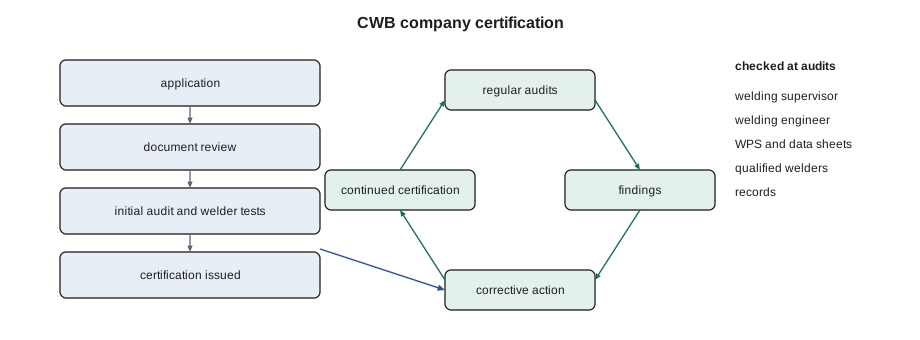
To be certified under W47.1, a company must meet requirements for personnel, procedures and quality. It must have a welding supervisor qualified to the standard, responsible for the welding work and for seeing that procedures are followed. Depending on its division, it must have a welding engineer, on staff or retained, accepted by the CWB and responsible for its procedures. It must have an approved welding procedure specification for each process and accepted data sheets for its joints. Its welders, welding operators and tack welders must be qualified by CWB tests for the processes and positions they use. And it must keep records of all of this and make them available to the CWB.
Getting certified starts with an application and a review of the company's documents, followed by an initial audit at which the CWB checks the personnel, procedures and facilities and tests the welders. Once certified, the company is audited regularly: the CWB's representative visits, checks that the certified personnel are still in place, reviews the procedures in use against the accepted list, checks welder qualifications and their expiry dates, looks at work in progress and records, and witnesses welder tests. Findings must be corrected within set times, and serious ones can lead to suspension.
Welder qualification through the CWB
A CWB welder test is taken with the employer, at its shop or at an accredited test centre, on plates or pipe to the standard's test configurations, witnessed by a CWB representative or an approved examiner. The coupons are bent or examined as required, and a welder who passes receives a qualification for the process, position, joint type and filler classification tested, recorded by the CWB and shown on the welder's card. The qualification is valid for two years and is renewed by a check test before expiry. Welders are qualified in a sequence of positions: flat and horizontal first, then vertical and overhead, and passing the higher-position tests covers the lower ones.
Because the qualification is held within a company's certification, a welder who changes employers takes the record of their tests, and the new employer can have the CWB transfer the qualification, subject to the standard's rules, instead of retesting. Hartwell's office keeps the transfer forms for new hires, and Lucia checks each new welder's record with the CWB before they weld any certified work.
Supervisors, engineers and other roles
W47.1 also qualifies the people who direct welding. A welding supervisor qualifies by experience and by passing CWB examinations on the standard and on welding practice; the supervisor's name is on the company's certification and must be replaced if the supervisor leaves. A welding engineer must be a licensed professional engineer accepted by the CWB, with welding knowledge shown by examination or experience. Elena is Hartwell's accepted welding engineer, and Glen is its qualified welding supervisor. If either left, Hartwell would have to tell the CWB and replace them within a set time to keep its certification.
Other certifications appear on the job too. Pressure equipment work needs the jurisdiction's certificate of authorization and the procedure registrations and pressure welder records discussed in lesson 3. Pipeline work needs qualifications under the pipeline code, held by the pipeline company. Aluminum and rebar have their own standards. A welder's wallet can hold several cards from several schemes, and each one covers only what it says.
Keeping certification current
Certification is a continuous effort. Procedures must be kept current as processes, consumables and codes change; welders must be retested before qualifications expire; key people must stay in place or be replaced; records must be complete; findings must be closed. Hartwell keeps a single schedule that shows every due date in the system, and Glen reviews it at the Monday production meeting.
# Certification due-date schedule: what is due in the next 90 days?
from datetime import date
today = date(2026, 11, 2)
items = [
    # item, owner, due date
    ('CWB check test: R. Haldane, FCAW V and O', 'Lucia', date(2026, 11, 20)),
    ('CWB check test: M. Kowalchuk, SMAW all', 'Lucia', date(2027, 1, 14)),
    ('Annual CWB company audit', 'Glen', date(2026, 12, 3)),
    ('WPDS revision for new flux-cored wire', 'Elena', date(2026, 10, 30)),
    ('Calibration: current and voltage meters', 'Lucia', date(2026, 11, 10)),
    ('Welding supervisor examination: backup supervisor', 'Glen', date(2027, 3, 1)),
    ('ABSA quality program review', 'Elena', date(2027, 6, 12)),
]
horizon = 90
for item, owner, due in sorted(items, key=lambda x: x[2]):
    days = (due - today).days
    if days < 0:
        flag = f'OVERDUE by {-days} days'
    elif days <= horizon:
        flag = f'due in {days} days'
    else:
        continue
print(f"{due} {item:<46} {owner:<8} {flag}")2026-10-30 WPDS revision for new flux-cored wire Elena OVERDUE by 3 days 2026-11-10 Calibration: current and voltage meters Lucia due in 8 days 2026-11-20 CWB check test: R. Haldane, FCAW V and O Lucia due in 18 days 2026-12-03 Annual CWB company audit Glen due in 31 days 2027-01-14 CWB check test: M. Kowalchuk, SMAW all Lucia due in 73 days
The schedule picks out what falls in the next three months and flags the procedure revision for the new flux-cored wire as overdue. Elena had written it but not yet sent it for approval, and the wire had already arrived in the stores. Glen holds the wire in quarantine until the revision is approved, which takes four days. The audit next month would have found the wire in use under an old procedure; the schedule found it first.
Recognition across borders
Canadian and American systems meet often. Canadian fabricators supply steel to American jobs and the reverse, and inspectors cross the border. D1.1 accepts CSA W178.2 Level 2 and 3 inspectors, and many Canadian shops hold both CWB certification and AISC certification so that they can bid on both sides. A Canadian job that specifies AWS D1.1 is still subject to Canadian law for the building, so the fabricator usually still needs CWB certification, and its procedures may need to satisfy both systems. Elena keeps a comparison table of the two codes taped inside her cupboard door.
What certification means for a welder
For Devon, the CWB system means three things. His qualifications are written records, tied to Hartwell's certification, that any employer can check. They expire, so he must keep welding and renew them on time. And they open doors: a welder with current CWB qualifications in all positions, plus pressure qualifications and a Red Seal, is welcome in most shops in the country. Elena's last advice is to keep copies of every test record and card, because a welder's history is worth as much as the welder's hands.
The audit visit
A CWB audit at Hartwell follows a pattern Glen knows well. The representative arrives, meets Glen and Elena, and confirms that the welding supervisor and welding engineer named on the certification are still in place. He asks for the list of accepted procedures and picks several to trace: the data sheet posted at a booth, its acceptance letter, and the work being welded under it. He picks welders at random from the shop floor and checks their qualifications against what they are welding, including the position and the filler. He looks at the rod ovens and the filler storage, at a few inspection records and at the repair log. He may witness welder tests booked for the visit. At the end he reviews his findings with Glen, and any that need correction are written up with a date by which they must be closed.
Auditors are not looking for perfection; they are looking for a system that finds and fixes its own problems. A shop that has found a lapse itself, recorded it and corrected it, with the cause understood, usually gets credit for a working system. A shop that hides problems, or whose records do not match what is on the floor, gets findings that are much harder to close, because the auditor can no longer trust the records.
The quality manual
Behind every certification is a quality manual, the shop's own description of how it controls its work. It names the people responsible and their authority, describes how contracts and drawings are reviewed and controlled, how material is bought, received, identified and traced, how procedures and welders are qualified and controlled, how welding and inspection are done and recorded, how nonconforming work is identified, held and dispositioned, how equipment is calibrated, how people are trained and how records are kept. It also says how the shop audits itself and how management reviews the results. The manual is not a document to impress auditors; it is the shop's rule book, and if the shop does not follow it, the certification means nothing.
Devon reads Hartwell's manual for the first time in this course. Much of it describes things he already does without thinking, such as marking his welder number on every joint and returning electrodes to the oven at break. Seeing them written down, with the reason and the person responsible, makes him understand that his habits are part of a system that lets a customer trust a weld he made months ago.
What certification costs and what it gives
Certification costs money: fees, the time of key people, procedure tests, welder tests, calibration, record keeping and the audits themselves. It gives a shop access to work it could not otherwise bid on, because owners and building codes require it. It also gives the shop a discipline that reduces repairs, rework and disputes, and it gives customers a reason to trust the shop's records without inspecting everything themselves. Glen's view, after twenty years, is that a well-run certification pays for itself in the repairs it prevents, and that the shops that complain most about it are usually the ones that run it worst.
When certification is at risk
Certification can be suspended or withdrawn. The usual reasons are serious audit findings that are not corrected in time, loss of a required person without replacement, welding by unqualified welders or to procedures that were never approved, falsified records, or unpaid fees. A suspended company may not weld work that requires the certification until it is restored, and work already done during a lapse may have to be reinspected or even replaced. For a shop like Hartwell, losing certification in the middle of the Riverside job would stop the bridge, so Glen treats every finding as urgent.
Welders are affected too. A welder whose qualification is withdrawn because of falsified test records, or who welds under another welder's identification, can lose more than a job: certifiers share information, and a welder's record follows them. Elena's last point in this section is plain: the system works only because people tell the truth in it, and the people who weaken it hurt every honest welder who depends on it.
Common mistakes
MistakeThinking a CWB ticket belongs to the welder alone.
InsteadIt exists within the company's certification; a new employer can transfer it under the standard's rules.
MistakeLetting a key person leave without telling the certifier.
InsteadReport the change and replace the person within the set time.
MistakeUsing new consumables before the procedure is revised.
InsteadQuarantine them until the revised procedure is approved.
MistakeMissing a check test or continuity date.
InsteadKeep one schedule of every due date and review it weekly.
MistakeAssuming one country's certification covers the other.
InsteadCheck what the job's jurisdiction requires.
Summary and key terms
- The CWB certifies companies to CSA W47.1 and other standards, and inspectors and inspection organizations to W178.
- Building and bridge codes require CWB-certified fabricators for structural steel.
- Certification requires qualified people, approved procedures, qualified welders and records, and is kept by regular audits.
- CWB welder qualifications last two years and are renewed by check tests.
- Supervisors and engineers have their own qualifications and roles.
- A single schedule of due dates keeps certification current.
- CWB
- The Canadian Welding Bureau, which runs welding certification under CSA standards.
- Company certification
- Certification that a company meets CSA W47.1 for welding of steel.
- Welding supervisor
- The person qualified under W47.1 to direct a company’s welding work.
- Check test
- A test that renews a CWB welder qualification before it expires.
- Audit
- A visit to check that certification requirements are still met.
- Quarantine
- Holding material aside so it cannot be used until it is approved.
Practice problems
Work each problem on paper first, then reveal the answer to check.
Why does a Canadian building fabricator need CWB certification?
Show answer
CSA S16, adopted by the building code, requires fabrication by a company certified to CSA W47.1.
How long is a CWB welder qualification valid?
Show answer
Two years, renewed by a check test.
What must Hartwell do if Glen, its welding supervisor, leaves?
Show answer
Tell the CWB and qualify a replacement within the set time.
Lesson quiz · 5 questions
Score 60% or more to complete this lesson.
Create a free account to save your progress, take quizzes and earn a certificate.