
TRD-101 · Lesson 9 of 12 · 19 min
Confined spaces: recognizing the hazard
Confined spaces kill in a particular way. A worker climbs down into a sewer manhole, a sump pit or a tank to do a quick job. The air looks and smells normal, but it is short of oxygen or full of a toxic gas. The worker collapses within seconds. A co-worker sees what happened and climbs down to help, and collapses too. Investigations of confined space deaths find this pattern again and again, and a large share of the people who die in confined spaces are would-be rescuers who went in without protection.
For plumbers, confined spaces are a regular part of the work: sanitary and storm manholes, sewer connections, sump and ejector pits, crawl spaces, valve chambers, tanks and large-diameter pipe. This lesson teaches Maya to recognize a confined space, to understand why it is dangerous, and to know that she must never enter one, or reach into one, without a permit, testing and the people and equipment the plan requires. Lesson 10 covers testing the atmosphere in more detail.
What counts as a confined space
In Ontario, confined spaces on construction projects are covered by the Confined Spaces regulation (O. Reg. 632/05). It defines a confined space as a fully or partially enclosed space that is not both designed and constructed for continuous human occupancy, and in which atmospheric hazards may occur because of its construction, location or contents or because of the work done in it. The definition turns on the atmosphere: a space that is enclosed but where no atmospheric hazard could develop is not a confined space under the regulation, although it may still be hazardous in other ways.
| Space on Kingsway Tower | Why it may be a confined space | Main hazards |
|---|---|---|
| Sanitary manhole at the street connection | Enclosed, entered from the top by ladder, not designed for occupancy | Hydrogen sulfide and methane from sewage, low oxygen, biological hazards, flowing water |
| Sump pit and sewage ejector pit in the lower parking level | Below grade, limited access, collects water and gases | Low oxygen, hydrogen sulfide, drowning, pumps that start automatically |
| Storm water storage tank under the ramp | Large enclosed tank with a single hatch | Low oxygen from rusting steel or decaying material, engulfment by water, coatings and solvents during repair |
| Crawl space under the existing building being renovated next door | Low, enclosed, limited exits | Low oxygen, mould, sewage leaks, pests, difficult rescue |
| Large ductwork and plenum spaces | Enclosed, may have limited exits | Fumes from work inside, moving fans, heat |
| Elevator pit | Below the lowest landing | May be treated as a confined space if water, fumes or gases can collect |
Not every awkward space is a confined space, and Maya does not have to decide on her own. Under Ontario's regulation, each employer whose workers may enter a confined space must have a written program, and a competent person must assess the hazards of each confined space and prepare a written plan before anyone enters. On a construction project, the constructor must coordinate when more than one employer's workers may enter the same space. On Kingsway Tower, Stonebridge has identified the confined spaces on the site, marked them with signs and keeps their covers closed or locked.
Why the air can kill
The air we breathe is about 21 percent oxygen. In a confined space, the atmosphere can change in ways that are invisible and often odourless. Three kinds of atmospheric hazard cause most confined space deaths.
| Hazard | How it happens | Why it is dangerous |
|---|---|---|
| Oxygen deficiency | Oxygen is used up by rusting steel, decaying organic material, bacteria in sewage or burning; or displaced by another gas such as nitrogen, argon, carbon dioxide or methane | Below about 19.5 percent, judgment and coordination suffer; at much lower levels a person can collapse after one or two breaths |
| Oxygen enrichment | A leak from an oxygen cylinder or hose, often during cutting or welding | Materials, including clothing, catch fire easily and burn fiercely |
| Flammable atmosphere | Methane from sewage, natural gas or propane leaks, solvent vapour from coatings, adhesives and cleaners | A spark, a hot tool or static can ignite it |
| Toxic atmosphere | Hydrogen sulfide from sewage, carbon monoxide from engines and heaters, fumes from welding, solvents and cleaning products | Can cause collapse, lung damage or death; hydrogen sulfide deadens the sense of smell at higher concentrations |
Hydrogen sulfide deserves special mention for plumbers, because sewers and sewage pits are full of it. At low concentrations it smells like rotten eggs, but at higher concentrations it paralyses the sense of smell, so a worker may think the smell has gone away just as the gas becomes deadly. You can never rely on your nose to judge a confined space.
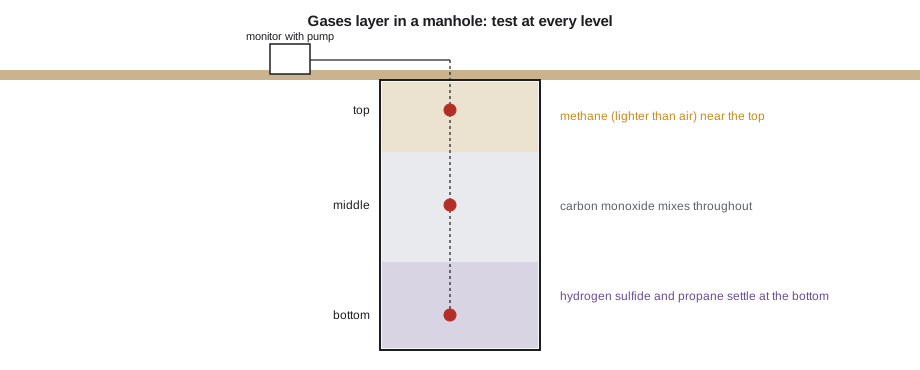
Gases also layer according to their weight. Hydrogen sulfide and propane are heavier than air and collect at the bottom of a pit; methane is lighter and collects at the top of a manhole or chamber; carbon monoxide mixes roughly evenly. A test taken only at the opening can miss a deadly layer a metre or two down. That is why testing is done at several levels, top, middle and bottom, before entry and continuously during the work.
Other confined space hazards
The atmosphere is the hazard that kills most often, but not the only one. Engulfment means being trapped or buried by water, sewage, sand, grain or other material; a pump that starts or a valve that opens upstream can flood a pit in minutes. Mechanical hazards include agitators, pumps and fans that can start automatically. Electrical hazards include pumps and controls in sump pits. Temperature extremes, noise that prevents communication, poor lighting, slippery surfaces, falling objects through the opening and the difficulty of getting an injured worker out all add to the risk. A confined space plan must deal with every one of these, which usually means locking out pumps and valves (lesson 7), as well as testing and ventilating the air.
The permit and the plan
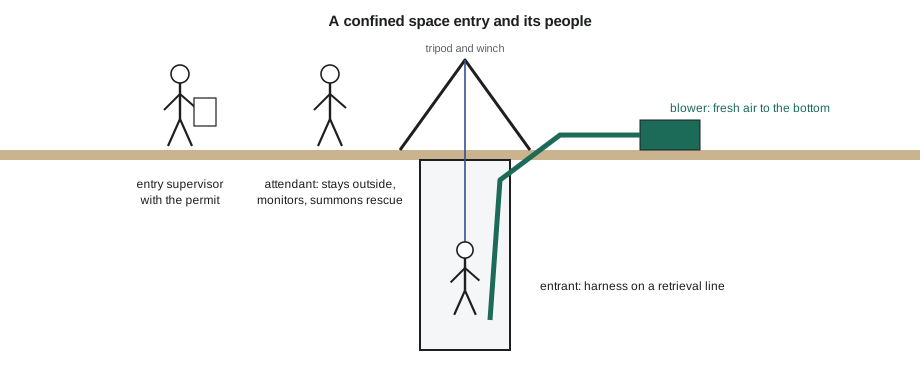
Before anyone enters a confined space on an Ontario construction project, the employer must have a written plan for that space, prepared by a competent person, and an entry permit must be issued for each entry. The permit records the space, the work, the hazards and controls, the people involved, the test results, the rescue arrangements and the time period. An attendant must be stationed outside the space whenever a worker is inside, and rescue procedures must be ready to put into effect immediately. Every worker involved must be trained in the hazards, the plan and their role.
| Role | Responsibilities |
|---|---|
| Entrant | Knows the hazards and signs of exposure; uses the equipment; stays in contact with the attendant; leaves immediately when told to, when an alarm sounds or when they notice any sign of danger |
| Attendant | Stays outside the space for the whole entry; keeps count of entrants; monitors conditions inside and outside; keeps unauthorized people away; calls rescue and orders evacuation; never enters to attempt a rescue |
| Entry supervisor | The competent person who checks the permit conditions are met before signing, authorizes entry, and ends the entry if conditions change |
| Rescue team | Trained and equipped to rescue from this space, and able to arrive in time; may be on-site or an outside service that has agreed in advance |
Maya is not trained to enter confined spaces yet and will not be for some time. Her job, as a first-year apprentice, is to recognize them, keep out, and never help someone else enter without a permit. But she may be asked to help with an entry in another role, such as fetching equipment, and she will see entries happening on the site. Knowing how one should look helps her spot one that is going wrong.
Never become the second victim
The single most important rule in this lesson is that nobody enters a confined space to rescue someone unless they are part of the trained, equipped rescue team for that space. When a worker collapses in a pit, every human instinct says to climb in and pull them out. If the air knocked them down, it will knock you down too, usually faster, because you will be working hard and breathing heavily. The attendant calls for rescue and, if the entrant is wearing a harness attached to a retrieval system, starts a non-entry rescue by winching them out from the surface.
Non-entry rescue is the reason entrants into vertical spaces wear a full-body harness attached to a retrieval line on a tripod or davit arm over the opening. It lets the attendant lift the entrant out without anyone going in. Where that is not possible, the rescue team enters with supplied-air or self-contained breathing apparatus.
Spotting an unsafe entry
One afternoon at Kingsway Tower, Maya was walking past the ejector pit in the lower parking level and saw a worker from another trade lifting the cover off with a pry bar. His partner had a drop light and a pail. There was no tripod, no gas monitor, no blower and no permit board. She did not know whether they had a permit, but she knew what an entry should look like. She asked them, politely, whether they had a confined space permit for the pit, and when they said they were only going to reach in and grab a fallen tool, she told them the pit was a marked confined space and called Anika. Anika stopped the work; the tool was retrieved later the same day under a permit, after the pit tested low in oxygen.
Reaching in or putting your head into a confined space can be as dangerous as climbing in. A worker who leans into a pit with low oxygen can collapse and fall in. Nothing goes into a marked confined space, not a head, not an arm, without the plan.
Spaces the work itself makes dangerous
Some spaces become dangerous only because of the work being done in or near them. Plumbers and pipefitters regularly use gases that displace oxygen: nitrogen to purge and pressure-test lines, argon and carbon dioxide as shielding gases for welding, and the purging of new gas piping releases fuel gas. In a small mechanical room, a pipe chase or a pit, a leak or a careless purge can drop the oxygen level quickly. Running a gas-powered pump, heater or saw in an enclosed area produces carbon monoxide. Applying coatings, adhesives or sealants inside a tank or vault fills it with solvent vapour.
| Work activity | How it can create an atmospheric hazard | Control |
|---|---|---|
| Purging new gas piping | Fuel gas released indoors creates a flammable atmosphere | Purge to the outdoors or through approved equipment; monitor the area; no ignition sources |
| Nitrogen pressure testing | Nitrogen displaces oxygen in small rooms and pits | Vent to outdoors; monitor oxygen; limit cylinder size in small spaces |
| Welding with shielding gas in a pit | Argon or carbon dioxide settles and displaces oxygen | Ventilation, continuous oxygen monitoring, confined space plan |
| Gas-powered pump in a parking level | Carbon monoxide builds up | Use electric equipment indoors, or ventilate and monitor CO |
| Coating the inside of a tank | Solvent vapour reaches flammable and toxic levels | Confined space plan with ventilation, monitoring and controlled ignition sources |
The lesson for Maya is that the question is not only whether a space is on Stonebridge's list of confined spaces, but also whether the work she is about to do could change the air in the space she is in. If it could, she raises it before starting, and the crew adds ventilation and monitoring to its hazard assessment.
Common mistakes
MistakeJudging the air in a pit or manhole by how it smells or looks.
InsteadNever rely on your senses; only testing with a calibrated monitor can tell you.
MistakeTesting only at the opening.
InsteadTest at the top, middle and bottom, because gases layer by weight.
MistakeClimbing in to help a co-worker who has collapsed.
InsteadCall for rescue and use the retrieval system; only the trained, equipped rescue team enters.
MistakeReaching into a confined space for a quick job.
InsteadNothing goes into a confined space without the permit, testing and attendant.
Summary and key terms
- Ontario's Confined Spaces regulation covers enclosed spaces not designed for continuous occupancy where atmospheric hazards may occur.
- Plumbers meet confined spaces in manholes, sumps, ejector pits, tanks, crawl spaces and vaults.
- Oxygen deficiency, flammable gases and toxic gases such as hydrogen sulfide cause most deaths.
- Hydrogen sulfide deadens the sense of smell; never rely on your nose.
- Gases layer by weight, so testing is done at the top, middle and bottom.
- Entry needs a written plan, a permit, testing, an attendant, rescue arrangements and trained workers.
- Never enter to rescue unless you are part of the trained, equipped rescue team.
- Confined space
- Under Ontario law, an enclosed or partly enclosed space not designed for continuous occupancy where atmospheric hazards may occur.
- Permit-required confined space
- A confined space with a serious hazard such as a hazardous atmosphere, engulfment or entrapment.
- Entrant
- A worker authorized to enter a confined space.
- Attendant
- A trained worker stationed outside a confined space who monitors the entrants and summons rescue.
- Entry permit
- A written authorization for a specific entry, recording hazards, controls, tests, people and rescue arrangements.
- Engulfment
- Being surrounded and trapped by liquid or loose material.
- Non-entry rescue
- Retrieving an entrant from outside the space, usually with a harness, retrieval line and winch.
Practice problems
Work each problem on paper first, then reveal the answer to check.
Why is hydrogen sulfide especially dangerous to plumbers?
Show answer
It is common in sewers and sewage pits, it is toxic, and at higher concentrations it deadens the sense of smell.
Where would you expect to find methane and where hydrogen sulfide in a manhole?
Show answer
Methane near the top because it is lighter than air; hydrogen sulfide near the bottom because it is heavier.
What does the attendant do if an entrant collapses?
Show answer
Calls for rescue, starts non-entry retrieval if possible, keeps others out, and does not enter.
Name three things Maya would expect to see at a properly prepared manhole entry.
Show answer
A posted permit, a gas monitor, a ventilation blower, a tripod with a retrieval line, an attendant and barricades.
Is leaning into a sump pit for a few seconds safe if you hold your breath?
Show answer
No; nothing goes into a confined space without the plan, testing and attendant.
Lesson quiz · 5 questions
Score 60% or more to complete this lesson.
Create a free account to save your progress, take quizzes and earn a certificate.