
TRD-101 · Lesson 12 of 12 · 19 min
First aid, emergencies and reporting
Every lesson so far has been about preventing harm. This last lesson is about what happens when prevention fails: a worker is hurt, a fire starts, a chemical spills, someone collapses. In the first minutes of an emergency, the people on the spot make the difference, and on a construction site those people are usually co-workers, not paramedics. The lesson then closes the loop with reporting and investigation, the habits that turn each incident and near miss into a lesson for the whole site, and a review of what Maya has learned in her first months.
First aid on a construction site
In Ontario, first aid requirements for most workplaces, including construction projects, are set out in Regulation 1101 under the Workplace Safety and Insurance Act and administered by the WSIB. Employers must provide a first aid station with a kit sized to the number of workers, post the WSIB first aid poster, keep a record of first aid given, and have workers with valid first aid certificates on each shift; the level of training required depends on the number of workers per shift. Since January 1, 2026, Ontario has also required construction projects with 20 or more workers that are expected to last three months or more to have an automated external defibrillator (AED) on site, maintained and readily accessible, with at least one worker trained in CPR and its use. Other provinces set their own first aid rules, often based on the CSA first aid standards.
| First aid resource on Kingsway Tower | Where and who |
|---|---|
| First aid station and main kit | Stonebridge trailer, with a smaller kit in each trade's gang box on every active floor |
| Trained first aiders | At least one in every crew on every shift; names on the board at the hoist on each floor |
| AED | At the site trailer and at the hoist landing on the podium level, checked weekly |
| Eyewash stations | At the hoist landing on every floor and beside the chemical storage area |
| Emergency phone numbers and site address | Posted at the trailer, at every hoist landing and on the back of every worker's orientation card |
| Stretcher and rescue equipment | In the trailer; fall rescue kits on every floor (lesson 5) |
Maya completed a first aid and CPR course in her pre-apprenticeship program, and Northbridge will keep her certificate current. Even workers who are not designated first aiders should know where the kits, eyewash and AED are, how to call for help, and the basics of what to do until help arrives.
Responding to an injury
Every first aid course teaches a sequence, and the first step is the one people most often skip: make sure the scene is safe before you approach. A worker lying at the bottom of a ladder may have fallen because of an electrical shock from a cord that is still live; a worker collapsed in a pit is in an atmosphere that will overcome a rescuer (lesson 9).
| Step | What to do |
|---|---|
| 1. Check the scene | Look for ongoing hazards: electricity, moving equipment, falling objects, gas, fire. Do not become a second casualty. |
| 2. Call for help | Shout for the nearest first aider; have someone call 911 and send someone to meet the ambulance at the site gate |
| 3. Check the person | Are they responsive? Breathing normally? Bleeding severely? |
| 4. Give first aid within your training | CPR and the AED for someone not breathing normally; firm pressure on severe bleeding; keep them still if a spinal injury is possible; treat for shock |
| 5. Stay with them | Keep them warm and reassured until the first aider or paramedics take over |
| 6. Report | Tell your supervisor; the injury and the first aid given are recorded |
When you call 911 from a construction site, the dispatcher needs to know exactly where to send the ambulance, and a large site can be confusing to find. Kingsway Tower's emergency card gives the street address of the site gate, the cross street, and a reminder to send a worker to the gate to guide paramedics to the right floor. The hoist is reserved for the paramedics as soon as an emergency is called.
| Common injury | First aid basics |
|---|---|
| Severe bleeding | Firm, direct pressure with a clean dressing; do not remove it if blood soaks through, add more on top; call 911 |
| Chemical in the eyes | Flush at the eyewash for at least 15 minutes, holding the eyelids open; check the SDS; get medical care |
| Burns from hot pipe or torch | Cool with cool running water for at least 10 minutes; remove rings and watches before swelling; cover loosely; get medical care for larger or deeper burns |
| Electrical shock | Do not touch until the power is off; check breathing; CPR and AED if needed; always get medical assessment |
| Suspected spinal injury after a fall | Do not move the person unless they are in immediate danger; keep the head and neck still; call 911 |
| Heat exhaustion | Move to shade, loosen clothing, give water if alert; if confused or not sweating, treat as heat stroke: call 911 and cool aggressively |
Fires
Fires on construction sites start most often from hot work, such as soldering, brazing, welding and cutting, from temporary heating, from electrical faults, and from smoking. Buildings under construction are especially vulnerable because fire separations, sprinklers and alarms are not yet in service, and wood framing, packaging and waste are everywhere.
Hot work on Kingsway Tower needs a permit from Stonebridge. The permit requires the area within a set distance to be cleared of combustibles or protected with fire blankets, a suitable fire extinguisher at hand, and a fire watch who stays during the work and for a period after it ends, typically 30 to 60 minutes, because smouldering fires in insulation or wood can take time to show. Maya often serves as Luis's fire watch when he solders near wood framing.
| Extinguisher type | Use on |
|---|---|
| ABC dry chemical (most common on sites) | Ordinary combustibles, flammable liquids and electrical equipment |
| Water | Ordinary combustibles only; never on electrical or flammable liquid fires |
| Carbon dioxide | Electrical equipment and flammable liquids; good in mechanical rooms |
| Class K | Cooking oils and fats; not usually on construction sites |
To use an extinguisher, remember PASS: pull the pin, aim at the base of the fire, squeeze the handle, sweep from side to side. Fight a fire only if it is small, you have the right extinguisher, you have a clear exit behind you, and someone has raised the alarm. If any of these is not true, get out and leave it to the fire department.
The emergency plan
Every site needs an emergency response plan, and every worker needs to know their part in it. Kingsway Tower's plan covers fire, serious injury, structural collapse, gas leak, chemical spill and severe weather, and it is reviewed at orientation and practised in drills.
| Element | On Kingsway Tower |
|---|---|
| Alarm | Three long blasts on an air horn, repeated on each floor by the foreman; radio announcement |
| Evacuation routes | Both stair towers; never the hoist unless directed |
| Muster point | The parking lot across the street, away from the building and the crane's swing |
| Headcount | Each foreman counts their crew against the daily sign-in sheet and reports to Anika |
| Calling for help | Anika or the senior Stonebridge person calls 911 and meets responders at the gate |
| Special hazards | Information for responders on gas cylinders, fuel storage, confined spaces and the crane |
| Rescue | Fall rescue kits on every floor; confined space rescue by the contracted rescue team (lesson 9) |
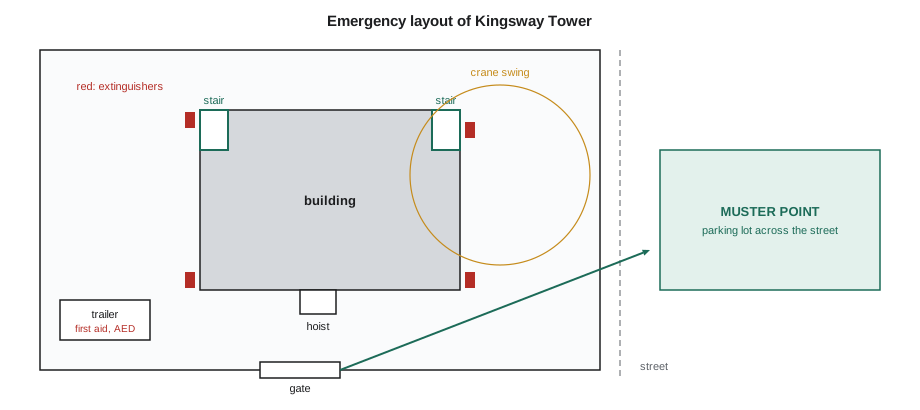
Signing in and out every day may feel like paperwork, but it is what makes the headcount work. If a crew of six is at the muster point and the sign-in sheet says seven, the fire department needs to know immediately that someone may still be in the building, and where they were working.
Spills
Small spills of products such as solvent cement, cutting oil or cleaners are part of mechanical work. The SDS, section 6, describes how to clean up each product. Most sites keep spill kits with absorbent pads, granules and bags near chemical storage. The response is: stop the source if it is safe to do so, keep people away, ventilate if the product gives off vapour, remove ignition sources for flammable products, absorb and collect the spill with the right material and PPE, dispose of it as the SDS directs, and report it. A large spill, a spill of something you do not recognize, or any spill that reaches a drain is reported immediately for a trained response, because it may also be an environmental release that the employer must report.
Reporting incidents and near misses
Lesson 2 explained why every injury must be reported. Near misses matter just as much. A near miss is an event that could have caused injury or damage but did not: a hammer that fell from the floor above and landed a metre from someone, a worker who slipped on a stair but caught the rail, a cover that moved underfoot. The difference between a near miss and a serious injury is often luck. Sites that collect and act on near-miss reports fix hazards before they hurt someone.
| Report | Example | What happens |
|---|---|---|
| Hazard | A guardrail clamp is loose on the eighth floor | Fixed the same day; noted in the inspection log |
| Near miss | A piece of strapping fell from the tenth floor into the walkway | Investigated: toe boards added where missing; overhead protection extended over the walkway |
| First aid injury | A cut finger from a pipe end | First aid given and recorded; deburring tool added to the gang box |
| Medical aid or lost-time injury | A sprained ankle from a stair needing a doctor's visit | Reported to the WSIB; investigated; stair repaired and lighting improved |
| Critical or serious injury | A fall through an opening | Ministry notified immediately; scene preserved; full investigation |
A good investigation asks why the incident happened, not who is to blame. The strapping fell because it was left near an edge without a toe board, because the toe boards had been removed to land a load and not replaced, because the procedure for landing loads did not say who replaces them. Each answer points to a fix. If the investigation stops at "worker was careless", nothing changes and the same thing happens next month.
Looking back on the first months
By the end of her first season, Maya has used almost everything in this course. She has learned the site's hazards and rules, used her right to refuse once and her right to participate several times, read labels and SDSs for every product she uses, filled out a hazard card every morning, worked behind guardrails and tied off on the roof, set up ladders and rolling scaffolds properly, put her own lock on equipment, protected herself from electricity and silica, recognized confined spaces and stayed out of them, chosen the right PPE and served as a fire watch.
| Lesson | The habit Maya takes from it |
|---|---|
| 1. First days | Ask before acting; keep people and machines apart; clean as she goes |
| 2. Rights and duties | Report hazards; refuse unsafe work through the proper process; report every injury |
| 3. WHMIS | Read the label and SDS before using a new product; never use unlabelled containers |
| 4. Hazards and planning | Scan up, down, around and at herself; a control for every hazard; stop when things change |
| 5. Fall protection | Guardrails and covers first; rated anchors only; check clearance and rescue |
| 6. Access equipment | Platforms over ladders; 4 to 1, three points of contact; check the scaffold tag |
| 7. Lockout | Identify every energy source; her own lock; always verify |
| 8. Electricity | Test the GFCI; inspect cords; scan before coring; jumper before cutting metal pipe |
| 9. Confined spaces | Recognize them, stay out without a permit, never become the second victim |
| 10. Air hazards | Control dust and fumes at the source; trust the monitor, not her nose |
| 11. PPE | Right type, right fit, good condition, worn throughout |
| 12. Emergencies | Scene safety first; know the plan; report near misses |
The next courses in the Skilled Trades stream build on this foundation with tools, trade mathematics, blueprint reading and the skills of each trade. Safety does not stop being a topic after this course; it becomes part of how every task is taught. Maya's foreman put it simply on her first day: the job is not done until everyone goes home in the same condition they arrived.
Common mistakes
MistakeRushing to help an injured co-worker without checking for hazards.
InsteadCheck the scene first; do not become a second casualty.
MistakeFighting a fire that is already spreading.
InsteadFight only small fires with the right extinguisher and a clear exit; otherwise evacuate.
MistakeLeaving without signing out.
InsteadSign in and out every day so headcounts in an emergency are accurate.
MistakeNot reporting a near miss because nobody was hurt.
InsteadReport it; near misses show where the next injury will happen.
Summary and key terms
- Ontario's Regulation 1101 sets first aid stations, kits, records and trained first aiders; since January 2026, larger construction projects need an AED.
- Respond to injuries in order: check the scene, call for help, check the person, give first aid within your training, stay with them, report.
- Flush chemical eye splashes for at least 15 minutes and cool burns with running water.
- Hot work needs a permit, an extinguisher and a fire watch that continues after the work ends.
- Use an extinguisher with PASS, and only on small fires with a clear exit.
- Know the alarm, routes, muster point and headcount; sign in and out every day.
- Report hazards, near misses and injuries, and investigate for causes, not blame.
- First aider
- A worker with a valid first aid certificate designated to give first aid on a shift.
- AED
- An automated external defibrillator, which checks the heart rhythm and delivers a shock if needed.
- Fire watch
- A worker who watches for fire during and after hot work, with an extinguisher ready.
- Hot work permit
- Written authorization for work involving flames or sparks, with required precautions.
- PASS
- Pull, aim, squeeze, sweep: the steps for using a fire extinguisher.
- Muster point
- The assembly area where workers gather after evacuating for a headcount.
- Near miss
- An event that could have caused injury or damage but did not.
Practice problems
Work each problem on paper first, then reveal the answer to check.
What is the first step in responding to an injured worker?
Show answer
Check the scene for ongoing hazards so you do not become a casualty.
How long should an eye splashed with a chemical be flushed?
Show answer
At least 15 minutes, holding the eyelids open, then get medical care.
Why does a fire watch stay after hot work ends?
Show answer
Smouldering fires in insulation or wood can take time to appear.
Why does signing in and out matter in an emergency?
Show answer
It lets foremen confirm everyone is out and tells responders if someone is missing and where they were working.
A hammer falls from an upper floor and lands near a walkway. What kind of report is this and why does it matter?
Show answer
A near miss; investigating it finds the cause, such as missing toe boards, before someone is hurt.
Lesson quiz · 5 questions
Score 60% or more to complete this lesson.
Create a free account to save your progress, take quizzes and earn a certificate.