
TRD-101 · Lesson 5 of 12 · 18 min
Fall protection: edges, openings and harnesses
Falls are the biggest single cause of traumatic deaths in construction. Many fatal falls are from surprisingly low heights: a worker steps backward off the edge of a slab, falls through a skylight or an uncovered opening, or loses balance on a ladder only a few rungs up. A fall of three metres onto concrete can kill. This lesson covers the basics every worker needs on a site like Kingsway Tower, where open floor edges, openings for shafts and pipe sleeves, and work at height are part of nearly every day. Lesson 6 covers ladders, scaffolds and elevated platforms.
HSE-212, Working at Heights and Fall Protection, in the Safety Training stream, goes much deeper into equipment, anchors and rescue. Here the focus is what a new worker must recognize, use and check.
When fall protection is required
In Ontario, the construction regulation requires fall protection where a worker could fall 3 m or more, and at lower heights where a fall could be especially dangerous: into operating machinery, into water or another liquid, onto or into a hazardous substance or object, or through an opening in a work surface. Guardrails are required at many open edges at lower heights still. Other provinces use similar triggers, most often 3 m. Ontario also requires every worker on a construction project who may use a fall protection system to complete working at heights training from an approved provider, and the training must be refreshed every three years.
| Situation on Kingsway Tower | Fall hazard | Protection |
|---|---|---|
| Perimeter of upper floors before the walls go in | A full storey or more, up to about 40 m | Perimeter guardrails installed by the formwork contractor and kept in place |
| Mechanical and elevator shafts | Down the shaft, potentially many storeys | Guardrails around shafts; shaft openings closed when not in use |
| Small openings for pipe sleeves and drains | A foot or leg through the hole; tripping; objects falling through | Secured, marked covers strong enough to support the load |
| Excavation edge at grade | About 7 m into the parking excavation | Perimeter fence and guardrails set back from the edge |
| Roof during vent pipe installation | Off the roof edge | Roof guardrails, or a warning line and harness system under the roofers' plan |
| Rolling scaffold in a suite | Under 3 m | Guardrails on the platform (lesson 6) |
Guardrails: the first choice
Lesson 4 introduced the hierarchy of controls. For falls, it means the first choice is always to eliminate the hazard, for example by doing the work at ground level, and the next is a guardrail or cover that prevents a fall without anyone having to do anything. Guardrails protect everyone in the area, all the time, whether they have been trained or not and whether they are paying attention or not. That is why Kingsway Tower's fall protection plan relies on guardrails on every floor edge and shaft, and on covers for every opening.
A guardrail system has a top rail at about waist height, an intermediate rail halfway down, and a toe board at the bottom to stop tools and materials from being kicked off the edge. Ontario's regulation sets the top rail between 0.9 m and 1.1 m above the surface, requires an intermediate rail and a toe board, and sets the loads the system must resist. Other provinces set similar dimensions. Guardrails on Kingsway Tower are engineered systems clamped to the slab edge, inspected daily by the formwork contractor and checked by Anika on her walks.
The biggest problem with guardrails on construction sites is not their design but their removal. Trades take sections down to land materials from the crane, to install windows or to run pipe, and do not always put them back. Kingsway Tower's rule is that a guardrail can only be removed by a worker who is protected by another system, such as a harness tied off to an anchor, while the guardrail is down; the opening must be attended or barricaded while it is open; and the person who removed the guardrail replaces it before leaving the area. A missing guardrail is reported immediately, and nobody works near the edge until it is back.
Openings and covers
Openings in floors and roofs cause many falls because they are easy to miss, especially when covered with loose plywood that looks like part of the floor. Ontario requires openings to be protected by guardrails or by covers that are secured in place, strong enough for any load likely to be put on them, and clearly identified. On Kingsway Tower, every opening cover is plywood or steel, screwed or blocked so it cannot slide, painted orange and stencilled with the words DANGER and OPENING.
The most common mistake with covers is moving one to get access and then not putting it back properly. Maya's first lesson about covers came when she needed to drop a pipe through a sleeve opening. Luis showed her how to remove the screws, slide the cover only far enough for the pipe, stand so she could not step into the hole, and screw the cover back down as soon as the pipe was through. If an opening has to stay open, it is guarded with a guardrail or barricade, never left with a loose cover or no protection.
Personal fall arrest: the ABCs
Where guardrails or covers cannot be used, workers use personal fall protection. There are two kinds. Travel restraint holds a worker back so they cannot reach the edge at all: a harness and a short lanyard attached to an anchor set back from the edge. Fall arrest lets the worker reach the edge but stops them if they fall. Restraint is always preferred, because a worker in restraint never falls; a worker in fall arrest falls and depends on the equipment, the clearance and the rescue.
A personal fall arrest system has several parts, often remembered as the ABCs, and every part must be right for the system to work.
| Letter | Component | What to know |
|---|---|---|
| A | Anchorage | A secure point strong enough to hold a fall, typically rated at 22 kN (about 5,000 lbf) or designed by an engineer; never a pipe, conduit, guardrail or ladder rung |
| B | Body harness | A full-body harness meeting CSA Z259.10, adjusted to fit snugly, with the back D-ring between the shoulder blades |
| C | Connector | An energy-absorbing lanyard or self-retracting device that links the harness to the anchor, with locking snap hooks or carabiners |
| D | Descent and rescue | A plan and equipment to get a fallen worker down quickly; required before anyone works in fall arrest |
| E | Education | Training on the equipment, the site plan and the hazards before using the system |
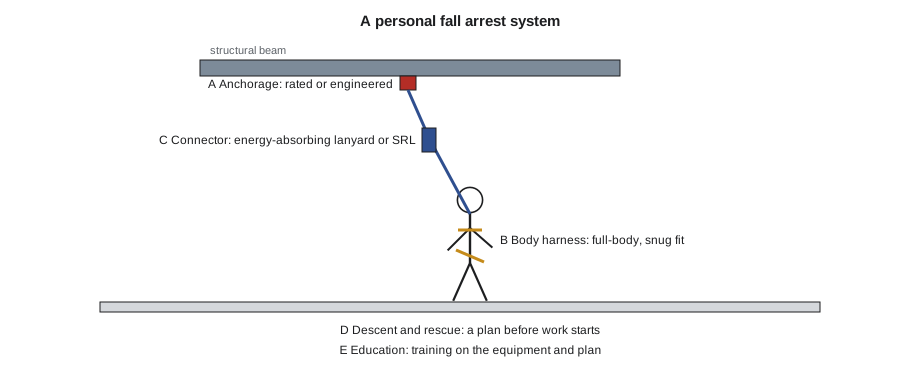
Equipment for fall protection in Canada is covered by the CSA Z259 series of standards, for example Z259.10 for harnesses, Z259.11 for energy absorbers and lanyards, and Z259.2.2 for self-retracting devices. Ontario's regulation also limits how far a worker may fall before the system starts to stop them and how much force the system may apply to the body; in practice that means an energy-absorbing lanyard or self-retracting device and an anchor at or above the D-ring wherever possible.
Fall clearance
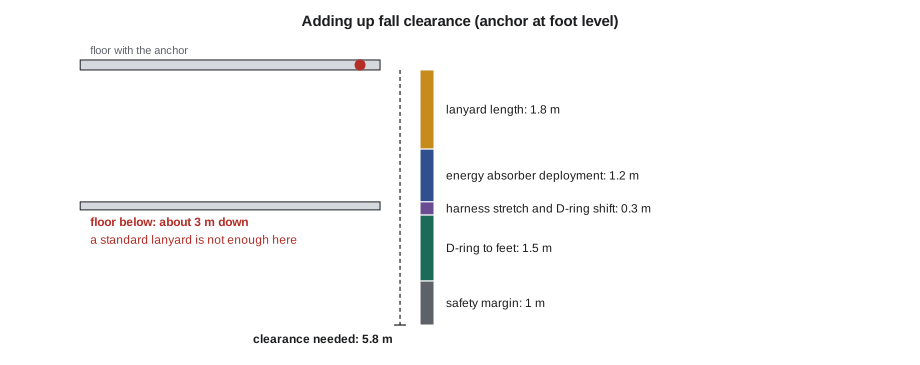
A fall arrest system takes distance to stop a fall. The lanyard pays out, the energy absorber tears open, the harness stretches, and the worker's body hangs below the anchor. If there is not enough clear space below, the worker hits the floor or an obstruction before the system stops them. Calculating the clearance needed is part of choosing the right connector.
# Total fall clearance needed below the anchor for a lanyard at foot level
lanyard = 1.8        # lanyard length
decel = 1.2          # maximum deployment of the energy absorber
d_ring_shift = 0.3    # harness stretch and D-ring movement
worker = 1.5          # D-ring to the worker's feet
margin = 1.0          # safety margin
needed = lanyard + decel + d_ring_shift + worker + margin
print(f"Clearance needed below the anchor: {needed:.1f} m")
available = 4.0       # anchor to the floor below
print("Enough clearance" if available >= needed else "Not enough clearance: use a self-retracting device or restraint")Clearance needed below the anchor: 5.8 m Not enough clearance: use a self-retracting device or restraint
With a 1.8 m lanyard anchored at foot level, a worker needs nearly 6 m of clear space below the anchor. On a typical floor of Kingsway Tower, the next floor down is only about 3 m away, so a standard lanyard anchored at the floor would let the worker hit the floor below. That is why the site plan calls for self-retracting devices, which lock within a short distance, or restraint, wherever workers tie off near a floor edge. Anchoring overhead also reduces the clearance needed.
Inspecting a harness
Fall protection equipment must be inspected by the user before every use and by a competent person at regular intervals, usually at least once a year. Any equipment that has arrested a fall, or shows damage, is removed from service immediately. Maya's harness check takes about two minutes.
| Part | What Maya looks for |
|---|---|
| Label | Present and readable, with the standard, date of manufacture and inspection record |
| Webbing | Cuts, frays, burns, holes, chemical damage, paint, stiffness or broken stitching; bend the webbing in a U to expose small cuts |
| Hardware | D-rings, buckles and adjusters free of cracks, sharp edges, rust and distortion; buckles that work smoothly |
| Fall indicator | Not deployed; a deployed indicator means the harness or lanyard has arrested a fall |
| Lanyard and energy absorber | No cuts or fraying; the absorber pack intact and not opened; snap hooks lock and close fully |
| Self-retracting device | Line retracts smoothly and locks when pulled sharply; housing undamaged |
Fit matters as much as condition. A loose harness can let the worker slip out during a fall or cause injury when it tightens. Leg straps should allow a flat hand between the strap and the leg, the chest strap should sit at mid-chest, and the back D-ring should sit between the shoulder blades.
Rescue and suspension
A worker who falls and is caught by a harness is not yet safe. Hanging motionless in a harness can cause suspension trauma, in which blood pools in the legs and the worker can lose consciousness and suffer serious harm within minutes. Every site where workers use fall arrest needs a rescue plan before the work begins: who will rescue, with what equipment, and how quickly. On Kingsway Tower, the plan uses a pre-rigged rescue kit on each floor and a telehandler or ladder where it can reach, with the emergency services called at the same time.
If a worker is suspended, they should try to relieve the pressure by pushing against a structure or standing in suspension relief straps, which many harnesses now carry in small pouches. Workers who use fall arrest are trained to deploy these straps. After rescue, a worker who has been suspended needs medical assessment even if they feel fine.
Common mistakes
MistakeTying off to a pipe, conduit or guardrail because no anchor is nearby.
InsteadUse only rated anchors; stop and ask for one if none is available.
MistakeRemoving a guardrail and leaving the opening unprotected.
InsteadRemove guardrails only when protected by another system, attend or barricade the opening, and replace the guardrail before leaving.
MistakeUsing a standard lanyard anchored at foot level one storey above a floor.
InsteadCheck the clearance; use a self-retracting device, overhead anchor or restraint.
MistakeWorking in fall arrest without a rescue plan.
InsteadKnow who will rescue you, with what equipment and how fast, before you start.
Summary and key terms
- Ontario requires fall protection at 3 m, or lower where a fall would be especially dangerous, and working at heights training renewed every three years.
- Guardrails and secured, marked covers are the first choice because they protect everyone without any action.
- Whoever removes a guardrail protects the opening and replaces the guardrail before leaving.
- Travel restraint prevents a fall; fall arrest stops one and needs clearance and rescue.
- A fall arrest system needs a rated anchor, a full-body harness, a suitable connector, a rescue plan and training.
- Fall clearance adds lanyard length, deceleration, harness stretch, worker height and a margin.
- Inspect harnesses before every use, and remove any equipment that has arrested a fall.
- Guardrail system
- A barrier of top rail, intermediate rail and toe board that prevents falls from an edge.
- Travel restraint
- A system that prevents a worker from reaching a point where a fall could occur.
- Fall arrest
- A system that stops a fall after it has started.
- Anchorage
- A secure point of attachment for fall protection, strong enough to hold a fall.
- Energy absorber
- A component that limits the force on the body by tearing or extending during a fall.
- Self-retracting device
- A connector that pays out and retracts a line and locks quickly in a fall.
- Suspension trauma
- A dangerous condition in which a worker hanging motionless in a harness loses consciousness as blood pools in the legs.
Practice problems
Work each problem on paper first, then reveal the answer to check.
Why are guardrails preferred over harnesses?
Show answer
They protect everyone in the area without requiring training, equipment or any action, and nobody falls.
Maya finds a piece of loose plywood over a sleeve opening. What should she do?
Show answer
Not step on it; secure and mark it or report it so it is replaced with a proper cover, and keep others away meanwhile.
What are the parts of a personal fall arrest system?
Show answer
Anchorage, body harness, connector, descent and rescue plan, and education.
Why might a standard lanyard be unsafe one storey above a floor?
Show answer
The total fall clearance needed is more than the distance to the floor below.
What should happen to a harness whose fall indicator has deployed?
Show answer
Remove it from service; it has arrested a fall.
Lesson quiz · 5 questions
Score 60% or more to complete this lesson.
Create a free account to save your progress, take quizzes and earn a certificate.