
TRD-101 · Lesson 8 of 12 · 18 min
Electrical hazards and temporary power
Every trade on a construction site works with electricity, even the trades that never touch a panel. Maya plugs her press tool and threading machine into temporary power on every floor, drills and cores through slabs and walls that may contain live conduit, cuts metal pipe that may be part of the building's grounding system, and works near the electricians as they energize new circuits. Electrical contact is one of the leading causes of traumatic deaths in construction, and many of the people killed are not electricians. They are workers who contacted an overhead line with a ladder or a boom, drilled into a live cable, or used a damaged cord in a wet area.
This lesson covers what every non-electrical worker needs to know. Electrical work itself, opening panels, working on circuits and testing, is for licensed electricians and electrical apprentices under supervision, and is covered in the electrician courses in the Skilled Trades stream.
How electricity hurts people
Electricity injures in four main ways. A shock happens when current passes through the body, which can stop the heart, stop breathing or cause internal burns along the current's path. Burns happen where current enters and leaves the body, and from the intense heat of an arc. An arc flash is an explosive release of energy when current jumps through the air between conductors, which can cause severe burns and blast injuries several feet away. And a shock that is not itself serious can make a worker jerk back and fall from a ladder or platform.
The danger of a shock depends mainly on the amount of current, its path through the body and how long it flows. Remarkably small currents are dangerous. The figures below are approximate, widely used guides for household-frequency alternating current; individual responses vary.
| Current through the body | Typical effect |
|---|---|
| About 1 milliampere | A faint tingle; the threshold of feeling |
| About 5 milliamperes | A noticeable, painful shock; most people can let go |
| About 10 to 20 milliamperes | Muscles contract; a person may be unable to let go of the conductor |
| About 50 to 100 milliamperes and above | Ventricular fibrillation of the heart is possible; often fatal without immediate CPR and defibrillation |
| Several amperes | Cardiac arrest, severe internal and external burns |
A typical household circuit can deliver thousands of times more current than it takes to kill. What limits the current through a person is mostly the resistance of their skin and body, and that resistance drops sharply when skin is wet, sweaty or broken, or when the person is standing in water or on a damp concrete floor.
# Ohm's law: current = voltage / resistance (rough illustration only)
voltage = 120   # volts, a standard receptacle
for condition, resistance in [("Dry skin, dry floor", 100_000),
                              ("Sweaty hands", 5_000),
                              ("Wet skin, standing in water", 1_000)]:
    current_ma = voltage / resistance * 1000
print(f"{condition:30s} about {current_ma:6.1f} mA")Dry skin, dry floor about 1.2 mA Sweaty hands about 24.0 mA Wet skin, standing in water about 120.0 mA
The numbers are a rough illustration, not a prediction for any real shock, but the point is clear. The same 120-volt receptacle that gives a tingle through dry skin can drive a current in the fibrillation range through wet skin. That is why water and electricity are such a dangerous combination on construction sites, where cords run through puddles, workers sweat in summer, and new concrete floors stay damp for weeks.
Temporary power on site
Kingsway Tower is powered by temporary panels fed from a construction service at the street. Each floor has a temporary distribution panel with receptacles, and trades plug in extension cords to reach their work. Temporary power is a common source of electrical incidents because cords get run over, pinched in doors, dragged through water and repaired with tape.
Ontario's electrical code, based on the Canadian Electrical Code, requires ground fault circuit interrupter (GFCI) protection for receptacles used for temporary power on construction sites, and the construction regulation requires electrical equipment and cords to be suitable for the use and maintained in good condition. A GFCI constantly compares the current going out on the hot conductor with the current returning on the neutral. If some current is leaking to ground, perhaps through a person, it trips in a fraction of a second. GFCIs for personnel protection trip at about 5 milliamperes, below the level that causes ventricular fibrillation.
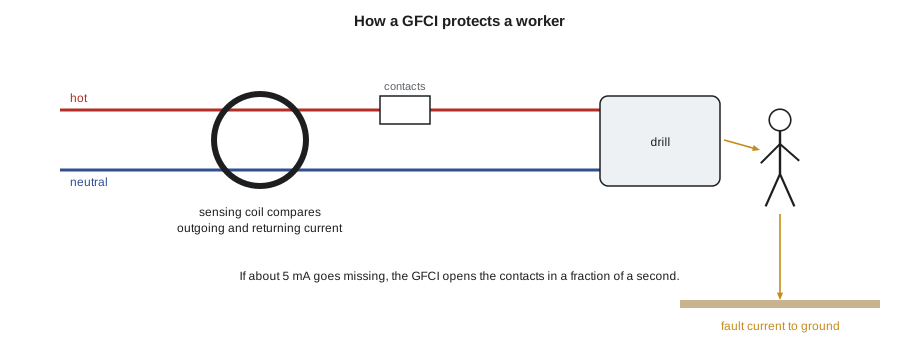
A GFCI is only useful if it works. Maya presses the test button on the GFCI or portable GFCI cord before plugging in at the start of each shift; the device should trip, and the reset button should restore power. If it does not trip, she does not use it and reports it. A GFCI that trips repeatedly is telling her something is wrong with her cord or tool; it should never be bypassed.
Cords and tools
| Check or rule | Why |
|---|---|
| Inspect cords and tools before each use: jacket intact, no exposed wires, plug and connector undamaged, ground pin present | Damaged insulation and missing ground pins are the most common electrical defects on sites |
| Use cords rated for hard or extra-hard usage and for outdoor use, of a size suited to the length and load | Light cords overheat and are easily damaged |
| Never remove the ground pin or use an adapter that defeats grounding | The ground path is what trips the breaker or GFCI in a fault |
| Do not repair cords with tape; remove damaged cords from service | Taped jackets hide damage and fail again |
| Run cords overhead or along walls, away from doors, sharp edges, vehicles and water | Prevents damage and trip hazards |
| Do not daisy-chain extension cords or overload them | Long chains drop voltage, overheat and multiply connection points |
| Unplug by pulling the plug, not the cord | Pulling the cord damages the connection |
| Keep tools and cords dry; do not use corded tools while standing in water | Water lowers body resistance and creates current paths |
| Use double-insulated or grounded tools; prefer battery tools in wet areas | Battery tools remove the cord hazard altogether |
Battery tools have changed this picture on many sites. Northbridge now issues battery press tools, drills, saws and work lights to most of its crews, and corded tools are used mainly for heavy equipment such as core drills and threading machines. Fewer cords means fewer trip hazards, fewer damaged cords and fewer chances for a shock in a wet area. Batteries bring their own, smaller hazards: a damaged or overheated lithium-ion battery can catch fire, so Maya charges batteries only on the chargers supplied, away from combustible material, and takes any swollen or damaged battery out of service.
Many Canadian sites use a coloured tape or tag system to show that cords and tools have been inspected each month or quarter; Kingsway Tower changes the colour every quarter, and a cord without the current colour is not allowed on site.
Drilling, coring and cutting
Plumbers make many holes: sleeves through slabs, holes through studs and blocks, openings in existing walls. In a new building most cables and conduits are installed after the plumbing rough-in, but not all of them, and in renovations walls and slabs can hide live cables anywhere. A core drill or saw that hits a live cable can energize the tool and the worker, and can start a fire.
| Before drilling or cutting | Why |
|---|---|
| Check the drawings and ask the electricians what is in the slab or wall | Conduits embedded in slabs and walls are shown on drawings and known to the electrical crew |
| Scan concrete with a ground-penetrating radar or similar scanner before coring | Locates conduit, rebar and post-tensioning tendons; cutting a tendon is a serious hazard of its own |
| In existing buildings, have the circuits in the area isolated and locked out where possible | Removes the energy instead of relying on finding the cable |
| Use tools with insulated grips and a GFCI; use a wet core drill only with GFCI protection | Limits the current if contact occurs |
| Stop immediately if the tool hits metal unexpectedly, and get the area checked | Continuing can cut deeper into a cable |
Kingsway Tower's floors are post-tensioned concrete, with high-strength steel tendons under very high tension running through the slab. Cutting one can release it violently and weaken the structure. Every core hole on the site is laid out from the drawings and scanned before drilling, and the scan is checked by Stonebridge. Maya's job, as a new worker, is never to core without a scan and a sign-off.
Metal pipe and bonding
One electrical hazard belongs especially to plumbers. Metal water piping in a building is bonded to the electrical grounding system, and in some buildings current can flow through the piping because of wiring faults or an open neutral in the electrical service. If a plumber cuts a metal water pipe that is carrying current, the plumber's body can complete the circuit between the two cut ends.
The precaution is simple and is part of Northbridge's procedure for cutting existing metal piping: before cutting, attach a bonding jumper cable with clamps on each side of the cut, so the current has a path that bypasses the gap. Remove the jumper only after the new section is installed and the pipe is continuous again. If Maya feels a tingle when she touches a pipe, she stops and calls an electrician.
Overhead and buried lines
Contact with overhead power lines by cranes, boom trucks, ladders, scaffolds and long pipe is one of the most common causes of electrical deaths in construction. In Ontario, the construction regulation sets minimum distances that workers, equipment and materials must keep from energized overhead conductors: 3 m for lines over 750 volts up to 150,000 volts, 4.5 m up to 250,000 volts, and 6 m above that, unless the utility has taken specific measures. Buried cables are just as dangerous for anyone digging; before any excavation, the locations of underground services must be marked, through Ontario One Call in Ontario.
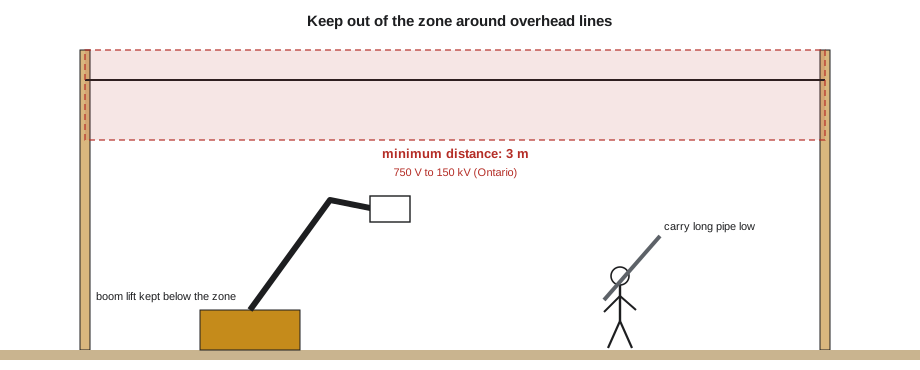
At Kingsway Tower, the overhead lines along the street were covered with insulating sleeves by the utility before work began, and the crane's operation is planned to keep loads well away. Maya's part is simple: never carry long pipe or ladders upright near the street, look up before raising anything, and never assume a line is dead or insulated.
If someone is shocked
If a co-worker is being shocked, the first instinct is to grab them, and that can make two casualties. Do not touch the person while they are in contact with the source. Shut off the power at the switch, breaker or plug if you can do it quickly and safely. If you cannot, and the voltage is low, push them clear with a dry non-conductive object such as a wooden broom handle. Never approach anyone in contact with an overhead line or a downed line; keep everyone back and call the utility and emergency services. Once the person is clear of the source, call for help, start CPR if they are not breathing normally and use an AED if one is available. Anyone who has had an electrical shock needs medical assessment, even if they feel fine, because heart rhythm problems can appear later. Lesson 12 covers first aid and emergency response.
Common mistakes
MistakeUsing a cord with a damaged jacket because it still works.
InsteadRemove it from service; damaged insulation is a shock hazard.
MistakeBypassing a GFCI that keeps tripping.
InsteadFind and remove the faulty cord or tool; the GFCI is doing its job.
MistakeCoring a slab without a scan because the drawings show nothing there.
InsteadScan first and get a sign-off; drawings are not always complete.
MistakeCutting existing metal water pipe without a bonding jumper.
InsteadClamp a jumper across the cut first, and stop if you feel a tingle.
Summary and key terms
- Electricity injures through shock, burns, arc flash and falls caused by shock.
- Currents of tens of milliamperes can stop the heart; wet skin lets far more current flow.
- Temporary receptacles on construction sites need GFCI protection under the electrical code.
- Test GFCIs before use, inspect cords and tools, and remove damaged equipment from service.
- Scan concrete and check drawings before drilling or coring, especially in post-tensioned slabs.
- Use a bonding jumper before cutting existing metal water pipe.
- Keep at least 3 m from overhead lines up to 150,000 volts in Ontario, and call before you dig.
- Shock
- The effect of electric current passing through the body.
- Arc flash
- An explosive release of energy when current flows through the air between conductors.
- GFCI
- A ground fault circuit interrupter, which trips when it detects current leaking to ground, at about 5 milliamperes for personnel protection.
- Ground pin
- The round or U-shaped prong on a plug that connects equipment to the ground path.
- Double-insulated tool
- A tool with two layers of insulation that does not rely on a ground pin for protection.
- Bonding jumper
- A cable clamped across a pipe cut to keep the electrical path continuous.
- Minimum approach distance
- The closest a person, tool or material may come to an energized overhead line.
Practice problems
Work each problem on paper first, then reveal the answer to check.
Why are wet conditions more dangerous for electric shock?
Show answer
Wet skin and wet floors lower resistance, so the same voltage drives much more current through the body.
What should Maya do before plugging into a GFCI-protected receptacle each shift?
Show answer
Press the test button to confirm it trips, then reset it.
Name three checks on an extension cord.
Show answer
Jacket intact with no exposed wires, plug and connector undamaged, ground pin present, current inspection colour.
Why is scanning required before coring a post-tensioned slab?
Show answer
To avoid cutting a tendon under high tension, or a live conduit.
What is the first thing to do if a co-worker is being shocked by a tool?
Show answer
Do not touch them; shut off the power or unplug the tool, then call for help and give first aid.
Lesson quiz · 5 questions
Score 60% or more to complete this lesson.
Create a free account to save your progress, take quizzes and earn a certificate.