
TRD-101 · Lesson 7 of 12 · 19 min
Lockout and hazardous energy
Machines, piping systems and electrical equipment store and transmit energy. When they are running, that energy does useful work. When a worker reaches into a machine, opens a pipe or touches a conductor to repair or install something, the same energy can start a motor, release a jet of steam, push a piston or drive current through a body. Lockout is the set of steps that puts all of that energy in a safe state, locks it there, and proves it is safe before anyone starts work. Done properly, it is one of the most reliable safety controls in any trade. Skipped or done halfway, it is behind a large share of amputations, crushing injuries, burns and electrocutions.
For a plumbing apprentice, lockout is not only about electrical panels. On Kingsway Tower, Maya will isolate water lines before cutting into them, isolate the gas supply before connecting an appliance, work on pumps and water heaters that have both electrical and water energy, and work near equipment that other trades have locked out. On renovation jobs she may work on steam and hot water systems that can scald in seconds.
The law and the standards
Ontario's construction regulation requires electrical equipment and installations to be de-energized, locked out and tagged before work is done on them, with limited exceptions for work that must be done live by qualified workers under strict precautions. It also requires machines and equipment to be stopped and secured against unexpected starting or movement before maintenance or repair. Most Canadian employers base their lockout programs on CSA Z460, Control of hazardous energy: lockout and other methods, which sets out a full program: written procedures, training, devices and verification.
Whatever the jurisdiction, the core idea is the same: a worker who is exposed to hazardous energy must have personal control over it. That is why each worker applies their own lock and keeps the only key.
Kinds of hazardous energy
The first step in any lockout is to identify every energy source, and new workers often think only of electricity. A typical piece of equipment on a mechanical site can have three or four different kinds.
| Energy type | Examples on a mechanical site | How it is isolated or released |
|---|---|---|
| Electrical | Pump motors, water heaters, boilers, control panels, heat tracing | Open the disconnect or breaker and lock it; test for absence of voltage |
| Mechanical (moving parts) | Fans, pump impellers, belts, rotating shafts | Isolate the power; block or restrain parts that could move by gravity or momentum |
| Water and fluid pressure | Domestic water mains, fire sprinkler lines, pressure-tested piping | Close and lock isolation valves; drain and vent the section; verify zero pressure |
| Thermal | Hot water, steam, hot surfaces of boilers and pipe | Isolate, let cool, drain; verify temperature |
| Pneumatic | Compressed air lines and tools, pneumatic test rigs | Close and lock valves; bleed the line; verify zero pressure |
| Hydraulic | Lifts, pipe benders, press tools, equipment with hydraulic cylinders | Lower to a resting position; isolate; relieve pressure |
| Chemical and fuel | Natural gas and propane lines, chemical feed systems | Close and lock valves; purge or vent per procedure; test the atmosphere |
| Gravity | Raised loads, counterweights, overhead doors | Lower to rest or block securely |
| Stored energy | Springs, capacitors in drives and controls, pressure in accumulators and expansion tanks | Release, discharge or block according to the procedure |
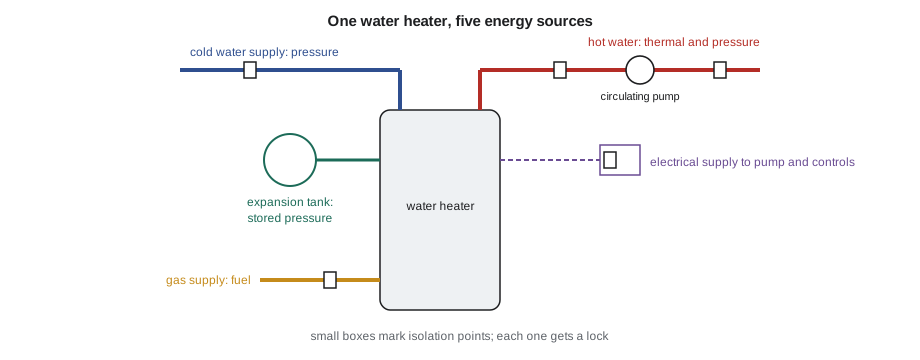
Look at the water heater in the figure. To replace its circulating pump safely, Maya and Luis must isolate the electrical supply to the pump, close the valves on each side of it, drain the section and relieve the pressure, let the water cool if it was hot, and make sure nothing can refill the section while they work. Isolating only the breaker would leave them opening a pipe full of hot water under pressure.
The steps of a lockout
Every lockout follows the same basic sequence. A written procedure for a specific piece of equipment fills in the details: which disconnects and valves, which locks and blocks, and how to verify.
| Step | What happens | On the pump replacement |
|---|---|---|
| 1. Prepare | Read the procedure; identify all energy sources and isolation points; gather locks, tags and blocks | Luis and Maya review the procedure and the drawings, and find the breaker, valves and drain points |
| 2. Notify | Tell everyone affected: operators, other trades, the building operator if occupied | Dave tells Stonebridge and the trades on the floor that the hot water loop will be off |
| 3. Shut down | Stop the equipment using its normal controls | Turn the pump off at its switch |
| 4. Isolate | Open disconnects, close valves, disconnect or block energy sources | Open the breaker; close the valves on both sides of the pump |
| 5. Lock and tag | Each worker applies a personal lock and tag to each isolation point | Luis and Maya each put a lock and tag on the breaker and on both valves |
| 6. Release stored energy | Drain, vent, bleed, discharge, block and let things cool | Open the drain and vent; let the section cool |
| 7. Verify | Prove the energy is isolated: try the controls, test for voltage, check gauges for zero pressure | Try the pump switch (nothing happens), test for voltage at the pump, confirm no flow from the drain |
| 8. Do the work | Work only within the isolated section; stop if anything changes | Replace the pump |
| 9. Restore | Remove tools, replace guards, check everyone is clear, remove own locks, notify, re-energize in sequence | Close the drain, refill and vent, remove locks, notify Dave, restore power and test |
Verification is the step that is most often skipped and the one that matters most. A breaker can be mislabelled, a valve can leak through, a second feed can exist that nobody knew about. The only way to know the energy is gone is to try to start the equipment, test for voltage with a tester that has been checked on a known live source, or read a gauge that should be at zero. Luis's rule is blunt: if you did not test it, it is not locked out.
Locks, tags and keys
A lockout device is a padlock that only its owner can open, usually a brightly coloured lock with the worker's name on it, used for nothing else. Many isolation points need an adapter to take a lock: breaker lockouts for panel breakers, valve covers for ball and gate valves, plug covers for corded equipment. A tag is attached to the lock with the worker's name, the date and the reason.
| Rule | Why |
|---|---|
| One worker, one lock, one key | Only the worker who applied the lock can remove it, so nobody can restore energy while they are exposed |
| Every worker exposed applies their own lock | Each person controls their own safety; a co-worker's lock does not protect you |
| Lock every isolation point | One missed valve or feed defeats the whole lockout |
| A tag alone is not a lockout | A tag is a warning that can be ignored or torn off; it is used alone only where a lock truly cannot be applied, with extra precautions |
| Never remove someone else's lock | Removal of an absent worker's lock follows a strict procedure run by the supervisor, after confirming the worker is not on site and is told before returning |
| Locks stay on through shift changes and breaks | The next crew applies its locks before the previous crew removes theirs |
Maya received her personal lock and tags from Northbridge in her first week, along with a breaker lockout, a valve lockout and a hasp that lets several locks go on one isolation point. Her name is engraved on the lock and her photo is on the tag. Nobody else has a key.
Group lockout
On larger jobs, many workers may need to be protected by the same lockout, and some equipment has dozens of isolation points. A group lockout makes this practical. A qualified person, usually the supervisor or the person in charge of the equipment, isolates and locks every point using group locks, puts the keys to those locks in a lockbox, and verifies the isolation. Each worker then puts their personal lock on the lockbox. The group locks cannot be removed until every personal lock has come off the box.
When the plumbing, electrical and controls trades all worked on the building's main booster pump set, Stonebridge's mechanical coordinator ran a group lockout. He locked the main disconnect, the control power and four valves, put the keys in the lockbox, verified the isolation with an electrician, and posted the procedure on the box. Maya, Luis and the other workers each added their own lock to the box and checked the verification record before starting. Each removed their own lock when they finished, and the coordinator removed the group locks only when the box was empty.
Working near other trades' equipment
Sometimes the hazard is not equipment Maya is working on but equipment near her work. On Kingsway Tower she may install piping beside a running fan, under a live electrical tray or next to a pressurized fire sprinkler main. If her work could bring her into contact with that energy, for example if she is drilling near the sprinkler main or working inside a mechanical room with a fan that could start automatically, she asks for it to be locked out and puts her own lock on it. Equipment controlled by timers, thermostats, pressure switches or building automation can start at any moment without anyone touching it.
The safe attitude is to treat all equipment as energized until you have verified otherwise, and to treat every lock and tag you see as untouchable. If a lock or tag is in your way, find its owner. Never operate a switch, valve or breaker that has a lock or tag on it.
Pressure testing and water
Plumbers deal with one hazardous energy source more than most trades: pressure in piping. New water and drain piping is pressure-tested, and compressed air stores far more energy than water at the same pressure. A failed fitting during an air test can turn into a projectile. That is why many codes and contractors prefer water testing where it is practical, and why Northbridge's procedure requires a pressure gauge, a relief valve set above the test pressure, the test area cleared of other workers, and pressure released before anyone works on the piping.
Cutting into existing water lines brings the same issues. Before Maya cuts a pipe, the section is isolated with valves that are locked closed, drained through a drain valve, and verified by opening a fixture or drain at the low point. A valve that is closed but not locked can be opened by another trade or the building operator who does not know someone is working downstream.
Cord-and-plug tools and simple equipment
Not every repair needs a full written procedure. Equipment powered only through a cord and plug, such as a pipe threading machine, a core drill or a portable pump, can be controlled by unplugging it, as long as the plug stays under the exclusive control of the worker doing the work. In practice that means the plug is in your hand or within your sight and reach the whole time, or it has a plug lockout cover with your lock on it.
| Situation | Is unplugging enough? |
|---|---|
| Changing the die head on the threading machine, plug on the floor beside you | Yes, if the plug stays where you can see and reach it |
| Clearing a jam in the core drill, cord running into the next room | No: lock the plug with a plug cover, or bring the plug to you |
| Repairing a portable pump that is still full of water | Unplugging controls the electricity, but the water pressure and contents still need to be released |
| Changing a blade on a battery tool | Remove the battery and keep it with you |
Maya's habit with corded tools is simple: before her hands go anywhere near the blade, bit or die, the plug comes out and stays in sight, or the battery comes out and goes in her pocket. It takes two seconds, and it removes the chance of a co-worker plugging the tool back in or a trigger catching on her sleeve.
Common mistakes
MistakeIsolating only the electrical supply on equipment with several energy sources.
InsteadIdentify every energy source: electrical, pressure, thermal, gravity and stored energy.
MistakeSkipping verification because the breaker is labelled.
InsteadAlways verify: try the controls, test for voltage and check gauges for zero.
MistakeRelying on a co-worker's lock.
InsteadEvery exposed worker applies their own lock and keeps their own key.
MistakeClosing a valve without locking it before cutting a pipe.
InsteadLock and tag isolation valves so nobody can reopen them while you work.
Summary and key terms
- Ontario requires electrical equipment to be de-energized, locked out and tagged, and machines to be secured against starting; CSA Z460 sets out a full lockout program.
- Hazardous energy includes electrical, mechanical, pressure, thermal, pneumatic, hydraulic, chemical, gravity and stored energy.
- The steps are prepare, notify, shut down, isolate, lock and tag, release stored energy, verify, work and restore.
- Verification proves the energy is gone; skipping it defeats the lockout.
- One worker, one lock, one key: every exposed worker applies their own lock.
- Group lockout uses a lockbox so many workers can be protected by the same isolation.
- Never operate anything with a lock or tag on it, and treat equipment as energized until verified.
- Lockout
- Placing a lock on an energy-isolating device so that equipment cannot be operated until the lock is removed by its owner.
- Tag
- A warning label attached to a lock or isolation point identifying who applied it and why.
- Energy-isolating device
- A device that physically prevents the transmission or release of energy, such as a disconnect switch or valve.
- Stored energy
- Energy that remains after isolation, such as pressure, spring tension, heat or charge in capacitors.
- Verification
- Testing or trying equipment to prove that energy has been isolated.
- Group lockout
- A lockout in which group locks secure the isolation points and each worker locks a lockbox holding the keys.
- Lockbox
- A box holding the keys to group locks, to which each worker applies a personal lock.
Practice problems
Work each problem on paper first, then reveal the answer to check.
Name four kinds of hazardous energy in a domestic hot water system.
Show answer
Electrical, water pressure, thermal and stored energy in the expansion tank; gas where the heater is gas-fired.
Why is verification essential even when the breaker is labelled?
Show answer
Labels can be wrong, valves can leak and there may be other feeds; only testing proves the energy is gone.
Why does every worker apply their own lock?
Show answer
So nobody can restore energy while they are exposed; only the lock's owner can remove it.
How does a group lockout protect each worker?
Show answer
The group locks cannot be removed until every worker's personal lock is off the lockbox.
What should Maya do if a locked valve is in the way of her work?
Show answer
Find the lock's owner; never operate or remove it herself.
Lesson quiz · 5 questions
Score 60% or more to complete this lesson.
Create a free account to save your progress, take quizzes and earn a certificate.