
TRD-101 · Lesson 2 of 12 · 20 min
Your rights and duties under OHS law
Every province and territory in Canada has an occupational health and safety act that applies to construction, and federally regulated workplaces have the Canada Labour Code. The details differ, but every one of these laws is built on the same foundation: employers must protect workers, and workers have rights that let them protect themselves. This lesson uses Ontario's Occupational Health and Safety Act (OHSA) and its Construction Projects regulation (O. Reg. 213/91) as the example, because that is the law on Kingsway Tower. If you work in another province, the names and section numbers will change but the ideas will not.
Knowing the law is not about memorizing section numbers. It is about knowing that you are entitled to training, information and protection, that you have duties of your own, and that you have a way to say no when a job is dangerous without losing your job for it.
The internal responsibility system
Canadian safety law rests on the internal responsibility system. The idea is that the people in the workplace, who know the work and the hazards best, are responsible for safety, each according to their authority and ability. The government inspector is a backstop who checks that the system is working, not the person who makes the site safe. On a construction project in Ontario, the law gives specific duties to five parties.
| Party | Example on Kingsway Tower | Main duties under Ontario law |
|---|---|---|
| Owner | The developer | Before the project starts, tell the constructor about designated substances, such as asbestos, present on the site |
| Constructor | Stonebridge Construction | Make sure every employer and worker on the project complies; register the project with the Ministry; coordinate safety among trades |
| Employer | Northbridge Mechanical | Provide training, information, supervision and equipment; take every precaution reasonable in the circumstances for the protection of a worker |
| Supervisor | Dave Kowal | Make sure workers work safely and use the required equipment; tell workers about hazards they may meet; take every precaution reasonable |
| Worker | Maya Chen | Work safely; use the equipment and clothing the employer requires; report hazards and contraventions to the supervisor or employer |
The phrase that appears again and again in Ontario's Act is that employers and supervisors must take every precaution reasonable in the circumstances for the protection of a worker. It is a high standard. It means a contractor cannot point to a rule it wrote and call the job done; it has to show that it trained people, supervised them, provided the right equipment and acted on hazards it knew about or should have known about.
Your three rights
Ontario's Act, like the laws in every province, gives workers three basic rights. Lawyers and inspectors refer to them all the time, and so should you.
| Right | What it means | How Maya uses it |
|---|---|---|
| The right to know | You must be told about the hazards of your work and trained to work safely, including WHMIS training on hazardous products | Asking Luis how the solvent cement is hazardous; reading the safety data sheet; attending task training |
| The right to participate | You can take part in identifying and solving safety problems, through the joint health and safety committee or a health and safety representative | Raising the problem of cords across the stairs at a toolbox talk; talking to the worker member of the committee |
| The right to refuse | You can refuse work you have reason to believe is likely to endanger yourself or another worker, following the process in the Act | Refusing to work beside an unguarded floor opening until it is covered (see below) |
Refusing unsafe work
The right to refuse is the most powerful right a worker has, and it comes with a process designed to get the hazard fixed quickly while protecting the worker who raised it. In Ontario, a worker may refuse work if they have reason to believe that equipment, the physical condition of the workplace, or workplace violence is likely to endanger them or another worker. The worker does not have to be certain; they need reason to believe. Some workers whose jobs are inherently dangerous, such as police and firefighters, have limits on this right, but construction workers do not.
| Step | What happens | Who is involved |
|---|---|---|
| 1. Report the refusal | Tell your supervisor or employer that you are refusing and why. Stay in a safe place nearby. | Worker and supervisor |
| 2. Investigate | The supervisor investigates with the worker present, and with a worker member of the joint committee or the health and safety representative. Usually the hazard is fixed here. | Supervisor, worker, worker representative |
| 3. Continue to refuse if still unsafe | If the worker still has reason to believe the work is dangerous, they may continue to refuse, and the Ministry is called. | Worker, employer |
| 4. Inspector investigates | A Ministry inspector investigates and decides in writing whether the work is likely to endanger the worker, and may issue orders. | Inspector, employer, worker |
| 5. Meanwhile | Another worker may be assigned the work only if told about the refusal and the reasons for it. The refusing worker is paid and may be given other work. | Employer |
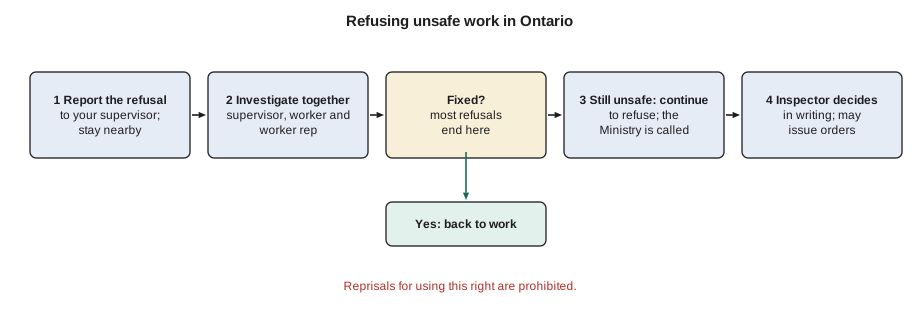
On Kingsway Tower, the right was tested in Maya's third week. Dave asked her to carry pipe to the north side of the sixth floor, where the cover over a large mechanical opening had been moved by another trade and was lying beside the hole. Maya told Dave she would not work near the opening until it was covered or guarded. Dave looked, agreed, called Anika, and the opening was guarded within twenty minutes. There was no argument. That is the way the process is supposed to work: most refusals end at the first conversation, because the hazard is obvious once someone points it out.
Ontario's Act also prohibits reprisals. An employer may not dismiss, discipline, penalize, intimidate or threaten a worker for acting in compliance with the Act, including refusing unsafe work or reporting a hazard. A worker who believes they have faced a reprisal can file a complaint with the Ontario Labour Relations Board, or have a union file a grievance.
Your duties as a worker
Rights come with duties. Under Ontario's Act, a worker must work in compliance with the Act and regulations, use or wear the equipment, protective devices or clothing the employer requires, and report to the employer or supervisor any hazard, defect in equipment or contravention they know of. A worker must not remove or make ineffective any protective device, must not use equipment in a way that endangers anyone, and must not engage in pranks, contests, feats of strength, unnecessary running or rough and boisterous conduct. Workers can be charged and fined for breaking the law, although it is rare and usually involves deliberate or reckless behaviour.
| Duty | What it looks like on Kingsway Tower |
|---|---|
| Follow the rules and your training | Using the ladder the way Luis showed her; working only on tasks she has been trained for |
| Use the protective equipment required | Wearing her hard hat, boots, vest and glasses; using her harness where the fall protection plan says to |
| Report hazards and defects | Telling Dave about the damaged cord; telling Anika about a missing guardrail on another trade's floor |
| Do not remove or defeat protection | Never removing a guardrail, guard or lockout device; if a guardrail has to come down, it is done under the procedure and replaced |
| No horseplay | No pranks with air hoses, no racing down the stairs, no throwing tools to each other |
Committees and representatives
The right to participate works through joint health and safety committees and health and safety representatives. In Ontario, a construction project where 20 or more workers are regularly employed and that is expected to last three months or more must have a joint health and safety committee, with at least half its members being workers chosen by the workers or their unions. Projects with six to 19 workers need a health and safety representative. On Kingsway Tower, the committee meets monthly, inspects the site, and makes written recommendations to Stonebridge, which must respond in writing.
For Maya, the committee is a way to raise issues that are bigger than a single hazard. When she noticed that the only route from the hoist to the washrooms on the upper floors went through an area where the masons were cutting block without dust control, she mentioned it to the worker member from her trade. The committee recommended a second route and wet cutting, and both were in place the next week.
Inspectors and enforcement
Ontario's Ministry of Labour, Immigration, Training and Skills Development employs the inspectors who enforce the Act. Inspectors can enter a workplace at any time without a warrant, inspect, take samples and photographs, interview workers in private, and issue orders, including stop-work orders. Ministry inspectors investigate serious injuries and fatalities, work refusals and complaints, and run proactive inspection campaigns, for example on falls. Companies and individuals convicted of offences face fines, and since November 2025 inspectors can also issue administrative monetary penalties for some contraventions. Anyone can call the Ministry's Health and Safety Contact Centre to report a hazard.
| If an inspector arrives | What Maya should do |
|---|---|
| The inspector walks the floor where she is working | Keep working safely; answer questions honestly |
| The inspector asks to speak with her | She may speak privately; she may have a worker representative present |
| She sees a hazard the inspector has not seen | She can point it out; reporting hazards to an inspector is protected |
| Her supervisor tells her not to talk | That would be unlawful interference; she should report it |
Reporting injuries and workers' compensation
If Maya is hurt at work, even slightly, she reports it to Dave right away and gets first aid. The employer must report injuries that need health care beyond first aid, or that cause time off work, to the Workplace Safety and Insurance Board (WSIB) within three days of learning about them, and must report critical injuries and fatalities to the Ministry immediately. Workers' compensation pays for health care and replaces lost wages for work-related injuries and illnesses, and in exchange workers generally cannot sue their employer. Early reporting matters: it gets the worker the right care, creates a record if a minor injury turns out to be serious, and helps the site fix the cause.
Some workers hide injuries because they are worried about their jobs, about being seen as careless, or about spoiling the site's safety record. A good contractor makes it clear that reporting is expected and never punished. A sprained wrist that is reported today is a minor first aid case; the same wrist hidden for a week and then reported may be a claim that is hard to prove, and the loose stair nosing that caused it is still waiting for the next person.
Questions every new worker can ask
Using your rights starts with simple questions. A new worker does not need to quote the law; asking the right questions on the first day tells you most of what you need to know about how seriously a contractor takes safety, and it shows your supervisor that you care about doing the job properly.
| Question | Why it matters |
|---|---|
| What are the main hazards of the work I will be doing? | You cannot protect yourself from hazards nobody has told you about. |
| What training will I get before I do this task, and who will show me? | Training before the task is required, and it tells you who your go-to person is. |
| What protective equipment do I need, and who provides it? | Employers must provide most required equipment; you need to know what to wear before you start. |
| Who do I report a hazard or an injury to, and how? | Fast reporting depends on knowing the route, especially on a large site. |
| What do I do in an emergency, and where is first aid? | In an emergency there is no time to find out. |
| Who is the worker representative or committee member for my trade? | They are your route for issues you are not comfortable raising directly. |
Maya asked Dave all six on her first morning. He answered most of them on the spot and walked her to the first aid station and the muster point himself. When she asked about the committee, he pointed her to the worker member from Northbridge, a second-year apprentice named Priya, who later became the person Maya went to with questions she felt awkward asking her foreman.
Common mistakes
MistakeThinking that refusing unsafe work means walking off the site.
InsteadReport the refusal to your supervisor and stay nearby in a safe place while it is investigated.
MistakeBelieving safety is only the employer's job.
InsteadWorkers have duties too: follow the training, use the protection provided and report hazards.
MistakeHiding a minor injury to protect the site's record.
InsteadReport every injury the same shift; good contractors expect it and never punish it.
MistakeAssuming you cannot talk to an inspector without your boss.
InsteadWorkers may speak to inspectors privately, and doing so is protected.
Summary and key terms
- Ontario's OHSA gives duties to owners, constructors, employers, supervisors and workers under the internal responsibility system.
- Employers and supervisors must take every precaution reasonable in the circumstances for the protection of a worker.
- Workers have the right to know, the right to participate and the right to refuse unsafe work.
- A refusal follows a set process: report, investigate with a worker representative, and call the Ministry if the hazard is not resolved.
- Reprisals against workers who use their rights are prohibited.
- Construction projects with 20 or more workers for three months or more need a joint health and safety committee.
- Report every injury right away; early reporting gets the worker care and gets the cause fixed.
- Internal responsibility system
- The principle that everyone in a workplace shares responsibility for safety according to their authority and ability.
- Constructor
- The party with overall responsibility for a construction project under Ontario law.
- Supervisor
- A person who has charge of a workplace or authority over a worker.
- Right to refuse
- A worker's right to refuse work they have reason to believe is likely to endanger themselves or another worker.
- Reprisal
- Dismissal, discipline, intimidation or other punishment of a worker for exercising rights under safety law.
- Joint health and safety committee
- A committee of worker and management members that identifies hazards and recommends improvements.
- WSIB
- Ontario's Workplace Safety and Insurance Board, which runs workers' compensation.
Practice problems
Work each problem on paper first, then reveal the answer to check.
Name the three rights of workers and give one example of each.
Show answer
Know (WHMIS training and SDS), participate (raising issues with the committee) and refuse (refusing to work beside an unguarded opening).
What should Maya do while a refusal is being dealt with?
Show answer
Stay in a safe place nearby and be available for the investigation; she may be given other work.
Which party coordinates safety among all the trades on Kingsway Tower?
Show answer
Stonebridge, the constructor.
Give two examples of reprisal or retaliation.
Show answer
Firing, demotion, worse assignments, lost overtime or threats because a worker reported a hazard or refused unsafe work.
Why does early injury reporting help the site, not only the worker?
Show answer
It identifies the hazard that caused the injury so it can be fixed before someone else is hurt.
Lesson quiz · 5 questions
Score 60% or more to complete this lesson.
Create a free account to save your progress, take quizzes and earn a certificate.