
ROOF-230 · Lesson 5 of 12 · 25 min
Natural and synthetic slate
▶ Video coming soon A video version of this lesson is on the way.
Every morning of his first two weeks with Crew 6, Rory spent half an hour with Bram at the slate bench in the corner of the yard before the trucks left. The bench was a heavy plank with a steel slater's stake driven into one end, and around it stood crates of salvaged slate from a demolished 1890s school, bought in 2025 with St. Brendan's Church in mind. "Slate is the only roof material you can hear," Bram said on the first morning, tapping a slate with his knuckle so it rang. Then he tapped another, which thudded. "That one's dead. Cracked inside, or soft. It goes in the bin."
This lesson covers natural slate: what it is, where it comes from, how it is graded, its sizes and thicknesses, headlap and exposure, nails and holes, the slater's tools, cutting and walking. It then covers synthetic slate and when it is, and is not, a suitable substitute. Repairs to slate are in lesson 11, and the St. Brendan's valley job in lesson 12.
What slate is
Slate is a metamorphic rock: fine-grained clay sediments that were buried, heated and squeezed until the minerals lined up in parallel. That alignment lets the stone split along its cleavage into thin, flat sheets, which is what makes it a roofing material. Good roofing slate is dense, hard and absorbs very little water, so frost cannot break it up. Poor slate is soft, absorbs water, and flakes or delaminates.
In North America, most roofing slate has come from Vermont and New York (greens, greys, purples and reds), Pennsylvania (blacks and dark greys), Virginia (dark blue-greys) and, historically, Quebec's Eastern Townships. Slate is also imported from Spain, Brazil, China and elsewhere, and quality varies widely by quarry. Slaters speak of hard and soft slate: hard slates can last 150 years or more; some soft slates last 50 to 80 years. Colours are either unfading, which keep their colour, or weathering, which change over the first years, often to buff or brown tones; a repair on a weathering slate roof is matched to the weathered colour, not the colour in the quarry crate.
Grades and tests
Roofing slate is specified to ASTM C406, which Canadian specifiers also use, since there is no separate Canadian slate standard. The standard grades slate by its expected service life:
| Grade | Expected service life |
|---|---|
| S1 | over 75 years |
| S2 | 40 to 75 years |
| S3 | 20 to 40 years |
The grade is set by laboratory tests on samples from the quarry: a breaking load test for strength, a water absorption test, and a weathering test that measures how deep the surface softens after exposure to acid. Industry guidance is that only S1 slate should normally be used for roofing. Salvaged slate has no lab grade, but a century on a roof is a field test of its own; it still has to be checked one piece at a time.
Bram's field test is what he showed Rory on the first morning. He holds each slate by one corner and taps it with a hammer or knuckle. A sound slate rings; a cracked, delaminated or soft one gives a dull thud. Then he looks at both faces and the edges for flaking, cracks and broken corners, and at the nail holes for wear, since a slate whose holes have been enlarged by a century of movement can be re-holed. On his first morning Rory sorted 40 salvaged slates: 31 rang, 5 thudded, and 4 had broken corners that could be cut down to a smaller size for the course near the ridge.
Sizes, thickness and weight
Slates come in rectangles from 250 by 150 mm (10 by 6 in) up to 600 by 350 mm (24 by 14 in), identified by length and width, and in thicknesses from about 5 mm (3/16 in) for standard roofs to 19 mm (3/4 in) or more for heavy textured and graduated roofs, where the thickness decreases from eave to ridge. Standard 5 to 6 mm (3/16 to 1/4 in) slate makes a roof of about 35 to 45 kg/m² (7 to 9 lb/ft²); thick graduated roofs weigh much more.
Headlap and exposure
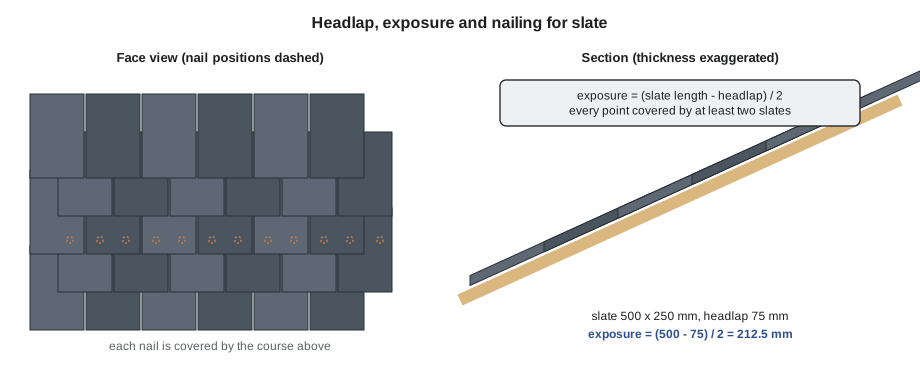
Slate is laid like a shingle: each course is offset half a slate from the one below, and every point on the roof is covered by at least two thicknesses of slate. The headlap is the distance by which each course overlaps the course two below it; it is what stops water that runs down the joint between two slates from reaching the deck. The exposure is the visible part of each course:
Ontario practice, following the slate industry's guidance, is a headlap of about 75 mm on most slopes, with more on slopes near the code minimum of 1 in 2 and never less on ordinary roofs. The code itself sets only the minimum slope for slate; the installation follows the specification and good practice. Steeper roofs shed water faster, so they need less headlap; low slopes need more.
Worked problem
Exposure and slates per area at St. Brendan's
The church nave is 14 in 12 slate, 500 mm by 250 mm, laid with 75 mm headlap. What is the exposure, and how many slates cover one square metre?
Show solution
- Exposure = (500 − 75) ÷ 2 = 212.5 mm.
- Area each slate shows = 0.2125 × 0.250 = 0.0531 m².
- Slates per m² = 1 ÷ 0.0531 = 18.8.
Answer: About 18.8 slates per square metre. This number drives every slate estimate in lesson 12.
Worked problem
How heavy is the slate?
Each slate is 500 by 250 mm and 5 mm thick, and slate weighs about 2,800 kg per cubic metre. What does the slate weigh per square metre of roof?
Show solution
- One slate = 0.500 × 0.250 × 0.005 = 0.000625 m³; weight = 0.000625 × 2,800 = 1.75 kg.
- Per m² = 18.8 × 1.75 = 32.9 kg/m².
Answer: About 33 kg/m² for the slate alone, before nails, underlayment, deck and snow, and about three times an asphalt roof.
Holes and nails
Each slate is hung on two nails, through holes made near its head. New slate often comes pre-holed; salvaged slate may need new holes. Holes are punched with the point of the slate hammer from the back of the slate, so the stone breaks away in a small cone (the spall) on the face. The nail head then sits in that cone, flush with the face, so the slate above lies flat. The holes are placed so that each nail is covered by the course above and clear of the joint above it; in the standard layout they fall a little above the middle of the slate's length, about 25 to 40 mm (1 to 1-1/2 in) in from each side.
Slate nails must last as long as the slate. Copper nails are the standard, with stainless steel also used. Iron and plain steel nails, common on cheap roofs in the past, rust through in a few decades, and the slates slide out even though they are perfectly sound. That failure, called nail sickness, is the most common reason old slate roofs are wrongly condemned. A common rule for nail length is twice the slate thickness plus 25 mm (1 in), so the nail passes through the slate and well into the deck.
- Drive each nail so the head just touches the slate in its spall, and stop. The slate should hang on the nails, not be clamped by them. A nail driven tight cracks the slate, now or when the deck moves.
- A nail left high lifts the slate above it, which cracks under foot or snow load.
- Never nail through the exposed face of a slate, except at the last course under a ridge or at a few repairs where the method in lesson 11 is used.
Worked problem
Nail length
What nail length suits a 5 mm slate, using twice the thickness plus 25 mm? Nails come in 32 mm and 38 mm lengths.
Show solution
- 2 × 5 + 25 = 35 mm.
- The 32 mm nail is too short, so use 38 mm.
Answer: 38 mm copper slating nails. On a plank deck such as St. Brendan's, the longer nail also gets a better grip in old wood.
The slater's tools
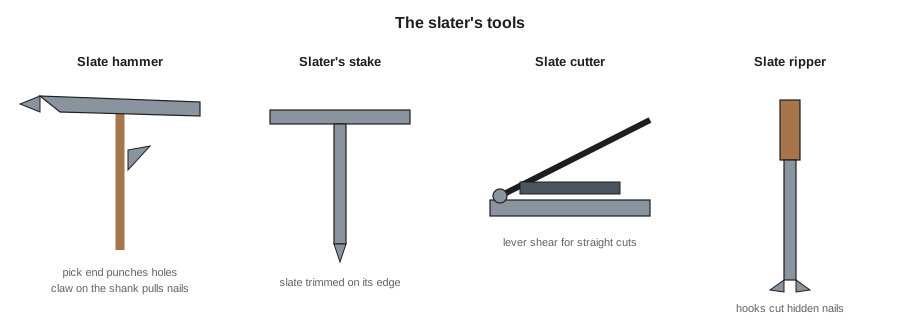
- Slate hammer: a flat face for driving nails, a sharp pick on the other end for punching holes, and a claw on the side of the shank for pulling nails. It also has an edge for trimming slate on the stake.
- Slater's stake: a T-shaped steel anvil driven into the bench or a roof plank. The slate is laid on its edge and trimmed by striking down along the line with the hammer's edge.
- Slate cutter: a lever shear that cuts slate along a straight line, faster and cleaner than the stake for most cuts.
- Slate ripper: a long, flat blade with hooks at the end, slid up under a slate to hook and cut or pull its hidden nails. It is the key repair tool (lesson 11).
- Hook ladders and roof brackets: slate must never be walked on, so all slate work is done from ladders hooked over the ridge, from planks on brackets, or from scaffolding.
Cuts are made from the back of the slate, so the bevelled break is on the face, as a slater would have done it a century ago. Rory's first cuts on the stake were ragged; by the end of the second week he could trim a slate to a line and punch two holes in under a minute.
Never walk on slate
A slate supported only at its edges by the courses below breaks easily under a boot. Even walking carefully, a slater does more damage than he repairs. Crew 6's rule is absolute: no one walks on a slate roof. Work is done from scaffolding at the eaves, from hook ladders over the ridge, or from planks on roof brackets that are fastened under the courses (with the slates removed at bracket locations and replaced after). On a church like St. Brendan's, the access plan, scaffolding and anchors are a large part of the job (lesson 12).
Synthetic slate
Synthetic slate is made from polymers, often with recycled rubber or plastic and mineral fillers, moulded to look like slate. It weighs about 10 to 15 kg/m² (2 to 3 lb/ft²), a third to a quarter of natural slate. It can be cut with a utility knife or saw, nailed with roofing nails through marked nailing zones, and installed by roofers without slating skills. It does not ring or crack in the same way, though it can scuff and some products are slippery.
Because it is not a traditional material, a synthetic slate is accepted under the codes through a product evaluation: in Canada, typically a CCMC evaluation or the maker's demonstration of compliance. The evaluation and the maker's instructions set the minimum slope, underlayment, fastening, fire classification and wind rating. The life of the roof is set by the maker's warranty and the product's track record, which for most products is a few decades rather than a century. Colours can fade, and pieces expand and contract more than stone, so they are laid with gaps the maker specifies.
Synthetic slate suits new houses that want the look of slate without the weight or cost, and repairs on roofs where the structure cannot carry natural slate. It does not suit a heritage building where the slate is part of what is protected: heritage staff almost always require natural slate to match. At St. Brendan's, the parish had asked about synthetic slate in July to save money; the heritage review in August required natural slate matching the original, and Bram agreed. "You don't patch a 1903 slate roof with plastic," he said. "You'd see it from the street for the next fifty years."
Matching slate on repairs
A slate repair is judged from the street. Bram matches replacement slate on five points, in this order: size, so the courses and exposure stay true; thickness, so the replacement lies flat with its neighbours; colour, matched to the weathered roof, not the fresh quarry face; texture, smooth or rough; and the way the edges are dressed. Salvaged slate from the same quarry and era is usually the best match. Before a large repair, he lays out a few candidate slates on the scaffold or on the ground beside the roof and looks at them from where people will see the roof, in daylight, before choosing.
Common mistakes
MistakeCondemning an old slate roof because slates are sliding out.
InsteadCheck the nails: if the slate rings and the nails have rusted, the slates can be rehung with copper nails.
MistakeDriving slate nails tight.
InsteadSet the head in the spall just touching the slate, so the slate hangs on the nails.
MistakeUsing steel or iron nails on slate.
InsteadUse copper or stainless steel nails, at least twice the slate thickness plus 25 mm (1 in) long.
MistakeWalking on a slate roof.
InsteadWork from scaffolding, hook ladders or roof brackets.
MistakeMatching a weathering slate to new quarry colour.
InsteadMatch the weathered colour of the existing roof, using salvaged slate if needed.
Summary and key terms
- Slate is a metamorphic rock that splits into thin sheets; good roofing slate is dense, hard and absorbs little water.
- ASTM C406 grades slate S1 (over 75 years), S2 and S3; S1 is normally used for roofing.
- Exposure equals slate length minus headlap, divided by two; headlap depends on the slope.
- Slates hang on two copper or stainless nails in holes punched from the back, with heads just touching the slate.
- The slate hammer, stake, cutter and ripper are the slater's main tools; slate is never walked on.
- Synthetic slate is lighter and easier to install, accepted through a product evaluation, but rarely accepted on heritage buildings.
- Slate
- A fine-grained metamorphic rock that splits into thin sheets used for roofing.
- Cleavage
- The natural plane along which slate splits.
- S1 slate
- The ASTM C406 grade with an expected service life over 75 years.
- Exposure
- The visible height of each course of slate.
- Spall
- The cone-shaped break on the face of a slate around a hole punched from the back.
- Nail sickness
- Failure of a slate roof because its iron or steel nails have rusted through.
- Slate ripper
- A flat hooked blade used to cut or pull hidden slate nails.
- Synthetic slate
- A moulded polymer roofing product made to look like slate.
Practice problems
Work each problem on paper first, then reveal the answer to check.
A slate is 600 mm long with 75 mm headlap. What is the exposure?
Show answer
(600 − 75) ÷ 2 = 262.5 mm.
What does a dull thud mean when you tap a slate?
Show answer
The slate is cracked, delaminated or soft and should be rejected.
What nail length suits a 6 mm slate?
Show answer
2 × 6 + 25 = 37 mm, so 38 mm.
Why are holes punched from the back of the slate?
Show answer
So the spall on the face lets the nail head sit flush.
Which grade of slate is normally used for roofing?
Show answer
S1.
Lesson quiz · 5 questions
Score 60% or more to complete this lesson.
Create a free account to save your progress, take quizzes and earn a certificate.