
ROOF-230 · Lesson 2 of 12 · 25 min
Metal shingles and panels
▶ Video coming soon A video version of this lesson is on the way.
After the sample wall, Ines Tavernier took Rory to the metal racks at the back of the shop. Coils of prefinished steel sat on a cradle beside the portable roll former that would make the Corrigan panels on site the next morning. Beside them were flat sheets of copper, a crate of stone-coated steel shingles left over from a 2024 job, a bundle of ribbed agricultural panels and a box of short offcuts that Ines used for teaching. She handed Rory a pair of aviation snips and a strip of steel. "Cut that," she said. He did, and she pointed at the curled edge and the bright line where the coating had been sheared. "Every cut you make is a place the steel can start to rust. That's the first thing to know about metal roofs."
This lesson covers the metals used for roofing, their coatings and finishes, how thickness is described, exposed-fastener panels, metal shingles including stone-coated steel, cutting and handling metal, and a storm repair on a stone-coated steel roof that Rory helped with on the Friday afternoon of his first week. Standing seam roofs are the subject of lesson 3.
Roofing metals
- Steel is the most common roofing metal. It is strong and cheap, but it rusts unless coated. Roofing steel is coated with zinc (galvanized) or with an aluminum-zinc alloy sold under names such as Galvalume. The coating is specified by weight: Z275 galvanized or AZM150 aluminum-zinc in metric, matching the US designations G90 and AZ50. Heavier coatings last longer.
- Aluminum does not rust and is light, which suits coastal and corrosive locations, but it is softer, dents more easily, and expands about twice as much as steel with temperature.
- Copper lasts a century or more, is easy to form and solder, and weathers from bright metal to brown and then green. It is the classic heritage metal, specified by weight, usually 16 oz or 20 oz per square foot (ROOF-120).
- Zinc (titanium-zinc alloy) weathers to a soft blue-grey and lasts a long time, but it must be ventilated underneath because moisture trapped on its underside corrodes it, and it is attacked by runoff from copper and from some woods such as cedar.
- Stainless steel, and stainless coated with a tin-zinc alloy, are used for very long-life and heritage roofs and for flashings that must not stain or corrode.
Metals that touch, or that drain onto each other, must be compatible. Copper is the most noble of the common roofing metals; water running off it attacks zinc, galvanized steel, aluminum-zinc coatings and aluminum below. Lead and copper should not touch aluminum-zinc coated steel. Wet concrete and mortar attack aluminum and aluminum-zinc coatings, and some pressure-treated lumber attacks aluminum and galvanized steel when wet. The maker's literature lists what each product must be kept away from.
Thickness and gauge
Steel roofing thickness is usually given as a gauge number: the higher the number, the thinner the steel. Copper is given in ounces per square foot, aluminum in thousandths of an inch or millimetres. The base metal thickness is what matters for strength; the coating adds a little.
| Steel gauge | Nominal thickness | Typical use |
|---|---|---|
| 29 | 0.36 mm (0.0142 in) | light ribbed panels on sheds and farm buildings |
| 26 | 0.48 mm (0.0179 in) | ribbed panels, some standing seam and trims |
| 24 | 0.61 mm (0.0239 in) | standing seam on houses and commercial roofs |
| 22 | 0.76 mm (0.0299 in) | heavy standing seam, structural panels |
The Ontario code sets a minimum thickness for sheet metal roofing on houses: 0.33 mm for galvanized steel and slightly more for copper, zinc and aluminum (Subsection 9.26.13). Ridgecap does not install anything lighter than 26 gauge on a house, and uses 24 gauge for standing seam. Lighter steel oil-cans (waves visibly between seams), dents under foot traffic and hail, and holds fasteners less well.
Worked problem
Gauge in millimetres and inches
A panel is 24 gauge steel, 0.61 mm thick. How thick is it in inches? Copper at 16 oz per square foot is 0.55 mm thick; which is thicker?
Show solution
- 0.61 ÷ 25.4 = 0.024 in.
- The steel is 0.61 mm and the copper 0.55 mm.
Answer: The 24 gauge steel is a little thicker than 16 oz copper, but thickness is not the whole story: copper is much softer and is installed with closer cleat spacing and more support.
Coatings and paint finishes
Most steel roofing is prefinished: the coated steel is painted at the mill before it is formed. The paint protects the metallic coating and gives the colour. Finishes in common use, from least to most durable:
- Polyester: the cheapest, used on sheds and farm buildings; fades and chalks (develops a powdery surface) within several years.
- Silicone-modified polyester (SMP): better fade and chalk resistance; common on ribbed panels and some residential standing seam.
- PVDF (polyvinylidene fluoride) resin finishes: the best colour retention and chalk resistance; standard on premium architectural panels and the usual choice for long warranties.
Finish warranties cover fade and chalk to a measured limit over a number of years, and they are separate from the warranty on the steel itself against perforation. Unpainted aluminum-zinc coated steel, which has a silvery spangled look, is also used on farm and industrial buildings. Scratches in the paint are touched up only with the maker's matching touch-up paint, sparingly; large areas of touch-up weather differently and look worse than the scratch.
Exposed-fastener panels
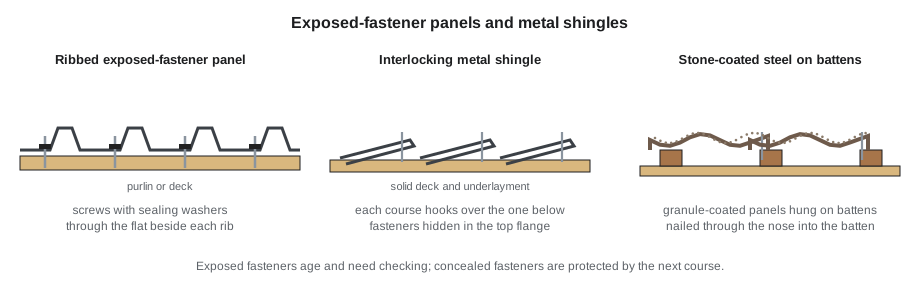
Exposed-fastener panels, often called ribbed, agricultural or through-fastened panels, have ribs pressed into them along their length and are screwed straight through the panel into wood or steel purlins (or into a deck) with self-drilling screws that have bonded sealing washers. Side laps overlap one rib; end laps overlap 150 mm (6 in) or more with sealant tape where the slope is low. They are cheap and fast to install, and common on sheds, barns, garages and some commercial buildings.
Their weakness is the screws. Each one is a hole through the roof sealed by a rubber washer. Washers age in sunlight, and as the panel expands and contracts, the screws work in their holes. On older roofs, leaks at screws and backed-out screws are normal, and the screws should be checked, tightened or replaced with oversize screws every 15 to 20 years. Driving them correctly makes a big difference:
- Drive each screw square to the panel.
- Stop when the washer is snug and its edge just shows beyond the metal cap. An overdriven screw squeezes the washer out sideways and splits it; an underdriven one leaves a gap.
- Use the screw the maker specifies, with the right length for the purlin and the right drill point for wood or steel.
- Follow the maker's screw pattern: in the flat beside the rib or on top of the rib, and how many per purlin, with more at eaves, ridges and end laps.
Ridgecap prefers standing seam on houses because there are no exposed screws in the field of the roof. Ines put it simply: "A ribbed panel roof has a thousand gaskets. A standing seam roof has none."
Worked problem
Screws for a ribbed panel roof
A shed roof has two slopes, each 11.0 m along the eave and 3.6 m up the slope. Panels cover 914 mm wide and are 3.6 m long. Purlins are at 600 mm centres, starting at the eave. The pattern calls for 4 screws per panel at each purlin. How many panels and screws are needed, with 5 in 100 extra screws?
Show solution
- Panels per slope = 11.0 ÷ 0.914 = 12.03, so 13 panels (one cut to width); 26 panels in all.
- Purlins = 3.6 ÷ 0.6 = 6 spaces, so 7 purlins.
- Screws per panel = 7 × 4 = 28; total = 26 × 28 = 728.
- With 5 in 100 extra: 728 × 1.05 = 764.4, so 765 screws, or four boxes of 250.
Answer: 765 screws for 26 panels, plus the trims, ridge cap and closures, which have their own fasteners. Every one of those screws is a washer that will one day need checking.
Metal shingles
Metal shingles are small panels, typically 0.3 to 0.5 m² (3 to 5 ft²) each, pressed with interlocking edges and shaped to look like shakes, slate or tile, or with simple flat or ribbed faces. Most are fastened through a concealed flange that the next course covers, so the fasteners are hidden, like a shingle. They suit roofs with many small planes, dormers and valleys where long panels would be wasteful, and owners who want the look of slate or wood without the weight or upkeep. The Ontario code allows sheet metal shingles at slopes down to 1 in 4.
Stone-coated steel is a variety of metal shingle: aluminum-zinc coated steel with an acrylic base coat, a layer of ceramic-coated stone granules and a clear top coat. The granules hide the metal, quiet the rain and give a textured, non-reflective look. The panels are larger, often about 1.3 m by 0.4 m (50 by 16 in), shaped like several shakes or tiles in one piece, and are usually laid over wood battens (with or without counter-battens) or directly on the deck, fastened with nails or screws through the front edge (the nose) into the batten below, as the maker shows.
Walking on metal shingles takes care. Makers say where to step, usually on the lower part of each panel where it is supported by the batten or the course below, and never on the unsupported high points of a tile shape. Stone-coated panels are less slippery than painted steel when dry but can be slick with frost or wet leaves.
Cutting, handling and care
- Cut with snips, electric shears or nibblers, which shear the metal cold. Never cut prefinished panels with an abrasive cut-off wheel or a grinder: the heat burns the paint and coating along the cut, and hot metal particles embed themselves in the finish nearby and rust within weeks, leaving orange specks the warranty does not cover.
- Sweep up the filings (swarf) from drilling and cutting the same day, before the dew. Left on the roof, they rust and stain the finish.
- Wear cut-resistant gloves and sleeves; panel edges and offcuts are as sharp as knives.
- Carry long panels on edge, with enough people to keep them from bending, and never in wind strong enough to turn them into sails.
- Protect the finish: no dragging panels across each other, soft-soled boots, no walking in the flat of panels except where the maker allows, and no tools left lying on the roof.
- Remember that metal on a sunny day can be too hot to touch bare-handed, and on a cool morning can be covered in invisible dew or frost.
- Keep a separation where the maker requires it between metal and wet treated wood, mortar or other metals.
Friday afternoon: a storm repair
On Friday, September 25, with the Corrigan roof finished at noon, Bram took Rory and Ines to Stoney Creek. A windstorm the previous week had dropped a maple limb on Harjit Bains's house, a two-storey home with a 2014 stone-coated steel roof in a shake profile on a 6 in 12 slope. The limb had creased five panels in two courses, scraped granules off three more, and bent a length of the ridge cap. The insurance adjuster had already visited.
Ridgecap had a crate of the same product left from a 2024 job, close in colour but not identical after a decade of weather. Bram's rule for repairs on any premium roof is to match the original as closely as possible, then put the best match where it is most visible and any slight mismatch where it is least. The creased panels were on the back slope, so the leftover panels went there.
The repair followed the maker's published method. Ines gently lifted the nose of each panel in the course above the damaged ones, just enough to reach the fasteners, and pulled them. The damaged panels slid out. New panels slid in, interlocked with their neighbours, and were fastened through the nose into the batten in the maker's pattern. Then the panels above were bent carefully back down and refastened. Where fastener heads or scratches were left exposed, Ines dabbed on the maker's touch-up coating and pressed loose granules from the same product into it. The scraped panels were touched up the same way rather than replaced, because their steel was sound.
Worked problem
How much roof did the limb damage?
Each panel covers about 0.46 m². Five panels were replaced and three touched up. What area was replaced, and how many spare panels were left from a crate of 12?
Show solution
- Replaced area = 5 × 0.46 = 2.3 m².
- Spares left = 12 − 5 = 7 panels.
Answer: A small area, but the repair took the three of them most of the afternoon, including setting up roof anchors and ladders. Bram left two of the spare panels with the owner in the garage, labelled, for the next storm.
Before they left, Rory photographed every repaired panel for the insurer and for Ridgecap's file, and Bram checked the attic below the impact for any sign that the limb had cracked the deck. It had not.
Common mistakes
MistakeCutting prefinished panels with an abrasive wheel.
InsteadCut with snips, shears or nibblers, and sweep up filings the same day.
MistakeOverdriving exposed-fastener screws.
InsteadStop when the washer is snug and just shows beyond its cap; replace any split washers.
MistakeLetting copper drain onto galvanized or aluminum-zinc coated steel.
InsteadKeep incompatible metals apart and route copper runoff away from other metals.
MistakeWalking anywhere on metal shingles.
InsteadStep only where the maker says the panel is supported.
MistakeRepainting large areas to hide scratches.
InsteadUse the maker's touch-up sparingly, or replace the panel if the damage is large.
Summary and key terms
- Roofing metals are coated steel, aluminum, copper, zinc and stainless steel, each with its own life, cost and compatibility.
- Steel thickness is given by gauge (higher number, thinner steel); 24 and 26 gauge are common on houses.
- Paint finishes range from polyester to SMP to PVDF, the most durable.
- Exposed-fastener panels are cheap and fast but depend on hundreds of screw washers that age.
- Metal shingles, including stone-coated steel, are small interlocking panels with mostly hidden fasteners.
- Metal is cut cold with snips or shears, never with abrasive wheels, and filings are swept up the same day.
- Gauge
- A number describing sheet steel thickness; a higher gauge is thinner.
- Galvanized steel
- Steel coated with zinc to protect it from rust.
- Aluminum-zinc coated steel
- Steel coated with an aluminum-zinc alloy, longer-lasting than plain galvanizing in most roof exposures.
- PVDF finish
- A durable fluoropolymer paint finish with good colour and chalk resistance.
- Exposed-fastener panel
- A ribbed metal panel screwed through its face with sealing washers.
- Stone-coated steel
- Metal shingle panels coated with stone granules over an acrylic base coat.
- Swarf
- Metal filings and chips from cutting and drilling.
- Oil-canning
- Visible waviness in the flat areas of metal panels.
Practice problems
Work each problem on paper first, then reveal the answer to check.
Which is thicker, 26 gauge or 29 gauge steel?
Show answer
26 gauge.
Why must filings be swept off a metal roof the same day?
Show answer
They rust and stain the finish.
A roof has 18 panels per slope, two slopes, 5 purlins and 4 screws per panel per purlin. How many screws?
Show answer
18 × 2 × 5 × 4 = 720.
Why is zinc roofing installed with ventilation beneath it?
Show answer
Moisture trapped on its underside corrodes it.
Name the most durable common paint finish for metal roofing.
Show answer
PVDF.
Lesson quiz · 5 questions
Score 60% or more to complete this lesson.
Create a free account to save your progress, take quizzes and earn a certificate.