
ROOF-110 · Lesson 6 of 12 · 20 min
Fall protection on low-slope roofs
▶ Video coming soon A video version of this lesson is on the way.
Falls are the leading cause of death in construction, and roofers fall more than almost any other trade. Many of those falls happen from low-slope roofs, which surprises new workers. A low-slope roof feels safe. You can walk around on it like a floor, set down tools and materials, and forget that the edge is there. Then you step back to roll out a sheet, or turn around carrying insulation boards in the wind, or walk backwards pulling a hose, and the edge is not where you thought it was. Skylights and openings are the other big killer on low-slope roofs. A plastic skylight dome looks solid but can break under a worker's weight, and an opening covered by a loose sheet of plywood is a trap.
"On a flat roof the edge sneaks up on you," Dana told Rory on his first day at Ashgrove Plaza. "So we decide where the edge is going to stop you before anyone goes up, and then we build that."
This lesson covers how roofers are protected from falls on low-slope roofs: the rules, the systems and how to set them up. Lesson 7 covers steep roofs and the personal fall arrest equipment used on both.
When fall protection is required
In Ontario, section 26 of O. Reg. 213/91 requires fall protection where a worker could fall more than 3 metres. It also applies at lower heights in some situations: where a worker could fall more than 1.2 metres from a surface used as a path for a wheelbarrow or similar equipment, or could fall into operating machinery, into water or another liquid, into or onto a hazardous substance or object, or through an opening in a work surface. On a roof, the height is measured from the roof surface to the ground or the next level below.
Ontario's rules also set an order of preference. Section 26.1 requires a guardrail system wherever it is practicable. If a guardrail is not practicable, the employer must use the highest-ranked method that is practicable, in this order: a travel restraint system, a fall restricting system, a fall arrest system or a safety net. On flat roofs, Ontario also allows a warning barrier set back from the edge, which you will see below. Every worker who may use fall protection must have completed a Chief Prevention Officer-approved Working at Heights training program (O. Reg. 297/13), and the training must be refreshed every three years.
| Method | How it protects | Typical use on low-slope roofs |
|---|---|---|
| Guardrail | a physical barrier at the edge stops anyone reaching it | perimeter of a roof, hoist landings, around openings |
| Barrier set back from the edge | a line on stanchions set back from the edge marks where work stops | the work area away from edges |
| Travel restraint | a harness and lanyard attached to an anchor are too short to let the worker reach the edge | work between the barrier and the edge |
| Fall arrest | a harness, connector and anchor stop a fall after it begins | edge work where restraint is not practicable |
| Safety net | a net catches a falling worker | rare in roofing; used below some large openings |
| Covers and guards for openings | a secured, marked cover or a guardrail stops a fall through | skylights, roof hatches, deck openings |
| (not permitted as a system in Ontario) | Ontario does not accept a monitor as fall protection | use a barrier, restraint or guardrail instead |
Guardrails
A guardrail is the best protection because it works without anyone having to do anything right. Ontario's construction regulation requires a guardrail to have a top rail between 0.9 m and 1.1 m above the surface, an intermediate rail halfway between the top rail and the surface, and a toe board at least 89 mm high where a toe board is needed, and it must be able to resist specified loads without failing. On roofs, guardrails are usually built from steel posts in weighted bases (non-penetrating guardrails), clamped to parapets, or fastened to the structure. A parapet can act as a guardrail only if it meets the same height and strength requirements; most parapets on older plazas are far too low.
Guardrails are always used at hoist landings and material loading points, where workers lean out and handle loads at the edge. They are also the preferred protection around large openings and along any edge where work goes on for a long time. When a section of guardrail must be removed to land materials, the opening is protected another way while it is open, and the guardrail is replaced as soon as the load is in.
Barriers set back from the edge
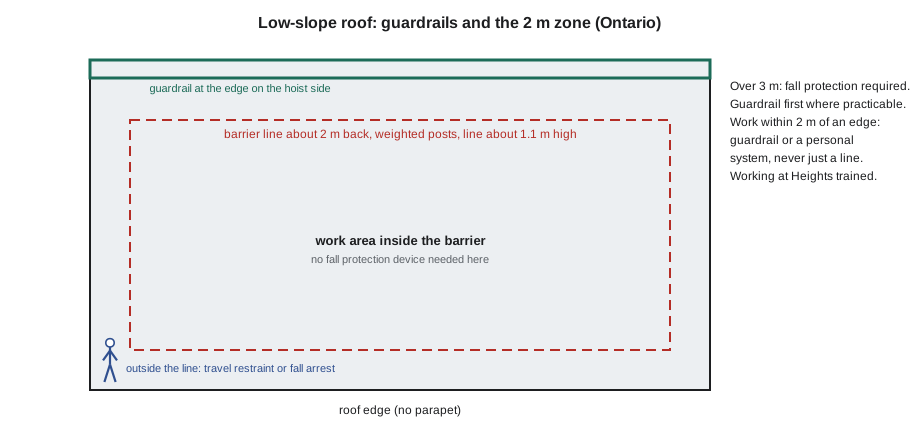
On flat roofs, Ontario allows the work area to be separated from the edge by a barrier rather than a guardrail. Section 207 of O. Reg. 213/91, written for built-up roofing on flat roofs, describes the barrier: it is set up at least 2 metres back from the perimeter, its posts are weighted or otherwise secured so they will not tip, and it carries a rope or line at about 1.1 metres above the roof. Inside the barrier, workers can move freely without a personal fall protection device. Any worker who goes outside the barrier, into the 2 metre zone along the edge, must be protected by a guardrail or by travel restraint or fall arrest. The barrier is a boundary, not a guardrail: it marks where people must stop, but it will not stop someone who walks into it. Check the ministry's guidance on flat roofs for how these rules apply to other kinds of roofing work.
On Ashgrove Plaza, Dana set the barrier 2 metres in from the open rear and side edges and clamped guardrail posts to the 300 mm front parapet, because the front edge faced a busy sidewalk and parking lot. The hoist landing at the rear had a full guardrail on both sides. Work inside the barrier needed no harnesses, which let the crew roll membrane and move materials freely. For the narrow strip along the edges, workers used travel restraint lines attached to anchors in the field of the roof.
Worked problem
Setting out a barrier around a work area
A rectangular section of Ashgrove Plaza's roof measures 40 m by 25 m with open edges on all four sides. The barrier will be set 2 m in from every edge, with posts no more than 3 m apart (Ridgecap's rule). How much line is needed, and how many posts?
Show solution
- Inside length: 40 − 2 × 2 = 36 m. Inside width: 25 − 2 × 2 = 21 m.
- Perimeter of the barrier: 2 × (36 + 21) = 114 m of line, plus extra for ties.
- Posts: 114 ÷ 3 = 38 spaces, so 38 posts around a closed loop.
Answer: About 114 m of line on 38 posts, inside which workers need no personal device. Anyone working in the 2 m strip uses travel restraint, fall arrest or a guardrail.
Safety monitoring
Some fall protection rules elsewhere allow a safety monitor, a person who watches workers near the edge and warns them. Ontario's construction regulation does not accept a safety monitor as a means of fall protection. If you work in Ontario, any work closer to an unprotected edge than the barrier must be protected by a guardrail, travel restraint, fall restriction, fall arrest or a net.
Personal systems on low-slope roofs
Travel restraint is the preferred personal system on low-slope roofs. The worker wears a full-body harness connected by a lanyard or line to an anchor, and the length is set so the worker cannot reach the edge. Because the worker never goes over the edge, there is no fall to arrest. The anchor can be a permanent roof anchor, a temporary anchor fastened through to the structure, or a weighted, non-penetrating mobile anchor designed for that roof surface and slope. The length of line must be measured: the distance from the anchor to the edge, minus a margin, decides the maximum lanyard length.
Fall arrest is used when the worker must be able to reach the edge, for example to install edge metal or flash the outside face of a parapet. A fall arrest system must stop the fall before the worker hits the ground or a lower level, so clearance below the edge matters, as you will see in lesson 7. On low-slope roofs there is another hazard: a lanyard running over the roof edge can be cut by a sharp metal edge or drip edge during a fall. Use lanyards and self-retracting lifelines rated for leading-edge use where the line may run over an edge.
Whatever personal system is used, the anchor must be strong enough. A pipe, a vent stack, a rooftop unit, a gas line or a skylight frame is not an anchor. Anchors are installed and inspected as their manufacturers and engineers specify.
Skylights and roof openings
Skylights are among the most dangerous features on a low-slope roof. Plastic domes and older wired glass can break under a worker who sits, steps or falls onto them, and they are often painted over or covered with dirt so that they blend into the roof. Many roofers have died falling through skylights while backing up or resting.
Ontario's construction regulation requires openings in a work surface that a worker could fall through to be covered or guarded, and the cover must be secured and strong enough for the loads it may carry. Skylights should be protected with a guardrail around them or a secured screen or cover rated for the load, before work starts nearby. Openings made during tear-off, such as where an old roof hatch or curb is removed, must be covered or guarded right away.
Dana's crew walks every roof before work starts and marks every skylight and opening on the site plan. Each one is protected before tear-off begins. "Never sit on a skylight, never stand on one and never step backwards on a roof you haven't walked," she told Rory.
Access, hatches and roof edges at the access point
Workers often reach low-slope roofs by ladder, stair tower, roof hatch or hoist landing, and the access point is often at the edge. Make sure the protection at the access point is in place before the first person steps off the ladder: a guardrail or a gate at the ladder landing, a protected path through the barrier to the work area, and a closed hatch or guardrail around an open hatch. A roof hatch left open with no guardrail is an opening someone can fall through.
Planning the fall protection for a low-slope job
Before work starts on a low-slope roof, the foreperson works through these questions and records the answers in the fall protection plan or site hazard assessment:
- How high is the roof, and does any edge or opening require protection?
- Where are the edges, parapets (and their heights), skylights, hatches and other openings?
- Where will workers access the roof, and where will materials come up and debris come down?
- Where can guardrails be used, and where will barriers or warning lines go?
- What work must be done near the edge, and what personal system will protect it?
- What anchors are available or will be installed, and are they rated for the system?
- How will a worker who falls and is caught by a fall arrest system be rescued?
- Who has the required training, and who will check the systems each day?
Ontario also requires written rescue procedures before workers use a fall arrest system or safety net, and Ridgecap writes a full fall protection plan for every job.
Common mistakes
MistakeTreating a barrier line as a guardrail.
InsteadA barrier or warning line marks a boundary but will not stop a fall; anyone outside it needs other protection.
MistakeTying off to a vent pipe or rooftop unit.
InsteadUse only anchors rated and installed for fall protection.
MistakeStepping backwards while rolling out membrane.
InsteadKnow where you are relative to the edge and openings, and set up barriers so the edge cannot sneak up on you.
MistakeLeaving a skylight unprotected because the work is not right beside it.
InsteadProtect skylights and openings before work starts anywhere nearby.
MistakeRelying on a safety monitor in Ontario.
InsteadOntario does not accept monitors; use a barrier, guardrail, restraint or arrest system.
Summary and key terms
- In Ontario, fall protection is required above 3 m and in other special cases; guardrails come first.
- A barrier set at least 2 m from the edge on secured posts, with a line at about 1.1 m, allows work without personal devices inside it.
- Ontario does not accept safety monitoring as fall protection.
- Travel restraint keeps workers from reaching the edge and is preferred over fall arrest.
- Skylights and openings must be guarded or covered with secured, rated covers.
- Every worker using fall protection needs approved Working at Heights training, refreshed every three years.
- Guardrail system
- A barrier of top rail, intermediate rail and posts (and toe board where needed) that stops workers reaching an edge.
- Barrier
- A line on secured posts set back from the edge of a flat roof to mark the boundary of the work area.
- Travel restraint
- A personal system that keeps a worker from reaching a fall hazard.
- Fall arrest system
- A personal system that stops a worker after a fall has begun.
- Working at Heights training
- Ontario's mandatory, CPO-approved training for workers who use fall protection.
- Skylight
- A window in a roof; many are not strong enough to hold a falling worker.
Practice problems
Work each problem on paper first, then reveal the answer to check.
Above what height does Ontario require fall protection in general?
Show answer
More than 3 metres.
Which fall protection method ranks first in Ontario?
Show answer
A guardrail system, wherever practicable.
How far back from the edge is a flat-roof barrier set, and how high is its line?
Show answer
At least 2 metres back, with a line at about 1.1 metres.
Can a 400 mm parapet act as a guardrail?
Show answer
No. It is well below the 0.9 m minimum top rail height.
Why is a skylight dangerous?
Show answer
It may not hold a worker's weight and can blend into the roof.
Lesson quiz · 5 questions
Score 60% or more to complete this lesson.
Create a free account to save your progress, take quizzes and earn a certificate.