
ROOF-110 · Lesson 11 of 12 · 24 min
Protecting the public and the building
▶ Video coming soon A video version of this lesson is on the way.
Ashgrove Plaza stayed open for business the whole time Ridgecap was re-roofing it. A pharmacy, a coffee shop, a dental office, a dry cleaner and a convenience store kept their doors open while the crew tore off the old roof above their heads. Customers parked in the lot, walked along the sidewalk under the front edge and carried coffee past the disposal bin at the rear. Delivery trucks backed into the laneway beside the kettle. Inside, a dentist was drilling teeth under the section being torn off, and the pharmacy's rooftop units drew air from right beside the work.
"The roof is the easy part," Dana told Rory on the first morning. "Our job is also to make sure nobody down there gets hurt, nothing falls on anybody, no water gets in and nobody inside breathes our fumes. If we do all that, the people in those stores barely notice we were here."
This lesson covers how roofers protect people who are not part of the crew, including the public, tenants and other trades, and how they protect the building and its contents during the work. It also covers awareness of two hazardous materials that roofers can disturb in older buildings: asbestos and silica.
Who needs protecting
On any roofing job, think about everyone who could be affected by the work:
- The public: pedestrians on sidewalks, customers in parking lots, children, cyclists and drivers on nearby streets.
- Occupants: people living or working in the building, who may be under the roof deck while it is torn off and replaced.
- Neighbours: people in nearby buildings and yards who may be affected by debris, fumes, noise and dust.
- Other trades: workers on the same site, such as mechanical contractors working on rooftop units or crews working below.
- Emergency responders: firefighters and paramedics who need clear access to the building.
Each group faces different hazards: falling objects, wind-blown debris, fumes entering the building, water leaks, blocked exits, tripping over hoses and cords, and burns from hot materials near kettles.
Keeping falling objects away from people
The biggest risk to the public on a roofing job is something falling or being dropped from the roof. A shingle, a piece of metal, a hand tool or a bucket falling a few storeys can kill. Roofers control this in three ways: keep things from falling, control where falling things can land, and keep people out of the area where they could land.
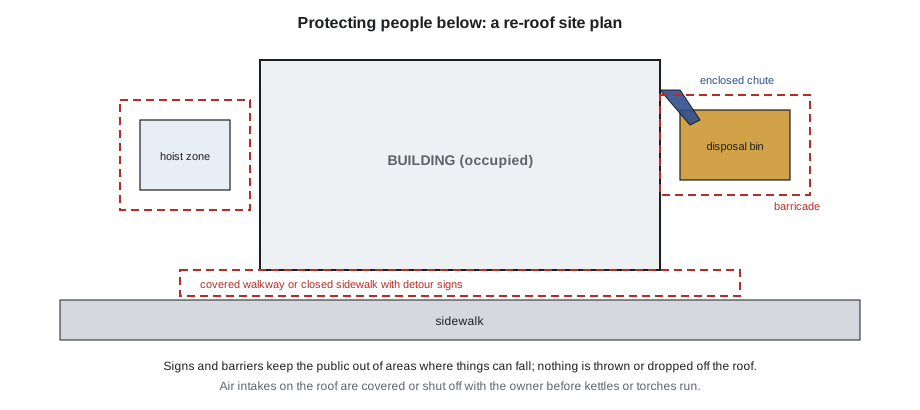
Keeping things from falling starts with housekeeping and tool control, covered in lesson 3: tools in belts, buckets and trays, materials stacked away from edges and secured against wind, debris bagged or moved to the chute as work goes on. At the roof edge, toe boards on guardrails stop tools and materials from being kicked off. On steep roofs, roof brackets and planks catch sliding materials.
Debris never goes off a roof by throwing or dropping it where it could endanger anyone. Ontario's construction regulation does not allow material to be thrown or dropped from a height where it could hurt someone, so roofers lower debris in an enclosed chute that empties into a bin, in a hoist bucket, or by crane in bins, or they carry it down in a controlled way. A chute should be enclosed, secured to the building and sized for the debris, with its bottom end ending inside the bin. The area around the bottom of the chute and the bin is barricaded with signs so nobody walks into it.
Keeping people out of the danger zone means barricades, fencing, signs and, where people must pass close to the building, overhead protection. Where a sidewalk runs along the roof edge, the options are to close it and detour pedestrians with signs (which usually needs a permit from the municipality), to build a covered walkway with a solid roof strong enough to stop falling objects, or to make sure nothing can fall over that edge by using guardrails with toe boards and keeping all work and materials back from it. On Ashgrove Plaza, the front sidewalk stayed open because the storefronts needed it, so Dana used guardrails with toe boards clamped to the front parapet, kept all materials well back from the front edge and did the front edge metal early on a Sunday morning with the sidewalk closed by the city's permit.
| Area | Hazard to the public | Protection |
|---|---|---|
| Under the roof edge | falling tools, materials, debris | guardrails with toe boards, materials kept back, covered walkway or closed sidewalk |
| Hoist and loading zone | loads overhead, swinging loads | barricade, signs, spotter during lifts, no walking under loads |
| Chute and bin | debris falling, dust, sharp material | enclosed chute into bin, barricade, signs, covered bin |
| Kettle area | burns, fire, fumes | barricade, attendant, set up away from entrances and intakes |
| Parking lot | nails, overspray, falling debris, vehicles near equipment | magnetic sweeps, car covers or move cars, cones and signs |
| Building entrances | objects falling near people entering or leaving | overhead protection or redirect entrances, schedule work around busy times |
Worked problem
Laying out a barricade around the bin
The disposal bin at Ashgrove Plaza is 6.0 m long and 2.4 m wide. Ridgecap's rule is to barricade at least 2 m out from every side of the bin and the chute landing. What size is the barricaded area, and how many metres of fencing are needed to go around it?
Show solution
- Barricade length: 6.0 + 2 × 2 = 10.0 m.
- Barricade width: 2.4 + 2 × 2 = 6.4 m.
- Perimeter: 2 × (10.0 + 6.4) = 32.8 m.
- Area: 10.0 × 6.4 = 64 m².
Answer: A barricaded area of 10.0 m by 6.4 m, needing about 33 m of fencing, with a gate on the side the truck uses and signs on each side.
Signs, communication and scheduling
Good communication prevents many problems with occupants and the public. Before work starts, the foreperson or the office meets the building owner or property manager to agree on:
- Work hours, noisy work times and any quiet periods, such as a dental office's appointment schedule or a school's exam days.
- Which entrances, parking areas and loading docks will be closed or changed, and when.
- Which rooftop units and air intakes will be shut down or covered, and when.
- How occupants will be told about the work, for example by notices on doors and emails to tenants.
- Who to call on each side if there is a leak, an odour complaint or an emergency.
Signs at entrances, sidewalks, barricades, kettles and the bin tell people what the hazard is and where to go instead. Signs should be clear, readable from a distance and placed before the hazard, not at it.
Fumes, odours and dust inside the building
Asphalt fumes, torch smoke, adhesive and primer vapours, engine exhaust and dust from tear-off can all be drawn into a building through rooftop air intakes, open windows, vents and gaps in the roof deck. Occupants may complain of odours, headaches or nausea, and people with asthma or other conditions can be badly affected. In schools, hospitals and food businesses, this can shut the building down.
To prevent this:
- Locate every air intake on and near the roof during the pre-job walk, and mark them on the site plan.
- Arrange with the owner to shut down or set the rooftop units to recirculate while hot work or adhesives are used nearby, or temporarily cover or filter the intakes, following the owner's mechanical contractor's advice.
- Set the kettle up downwind of intakes, doors and windows, and keep engine-driven equipment away from them.
- Use low-odour or low-VOC adhesives and primers where the specifications allow, especially over occupied spaces.
- Plan the most odorous work for times when the building is empty or lightly occupied.
Tear-off can also shake dust and debris down from the underside of the deck into the space below, especially in older buildings with exposed decks. Ask the owner to move or cover stock and equipment below the work, and plan protection, such as poly sheeting, in sensitive areas.
Keeping the building dry
A roofer's first duty to the building is to keep water out. A re-roof makes the building most vulnerable exactly when the old roof is off and the new one is not yet finished. Ridgecap's rules are simple:
- Never tear off more than can be made watertight the same day, with a margin for problems.
- Check the forecast before tearing off, and keep checking during the day.
- Install a temporary water cut-off (night seal) at the edge of every day's work so water cannot run under the new roof from the old one.
- Keep roof drains, scuppers and gutters working; protect drains from debris and never leave a drain blocked overnight.
- Keep tarps and temporary materials on the roof in case of sudden rain, and secure everything against wind at the end of the day.
- Check the inside of the building after heavy rain on the first night of each new section.
Worked problem
Planning tear-off to stay dry
The Ashgrove Plaza roof is about 2,600 m². Crew 2 can tear off and dry in (insulation and base sheet) about 280 m² in a normal day. The cap sheet is torched later over the dried-in areas. Rain is forecast for 3:00 pm on Thursday, and the crew needs about 1.5 hours to tear off and dry in 50 m². If the crew starts at 7:00 am and stops tear-off with 1.5 hours to spare before the rain, how much can it safely open up on Thursday, and how many normal days does the whole tear-off take?
Show solution
- Latest finish for dry-in: 3:00 pm − 1.5 h = 1:30 pm.
- Working time: 7:00 am to 1:30 pm = 6.5 hours.
- Rate: 50 m² per 1.5 h ≈ 33 m² per hour.
- Thursday area: 6.5 × 33 ≈ 217 m², so plan about 200 m².
- Whole roof: 2,600 ÷ 280 ≈ 9.3, so about 10 normal days.
Answer: On Thursday, open up only about 200 m² and have it dried in by 1:30 pm. The full tear-off takes about 10 normal working days, plus weather days.
Protecting rooftop equipment and the property
Roofs carry expensive equipment: rooftop heating and cooling units, exhaust fans, satellite dishes, solar panels, lightning protection and antennas. Workers, carts and materials can damage them, and torches can melt wiring and gaskets. Protect equipment with boards or covers, keep traffic paths away from it, and get the owner to arrange for the mechanical or electrical contractor to disconnect, lift or reconnect equipment when the roof under it is replaced. Never disconnect gas, electrical or refrigerant lines yourself unless you are qualified and authorized.
At ground level, protect landscaping, walls and windows from falling debris and overspray, keep the parking lot clear of nails with magnetic sweepers, and clean up daily. Report any damage to the owner right away. Customers remember the contractor who left nails in their driveway long after they forget the new roof.
Asbestos awareness
Buildings built before about 1990 may contain asbestos in some roofing materials: older built-up roofing felts, some roof cements, mastics and coatings, asbestos-cement shingles and panels, and the insulation on some old pipes and ducts on roofs. Asbestos fibres released from damaged or cut material can cause asbestosis, lung cancer and mesothelioma, often decades after exposure. Under Ontario's Occupational Health and Safety Act, the owner of a project must prepare a list of designated substances present at the project, including asbestos, and give it to contractors before the work is tendered. O. Reg. 278/05 (Designated Substance: Asbestos on Construction Projects and in Buildings and Repair Operations) classifies asbestos work into Type 1, Type 2 and Type 3 operations, based on how friable the material is, how much is disturbed and how it is removed, with increasing precautions, training and controls for each type. Removing non-friable asbestos roofing by hand, without breaking it up, is generally a lower-risk operation, while cutting it with power tools or disturbing friable material calls for much stricter measures. Only trained workers may do asbestos work, under the type of controls the regulation requires.
For an apprentice, the rule is simple: if you suspect a material contains asbestos, or you uncover something unexpected, such as old felts, fibrous cement or pipe insulation, stop work in that area, do not cut or break it, and tell your foreperson. Ridgecap checks the owner's hazardous materials information before every tear-off and has suspect materials tested when the information is missing.
Silica awareness
Crystalline silica is a mineral found in sand, stone, concrete, mortar, brick and clay and concrete roof tiles. Cutting, grinding or drilling these materials releases fine respirable dust that can cause silicosis, lung cancer, chronic obstructive pulmonary disease and kidney disease. Roofers make silica dust when they cut concrete or clay tiles, cut or drill into concrete decks or masonry parapets, grind mortar at chimneys and walls, and sometimes when sweeping up old gravel surfacing. Ontario's designated substance regulation for silica, O. Reg. 490/09, sets occupational exposure limits for respirable crystalline silica but does not apply to construction projects; instead, the ministry publishes a guideline, Silica on Construction Projects, that classifies silica tasks and sets out controls and respirators for each, and employers must still take every reasonable precaution under the Act.
Practical controls for roofers include using saws and grinders with water feed or with shrouds connected to a dust collector, cutting tiles on the ground in a controlled area rather than on the roof, wetting gravel before removal, using a HEPA vacuum instead of dry sweeping, positioning work so dust blows away from others and from air intakes, and wearing the respirator the task calls for.
Common mistakes
MistakeDropping debris over the edge into the bin when nobody is around.
InsteadUse an enclosed chute, hoist or controlled lowering every time; people walk into areas unexpectedly.
MistakeRunning the kettle beside a rooftop air intake.
InsteadLocate intakes, set up downwind and have the owner shut down or protect units during hot work.
MistakeTearing off a large area because the morning is sunny.
InsteadOpen up only what can be dried in before the forecast weather, with a margin.
MistakeCutting into an unknown old felt or cement to see what it is.
InsteadStop, do not disturb it, and tell the foreperson so it can be tested.
MistakeDry-sweeping dust from cutting concrete tile.
InsteadUse wet methods or a HEPA vacuum, and the respirator the task requires.
Summary and key terms
- Protect the public, occupants, neighbours, other trades and emergency responders from every hazard the work creates.
- Never throw or drop debris where it could hurt someone; use enclosed chutes, hoists or controlled lowering, and barricade the landing area.
- Use guardrails with toe boards, keep materials back from edges, and close or cover walkways under the work.
- Coordinate with the owner on hours, access, signs and rooftop units, and keep fumes out of air intakes.
- Never open more roof than can be made watertight before the weather turns; install night seals daily.
- Asbestos work is classified as Type 1, 2 or 3 under O. Reg. 278/05; silica on construction is managed under the ministry's guideline.
- Covered walkway
- A sidewalk protected by a solid roof strong enough to stop falling objects.
- Enclosed chute
- A closed tube or channel that carries debris from the roof to a bin.
- Night seal
- A temporary watertight cut-off installed at the edge of each day's roofing work.
- Air intake
- An opening that brings outside air into a building's ventilation system.
- Asbestos
- A fibrous mineral once used in some roofing materials; its fibres cause serious lung disease.
- Respirable crystalline silica
- Fine silica dust, made by cutting or grinding stone, concrete, masonry or tile, that can lodge deep in the lungs.
Practice problems
Work each problem on paper first, then reveal the answer to check.
What must an Ontario project owner give contractors before tendering about hazardous substances?
Show answer
A list of designated substances, such as asbestos, present at the project.
A bin is 5 m by 2.5 m and needs a 2 m barricade all around. What is the barricade perimeter?
Show answer
(5 + 4) × 2 + (2.5 + 4) × 2 = 18 + 13 = 31 m.
Name two ways to stop fumes entering a building during hot work.
Show answer
Shut down or protect rooftop air intakes with the owner, and set up kettles downwind and away from intakes (also low-odour products and scheduling).
What is a night seal?
Show answer
A temporary watertight cut-off at the edge of the day's work.
Does O. Reg. 490/09's silica exposure limit apply to construction projects?
Show answer
No; the ministry's Silica on Construction Projects guideline applies, along with the general duty to protect workers.
Lesson quiz · 5 questions
Score 60% or more to complete this lesson.
Create a free account to save your progress, take quizzes and earn a certificate.