
ROOF-110 · Lesson 3 of 12 · 22 min
Hand tools and power tools
▶ Video coming soon A video version of this lesson is on the way.
Rory's first purchase as an apprentice was a tool belt, and his second was a better tool belt. The first one held a hammer, a tape and a utility knife and nothing else. By his third week, Dana had added a chalk line, aviation snips, a hand seamer, a flat bar, a carpenter's pencil, a marker, a seam probe and a small roller to the list, and the old belt was sagging. "Buy good tools once," she told him. "Cheap tools break at the worst moment, and on a roof the worst moment is when you are leaning over to reach something."
This lesson covers the hand tools and power tools that roofers use every day, how to choose and look after them and how to use them without hurting yourself or anyone else. Kettles, torches and hot-air welders, which add fire and burn hazards, are covered more fully in lesson 4. Ladders and hoists are covered in lesson 8.
The roofer's hand tools
Most roofing hand tools fall into a few families: tools for measuring and marking, for cutting, for fastening, for prying and removing, and for applying and finishing. Many are shared with carpentry and sheet metal, but roofers use them in tougher conditions: on slopes, in wind and heat, on surfaces covered in granules or asphalt.
| Family | Tools | Roofing use |
|---|---|---|
| Measuring and marking | tape measure, chalk line, framing square, speed square, level, slope gauge, marker, crayon | laying out courses, cut lines, slope, setbacks for barrier lines |
| Cutting | utility knife with hook and straight blades, aviation snips (left, right and straight), shears | cutting membrane, shingles, insulation, metal flashing |
| Fastening | roofing hammer or hatchet, hammer tacker, hand riveter, screwdrivers | nailing, tacking underlayment, riveting metal |
| Prying and removing | flat bar, cat's paw, shingle removal shovel, roofing spade, pry bar | tear-off, pulling nails, removing flashing |
| Applying and finishing | caulking gun, trowels, brushes, rollers, seam probe, hand seamer, broom, squeegee | sealants, mastics, seams, cleanup, bending metal |
The utility knife is probably the tool that causes the most injuries on a roofing crew. Roofers cut membranes, underlayments, insulation and shingles all day, often while kneeling and pulling the blade toward themselves. A hook blade lets you cut membrane and shingles from the back by pulling the hook through the material, with the point shielded. A few habits prevent most cuts:
- Cut away from your body and away from your free hand, and keep your free hand behind the blade.
- Use a sharp blade. A dull blade needs more force, and more force means a worse slip.
- Retract or close the knife every time you put it down or carry it.
- Put used blades in a blade bank or a closed container, never loose in a pocket or on the roof.
- Wear cut-resistant gloves for cutting tasks, and keep the material supported so it does not shift.
Aviation snips are colour-coded by the direction they cut. Red handles usually cut left (curving to the left), green usually cut right and yellow cut straight. Cut metal edges are as sharp as a knife, so wear cut-resistant gloves when handling flashing and coil stock, and bend or hem exposed edges where the detail allows.
A roofing hatchet has a hammer face for nailing and a sharp blade for splitting wood shakes or cutting shingles; many have an adjustable gauge for setting shingle exposure. A roofing hammer with a magnetic nail holder lets you set a nail one-handed. Keep striking faces clean and free of mushrooming, and replace cracked or loose handles. A hammer that flies off its handle on a roof can strike someone below.
Keeping tools under control at height
On the ground, a dropped tool is an inconvenience. On a roof, it can slide off the edge and strike someone below, or trip someone on the roof. Roofers manage this in a few ways. Tools are carried in a belt or a bucket, not in hands while climbing. Loose tools are kept away from the edge, and on steep roofs they rest on roof brackets or in a tool tray, not on the slope. When working at an edge above people or a walkway, tool lanyards tie tools to the worker's belt or wrist. And the area below is barricaded or covered so that anything that does fall cannot reach anyone, as you will see in lesson 11.
Housekeeping is part of tool safety. Scraps of membrane, shingle wrappers, plastic bags and cut-offs are trip hazards and, in wind, they become missiles. Granules and loose nails on a steep roof act like ball bearings underfoot. Crew 2 sweeps and bags debris through the day, not only at the end, and uses a magnetic sweeper around the building after every tear-off to pick up nails before tenants' cars find them.
Power tools on the roof
Power tools make roofing faster, but they add electrical, noise, dust and impact hazards. The main ones on Ridgecap's trucks are listed below.
| Tool | Use | Main hazards and controls |
|---|---|---|
| Pneumatic coil nailer | nailing shingles and underlayment | nails into hands, legs and feet; air hose trips; use full sequential trigger |
| Cordless drill and impact driver | membrane fasteners and plates, metal screws | wrist injury from torque; battery fires if damaged |
| Circular saw | cutting sheathing and wood blocking | kickback; guards removed; dust; cord damage |
| Roof cutter (walk-behind saw) | cutting old roof into strips for tear-off | noise, dust (possibly silica or asbestos), blade contact, cutting through deck |
| Power tear-off machine | stripping old built-up or single-ply roofs | noise, vibration, run-away machine, hidden openings |
| Angle grinder | cutting metal, removing old fasteners | sparks start fires, wheel bursts, kickback; treat as hot work |
| Hot-air welder | welding TPO and PVC seams | burns, fire at combustible details, cords, fumes from overheated plastic |
| Air compressor | supplies nailers | hose whip, noise, carbon monoxide from gas engines near air intakes |
Before using any power tool, inspect it. Check the guard, cord or hose, plug or coupling, switch and accessory. A tool with a damaged cord, a missing guard or a switch that sticks is tagged and taken out of service. Use the right accessory for the material: a blade or wheel rated for the speed of the tool and the material being cut. Hold the tool with both hands where it is designed for it, and keep a firm footing. On a slope that means working from roof brackets or a level platform, not leaning off balance.
Electrical tools and cords outdoors on construction sites must be protected by ground fault circuit interrupters (GFCIs). The temporary wiring rules in the electrical code and the construction regulation require it, and a GFCI shuts off power in a fraction of a second if current leaks to ground, for example through a wet cord or a damaged tool. Test the GFCI with its test button at the start of each day. Use extension cords rated for outdoor and heavy use, keep them out of puddles and away from kettles and torches, and never run them where they can be cut by roofing edges or crushed by equipment.
Cordless tools reduce cord hazards, which is one reason they have taken over much of the roofing toolbox. Their lithium-ion batteries bring a different hazard: a damaged, crushed or overheated battery can catch fire. Keep batteries out of direct sun on a hot roof when you can, do not use batteries that are swollen, cracked or very hot, and charge them on the ground, away from combustible materials, using the manufacturer's charger.
Nail guns
Pneumatic nail guns are the main fastening tool on steep-slope roofs. They are fast and accurate, and they cause a large number of serious injuries in residential construction: nails through hands, fingers, feet and legs, nails that ricochet off hard knots or metal, and sometimes nails into eyes, heads and chests. Many of these injuries come from the way the tool is triggered.
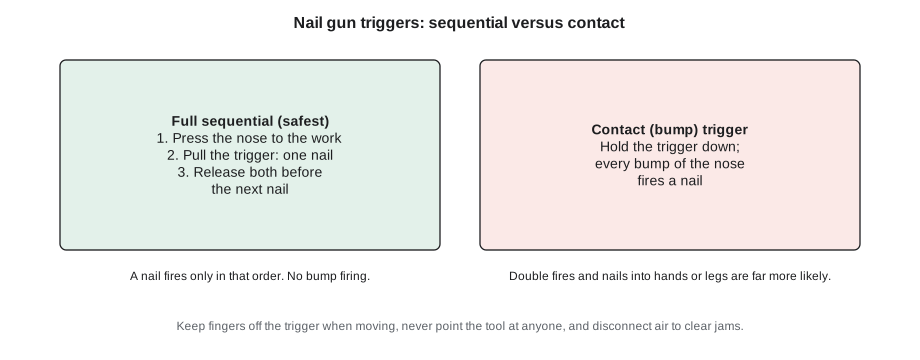
Nail guns have two controls: the trigger and a spring-loaded contact element at the nose. How they interact decides when a nail fires. A full sequential trigger fires only when the contact element is pressed first and the trigger is pulled second, and both must be released before the next nail. A contact trigger (often called a bump trigger) fires whenever the contact element is pushed while the trigger is held down, so the operator can "bump fire" quickly across a roof. Research by NIOSH found that the risk of a nail gun injury is about twice as high with contact triggers as with sequential triggers. NIOSH's nail gun safety guide, which is widely used by Canadian contractors too, recommends full sequential triggers, especially for new workers.
Ridgecap issues only full sequential trigger nailers to apprentices, and Dana's crews use them for all roofing. Keisha admitted it slowed her down for about a week. After that, she said, she stopped noticing.
Other nail gun habits that prevent injury:
- Keep your finger off the trigger when you are not nailing, and never carry the tool with your finger on the trigger.
- Keep your free hand at least a hand's width away from the nailing point.
- Never point the tool at yourself or anyone else, and never bypass or remove the safety contact.
- Disconnect the air before clearing a jam, adjusting the tool, passing it to someone or leaving it.
- Set the air pressure to the tool manufacturer's range; too much pressure overdrives nails and increases recoil.
- Watch for hard spots, knots and metal that can deflect a nail, and keep the nose flat to the surface.
Air hoses are a trip hazard and, on a steep roof, a hazard that can pull you off balance. Route the hose so it is not underfoot, use a swivel fitting so it does not kink, and never use the hose to lower the tool or to steady yourself. Compressors with gasoline engines produce carbon monoxide; keep them on the ground and away from building air intakes, windows and doors.
Worked problem
Planning fasteners for a shingle job
A Linden Street re-roof needs 30 roofing squares of laminated shingles. (Canadian roofers still use the square: 100 square feet of roof, about 9.29 m².) The shingle maker's instructions for this product call for 64 shingles per square and 4 nails per shingle in normal areas. Coil nails come in coils of 120, packed 60 coils to a box. How many boxes are needed, allowing an extra 10 in 100 for waste and starter courses?
Show solution
- Shingles: 30 × 64 = 1,920 shingles.
- Nails: 1,920 × 4 = 7,680 nails.
- Add 10 in 100: 7,680 × 1.10 = 8,448 nails.
- Coils: 8,448 ÷ 120 = 70.4, so 71 coils.
- Boxes: 71 ÷ 60 = 1.18, so 2 boxes.
Answer: Two boxes (120 coils). Always check the product instructions: high-wind areas and some products need more nails per shingle.
Noise, dust and vibration from tools
Power tools on roofs are loud. Roof cutters, tear-off machines, grinders and circular saws can easily exceed 100 dBA at the operator's ear. Hearing loss from noise is permanent and painless, so it creeps up over years. Lesson 5 covers hearing protection and exposure limits; for now, remember that if you have to shout to be heard by someone an arm's length away, the noise is likely loud enough to damage hearing.
Cutting old roofing can release dust. Old built-up roofs, mastics and some flashing cements may contain asbestos, and cutting concrete tile, clay tile, concrete decks or masonry makes respirable crystalline silica dust. Both cause serious, permanent lung disease. Before cutting into an old roof, the foreperson checks the owner's information about hazardous materials, and if there is any doubt, the material is tested before work begins. Tools with water feed or dust extraction, and the right respirator, are used where silica or other dust cannot be avoided. Lesson 11 returns to asbestos and silica.
Vibration from roof cutters, tear-off machines and impact tools can damage nerves and blood vessels in the hands and arms over time. Rotate tasks, use tools with vibration-reducing handles, keep tools well maintained and take breaks.
Looking after tools
Tools that are maintained are safer. At Ridgecap, tools are checked when they are issued and before each use, and any defect is reported to the lead hand. The shop keeps a red tag board: a tool with a red tag is out of service until it is repaired or thrown out.
- Keep blades and snips sharp and replace them when they dull.
- Clean asphalt and sealant off tools before they set; use the solvent the product label recommends, outdoors and away from flames.
- Oil pneumatic tools as the manufacturer directs, and drain compressor tanks daily.
- Store tools dry and secure on the truck, not loose in the bed where they can slide or be stolen.
- Never modify a tool, remove a guard or bypass a safety device.
Dana had Rory sharpen and clean his own tools on rainy mornings. "If you keep your tools, you'll keep your fingers," she said.
Common mistakes
MistakeLeaving a utility knife open on the roof or in a pocket.
InsteadRetract or close the knife every time, and carry it in a sheath or pouch.
MistakeUsing a contact (bump) trigger nailer because it is faster.
InsteadUse a full sequential trigger, especially as a new worker. The time saved is small and the injury risk is roughly halved.
MistakeClearing a nail gun jam with the air connected.
InsteadDisconnect the air supply first, then clear the jam as the manual directs.
MistakeRunning a gas compressor next to a rooftop air intake.
InsteadKeep engines on the ground, away from intakes, doors and windows, to prevent carbon monoxide entering the building.
MistakeCutting into an old roof without knowing what is in it.
InsteadCheck for asbestos and silica-containing materials before cutting, and use dust controls and respirators where needed.
Summary and key terms
- Roofing hand tools fall into measuring, cutting, fastening, prying and finishing families.
- Utility knives cause many injuries; cut away from yourself, keep blades sharp, retract the blade and dispose of blades safely.
- Tools at height must be controlled with belts, buckets, trays and lanyards, and the area below protected.
- Inspect power tools before use, use GFCI protection outdoors and treat damaged batteries as a fire hazard.
- Full sequential trigger nail guns are much safer than contact triggers and are recommended for new workers.
- Tools create noise, dust and vibration; check for asbestos and silica before cutting old materials.
- Hook blade
- A utility knife blade shaped like a hook, used to cut membranes and shingles from the back with the point shielded.
- Aviation snips
- Compound-lever metal cutting snips, colour-coded by cutting direction.
- Full sequential trigger
- A nail gun trigger that fires only when the nose is pressed first and then the trigger is pulled, one nail at a time.
- Contact trigger
- A nail gun trigger that fires each time the nose is bumped while the trigger is held down.
- GFCI
- A ground fault circuit interrupter, a device that cuts power quickly when current leaks to ground.
- Square
- A roofing unit of area equal to 100 square feet of roof surface.
Practice problems
Work each problem on paper first, then reveal the answer to check.
Which colour of aviation snips usually cuts straight?
Show answer
Yellow.
What should you do before clearing a jam in a pneumatic nailer?
Show answer
Disconnect the air supply.
Why are gas-powered compressors kept away from building air intakes?
Show answer
Their exhaust contains carbon monoxide, which can be drawn into the building.
How much higher is the injury risk with contact trigger nailers, according to NIOSH research?
Show answer
About twice as high as with sequential triggers.
A job needs 20 squares, 64 shingles per square and 4 nails per shingle. How many nails before waste?
Show answer
20 × 64 × 4 = 5,120 nails.
Lesson quiz · 5 questions
Score 60% or more to complete this lesson.
Create a free account to save your progress, take quizzes and earn a certificate.