
RCDD-111 · Lesson 7 of 12 · 18 min
Conduit and sleeves
▶ Video coming soon A video version of this lesson is on the way.
Tomasz has a photograph on his phone that he shows to every new designer he meets. It is a run of conduit in a hospital corridor ceiling: from the telecommunications room it rises, turns, jogs around a duct, drops, turns again, crosses a beam with two more bends and finally disappears into a wall toward an operating room. 'Six bends,' he says. 'Forty metres without a pull box. We pulled three cables through it with a winch and the third one came out with the jacket stripped. The engineer said the drawing showed a straight line.' Daniel laughs, but Roz points at the screen. 'That is exactly why the standards have rules for conduit. A straight line on a drawing is a wish. The rules are what make it a pathway.'
Conduit is the most protected and the most permanent pathway in a building. Once it is buried in a slab, a wall or a ceiling, it is very expensive to change, so the design has to get it right the first time: the right type, the right size, the right route, the right number of bends and pull points, and the right fittings. Sleeves, the short conduits that pass through floors and walls, are the hinges of the backbone and must be planned with the same care. This lesson covers both. The fill rules that decide how many cables a conduit can hold come in lesson 10.
Where conduit is used
Conduit appears in many parts of an ICT design. Entrance conduits bring service and campus cables into the building, as lesson 2 explained. Backbone conduits and sleeves connect stacked telecommunications rooms and the equipment room. Horizontal conduits run from a cable tray or a telecommunications room to outlets in walls, floors and ceilings, especially where cables pass through spaces where cable must be protected, such as walls that cannot be opened later, exposed locations, hazardous or wet areas, and some healthcare and secure spaces. Conduit is also used where the electrical code or the owner requires cable to be enclosed, for example where cable that is not rated for an air-handling space must pass through one.
Conduit is not always the best choice. Compared with cable tray and open supports, it is expensive, slow to install and hard to add to: once full, a conduit cannot take another cable. Many modern office buildings use cable tray in corridors and short conduit stubs from the ceiling into each wall box, which combines protection where it is needed with flexibility elsewhere. The designer chooses conduit where its protection and permanence are worth its cost.
Types and trade sizes
In Canada, the common conduit types are electrical metallic tubing (EMT), rigid metal conduit, rigid PVC conduit and electrical non-metallic tubing (ENT), with flexible metal conduit for short connections. Conduit sizes are identified by metric trade designators: 16, 21, 27, 35, 41, 53, 63, 78, 91 and 103, roughly the nominal diameter in millimetres. The actual internal diameter differs between types of the same trade size, which matters for fill calculations, so the designer always uses the internal area for the specific conduit type from the code's tables or the manufacturer's data.
Metallic conduit is part of the building's bonding system and must be bonded according to the electrical code; RCDD-113 covers the details. PVC and ENT are used where corrosion, embedding in concrete or cost favour them, subject to code limits on where non-metallic conduit may be used, such as in fire-rated construction and air-handling spaces. The electrical engineer is usually responsible for conduit types in the specification, but the ICT designer must make sure the choice works for the cable it will carry.
The design rules
ANSI/TIA-569 sets out rules for telecommunications conduit that are stricter than ordinary electrical practice, because telecommunications cables, especially large copper and fibre backbone cables, are more easily damaged by pulling tension, sharp bends and long pulls than power conductors are. The main rules are easy to remember, and the exam expects you to know them.
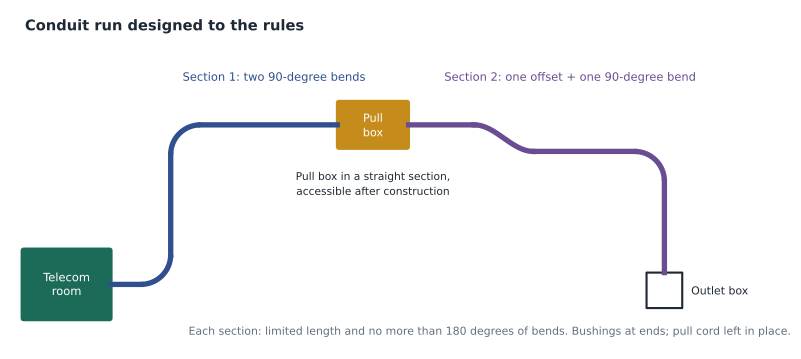
- Length between pull points: no continuous section of conduit should be longer than about 30 m between pull points, measured along the conduit.
- Bends between pull points: no more than two 90-degree bends, or a total of 180 degrees, between pull points. Offsets and smaller bends count toward the total.
- No back-to-back reverse bends: a U-shaped section, which can trap cables and add huge friction, should be avoided.
- Bend radius: the inside radius of each bend should be at least 6 times the internal diameter for conduit of 53 mm trade size or smaller, and at least 10 times the internal diameter for larger conduit. Conduit carrying fibre should use at least 10 times regardless of size.
- Conduit bodies: short-radius conduit bodies, such as the familiar L-shaped access fittings, should not be used as pull points or in place of bends for telecommunications cable.
- Fittings: ends should be reamed and fitted with bushings to protect cable jackets, and every empty conduit should be left with a pull cord rated for the expected pull.
Each of these rules exists because cable pulling tension grows quickly with every bend. Friction around a bend multiplies the tension rather than simply adding to it, so a run with four bends can need many times the pulling force of a straight run of the same length. The cable's maximum pulling tension, which manufacturers publish, is easily exceeded on a poorly designed run, damaging the cable invisibly, and the damage may only appear as failed test results or intermittent faults.
This capstan relationship explains the bend rule. The tension leaving a bend equals the tension entering it multiplied by an exponential factor that depends on the coefficient of friction between cable and conduit and on the angle of the bend in radians. With a typical friction coefficient of about 0.5, a single 90-degree bend multiplies the tension by about 2.2, two bends by nearly 5, and four bends by more than 23. Pull points reset the count by allowing the cable to be pulled out and fed in again.
Pull boxes
When a run needs more bends or more length than the rules allow, the designer adds a pull box. A pull box should be placed in a straight section of conduit, not used in place of a bend, so that the cable passes straight through and can be pulled out, looped and fed into the next section. It must be accessible after construction, which means not above a fixed ceiling, not behind a wall and not in a space that will be locked or occupied by equipment. Telecommunications pull boxes are much larger than electrical junction boxes of the same conduit size, because they must accommodate the bend radius of the cable inside the box; the standard gives sizing rules based on the conduit size, and large backbone conduits need large boxes.
Pull boxes should not be used for splicing, and conduits entering and leaving should be aligned on opposite sides of the box so that the cable runs straight through. Where a run must change direction at a pull box, the box must be sized for the angle pull, which needs more space.
Conduit in the backbone and between rooms
Backbone conduits connect the equipment room to telecommunications rooms that are not stacked directly above it, and connect rooms on the same floor to each other. They follow the same rules as horizontal conduit, but because backbone cables are larger and fewer, they are usually sized at 103 mm or larger, with at least one spare beside every conduit in use. Where a backbone conduit must run horizontally through occupied space, it should follow corridors and common areas, with pull boxes in accessible locations, so that future cables can be added without entering tenant spaces. Inner duct, a flexible plastic tube installed inside a larger conduit, divides one conduit into several channels so that fibre cables added at different times do not tangle with each other or with copper.
Worked problem
Checking a horizontal conduit run
Daniel is reviewing a conduit run from telecommunications room B on the third floor to a lecture hall control room. The run is 42 m long and has these direction changes in order: a 90-degree bend out of the room, two 45-degree bends forming an offset around a duct, a 90-degree bend to follow the corridor, and a final 90-degree bend down into the control room wall. Does it meet the rules, and if not, how should it be fixed?
Show solution
- Total bend angle: 90 + 45 + 45 + 90 + 90 = 360 degrees, double the 180-degree limit between pull points.
- Length: 42 m exceeds the 30 m limit between pull points.
- Fix: add one pull box in a straight section after the offset. The first section then has 90 + 45 + 45 = 180 degrees, which is at the limit, and the second has 90 + 90 = 180 degrees.
- Check lengths: Daniel places the pull box 20 m from the room, leaving 22 m for the second section. Both are within the limit.
- Check access: the pull box location is above a corridor with an accessible ceiling, not above the lecture hall's fixed ceiling, so it can be reached.
Answer: It fails on both bends and length. One accessible pull box in a straight section after the offset fixes both.
Conduit to outlets
Horizontal conduits to wall outlets are often the smallest conduits in the building and the most numerous. Common practice is to provide at least 21 mm (trade size 3/4) conduit to each outlet, and 27 mm (trade size 1) where several cables or larger category cables will share the box, because modern four-pair cables are thicker than older ones and several of them quickly fill a small conduit. Outlet boxes should be deep and large enough to keep cable bend radius at the termination, commonly a 100 mm square box with a single-gang or double-gang plaster ring rather than a shallow single-gang box. A conduit from the ceiling into a wall box is usually called a stub, and it should end above the ceiling near the cable tray with a bushing so cables can drop in cleanly.
Sleeves and slots
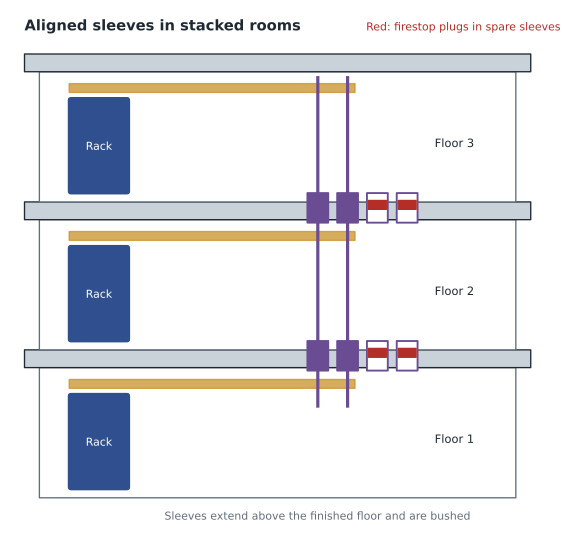
Sleeves are short lengths of conduit that pass through a floor or wall to provide a pathway for cable. In stacked telecommunications rooms, the backbone runs through groups of floor sleeves, aligned from floor to floor. Common practice uses 103 mm sleeves for backbone, with the number based on the area the stack serves plus spares; a typical small to medium building starts with several sleeves per room and adds more for larger floors and more tenants. Floor sleeves should extend above the finished floor, commonly by about 25 to 75 mm, so that water on the floor does not run down into the room below, and they should be bushed at both ends.
Slots are rectangular openings in the floor, used where large numbers of cables pass between floors. They are more flexible than sleeves but harder to firestop, harder to protect and a fall hazard if not curbed, so many designers prefer sleeves except in very large risers. Every sleeve and slot through a fire-rated floor or wall is a penetration that must be firestopped with a listed system, including sleeves that are empty on day one. Lesson 11 covers how to keep these penetrations both sealed and usable.
Common mistakes
MistakeA pull box at a corner lets the conduit turn without counting as a bend.
InsteadPull boxes belong in straight sections; using them in place of bends needs much larger boxes and makes pulling harder.
MistakeFour gentle bends are fine if each is less than 90 degrees.
InsteadAll bends count toward the 180-degree total between pull points, including offsets.
MistakeA conduit body is a convenient pull point.
InsteadShort-radius conduit bodies are not suitable for telecommunications cable and should not be used as pull points.
MistakeEmpty spare sleeves do not need firestopping.
InsteadEvery penetration of a fire separation must be sealed with a listed system, whether or not it contains cable.
Summary and key terms
- Conduit is the most protected and permanent pathway; use it where protection or code requires it and plan it right the first time.
- Use the internal diameter of the specific conduit type for fill and bend calculations.
- Limit each section between pull points to about 30 m and two 90-degree bends, avoid reverse bends and conduit bodies, and meet the bend radius rules.
- Pulling tension multiplies around each bend, which is why bend limits matter.
- Place pull boxes in straight, accessible sections, sized for the cable bend radius.
- Provide adequate outlet conduit and deep boxes, and leave pull cords and bushings.
- Align and bush backbone sleeves, extend them above the floor and firestop every penetration.
- Pull point
- A location, such as a pull box, where cable can be pulled out and re-fed.
- Trade size
- The nominal size designation of a conduit.
- Offset
- A pair of bends that shifts a conduit sideways around an obstacle.
- Conduit body
- A short-radius access fitting used in electrical work, unsuitable as a telecommunications pull point.
- Sleeve
- A short conduit through a floor or wall that provides a cable pathway.
- Capstan effect
- The exponential increase in pulling tension as a cable passes around a bend.
Practice problems
Work each problem on paper first, then reveal the answer to check.
Why does pulling tension rise so quickly with bends?
Show answer
Friction around each bend multiplies the tension exponentially, so tensions compound with every bend.
Why should floor sleeves extend above the finished floor?
Show answer
So water spilled on the floor does not run into the sleeve and down to the room below.
When is cable tray a better choice than conduit for horizontal pathways?
Show answer
In accessible ceilings where flexibility, capacity and easy additions matter more than full enclosure.
Lesson quiz · 5 questions
Score 60% or more to complete this lesson.
Create a free account to save your progress, take quizzes and earn a certificate.