
PWR-340 · Lesson 8 of 12 · 22 min
Process safety management
▶ Video coming soon A video version of this lesson is on the way.
Across the road from Keswold Energy Centre, Marrowby Foods freezes and chills most of what it makes, and its refrigeration plant runs on anhydrous ammonia. On one of his visits to Keswold, Okonkwo had watched Anselm Rasmusen take a call from Marrowby's plant engineer about the steam supply, and afterward Anselm had pointed out of the control room window at a row of evaporative condensers on Marrowby's roof. "That is the most hazardous thing on this road," he said. "Not our turbine. Their ammonia. They run a full process safety program for it, and they audit us as a supplier because their steam comes from here."
When Okonkwo mentioned it to Grazyna, she made it the subject of the next session. "Process safety is the part of safety that stops the big ones: the explosions, the toxic releases and the fires that kill people outside the fence," she said. "Most of what we measure in a plant, the lost-time injuries and the trips and falls, tells you almost nothing about whether you are about to have one."
This lesson explains the difference between personal and process safety, the major accident that made that difference clear, the elements of a process safety management system, and the legal and voluntary frameworks that apply in Canada and the US. It works examples on deciding whether an inventory of a hazardous substance falls under the rules, and on the recurring deadlines of a process safety program. Hazard analysis and management of change, two of the elements, get lesson 9 to themselves; incident investigation gets lesson 10.
Personal safety and process safety
Personal or occupational safety deals with harm to individuals from the work they are doing: falls, cuts, strains, burns, being struck by objects. Its incidents are frequent and usually small, and they are measured by injury rates.
Process safety deals with harm from the loss of containment of hazardous materials or energy: fires, explosions and toxic releases, which are rare but can kill many people, inside and outside the plant, at once. Their causes lie in design, equipment integrity, procedures, change and organization more than in the actions of an individual at the moment.
The two need different measures and different management. A plant can have an excellent personal safety record and a deteriorating process safety condition at the same time, because the things that cause major accidents, such as overdue inspections, bypassed alarms, untested trips, undocumented changes and lost knowledge, do not show up in injury statistics until the day they all line up.
Texas City
On March 23, 2005, during the startup of an isomerization unit at the BP refinery in Texas City, Texas, a distillation tower called the raffinate splitter was overfilled with flammable liquid. Its level instruments did not show the true level, and the operators continued to feed it for hours. When the liquid finally reached the top and flowed into the relief system, it overwhelmed a blowdown drum that vented directly to the atmosphere, and a geyser of hydrocarbon fell around the unit. A vapour cloud formed and was ignited, probably by an idling vehicle. Fifteen people were killed and about 180 injured. Most of those killed were in temporary office trailers placed close to the unit.
The CSB investigation and an independent panel chaired by former US Secretary of State James Baker found a long list of causes, including: a startup procedure that was not followed and had not been kept up to date; level instruments and alarms that did not work and had not been repaired; an atmospheric blowdown drum that industry practice had moved away from; trailers sited within the blast zone without hazard analysis; operator fatigue after weeks of long shifts; cost-cutting that had affected maintenance and training; and a management focus on personal injury rates that had hidden the decline in process safety. The Baker panel's report led many companies to adopt process safety indicators separate from injury rates.
"Every one of those causes exists, in a smaller form, in every plant I have worked in," Grazyna said. "An instrument everybody knows reads wrong. A procedure that says one thing while people do another. A temporary arrangement that has become permanent. A change made without thinking it through. The skill is seeing them as the precursors they are."
The elements of a process safety program
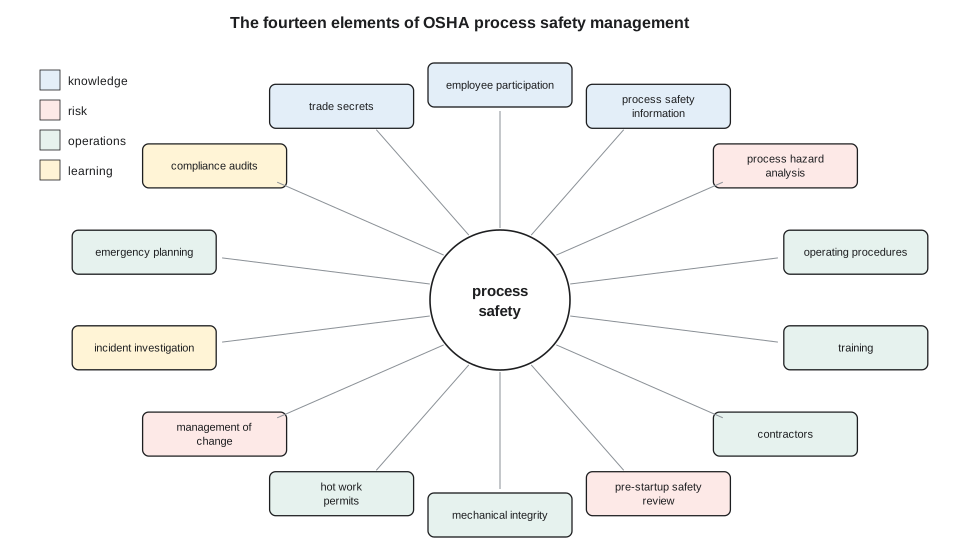
In the US, the Process Safety Management of Highly Hazardous Chemicals standard, OSHA 29 CFR 1910.119, has applied since 1992 to processes containing listed highly hazardous chemicals above their threshold quantities, and to processes with 10,000 lb or more of flammable liquids or gases, with some exemptions. One exemption matters to boiler plants: hydrocarbon fuels used solely for workplace consumption as a fuel, such as the natural gas that fires Cantwell's boilers, are not by themselves a covered process. The standard sets out fourteen elements, which most other frameworks also contain in some form:
- Employee participation: consulting workers on the program and giving them access to its information.
- Process safety information: the hazards of the chemicals, the technology of the process, and the design of the equipment, including materials, P&IDs, relief system design, codes used and safety systems.
- Process hazard analysis (PHA): a systematic study of what could go wrong, by a qualified team, updated and revalidated at least every five years (lesson 9).
- Operating procedures: written, current, certified annually, covering each operating phase including startup, shutdown and emergency operation.
- Training: initial training and refresher training at least every three years, documented.
- Contractors: selecting contractors with good safety performance and making sure their workers know the hazards and the rules.
- Pre-startup safety review (PSSR): confirming before startup of new or modified equipment that it is built as designed, procedures and training are in place and the PHA recommendations are resolved.
- Mechanical integrity: written procedures, training, inspection and testing of pressure vessels, piping, relief systems, emergency shutdown systems and controls, following recognized and generally accepted good engineering practices (lesson 7).
- Hot work permits for welding and other ignition sources near covered processes.
- Management of change (MOC) for changes in chemicals, technology, equipment, procedures and facilities (lesson 9).
- Incident investigation of incidents and near misses, started within 48 hours, with reports kept for five years (lesson 10).
- Emergency planning and response.
- Compliance audits at least every three years.
- Trade secrets: making process information available to those who need it even when it is commercially confidential.
The US Environmental Protection Agency's Risk Management Program rule, 40 CFR Part 68, applies a parallel set of requirements to many of the same facilities, aimed at protecting the public and the environment, with hazard assessments, prevention programs, emergency response and a risk management plan filed with the agency. The rule has been amended repeatedly; in February 2026 EPA proposed rescinding much of the 2024 amendments, and a plant must check which version is in force.
Process safety in Canada
Canada has no single federal process safety regulation like OSHA's. Instead, several pieces fit together:
- CSA Z767, Process Safety Management, a National Standard of Canada first published in 2017 and revised in 2024. It sets out a management system approach to process safety for any organization with hazardous processes. It is voluntary unless a regulator, a permit or a contract makes it mandatory, but it is widely used as the benchmark for good practice.
- Provincial occupational health and safety law, such as Ontario's Occupational Health and Safety Act, with its general duty on employers to take every precaution reasonable in the circumstances, which in a hazardous process includes recognized process safety practice.
- Equipment and operating regulations, such as O. Reg. 220/01 for pressure equipment, O. Reg. 219/01 for operating engineers and refrigeration plants, and CSA B52 for refrigeration systems.
- The federal Environmental Emergency Regulations, 2019, under the Canadian Environmental Protection Act, which require facilities that store listed substances above threshold quantities to notify Environment and Climate Change Canada and, above set capacities, to prepare, test and exercise an environmental emergency plan.
The Center for Chemical Process Safety (CCPS), part of the American Institute of Chemical Engineers, has members in both countries and publishes the guidance most programs draw on, including its Risk Based Process Safety framework of twenty elements in four groups: committing to process safety, understanding hazards and risk, managing risk, and learning from experience.
Is it covered?
The first question about any hazardous material is whether its quantity brings it under the rules. Thresholds apply to the maximum intended inventory of a process, counting all interconnected vessels and piping and any vessels close enough to be involved in a single release.
Worked problem
Marrowby's ammonia
Marrowby's refrigeration system holds anhydrous ammonia in its high-pressure receiver (4,200 kg), its evaporators and coils (1,900 kg), its recirculator vessel (1,400 kg) and its piping (500 kg). Under the Environmental Emergency Regulations, 2019, the threshold quantity for anhydrous ammonia is 4.50 tonnes at a concentration of at least 10 in 100. Is Marrowby above the threshold, and by how much? Would it also be covered by OSHA's standard (10,000 lb, about 4,540 kg) if it were in the US?
Show solution
- Total inventory:
- \[4{,}200 + 1{,}900 + 1{,}400 + 500 = 8{,}000 \text{ kg} = 8.0 \text{ t}\]
- Compare with the threshold:
- \[\frac{8.0}{4.50} = 1.78\]
Answer: Marrowby holds about 1.8 times the threshold, so it must notify Environment and Climate Change Canada and maintain an environmental emergency plan if its capacities require one. It would be well over OSHA's threshold in the US as well. Its process safety program follows CSA Z767 and the refrigeration industry's guidance, and its refrigeration plant is also regulated by TSSA under O. Reg. 219/01 and CSA B52. Cantwell, by contrast, has no listed substance above any threshold, and its natural gas is fuel, so it has no legal process safety program. It uses the same tools anyway.
Keeping a program alive
A process safety program is a set of recurring obligations, and most failures of programs are failures to keep doing them. A plant manager's calendar for a covered process includes:
| Activity | Typical frequency | What it protects against |
|---|---|---|
| Process hazard analysis revalidation | At least every 5 years | Hazards missed or changed since the last study |
| Operating procedure review and certification | Every year | Procedures drifting away from practice |
| Refresher training | At least every 3 years | Lost knowledge and skills |
| Compliance audit | At least every 3 years | Program elements decaying unnoticed |
| Relief device and safety system testing | By the inspection plan | Protection that fails on demand |
| Incident investigation | Start within 48 hours | Losing evidence and memory |
Worked problem
A PSM calendar
Marrowby's last process hazard analysis was completed in March 2022, its last compliance audit in October 2024, and its operators' last refresher training in May 2024. When are the next ones due at the latest, using the frequencies in the table?
Show solution
- PHA revalidation: March 2022 + 5 years = March 2027.
- Compliance audit: October 2024 + 3 years = October 2027.
- Refresher training: May 2024 + 3 years = May 2027.
Answer: All three fall in 2027, which is a planning problem in itself: the same few experienced people are needed for the PHA, the audit and the training. Programs that stagger these work better than programs that bunch them.
Measuring process safety
Because injury rates do not show process safety performance, the industry measures it separately. Lagging indicators count events that have happened: losses of primary containment classified by their severity, often called Tier 1 and Tier 2 process safety events. Leading indicators measure the health of the barriers: the fraction of safety-critical inspections and tests done on time, the number of overdue PHA recommendations, the number of safety systems in bypass, the backlog of open MOCs, the alarm rate per operator and the number of temporary repairs in service. Tier 3 and Tier 4 indicators capture near misses and these measures of system health.
Cantwell tracks some of these without calling them process safety indicators: Pilar's alarm statistics (PWR-240), Fenella's maintenance backlog, the dates of inspections and safety valve overhauls, and the open items from the fall safety walk. "If I had to pick one number," Grazyna said, "it would be the count of protective devices that are bypassed, defeated or overdue for testing. At a well-run plant it is zero, or close to it, and everyone knows why when it is not."
Common mistakes
MistakeJudging process safety by the injury rate.
InsteadUse separate process safety indicators, leading and lagging.
MistakeAssuming a plant is exempt from process safety thinking because it has no covered process.
InsteadThe tools, such as PHA, MOC and mechanical integrity, apply to any plant with hazards.
MistakeCounting only the largest vessel when checking a threshold quantity.
InsteadCount all interconnected vessels and piping in the process.
MistakeTreating a PHA as finished once the report is written.
InsteadIts recommendations must be resolved, and the study revalidated.
MistakeLetting temporary arrangements become permanent without review.
InsteadTreat them as changes; review, approve and time-limit them.
MistakeThinking CSA Z767 has the force of law everywhere in Canada.
InsteadIt is voluntary unless a regulator, permit or contract requires it.
Summary and key terms
- Process safety prevents fires, explosions and toxic releases from loss of containment; it needs different measures from personal safety.
- The 2005 Texas City explosion showed how procedures, instruments, siting, fatigue, cost pressure and misleading metrics combine.
- OSHA 1910.119 sets fourteen elements, from process safety information and PHA to MOC, mechanical integrity and audits; EPA's RMP rule runs in parallel.
- In Canada, CSA Z767:24, provincial OHS law, equipment regulations and the federal Environmental Emergency Regulations together cover process safety.
- Threshold quantities decide coverage; count the whole interconnected inventory.
- Programs depend on recurring obligations and on leading indicators of barrier health.
- Process safety
- Management of hazards that can cause loss of containment, fires, explosions and toxic releases.
- Threshold quantity
- The inventory of a listed substance at or above which a process falls under the rules.
- Process hazard analysis
- A systematic team study of what can go wrong in a process and how it is controlled.
- Pre-startup safety review
- A check before starting new or modified equipment that it is ready and safe.
- Process safety information
- Documented knowledge of a process's chemicals, technology and equipment.
- Leading indicator
- A measure of the health of safety barriers before an event occurs.
- Lagging indicator
- A measure of events that have already happened.
- Loss of primary containment
- An unplanned release of material or energy from its container.
- Risk Based Process Safety
- The CCPS framework of twenty process safety elements in four groups.
Practice problems
Work each problem on paper first, then reveal the answer to check.
A site holds 2.9 t of anhydrous ammonia. Is it above the Environmental Emergency Regulations threshold?
Show answer
No; the threshold is 4.50 t.
A PHA was completed in June 2023. When must it be revalidated at the latest (5-year rule)?
Show answer
June 2028.
Name two leading process safety indicators.
Show answer
For example, overdue safety-critical inspections and safety systems in bypass.
Why was the Texas City blowdown drum significant?
Show answer
It vented flammable liquid and vapour directly to the atmosphere.
Lesson quiz · 5 questions
Score 60% or more to complete this lesson.
Create a free account to save your progress, take quizzes and earn a certificate.