
PWR-340 · Lesson 5 of 12 · 23 min
Pressure relief devices and their sizing
▶ Video coming soon A video version of this lesson is on the way.
Each of Cantwell's three steam boilers has two spring-loaded safety valves on the steam drum, both set at 1,380 kPa (200 psi). Under the 2025 code adoption amendment, TSSA sets the maximum intervals at which relief valves must be serviced, and a request to stretch an interval needs TSSA's approval backed by the valve's servicing history. Grazyna keeps that history in a binder of its own: each valve's nameplate, its capacity certification, every test and overhaul, and the shop reports from the valve repair company.
"The safety valve is the last thing between this plant and a boiler explosion," she told Okonkwo, opening the binder at boiler 3. "Every control, every cutout and every operator can fail, and the valve still has to open, pass enough steam, and close again. The exam wants you to size one. The job wants you to understand why it is sized the way it is, and never to do anything that would stop it working."
This lesson describes the kinds of pressure relief devices and the terms used to describe their behaviour, explains how valves are certified and sized for steam, and sets out the main rules for power boilers and pressure vessels and the operator's part in keeping relief devices working. It works examples on safety valve sizing, blowdown and capacity checks. Sizing here uses a long-established physical relation for steam flow through a nozzle as a teaching form; the code's own capacity rules, and each valve's certified coefficient, govern real selections.
Kinds of relief device
- A safety valve is a spring-loaded valve for steam, gas or vapour that opens with a rapid full lift, called a pop, once the set pressure is reached. Boiler drum and superheater valves are safety valves.
- A relief valve opens gradually in proportion to the overpressure and is used for liquids, for example on a hot water boiler or a heat exchanger's water side.
- A safety relief valve can act either way, popping on gas and opening proportionally on liquid.
- A pilot-operated relief valve uses a small pilot valve to control a main valve held shut by system pressure. It can be set closer to the operating pressure and seals tightly up to set pressure, which suits large flows and high pressures.
- A rupture disc is a thin membrane that bursts at a set pressure. It cannot reclose, so it is used alone only where losing the contents is acceptable, or under a relief valve to protect it from corrosive or fouling service, with a gauge or telltale between them to show whether the disc has leaked.
- A vacuum breaker or vacuum relief valve protects vessels such as deaerators, condensate receivers and tanks from collapse under vacuum when steam condenses inside them.
How a safety valve behaves
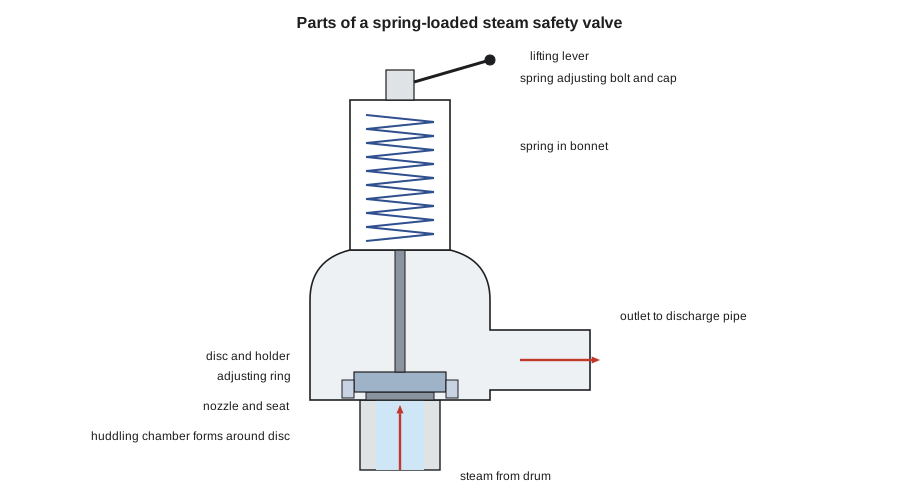
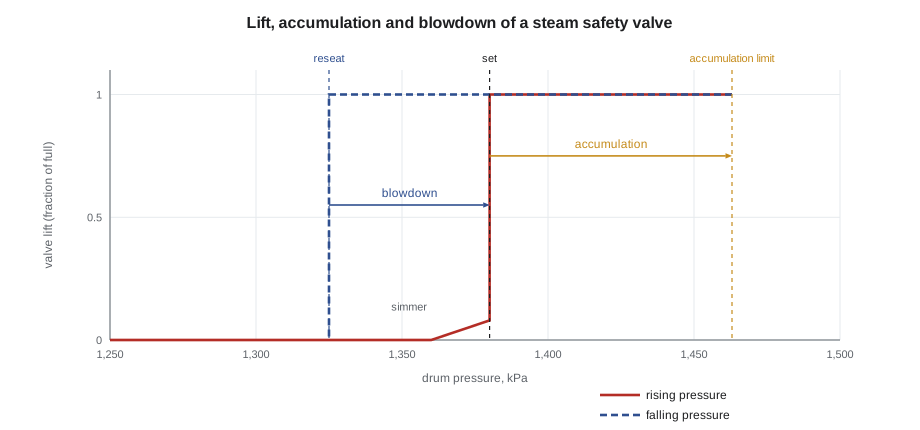
A spring-loaded safety valve is held shut by its spring. As pressure under the disc approaches the set pressure, the valve may simmer, leaking audibly as the seat load falls. At the set pressure the disc lifts slightly, steam escapes into the huddling chamber formed around the disc holder by an adjusting ring, the pressure acting on the larger area there forces the disc rapidly to full lift, and the valve pops. As the boiler pressure falls, the valve stays open until the pressure drops below the set pressure by the blowdown, then closes sharply.
- Set pressure: the inlet pressure at which the valve is adjusted to open.
- Overpressure: the rise above set pressure needed for the valve to reach its rated lift and capacity. Section I valves are certified at 3 in 100 above set pressure, or 14 kPa (2 psi) for low settings, whichever is greater.
- Accumulation: the rise above the MAWP while all valves discharge, limited for a power boiler to 6 in 100 of the highest set pressure (lesson 2).
- Blowdown: the difference between set pressure and reseating pressure, usually expressed in hundredths of the set pressure. It is set by the adjusting rings at the factory or repair shop, typically a few in 100 for boiler valves.
- Chatter: rapid opening and closing that damages the seat and disc, usually caused by a valve that is oversized for the flow, excessive inlet pressure loss or high back pressure.
- Back pressure: pressure at the valve outlet, either superimposed by a common discharge header or built up by flow through the discharge pipe. Conventional valves tolerate only limited back pressure; balanced bellows valves cancel its effect on the set pressure.
Worked problem
Reseat pressure
A boiler 3 safety valve is set at 1,380 kPa (200 psi) with a blowdown of 4 in 100. At what pressure does it close?
Show solution
- \[p_{reseat} = 1{,}380 \times (1 - 0.04) = 1{,}325 \text{ kPa}\]
Answer: The drum must fall about 55 kPa below set pressure before the valve reseats. Too short a blowdown risks chatter; too long a blowdown wastes steam and drops the drum pressure, and with it the water level reading swells and shrinks sharply.
Certification and the Red Book
Code safety and relief valves are built by manufacturers holding the ASME certificate for valves, marked with the certification mark and a designator: V for Section I power boiler valves, HV for heating boiler valves, and UV for pressure vessel valves (with the National Board's NB mark showing that capacity has been certified). Their capacity is certified by flow tests at a laboratory accepted by ASME and the National Board, which determine a coefficient of discharge for the valve design. The National Board publishes the certified designs and their coefficients in NB-18, widely called the Red Book. The rated capacity on a nameplate is the certified figure at the code's overpressure, not a nominal or catalogue value.
A valve may be repaired only by its manufacturer or by an organization holding the National Board VR certificate, which keeps the valve's certification valid by restoring it to its certified design, setting it, testing it and sealing it, and attaching a repair nameplate. In Canada, CSA B51 and the provincial regulations require relief devices to be registered and repaired by organizations the regulator accepts, and many valve shops hold the VR certificate as well. The wire seals on the adjusting cap and rings show that nobody has changed the setting since the valve left the shop. A broken seal means the valve's setting can no longer be trusted.
Sizing a steam safety valve
For steam above about twice atmospheric pressure, the flow through a nozzle is choked: it reaches sonic speed in the throat, and the mass flow depends only on the throat area and the upstream absolute pressure, not on the pressure downstream. An empirical relation published by Napier in the nineteenth century describes this well for dry saturated steam, and it remains the physical basis of steam valve sizing:
Here A is the valve's flow area, P₁ is the absolute pressure at the valve inlet while it is flowing (set pressure plus overpressure plus atmospheric pressure), and K is the valve's coefficient of discharge, with the code's derating applied. A well-rounded nozzle passes nearly the ideal flow; a sharp-edged orifice, like the failed steam trap in PWR-230, passes only about six-tenths of it. Corrections apply for superheated steam and for high pressures, and the code's own equation and the certified coefficient from the Red Book are what a valve's rating actually uses.
Worked problem
Sizing boiler 3's safety valves
Boiler 3's maximum continuous steaming capacity is 11,300 kg/h. Its two safety valves are set at 1,380 kPa and must together pass the full capacity at 3 in 100 overpressure. Take atmospheric pressure as 101.3 kPa and a derated coefficient K = 0.975 × 0.9 = 0.8775 (typical). Find the total flow area needed and the area of each valve if the capacity is shared equally.
Show solution
- Flowing inlet pressure:
- \[P_1 = 1{,}380 \times 1.03 + 101.3 = 1{,}522.7 \text{ kPa abs}\]
- Rearrange for area:
- \[A = \frac{W}{0.00525 \, K \, P_1} = \frac{11{,}300}{0.005252 \times 0.8775 \times 1{,}522.7} = \frac{11{,}300}{7.017} = 1{,}610 \text{ mm}^2\]
- Each of two valves:
- \[A_{each} = 805 \text{ mm}^2 \quad \Rightarrow \quad d = \sqrt{\frac{4 \times 805}{\pi}} = 32.0 \text{ mm}\]
Answer: Each valve needs a flow area of at least about 805 mm², a throat about 32 mm across. The designer then picks the next standard valve size from the manufacturer's certified list, whose rated capacity at this set pressure equals or exceeds half the boiler's output. Cantwell's valves are each rated at 6,350 kg/h at 1,380 kPa, so together they can pass 12,700 kg/h, about 1.12 times the boiler's capacity.
The rules for power boilers
Section I's overpressure protection rules, now set out with Section XIII's detailed requirements, can be summarized in the course's own words:
- Every power boiler must have at least one safety valve, and two or more if its heating surface exceeds about 47 m² (500 sq ft) or its capacity exceeds a set limit. Cantwell's boilers, at 381 m² (4,100 sq ft), need at least two.
- The total certified capacity of the drum valves must be at least the boiler's maximum steaming capacity, determined by the manufacturer, so that pressure cannot rise more than the permitted accumulation with all valves open and the burners at full fire.
- At least one valve must be set at or below the MAWP, and the others within a narrow range above it.
- Superheaters need their own safety valves, sized and set so that steam keeps flowing through the superheater to cool it while the drum valves discharge. The superheater valve is set lower than the drum valves for this reason.
- Economizers that can be isolated from the boiler need their own relief valves.
- Valves must be connected directly to the drum or header, with no valve between them and the boiler, and with an inlet connection no smaller than the valve inlet. The discharge piping must be supported independently, sized so that back pressure does not reduce capacity, drained at its low point, and led to a safe place.
The last rule is where most field problems arise. A heavy discharge pipe hung on the valve body distorts it and makes it leak. A drip pan elbow with a blocked drain fills with condensate and freezes. A discharge pipe that ends inside the boiler room, or close to a walkway or roof hatch, can scald anyone nearby when the valve lifts, so the outlet is led to a safe point outside and away from people.
Vessels and other equipment
Pressure vessels under Section VIII must be protected against any pressure above their MAWP that can arise from any source: a failed pressure-reducing valve, a blocked outlet, heat from a fire, thermal expansion of trapped liquid, or a heat exchanger tube rupture. The designer considers every overpressure scenario and sizes the relief device for the worst credible one. For a single valve the accumulation is typically limited to 10 in 100 of the MAWP, for multiple valves 16 in 100, and for fire exposure 21 in 100.
At Cantwell, the deaerator has a relief valve sized for the full flow of steam through its pressure-reducing valve if that valve fails wide open, plus a vacuum breaker. The instrument air receiver has a safety valve sized for the full output of both compressors. The plate heat exchangers' district water side has thermal relief valves, because water trapped between closed valves and heated will expand and can burst a shell or gasket.
The operator's duties
- Never gag, wedge, plug or adjust a safety valve, and never raise its set pressure. Only a qualified repair organization may set and seal it.
- Never place a valve between a safety valve and the equipment it protects, unless the code expressly allows it with locking arrangements, as for some vessel installations with dual valves.
- Test the valves by hand lever or by raising pressure only as the plant's procedure and the manufacturer allow, typically with the boiler at a pressure of at least about three-quarters of the set pressure, so that the steam blows the seat clean as it closes.
- Report a simmering, leaking or chattering valve. A leaking valve wire-draws its seat and gets worse.
- Keep every valve within its servicing interval under TSSA's requirements, with records of each test and overhaul, and seek TSSA's approval before extending an interval.
- Check discharge pipes, drains and supports on rounds, and keep the area around outlets clear.
Grazyna closed the binder. "Boiler 3's valves were overhauled and bench-set at the valve shop last year, with the seals and repair nameplates to show it. I want you to read every nameplate on every relief device in this plant before your exam. You will find at least one surprise. Everyone does."
Common mistakes
MistakeSizing a safety valve on gauge pressure.
InsteadNapier's relation and the code use absolute inlet pressure while flowing.
MistakeRaising a safety valve setting to stop it simmering.
InsteadFind the cause, such as operating too close to set pressure; never change the setting.
MistakeSupporting the discharge pipe on the valve.
InsteadSupport discharge piping independently so it does not distort the valve.
MistakeAssuming a valve's rated capacity is its catalogue size.
InsteadRated capacity is the certified value at the code's overpressure, from the nameplate and Red Book.
MistakeSetting the superheater valve higher than the drum valves.
InsteadSet it lower so that steam keeps flowing through the superheater.
MistakeIgnoring thermal relief on liquid-filled equipment.
InsteadTrapped liquid that is heated can burst a vessel; provide relief.
Summary and key terms
- Safety valves pop open on steam; relief valves open gradually on liquid; pilot-operated valves, rupture discs and vacuum breakers serve special duties.
- Set pressure, overpressure, accumulation, blowdown, chatter and back pressure describe a valve's behaviour.
- Valves are certified for capacity, listed in the National Board Red Book, and repaired only by the manufacturer or a VR certificate holder.
- Choked steam flow depends on flow area and absolute inlet pressure, as Napier's relation shows; codes add certified coefficients and derating.
- Power boilers need enough certified valve capacity for their maximum steaming rate, with set pressures and superheater valves arranged by the rules.
- Vessels need relief for every credible overpressure scenario; operators must never gag, adjust or isolate relief devices.
- Safety valve
- A spring-loaded valve for steam or gas that opens with a rapid full lift at set pressure.
- Relief valve
- A valve that opens gradually with rising pressure, used for liquids.
- Overpressure
- The rise above set pressure needed for a valve to reach rated lift and capacity.
- Blowdown
- The difference between a safety valve's set pressure and its reseating pressure.
- Huddling chamber
- The space around a safety valve disc that produces the rapid pop to full lift.
- Back pressure
- Pressure at a relief valve's outlet, superimposed or built up by flow.
- Coefficient of discharge
- The ratio of a valve's certified flow to the ideal flow through its area.
- Rupture disc
- A non-reclosing membrane that bursts at a set pressure.
- Red Book
- The National Board's listing of certified pressure relief device capacities, NB-18.
Practice problems
Work each problem on paper first, then reveal the answer to check.
A valve set at 1,100 kPa has an area of 1,000 mm² and K = 0.8775. Find its capacity at 3 in 100 overpressure (atmosphere 101.3 kPa).
Show answer
P₁ = 1,234.3 kPa abs; W = 0.005252 × 0.8775 × 1,000 × 1,234.3 ≈ 5,690 kg/h.
A valve set at 860 kPa has a blowdown of 5 in 100. Reseat pressure?
Show answer
817 kPa.
A boiler makes 20,000 kg/h. Two valves are rated 9,500 kg/h each. Are they enough?
Show answer
No; 19,000 kg/h is less than the boiler's capacity.
Why is a superheater safety valve set below the drum valves?
Show answer
So steam flows through the superheater and cools it while the valves discharge.
Lesson quiz · 5 questions
Score 60% or more to complete this lesson.
Create a free account to save your progress, take quizzes and earn a certificate.