
PWR-340 · Lesson 1 of 12 · 26 min
The structure of pressure equipment codes
▶ Video coming soon A video version of this lesson is on the way.
Okonkwo Demarest had passed his Fourth Class papers in the spring of 2025 and was now working through the Third Class Part A course on his nights off. The second paper of Part A, 3A-2, opens with industrial legislation and codes and then asks candidates to do code calculations: drum, tube and head thickness, allowable pressure, and safety valve capacity. On a quiet night shift that autumn, with the boilers steady and the rounds done, Grazyna Wolanski left a note on the control room desk: "Code binder, my office, before your break. Bring the 3A-2 outline."
PWR-220 had shown Okonkwo the hierarchy of law, regulation and code that applies to boilers in Ontario. This time Grazyna wanted something different. "At Fourth Class you learned which document answers which question," she said. "At Third Class you have to open the document and find the answer. That means knowing how a code is built: what is in each part, how the paragraphs are numbered, which parts are mandatory, and how a rule gets changed. If you understand the structure, a thousand pages become a map."
This lesson explains how the main pressure equipment codes are organized: the ASME Boiler and Pressure Vessel Code and its sections, the divisions of Section VIII, the B31 piping codes, the National Board Inspection Code, the American Petroleum Institute's in-service inspection codes, and the Canadian code that ties many of them together. It shows how a section is laid out from scope to data report, how paragraph numbers work, how editions, code cases and interpretations keep a code current, and how a jurisdiction decides which edition is law. Later lessons in this course use the codes; this one explains how to find your way around them. As in the rest of the program, the course describes the codes in its own words and does not reproduce their text or tables.
Codes for building and codes for keeping
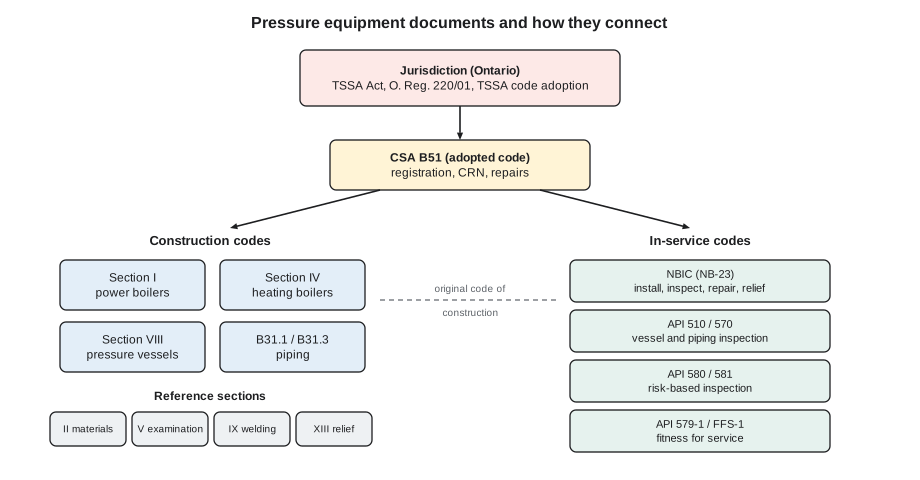
Pressure equipment codes fall into two families, and the first question to ask of any code is which family it belongs to.
- Construction codes cover everything up to the moment the item is first put into service: materials, design, fabrication, welding, examination, testing, marking and the manufacturer's data report. The ASME Boiler and Pressure Vessel Code (BPVC) and the ASME B31 piping codes are construction codes.
- Post-construction or in-service codes cover what happens afterward: installation, operation, inspection, repair, alteration, re-rating and the assessment of damage. The National Board Inspection Code (NBIC) and the API inspection codes are in-service codes, and ASME publishes post-construction standards of its own as well.
The two families have different starting points. A construction code assumes new, known material built to a drawing, and it gives conservative rules that keep the design simple. An in-service code has to deal with equipment that has been in service for years, that may be corroded, cracked, bulged or repaired, and that may have been built to an edition no longer in print. That is why in-service codes refer back to the original code of construction, and why the data report and the edition it names matter for the whole life of the item.
A third kind of document sits above both: the jurisdictional requirement. In Ontario that is the Technical Standards and Safety Act, O. Reg. 220/01 and TSSA's Boilers and Pressure Vessels Code Adoption Document, which adopts CSA B51 and, through it, the ASME and other codes. CSA B51 is itself a mixture: it adds Canadian construction requirements such as design registration and the CRN, and it also sets rules for inspection, repair and alteration after construction.
The ASME Boiler and Pressure Vessel Code
The BPVC is published as a set of separate books called sections, identified by Roman numerals. PWR-220 listed the ones an operating engineer meets most. At Third Class it helps to see them grouped by the job they do:
| Group | Sections | What they do |
|---|---|---|
| Construction of boilers | I, IV | Rules for power boilers (I) and heating boilers (IV): materials, design, fabrication, inspection, testing and marking |
| Construction of vessels | VIII (Divisions 1, 2, 3), X, XII | Rules for pressure vessels in three divisions, fibre-reinforced plastic vessels (X) and transport tanks (XII) |
| Reference sections | II, V, IX, XIII | Materials and their allowable stresses (II), examination methods (V), welding and brazing qualification (IX) and overpressure protection (XIII), used by the construction sections |
| Care and operation | VI, VII | Recommended guidelines for operating and caring for heating boilers (VI) and power boilers (VII) |
| Nuclear | III, XI | Construction (III) and in-service inspection (XI) of nuclear components |
The grouping explains how the code works in practice. A construction section such as Section I does not repeat the material specifications, the radiography procedure or the welder test. It references Section II for the material, Section V for how the radiograph is taken, Section IX for how the welding procedure and the welder are qualified, and Section XIII for the rules on safety valves, while it keeps the acceptance standards and the design rules for its own equipment. Reading a Section I requirement often means following a reference into two or three other books.
Section II has four parts. Part A holds the specifications for ferrous materials, Part B for nonferrous materials and Part C for welding rods, electrodes and filler metals. Part D holds the properties: maximum allowable stress values for each material at each temperature, yield and tensile strength values, physical properties such as thermal expansion and modulus of elasticity, and the external pressure charts used for vessels under vacuum. When a design calculation uses an allowable stress S, it comes from Part D, for the material, the section of the code and the design temperature.
Material specifications in Section II carry the prefix SA or SB, such as SA-516 for pressure vessel plate or SB-111 for copper alloy condenser tubes. Most are adopted from ASTM specifications with the same number, sometimes with changes, and the code allows only material certified to the SA or SB version, or material the code specifically accepts. A plate stamped A-516 by the mill is not automatically SA-516; its certification must show that it meets the code's version.
How a construction section is laid out
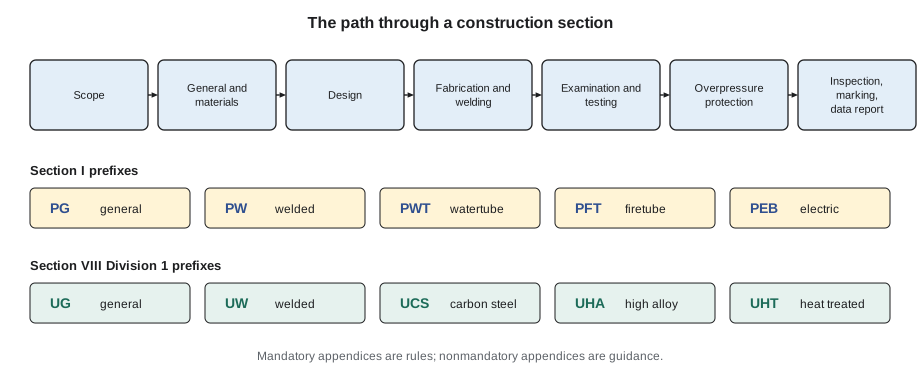
Whatever the equipment, a construction section follows much the same path that the item itself follows through the shop:
- Scope: what the section covers and where its boundaries are. Section I, for example, covers the boiler proper and the boiler external piping up to defined valves; beyond those, the piping code takes over (lesson 6).
- General requirements: responsibilities of the manufacturer and the inspector, materials permitted, design temperature and pressure, and the formulas for the common parts.
- Requirements by method of construction or type: welded construction, riveted construction in older editions, and rules for particular boiler types such as watertube and firetube designs, or for vessels in carbon steel, alloy steel, nonferrous metals and so on.
- Fabrication, examination and testing: forming, welding, heat treatment, nondestructive examination and the hydrostatic or pneumatic test.
- Overpressure protection: in current editions, the section's own requirements, with the details in Section XIII.
- Inspection, certification, marking and data reports: what the Authorized Inspector must see and sign, the certification mark and designator, the nameplate and the manufacturer's data report forms.
- Appendices: mandatory appendices, which are part of the rules, and nonmandatory appendices, which give guidance, examples and recommended practice.
Paragraph numbers carry a prefix that tells you where you are. In Section I, paragraphs beginning PG are general requirements for all power boilers, PW cover welded construction, PWT watertube boilers, PFT firetube boilers and PEB electric boilers. In Section VIII Division 1, UG paragraphs are general requirements, UW welded vessels, UCS carbon and low-alloy steels, UHA high-alloy steels and UHT heat-treated steels. Division 2 is organized in numbered parts instead. Once you know the prefixes, a reference such as "see the PW requirements for postweld heat treatment" tells you which part of the book to open.
Divisions and design margins
Section VIII is divided into three divisions, and the difference between them is one of the most important ideas in pressure equipment design.
- Division 1 is design by rule. The designer uses formulas, charts and detailed rules for each part, with a relatively large design margin. It is the code for most vessels in a boiler plant: air receivers, blowdown tanks, deaerators, flash tanks and heat exchanger shells.
- Division 2 is design by analysis as well as by rule. It allows more detailed stress analysis, including finite element analysis, and requires more examination, documentation and a user's design specification, in return for a smaller design margin and so thinner, lighter vessels. It suits large, thick or costly vessels.
- Division 3 covers very high pressures, typically above about 70 MPa (10,000 psi), with fracture mechanics and fatigue analysis at its centre.
The design margin is built into the allowable stress. For carbon and low-alloy steels at temperatures below the creep range, Section II Part D sets the Division 1 allowable stress at the lowest of several values, including the specified minimum tensile strength divided by 3.5 and two-thirds of the specified minimum yield strength. For Division 2 the corresponding values are the tensile strength divided by 2.4 and the yield strength divided by 1.5. At high temperature, further limits based on creep and rupture strength take over in both. Section I uses the same basis as Division 1.
Worked problem
Division 1 and Division 2 allowable stress
SA-516 Grade 70 plate has a specified minimum tensile strength of 485 MPa and a specified minimum yield strength of about 260 MPa (typical published values). Estimate the allowable stress at moderate temperature under each division's basis, and the effect on shell thickness.
Show solution
- Division 1: the lower of the two limits.
- \[\frac{485}{3.5} = 138.6 \text{ MPa} \qquad \tfrac{2}{3} \times 260 = 173.3 \text{ MPa} \quad \Rightarrow \quad S_1 \approx 138 \text{ MPa}\]
- Division 2: the lower of its two limits.
- \[\frac{485}{2.4} = 202.1 \text{ MPa} \qquad \frac{260}{1.5} = 173.3 \text{ MPa} \quad \Rightarrow \quad S_2 \approx 173 \text{ MPa}\]
- Shell thickness is inversely proportional to the allowable stress:
- \[\frac{t_2}{t_1} \approx \frac{138.6}{173.3} = 0.80\]
Answer: For this plate, tensile strength governs in Division 1 and yield strength governs in Division 2. A Division 2 shell can be about 20 in 100 thinner. The saving is paid for in analysis, examination and documentation, and the actual allowable values must always be taken from Part D for the edition, material and temperature.
The same idea explains why an operator must never treat two similar-looking vessels as interchangeable. A Division 2 vessel and a Division 1 vessel of the same size and pressure may differ in wall thickness, examination and documentation, and the Division 2 vessel's design specification may limit the cycles or temperatures it is fit for. The nameplate shows which division it was built to: the designator U for Division 1 and U2 for Division 2.
The piping codes
Piping has its own code family, ASME B31, published as separate books for different services. The two a power engineer meets most are B31.1, Power Piping, used for steam, feedwater, condensate, fuel and other piping in power plants, district heating plants and industrial boiler plants, and B31.3, Process Piping, used in refineries, chemical plants and many industrial processes. Others include B31.5 for refrigeration piping, B31.9 for building services piping and B31.8 for gas transmission. Unlike the BPVC, the B31 books are each complete in themselves, although they reference material specifications, the ASME standards for flanges and fittings, and Section IX for welding.
The boundary between the boiler code and the piping code matters. Piping attached to a power boiler, up to and including the required stop valves, is boiler external piping and comes under Section I's administrative rules (inspection, certification and data reports) while being designed and built to B31.1's technical rules. Lesson 6 returns to this boundary.
The in-service codes
The National Board Inspection Code (NBIC), published as NB-23, is the main in-service code for boilers and pressure vessels in the US and is accepted in parts of Canada. The current 2025 edition is published in four parts: Part 1 for installation, Part 2 for inspection, Part 3 for repairs and alterations, and Part 4 for pressure relief devices. PWR-220 introduced the R certificate for repair organizations and the VR certificate for relief valve repair.
The API codes come from the petroleum and chemical industries but are used in many other plants. API 510 covers in-service inspection, repair, alteration and re-rating of pressure vessels; API 570 does the same for process piping; API 580 and API 581 set out risk-based inspection; and API 579-1/ASME FFS-1 gives methods for fitness-for-service assessment of damaged equipment, in three levels of increasing detail. API 571 describes the damage mechanisms that affect fixed equipment. Lesson 7 uses these ideas.
CSA B51 is the Canadian national code adopted by every province and territory. Part 1 covers boilers, pressure vessels, piping and fittings; Parts 2 and 3 cover high-pressure cylinders and ground storage vessels for compressed natural gas and hydrogen vehicle fuel. Part 1 is the part a power engineer uses: it requires registration of designs, adds Canadian construction rules to the ASME codes it references, and sets rules for inspection, repair and alteration. In Ontario, TSSA's code adoption document that took effect on August 1, 2025, adopts CSA B51:24 and lists Ontario's amendments.
Editions, addenda, code cases and interpretations
Codes change. ASME publishes the BPVC every two years; the 2025 edition appeared in July 2025, and the next is due in 2027. The B31 codes and the NBIC have their own cycles. Between editions, the rules evolve in three ways:
- Code cases allow an alternative to the code, such as a new material or a new method, before it is written into the code. A code case may be used only where it is accepted by the jurisdiction and, for construction, where it is recorded on the data report.
- Interpretations are the committee's formal answers to questions about what a rule means. They clarify the existing rule; they do not change it.
- Errata correct printing errors.
The edition that governs an item depends on what is being done. For new construction, the manufacturer builds to an edition that the jurisdiction accepts, and the data report records which one. For repairs and alterations, the in-service code and the jurisdiction decide, and replacement parts are generally built to the original code of construction or a later edition the inspector accepts. An item does not have to be rebuilt every time the code changes.
In Ontario, the edition in force is the one named in TSSA's code adoption document, not necessarily the newest one in print. The 2025 amendment, for example, adopted CSA B51:24 effective August 1, 2025, and replaced the previous amendment. Grazyna's binder records each edition in force and the date it took effect, and she checks TSSA's notices every year.
Reading a code: Grazyna's method
Grazyna gave Okonkwo four rules for finding his way around a code book, on the exam or in the plant:
- Start with the scope. Before reading a rule, confirm that the section applies to the item and the situation. Many wrong answers come from applying a power boiler rule to a pressure vessel, or a construction rule to a repair.
- Use the prefix and the index. Paragraph prefixes show which part of the book a rule is in, and the index points to the paragraphs for each topic.
- Follow the references. A requirement that names another section or standard is incomplete until you have read what it refers to.
- Read the whole paragraph, including the exceptions. Code paragraphs often state a rule and then list conditions and exceptions in the sub-paragraphs that follow.
Worked problem
Following a requirement through the code
A replacement section of a power boiler's feedwater line, between the boiler and its stop valves, is being designed. List the documents the designer will use.
Show solution
- Scope: piping attached to a power boiler up to and including its stop valves is boiler external piping, so Section I governs its administration.
- Design and construction: Section I refers to B31.1 for the piping's technical rules, so the wall thickness, fittings and flanges come from B31.1 and the standards it references.
- Material: the pipe specification (for example SA-106) and its allowable stress come from Section II.
- Welding: the procedure and the welders are qualified to Section IX.
- Jurisdiction: the work is a repair or alteration under CSA B51 and TSSA's requirements, with the inspector's acceptance before it starts.
Answer: Five documents for one length of pipe. Each does a different job, and missing any one of them makes the job non-compliant.
Common mistakes
MistakeTreating a construction code as the rule for in-service repairs.
InsteadIn-service work follows the in-service code and the jurisdiction, referring back to the original code of construction.
MistakeUsing the newest code book on the shelf as the law.
InsteadThe edition in force is the one the jurisdiction has adopted; check its adoption notice.
MistakeReading a code requirement without following its references.
InsteadRequirements often depend on other sections, such as II, V, IX and XIII.
MistakeAssuming a Division 2 vessel is the same as a Division 1 vessel of the same size.
InsteadDivision 2 uses a smaller design margin and needs more analysis, examination and documentation.
MistakeTreating an interpretation as a change to the code.
InsteadInterpretations explain the existing rule; changes come through new editions and code cases.
MistakeAccepting mill-stamped ASTM material as code material without checking its certification.
InsteadThe code requires material certified to its SA or SB specification or otherwise accepted.
Summary and key terms
- Construction codes govern equipment until it enters service; in-service codes such as the NBIC and the API codes govern inspection, repair, alteration and assessment afterward.
- The BPVC sections are grouped into boiler and vessel construction sections, reference sections (II, V, IX, XIII), care and operation guidelines (VI, VII) and nuclear sections.
- Section II provides material specifications (Parts A, B, C) and allowable stresses and properties (Part D).
- Construction sections follow the path of the item from scope and materials to marking and data reports; paragraph prefixes such as PG, PW, UG and UW show where a rule lives.
- Section VIII Division 1 is design by rule with a larger margin; Division 2 allows design by analysis with a smaller margin and more examination.
- The B31 codes cover piping; boiler external piping is administered by Section I and built to B31.1.
- Code cases, interpretations and errata keep codes current between editions; the jurisdiction decides which edition is law.
- Construction code
- A code that governs materials, design, fabrication, examination, testing and marking of new equipment.
- In-service code
- A code that governs inspection, repair, alteration and assessment of equipment after it enters service.
- Original code of construction
- The code and edition an item was built to, recorded on its data report.
- Design by rule
- Design using prescribed formulas and rules, as in Section VIII Division 1.
- Design by analysis
- Design using detailed stress analysis, permitted in Section VIII Division 2.
- Code case
- An approved alternative to a code rule, usable where the jurisdiction accepts it.
- Interpretation
- A code committee's formal answer to a question about the meaning of a rule.
- Mandatory appendix
- An appendix whose rules are part of the code requirements.
- Boiler external piping
- Piping attached to a power boiler up to its required stop valves, administered under Section I.
Practice problems
Work each problem on paper first, then reveal the answer to check.
Which BPVC section gives the allowable stress for a plate at a given temperature?
Show answer
Section II, Part D.
What do paragraphs beginning PW cover in Section I?
Show answer
Requirements for boilers built by welding.
A vessel nameplate shows the designator U2. What does that tell you?
Show answer
It was built to Section VIII Division 2.
Which edition of CSA B51 does TSSA's 2025 code adoption amendment adopt, and from what date?
Show answer
CSA B51:24, effective August 1, 2025.
Lesson quiz · 5 questions
Score 60% or more to complete this lesson.
Create a free account to save your progress, take quizzes and earn a certificate.