
PWR-320 · Lesson 9 of 12 · 23 min
Combined cycle and cogeneration
▶ Video coming soon A video version of this lesson is on the way.
By Tuesday, November 10, 2026, Keswold had been back in service for nearly three weeks, and the heating season had begun. Marrowby Foods was running its autumn production around the clock and taking its full contract steam. Okonkwo came in for the afternoon with a list of questions from Grazyna Wolanski, who had been asked to scope the gas-engine combined heat and power study on Cantwell's 2027 capital list. "Ask Anselm how much of the gas Keswold buys ends up as something useful," she had written. "And ask him what his steam costs him."
Anselm answered the first question by opening the plant's daily heat balance on the control room screen. "That's the number Marrowby's contract and our environmental reports care about," he said, pointing at a figure near the bottom: fuel utilization, a little over 0.55. "A good simple cycle gas turbine gets about a third. A good combined cycle without process steam gets about half or more. We get over a half, and some of it is heat that Marrowby would otherwise have burned gas to make."
This lesson explains how combined cycle and cogeneration plants put the gas turbine's exhaust heat to work, how a heat recovery steam generator is designed around its pinch point, how supplementary firing changes the balance, and how the performance of such plants is measured. It works Keswold's heat recovery and heat balance and compares the results with those of other arrangements.
Why combine cycles
Lesson 8 showed that a gas turbine rejects most of its fuel energy in its exhaust, at temperatures of 450 to 650 °C. That is hot enough to raise steam at conditions a steam turbine can use. A combined cycle plant passes the gas turbine exhaust through a heat recovery steam generator (HRSG) and uses the steam in a steam turbine, adding output without burning any more fuel. The gas turbine is the topping cycle, using the heat at high temperature; the steam cycle is the bottoming cycle, using what is left at lower temperature. Large modern combined cycle plants reach electrical efficiencies above 0.6 on the lower heating value, the highest of any fuel-burning power plant.
Cogeneration, or combined heat and power (CHP), means producing useful heat and electricity from the same fuel. The heat may come from a back-pressure or extraction steam turbine, from a HRSG supplying process steam directly, or from the jacket water and exhaust of a reciprocating engine. Keswold is both: a combined cycle plant that also supplies process steam, through the extraction of its steam turbine, to Marrowby Foods. Cogeneration is also classified by where the power comes first: in a topping cycle plant like Keswold, power is produced first and the rejected heat is used; in a bottoming cycle plant, a high-temperature industrial process comes first and its waste heat raises steam for power.
The heat recovery steam generator
A HRSG is a boiler with no furnace. The gas turbine exhaust flows through a large duct, usually horizontally in modern plants, past banks of finned tubes. In the direction of gas flow, a single-pressure HRSG like Keswold's has:
- A superheater, in the hottest gas, raising saturated steam from the drum to the final steam temperature. Keswold has an attemperator, a spray of feedwater between two superheater sections, to control the final temperature.
- An evaporator, a bank of tubes connected to a steam drum by downcomers and risers, in which water boils at the drum's saturation temperature. Circulation may be natural, driven by density difference as in PWR-220's boilers, or forced by pumps.
- An economizer, in the coolest gas, heating the feedwater from the deaerator to just below the drum's saturation temperature.
Larger plants have two or three pressure levels, each with its own drum, evaporator, superheater and economizer, interleaved through the duct, and often a reheater. The extra pressure levels let the HRSG cool the gas further, because steam can be raised at a low pressure from gas too cool to boil water at high pressure. Some HRSGs are once-through, with no drums, which suits frequent cycling.
Pinch point and approach
A HRSG's temperature profile has a constraint that a fired boiler does not. In the evaporator the water boils at constant temperature, while the gas is cooling steadily. At the cold end of the evaporator, the gas must still be hotter than the boiling water by some margin, or the heat transfer surface would have to be infinitely large. That smallest temperature difference is the pinch point. The amount by which the economizer outlet water is below its saturation temperature is the approach; it is kept positive so that the economizer does not boil at part load.
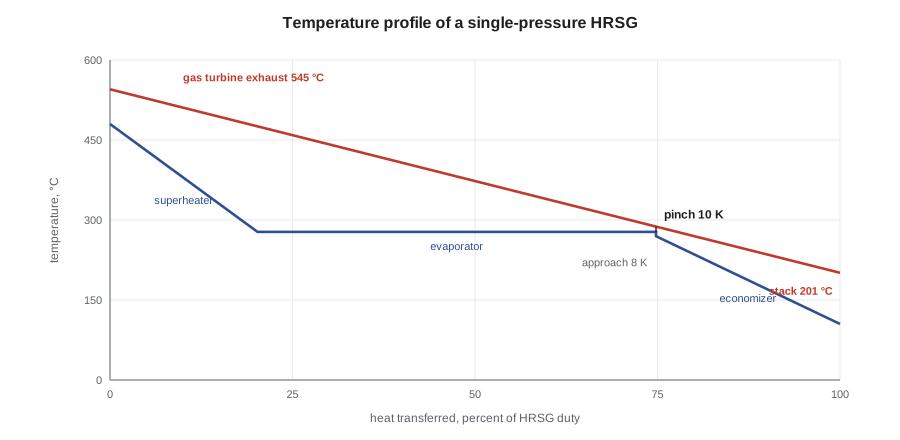
Pinch points are typically chosen in the range of about 8 to 15 K. A smaller pinch recovers more heat but needs much more surface; a larger one needs less surface but sends more heat up the stack. Once the pinch is chosen, the steam flow follows directly, because the gas between the turbine exhaust and the pinch supplies the superheater and evaporator, and the economizer then uses what it can below the pinch.
Worked problem
Keswold's unfired HRSG
Keswold's gas turbine exhaust is 145 kg/s at 545 °C, with c_p = 1.10 kJ/kg·K. The drum is at 6,200 kPa absolute, saturation 277.7 °C, with a pinch of 10 K and an approach of 8 K. Steam leaves the superheater at 6,000 kPa and 480 °C (h = 3,375.2 kJ/kg); water leaves the economizer at 269.7 °C (h = 1,183.5 kJ/kg); feedwater enters at 105 °C (h = 444.7 kJ/kg). Find the steam flow without supplementary firing, the economizer duty and the stack temperature.
Show solution
- Gas temperature at the pinch:
- \[T_p = 277.7 + 10 = 287.7\ ^\circ\text{C}\]
- Heat from gas above the pinch, to the superheater and evaporator:
- \[Q = 145 \times 1.10 \times (545 - 287.7) = 41{,}040 \text{ kW}\]
- Steam flow, heated from economizer outlet to final steam:
- \[\dot m_s = \frac{41{,}040}{3{,}375.2 - 1{,}183.5} = 18.7 \text{ kg/s} \ (67{,}400 \text{ kg/h})\]
- Economizer duty:
- \[Q_{eco} = 18.7 \times (1{,}183.5 - 444.7) = 13{,}830 \text{ kW}\]
- Stack temperature:
- \[T_{stack} = 287.7 - \frac{13{,}830}{145 \times 1.10} = 201\ ^\circ\text{C}\]
Answer: Without supplementary firing, Keswold's HRSG would raise about 18.7 kg/s of steam, and its stack would be at about 201 °C. A single pressure level cannot cool the gas much further, because the economizer has run out of water to heat. That stack temperature is high by combined cycle standards, which is why larger plants add low-pressure sections; at Keswold, a feedwater preheating coil in the coolest gas, heating condensate on its way to the deaerator, recovers part of it.
Supplementary firing
A gas turbine burns its fuel with a great deal of excess air, so its exhaust still contains plenty of oxygen, typically 12 to 15 in 100 by volume. Duct burners in the HRSG inlet duct can burn more natural gas in that exhaust, raising its temperature and so the steam output, without a separate supply of combustion air. This is called supplementary firing. It lets a cogeneration plant meet a process steam demand larger than the unfired HRSG can supply, or keep steam flowing when the gas turbine is at part load.
Worked problem
What Keswold's duct burners add
At full load in winter, Keswold's HRSG supplies 22.0 kg/s of steam. How much heat must the duct burners add, and how much fuel do they burn if they are 0.98 efficient on the lower heating value?
Show solution
- Extra steam over the unfired flow:
- \[22.0 - 18.72 = 3.28 \text{ kg/s}\]
- Heat to raise it from feedwater to final steam:
- \[Q = 3.28 \times (3{,}375.2 - 444.7) = 9{,}610 \text{ kW}\]
- Duct burner fuel:
- \[\frac{9{,}610}{0.98} = 9{,}800 \text{ kW} \approx 9.8 \text{ MW}\]
Answer: Almost all of the duct burner fuel's energy reaches the steam, because the burners use the turbine exhaust's oxygen and its heat is already there. But that steam is then used in the steam cycle at an efficiency of about a third, so supplementary firing raises output while slightly lowering the plant's overall electrical efficiency. For process steam, which needs no conversion to power, it is very efficient.
Keswold's heat balance
With the steam turbine at full load and Marrowby taking 6.0 kg/s (48,000 lb/h), the plant's balance on November 10 looked like this, on the lower heating value of the fuel. The steam turbine's numbers come from the expansion calculated with IAPWS-IF97 properties in lesson 3, with a generator efficiency of 0.975 and mechanical efficiency of 0.99.
| Item | Value |
|---|---|
| Gas turbine fuel (efficiency 0.34) | 132.4 MW |
| Duct burner fuel | 9.8 MW |
| Total fuel | 142.2 MW |
| Gas turbine generator output | 45.0 MW |
| Steam turbine generator output | 18.0 MW |
| Process heat to Marrowby (6.0 kg/s at 3,018.7 kJ/kg, condensate returned at 60 °C, 252.1 kJ/kg) | 16.6 MW |
| Electrical efficiency (63.0 ÷ 142.2) | 0.443 |
| Fuel utilization ((63.0 + 16.6) ÷ 142.2) | 0.560 |
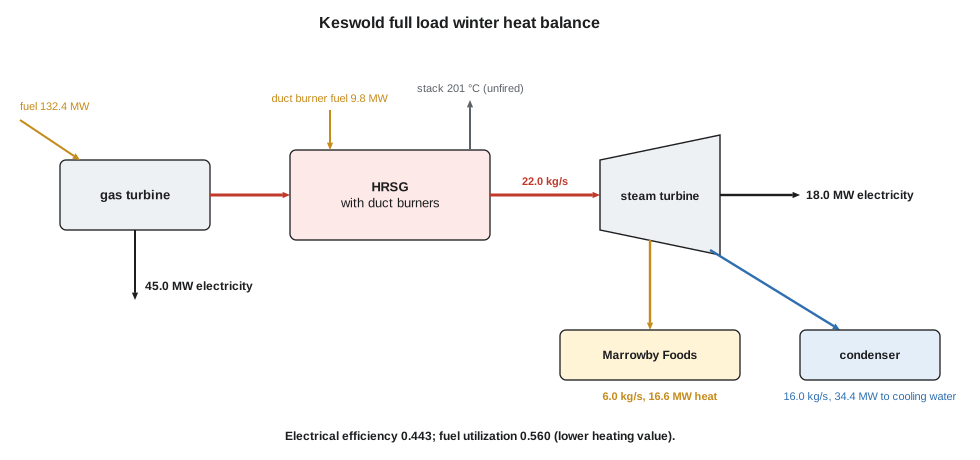
Two other arrangements show what the extraction is worth. If all 22.0 kg/s (175,000 lb/h) went to the condenser, with no process steam, the steam turbine would make about 21.9 MW (22.0 MW) and the plant's electrical efficiency would rise to about 0.47, but its fuel utilization would fall to that same 0.47, because none of the rejected heat would be used. Without duct firing and without extraction, the 18.7 kg/s (148,300 lb/h) of unfired steam would make about 18.7 MW (18.6 MW), for an electrical efficiency of about 0.48: the best electrical efficiency of the three, because no fuel is burned at the lower efficiency of the steam cycle alone.
Okonkwo wrote down the power-to-heat ratio as well, which Grazyna had asked for: the electrical output divided by the useful heat. At Keswold it is about 63.0 ÷ 16.6 = 3.8. A district heating plant like Cantwell, with a large heat load and a modest electrical one, would sit at the other end of the range, which is why reciprocating engines and back-pressure turbines, both of which deliver much more heat per unit of power, are what Cantwell's study is considering.
Measuring and regulating cogeneration
Because a cogeneration plant produces two products, there is no single correct efficiency. Fuel utilization, sometimes called total efficiency, adds power and useful heat and divides by fuel; it treats a unit of heat as worth a unit of electricity, which flatters plants that make mostly heat. Other measures credit the heat at the fuel a separate boiler would have used, or compare the fuel the plant burns with the fuel separate production of the same power and heat would need. Each is used for a different purpose, and the examinations expect a candidate to state which one is being used.
The rules that govern cogeneration differ between jurisdictions. In Ontario, generators of Keswold's size sell power under contracts with the Independent Electricity System Operator (IESO) or into its market, are registered and certificated under the province's pressure equipment and operating engineers rules administered by TSSA, and report greenhouse gas emissions under federal and provincial programmes. Whatever the rules, Keswold's operators see the result in one place: the steam contract requires the extraction pressure and flow to be held within limits, and the power schedule requires the megawatts, so the two have to be balanced every hour.
Operating a combined cycle
Running a combined cycle is a matter of keeping three machines in step. The gas turbine responds quickly, the HRSG slowly, because it must heat its thick drums and headers within stress limits, and the steam turbine somewhere between. Starts are sequenced so that the gas turbine loads up while the HRSG's steam goes through the bypass to the condenser (lesson 5); the steam turbine is rolled once the steam temperature matches its metal. On a trip of the steam turbine, the HRSG keeps making steam, which the bypass system takes, with the gas turbine usually running back to a lower load. On a trip of the gas turbine, the HRSG's steam collapses within minutes and the steam turbine follows it down.
At part load the operators try to keep the gas turbine exhaust temperature up, by closing the inlet guide vanes, so that the HRSG and steam turbine stay productive; a gas turbine at low load with its exhaust temperature falling sends cooler steam to the steam turbine and can force it to unload. Cycling a HRSG every day consumes the fatigue life of its drums and headers much faster than steady operation, which is why many HRSGs now have thinner, smaller drums or no drums at all.
Anselm's answer to Grazyna's second question was on the screen too. Each extra kilogram per second of steam Marrowby took cost Keswold about 0.68 MW of output (lesson 3), and the steam price in the contract was built on that lost power plus a share of the duct burner gas. "Tell her the steam isn't free just because it's heat we'd throw away," he said. "It's only free if nobody wanted the megawatts." Okonkwo added that to his notes and to Grazyna's list.
Common mistakes
MistakeTaking the HRSG's steam flow from the whole gas temperature drop to the stack.
InsteadSteam flow is set by the gas above the pinch point; the economizer uses what is left below it.
MistakeThinking supplementary firing raises a combined cycle's electrical efficiency.
InsteadDuct burner fuel is converted at the steam cycle's lower efficiency; it raises output but slightly lowers efficiency.
MistakeQuoting fuel utilization as if it were electrical efficiency.
InsteadFuel utilization adds useful heat to power; state which measure is used.
MistakeLetting the economizer approach fall to zero.
InsteadA positive approach keeps the economizer from steaming at part load.
MistakeExpecting the steam turbine to keep running when the gas turbine trips.
InsteadWithout exhaust heat the HRSG's steam collapses and the steam turbine must unload or trip.
Summary and key terms
- A combined cycle uses a HRSG to raise steam from gas turbine exhaust for a steam turbine; cogeneration produces useful heat and power from one fuel.
- A HRSG has superheater, evaporator and economizer sections; multiple pressure levels recover more heat.
- The pinch point and approach fix the steam flow and the stack temperature.
- Duct burners use the exhaust's oxygen to raise steam output, efficiently for process steam but at the steam cycle's efficiency for power.
- Keswold's winter heat balance gives an electrical efficiency of about 0.44 and a fuel utilization of about 0.56.
- Cogeneration performance has several measures; operation balances the fast gas turbine, the slow HRSG and the steam turbine.
- Combined cycle
- A plant in which the exhaust heat of a gas turbine raises steam for a steam turbine.
- Cogeneration
- The production of useful heat and electricity from the same fuel; also called combined heat and power.
- Topping cycle
- A cogeneration arrangement that produces power first and uses the rejected heat.
- Bottoming cycle
- An arrangement that recovers waste heat from a high-temperature process to produce power.
- HRSG
- Heat recovery steam generator; a boiler heated by the exhaust of a gas turbine.
- Pinch point
- The smallest temperature difference between gas and boiling water in a HRSG evaporator.
- Approach
- The amount by which economizer outlet water is below its saturation temperature.
- Supplementary firing
- Burning fuel in duct burners in a gas turbine exhaust to increase HRSG steam output.
- Power-to-heat ratio
- The electrical output of a cogeneration plant divided by its useful heat output.
Practice problems
Work each problem on paper first, then reveal the answer to check.
Exhaust gas 100 kg/s at 520 °C, c_p 1.10, cools to a pinch temperature of 270 °C. Find the heat to the superheater and evaporator.
Show answer
100 × 1.10 × 250 = 27,500 kW.
That heat raises steam from 1,150 kJ/kg to 3,300 kJ/kg. Find the steam flow.
Show answer
27,500 ÷ 2,150 = 12.8 kg/s.
A plant makes 40 MW of power and 25 MW of useful heat from 110 MW of fuel. Find its electrical efficiency, fuel utilization and power-to-heat ratio.
Show answer
0.364; 0.591; 1.6.
Duct burners must add 6,000 kW to the steam at 0.98 efficiency. How much fuel do they burn?
Show answer
6,000 ÷ 0.98 = 6,120 kW.
Lesson quiz · 5 questions
Score 60% or more to complete this lesson.
Create a free account to save your progress, take quizzes and earn a certificate.