
PWR-210 · Lesson 3 of 12 · 26 min
Work, power and efficiency
▶ Video coming soon A video version of this lesson is on the way.
On Thursday, October 1, 2026, the electrical utility's monthly bill arrived at Cantwell, and Grazyna Wolanski left it on the control room desk with a question written across the top: "Which motor in this plant costs us the most to run, and what does it actually do with the energy?" Tamar Ellingsen started with the boiler feed pumps, because she could hear them from the desk. By the end of the day she had worked out how much of each kilowatt reaching the motor ended up lifting water into the boiler, and the answer surprised her.
This lesson covers work and energy, power, the link between mechanical work and heat, efficiency for single machines and for chains of machines, and how to work out the power a pump puts into the water it moves. Lesson 10 returns to pumps in more detail.
Work
In mechanics, work is done when a force moves its point of action along the direction of the force. The work done is the force times the distance moved in the direction of the force. Holding a heavy valve still is tiring but does no mechanical work; lifting it does.
In SI, work is measured in joules (J): one joule is the work done when a force of one newton moves through one metre. Large amounts are written in kilojoules (kJ) or megajoules (MJ). Because work and energy are the same kind of quantity, heat is measured in joules too.
Worked problem
Lifting a motor
The crew lifts a spare feed pump motor of mass 250 kg onto a platform 6 m above the boiler room floor with a chain block. How much work is done on the motor? If the lift takes 30 s, what is the average power?
Show solution
- Weight of the motor:
- \[F = 250 \times 9.81 = 2{,}452.5 \text{ N}\]
- Work done:
- \[W = 2{,}452.5 \times 6 = 14{,}715 \text{ J} \approx 14.7 \text{ kJ}\]
- Average power:
- \[P = 14{,}715 \div 30 \approx 490 \text{ W}\]
Answer: About 14.7 kJ of work, at an average of about 490 W, roughly what a strong worker can sustain for a short time. With a chain block of efficiency 0.75 (lesson 2), the person pulling the hand chain actually does about 14.7 ÷ 0.75 ≈ 19.6 kJ.
Energy and its forms
Energy is the capacity to do work. A power plant is, more than anything, a place where energy changes form. The chemical energy in natural gas becomes heat in the flame, the heat becomes the internal energy of steam, the steam's energy drives a turbine or warms a customer's building, and electrical energy runs the pumps and fans. Each change loses some energy as low-temperature heat that can no longer be used, but none of it disappears: the law of conservation of energy says energy cannot be created or destroyed, only changed from one form to another. Lesson 12 uses that law to balance the plant's energy books.
| Form of energy | Where it appears at Cantwell |
|---|---|
| Chemical | Natural gas and fuel oil before they burn |
| Heat (thermal) | Flame, flue gas, steam, condensate, hot water |
| Kinetic (motion) | Moving water in pipes, spinning pump impellers and turbine rotors |
| Potential (height) | Water held up in the deaerator above the feed pumps |
| Pressure energy | Water and steam under pressure in the drums and lines |
| Electrical | Supply to motors, controls and lighting |
Potential energy is the energy a body has because of its height: mass times gravitational acceleration times height in SI, or weight times height in US units. Kinetic energy is the energy of a moving body: half its mass times its speed squared. A raised deaerator gives the water in it potential energy that becomes pressure at the feed pump suction, which lesson 10 shows is what keeps the pump from cavitating.
Power
Power is the rate of doing work or of transferring energy: work divided by the time taken. Two pumps that lift the same water to the same height do the same work, but the one that does it in half the time needs twice the power.
In SI, power is measured in watts (W), one joule per second. Motors, boilers and heaters are rated in kilowatts (kW) or megawatts (MW). Older equipment may still carry horsepower ratings; 1 hp is about 0.746 kW.
Energy is power times time. That is how the utility bills the plant: in kilowatt-hours (kWh), the energy used by a load of one kilowatt for one hour. One kilowatt-hour is 3,600 kJ, or about 3,412 Btu.
Efficiency
No real machine delivers all the energy put into it. Some is lost as heat through friction, electrical resistance, turbulence in the fluid and leakage. The efficiency of a machine is its useful output divided by its input, both in the same units of energy or power. It is a number less than 1, often written in hundredths.
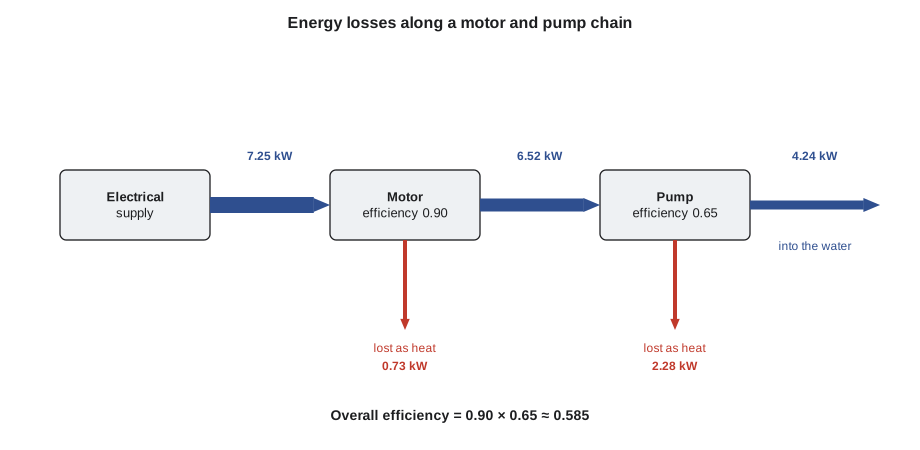
When several machines are connected in a chain, so that the output of one is the input of the next, the overall efficiency is the product of the individual efficiencies. A motor of efficiency 0.90 driving a pump of efficiency 0.65 has an overall efficiency of 0.90 × 0.65 = 0.585. Multiplying efficiencies, never adding them, is the key.
The power a pump gives the water
A pump does work on water by raising its pressure. The useful power it gives the water, the hydraulic power (also called water power), depends on how much water it moves and how much pressure, or head, it adds. Head is pressure expressed as the height of a column of the liquid that would produce it; lesson 6 explains it. The pump's shaft power is larger than the hydraulic power by the pump's losses, and the motor's electrical input is larger again by the motor's losses.
In SI, the hydraulic power is the density of the liquid times gravitational acceleration times the volume flow times the head:
with ρ in kg/m³, g = 9.81 m/s², Q in m³/s and H in metres, giving watts. Equivalently, it is the flow in m³/s times the pressure rise in pascals.
Worked problem
Feed pump power
Boiler 3's feed pump delivers 3.5 L/s of feedwater at about 105 °C (density about 950 kg/m³) against a head of 130 m. The pump efficiency is 0.65 and the motor efficiency is 0.90. Find the hydraulic power, the shaft power and the electrical input.
Show solution
- Flow in m³/s:
- \[3.5 \text{ L/s} = 0.0035 \text{ m}^3\text{/s}\]
- Hydraulic power:
- \[P_{\text{hyd}} = 950 \times 9.81 \times 0.0035 \times 130 \approx 4{,}240 \text{ W}\]
- Shaft power:
- \[P_{\text{shaft}} = 4{,}240 \div 0.65 \approx 6{,}520 \text{ W}\]
- Electrical input:
- \[P_{\text{in}} = 6{,}520 \div 0.90 \approx 7{,}250 \text{ W}\]
Answer: About 4.2 kW reaches the water, 6.5 kW at the shaft and 7.25 kW from the supply. The overall efficiency is 4.24 ÷ 7.25 ≈ 0.585: only about 58 parts in 100 of the electricity ends up in the water. The rest becomes heat in the motor windings, the bearings and the turbulent water inside the pump casing.
That was the number that surprised Tamar. Then she worked out the cost. Each feed pump runs whenever its boiler fires, about 8,000 hours a year.
Worked problem
What the feed pump costs to run
The feed pump motor draws about 7.25 kW for 8,000 h a year. At an average of 0.13 dollars per kWh, what is the energy use and the yearly cost?
Show solution
- Energy:
- \[7.25 \times 8{,}000 = 58{,}000 \text{ kWh}\]
- Cost:
- \[58{,}000 \times 0.13 = 7{,}540 \text{ dollars}\]
Answer: About 58,000 kWh and about 7,540 dollars a year for one pump, at sample prices. Raising the pump's efficiency from 0.65 to 0.75 by replacing a worn impeller would cut the shaft power by about 13 in 100 and save roughly a thousand dollars a year.
Work, heat and the first law
Mechanical work and heat are two forms of the same thing, energy, and one can become the other. A brake turns the work of a moving vehicle into heat; a steam turbine turns heat into work. The amount is fixed by the mechanical equivalent of heat, which in SI is built into the units (both are joules) and in US units is 778 ft·lb per Btu.
The first law of thermodynamics is the conservation of energy applied to heat and work: the energy added to a system as heat, minus the work the system does, equals the increase in its stored energy. For a steady-flow device such as a boiler, a pump or a heat exchanger, the first law says that the energy entering with the fluid, plus any heat and work added, equals the energy leaving with the fluid. Lessons 7 and 12 use this every time they find the heat needed to make steam.
The heat lost in the feed pump is not wasted entirely: much of it warms the feedwater slightly on its way to the boiler. In a pump that is running against a closed valve, though, all of the shaft power goes into the trapped water, which heats up quickly and can flash to steam inside the casing. That is why feed pumps have a minimum flow recirculation line back to the deaerator, and why an operator never runs a centrifugal pump dead-headed for long.
Worked problem
How fast a dead-headed pump heats its water
If the feed pump's full shaft power of about 6.5 kW went into the 20 kg of water trapped in its casing, how fast would the water temperature rise? Use 4.2 kJ/(kg·K).
Show solution
- Heat added each second:
- \[6.5 \text{ kW} = 6.5 \text{ kJ/s}\]
- Temperature rise per second:
- \[6.5 \div (20 \times 4.2) \approx 0.077 \text{ K/s}\]
- Per minute:
- \[0.077 \times 60 \approx 4.6 \text{ K per minute}\]
Answer: About 4.6 K a minute. Starting from 105 °C in a casing at full discharge pressure, the water is already near its boiling point at suction pressure, so it would begin to flash and the pump could be damaged within minutes. Real pumps have some heat loss to the casing, but the lesson stands.
Efficiency across the plant
Efficiency appears at every level of a plant, and an operator should know roughly what to expect. A large electric motor is typically 0.90 to 0.96 efficient; a centrifugal pump 0.50 to 0.85, depending on size and condition; a gas-fired steam boiler about 0.80 to 0.85; a small steam turbine driving a pump perhaps only 0.30 to 0.50 (typical figures). The overall efficiency of turning fuel into useful work is the product of all the steps, and it is always much lower than any single step.
| Device | Typical efficiency | Where the losses go |
|---|---|---|
| Large electric motor | 0.90 to 0.96 | Heat in windings and core, friction, fan |
| Centrifugal pump | 0.50 to 0.85 | Turbulence, recirculation inside the casing, friction |
| Gas-fired steam boiler | 0.80 to 0.85 | Hot flue gas, radiation from the casing, blowdown |
| Small steam turbine | 0.30 to 0.50 | Steam leaving still hot, friction, leakage |
| Chain block | 0.40 to 0.80 | Friction in gears and sheaves |
Cantwell's backup feed pump is driven by a 75 hp steam turbine instead of a motor, so that the boilers can still be fed if the electricity fails. The turbine is far less efficient than a motor, but its exhaust steam goes to the deaerator, where its heat warms the feedwater. Counting that heat, the turbine-driven pump wastes much less energy than its efficiency alone suggests. Lesson 12 returns to this idea: an efficiency figure depends on what you count as useful output.
What Tamar told Grazyna
Tamar's answer went back on the bill: the hot water loop pumps used the most electricity, because they ran all year; the feed pumps came second. Of every kilowatt-hour into a feed pump motor, a little under 60 parts in 100 ended up as pressure in the water. Grazyna read it and added one line. "Now check whether the pump is still at 0.65. Worn impellers drift down every year, and nobody notices until someone does this sum." Lesson 10 shows how to do that from pressure gauges and a flow reading.
Common mistakes
MistakeAdding efficiencies in a chain of machines.
InsteadMultiply them: overall efficiency is the product of the stage efficiencies.
MistakeConfusing work with force, or power with energy.
InsteadWork is force times distance; power is work per unit time; energy is power times time.
MistakeUsing the pump's hydraulic power as the motor's electrical load.
InsteadDivide by the pump and motor efficiencies to get the input.
MistakeTreating 1 kWh and 1 kW as the same kind of quantity.
InsteadA kilowatt is a rate; a kilowatt-hour is an amount of energy.
MistakeRunning a centrifugal pump against a closed discharge for long periods.
InsteadAll its shaft power heats the trapped water; use the minimum flow line.
Summary and key terms
- Work is force times distance moved in the direction of the force; energy is the capacity to do work.
- Power is the rate of doing work; energy used is power times time, billed in kilowatt-hours.
- Efficiency is output divided by input; overall efficiency is the product of the stage efficiencies.
- A pump's hydraulic power is ρgQH; shaft and electrical power are larger by the pump and motor losses.
- Heat and work are both energy; the first law of thermodynamics says energy is conserved.
- A dead-headed pump turns all its shaft power into heat in the trapped water.
- Work
- Force times the distance moved in the direction of the force.
- Power
- The rate of doing work or transferring energy.
- Efficiency
- Useful output divided by input.
- Hydraulic power
- The power a pump gives to the liquid it moves.
- Kilowatt-hour
- The energy used by a one-kilowatt load in one hour.
- First law of thermodynamics
- Energy is conserved: heat added minus work done equals the change in stored energy.
Practice problems
Work each problem on paper first, then reveal the answer to check.
A force of 500 N moves a load 4 m. How much work is done?
Show answer
2,000 J, or 2 kJ.
A 3 kW motor runs for 10 h. How much energy does it use?
Show answer
30 kWh.
A motor of efficiency 0.92 drives a pump of efficiency 0.70. What is the overall efficiency?
Show answer
About 0.64.
A pump gives 2 kW to the water at an overall efficiency of 0.6. What is the electrical input?
Show answer
About 3.3 kW.
What is the potential energy of 1,000 kg of water raised 5 m?
Show answer
About 49,050 J, or 49 kJ.
Lesson quiz · 5 questions
Score 60% or more to complete this lesson.
Create a free account to save your progress, take quizzes and earn a certificate.