
PWR-210 · Lesson 8 of 12 · 25 min
Heat transfer in boilers
▶ Video coming soon A video version of this lesson is on the way.
On Wednesday, October 21, 2026, Lorne Fitzwilliam handed Tamar Ellingsen the plant's thermal camera at the top of the ladder into steam vault 4. On the screen, the main steam line was a cool purple where it was wrapped in insulation, and then, for about three metres, a glaring white. Someone working in the vault in the summer had cut away the jacketing and insulation to reach a hanger, and nobody had put it back. "That white stretch is heating the street," Lorne said. "Work out how much, and we'll put the number on the work request."
This lesson covers the three ways heat moves, conduction, convection and radiation, and how each works in a boiler. It shows how scale and soot act as insulation in the wrong place, how heat passes through a tube wall from flame to water, why insulation on hot pipes matters, and how to estimate the heat lost from a bare pipe. It builds on the heat and temperature ideas from lesson 5.
Three ways heat moves
Heat always flows from a hotter body to a colder one. It moves in three ways, and a boiler uses all three:
- Conduction is heat passing through a solid, or through a still fluid, from molecule to molecule. Heat crosses a boiler tube wall by conduction.
- Convection is heat carried by a moving fluid. Hot flue gas sweeping over tubes gives up heat by convection, and the boiling water on the other side carries it away by convection.
- Radiation is heat sent as electromagnetic waves, like light, with no material needed between the bodies. A flame radiates heat to the furnace walls and tubes that can "see" it.
In a firetube or watertube boiler, the furnace absorbs most of its heat by radiation from the flame. Further along, in the convection passes, the gas has cooled and the heat arrives mainly by convection. The economizer and air heater, where fitted, recover more heat by convection from gas that would otherwise go up the stack.
Conduction
The rate of heat conducted through a flat wall depends on the material, the area, the temperature difference across the wall and its thickness. Doubling the area or the temperature difference doubles the heat flow; doubling the thickness halves it. The material's ability to conduct heat is its thermal conductivity, k.
Here Q is the rate of heat flow in watts, k is the thermal conductivity in W/(m·K), A is the area in m², ΔT is the temperature difference across the wall in K and x is the thickness in m.
| Material | Thermal conductivity (typical) |
|---|---|
| Copper | about 390 W/(m·K) (about 225 Btu/(h·ft·°F)) |
| Carbon steel | about 45 W/(m·K) (about 26 Btu/(h·ft·°F)) |
| Boiler scale (varies widely) | about 0.5 to 2.5 W/(m·K) (about 0.3 to 1.4 Btu/(h·ft·°F)) |
| Soot | about 0.1 W/(m·K) (about 0.06 Btu/(h·ft·°F)) |
| Mineral wool insulation | about 0.04 W/(m·K) (about 0.023 Btu/(h·ft·°F)) |
| Still air | about 0.026 W/(m·K) (about 0.015 Btu/(h·ft·°F)) |
Steel conducts heat about 45 times better than typical scale and hundreds of times better than soot. That is the whole problem with deposits: they put a poor conductor in the path of the heat.
Why scale overheats tubes
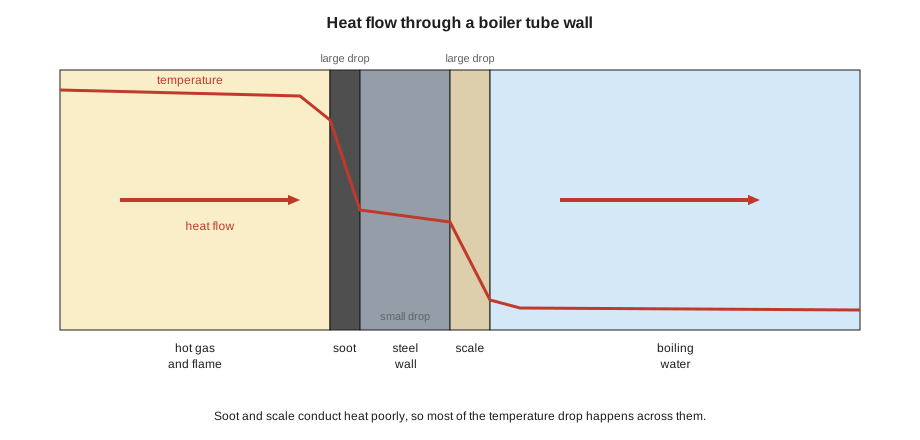
In a clean boiler tube, the heat that arrives from the fire passes through the steel and straight into the boiling water. Water boiling against a metal surface carries heat away very effectively, so the metal stays only a little hotter than the water. If a layer of scale forms on the water side, the same heat must also pass through the scale. Because scale conducts so poorly, a large temperature difference builds up across it, and the steel underneath gets much hotter than the water.
Worked problem
Temperature rise across a scale layer
A furnace tube in the hottest zone of a boiler receives heat at a rate of about 112,500 W per square metre. The steel wall is 4 mm thick with k = 45 W/(m·K). How large is the temperature difference across the steel? If a 1 mm layer of scale with k = 1.0 W/(m·K) forms on the water side, how much does the temperature difference across the scale add?
Show solution
- Rearranging conduction for one square metre:
- \[\Delta T = \frac{Q \, x}{k \, A}\]
- Across the steel:
- \[\Delta T = \frac{112{,}500 \times 0.004}{45 \times 1} = 10 \text{ K}\]
- Across the scale:
- \[\Delta T = \frac{112{,}500 \times 0.001}{1.0 \times 1} = 112.5 \text{ K}\]
Answer: Only 10 K across the steel, but about 112 K across a single millimetre of scale. With water at 185 °C, the clean tube metal runs near 200 °C; the scaled tube runs over 300 °C, and thicker or less conductive scale pushes it higher. Steel loses strength as it heats, so the tube can bulge and fail even though the water level and pressure are perfectly normal.
This example explains why water treatment, the subject of PWR-120 and PWR-220, is a matter of safety and not just efficiency. Scale also wastes fuel: less heat reaches the water, so more leaves in the flue gas and the stack temperature rises. Oil and sludge on the water side act the same way, and an oil film is especially dangerous because it can form quickly after a condensate contamination.
Soot on the fire side
Soot and ash on the fire side of the tubes are poor conductors too. They do not usually overheat the metal, because they sit on the hot side and simply reduce the heat that reaches the tube, but they waste a great deal of fuel. With less heat absorbed, the gas leaves the boiler hotter. A rising stack temperature at the same firing rate and excess air is one of the first signs of fouling, on either side of the tubes, and a reason to look at both the combustion and the water treatment records. Clean gas-fired boilers produce very little soot; oil firing, poor combustion or a burner problem can coat the tubes quickly.
Convection
Convection is the main way heat leaves the hot gas and enters the water in the convection passes. The rate depends on the area, the temperature difference between the fluid and the surface, and a heat transfer coefficient, h, that depends on how fast and how turbulently the fluid moves and on what it is.
Typical values of h range from about 5 to 25 W/(m²·K) for air moving slowly over a pipe, through 50 to 150 for flue gas in a boiler pass, to many thousands for boiling or condensing water. Because the gas side coefficient is so much lower than the water side, it is the gas side that limits the heat transfer. Boiler designers add surface on the gas side, with more tubes, fins or extended surfaces, and they keep gas velocities up to improve h.
Natural convection happens when a fluid moves on its own because warm fluid is lighter and rises. It drives the circulation in many watertube boilers, where water heated in the riser tubes rises and cooler water falls through the downcomers. Forced convection uses a fan or pump to move the fluid, as the forced draft fan does for combustion air and the circulating pumps do in the hot water system.
Radiation
Every surface radiates heat, and the amount rises very steeply with its absolute temperature: in proportion to the fourth power. Double the absolute temperature and the radiation increases sixteen times. That is why radiation dominates in the furnace, where the flame is extremely hot, and matters little in the cooler passes.
Here ε is the emissivity, a number between 0 and 1 describing how well the surface radiates compared with a perfect radiator; σ is the Stefan-Boltzmann constant, 5.67 × 10⁻⁸ W/(m²·K⁴); and the temperatures must be absolute, in kelvin.
Worked problem
Radiation in the furnace
Estimate the radiation from a flame at about 1,500 °C to furnace tubes at about 200 °C, taking an effective emissivity of 0.8, per square metre of tube surface.
Show solution
- Absolute temperatures:
- \[T_1 = 1{,}773 \text{ K}, \quad T_2 = 473 \text{ K}\]
- Radiation:
- \[Q = 0.8 \times 5.67 \times 10^{-8} \times (1{,}773^4 - 473^4) \approx 446{,}000 \text{ W/m}^2\]
Answer: About 446 kW per square metre, several times the rate in the hottest convection passes. Real furnaces receive less, because the flame does not fill the whole view and gas radiation is complicated, but the example shows why the furnace is the hardest-working surface in a boiler and why it must always be covered by water.
Radiation also explains everyday plant observations. Refractory glows and radiates heat back into the flame, helping it burn steadily. A sight glass on a furnace feels hot from across the room. And as lesson 5 noted, an infrared thermometer measures radiation, so a shiny, low-emissivity surface reads lower than its true temperature.
From flame to water: the overall picture
In a real boiler, heat passes through several layers in series: the gas film on the fire side, any soot, the steel, any scale, and the water film on the water side. Each layer resists the flow of heat, and the resistances add, much as resistances in series add in an electrical circuit (lesson 11). Engineers combine them into an overall heat transfer coefficient, U, so that the heat flow is Q = U A ΔT, with ΔT the difference between the gas and water temperatures. A clean, well-treated boiler has the highest U; every deposit lowers it.
The temperature difference falls along the boiler as the gas cools. Near the furnace it is large, and each square metre of surface does a lot of work; near the outlet it is small, and each square metre does less. Adding more and more surface brings diminishing returns, which is why a stack temperature a little above the water or steam temperature is the practical limit for a boiler, and why economizers use the cooler feedwater to recover a little more.
Heat loss from pipes and insulation
Heat that escapes from a pipe is heat paid for and wasted. A bare steam pipe loses heat to the surrounding air by convection and radiation together. A combined coefficient covers both for a rough estimate.
Worked problem
Heat lost from the bare section
The bare section in vault 4 is NPS 6 pipe with an outside diameter of 168.3 mm, carrying steam at about 185 °C. The vault air is about 20 °C. Using a combined convection and radiation coefficient of 12 W/(m²·K), estimate the heat lost per metre of pipe, and over a year for the 3 m bare length, taking 8,000 hours of operation.
Show solution
- Outside surface area per metre:
- \[A = \pi \times 0.1683 \times 1 \approx 0.529 \text{ m}^2\]
- Heat loss per metre:
- \[Q = 12 \times 0.529 \times (185 - 20) \approx 1{,}047 \text{ W}\]
- Over a year for 3 m:
- \[1{,}047 \times 3 \times 8{,}000 \approx 25{,}100{,}000 \text{ Wh} \approx 25 \text{ MWh}\]
Answer: About 1 kW lost from every metre and about 25 MWh a year from the bare stretch, before counting the extra condensate that forms in the line. Insulation typically cuts a bare pipe's loss by around nine tenths or more, so replacing it pays for itself quickly.
Insulation works because it traps air in tiny pockets, and still air conducts heat poorly. It works only while it is dry and intact: wet insulation conducts heat many times faster and can cause corrosion of the pipe beneath it, which is hard to see. Insulation also protects people from burns. Damaged jacketing, missing sections at valves and flanges, and insulation soaked by a leak are all worth reporting.
The work request
Tamar's work request asked for 3 m of NPS 6 pipe insulation and jacketing in vault 4, with her estimate of about 25 MWh of heat a year written in the description. Fenella Thorncroft scheduled it for the following week and added a note to the hanger crew's procedure: "Reinstate insulation before closing the job." Lorne asked one more question on the way back up the ladder: "If that pipe had a millimetre of scale inside, would it lose more heat or less?" Tamar thought about it, then answered correctly: slightly less, because the scale is one more resistance in the path, though no one would recommend it as insulation.
Common mistakes
MistakeUsing °C or °F in the radiation formula.
InsteadRadiation needs absolute temperatures, K or °R.
MistakeThinking scale only costs fuel.
InsteadScale on the water side overheats tube metal and can cause failure.
MistakeTreating a rising stack temperature as normal.
InsteadAt steady firing and excess air it usually means fouling on the fire side or the water side.
MistakeLeaving insulation off after maintenance.
InsteadBare hot pipe wastes heat and is a burn hazard; reinstate it.
MistakeForgetting to convert inches to feet, or millimetres to metres, in conduction.
InsteadKeep units consistent with the conductivity.
Summary and key terms
- Heat moves by conduction, convection and radiation; a boiler uses all three.
- Conduction Q = kAΔT/x; steel conducts well, scale, soot and insulation poorly.
- Scale on the water side forces a large temperature drop and overheats tube metal.
- Convection Q = hAΔT; the gas side coefficient limits heat transfer in a boiler.
- Radiation rises with the fourth power of absolute temperature and dominates in the furnace.
- Bare hot pipes lose heat steadily; dry, intact insulation cuts the loss by most of its value.
- Conduction
- Heat transfer through a solid or still fluid from molecule to molecule.
- Convection
- Heat transfer carried by a moving fluid.
- Radiation
- Heat transfer by electromagnetic waves, needing no material in between.
- Thermal conductivity
- A material's ability to conduct heat.
- Heat transfer coefficient
- A number describing how readily heat passes between a surface and a moving fluid.
- Emissivity
- How well a surface radiates compared with a perfect radiator, from 0 to 1.
- Overall heat transfer coefficient
- A single coefficient combining all the layers between a hot fluid and a cold one.
Practice problems
Work each problem on paper first, then reveal the answer to check.
Heat of 50,000 W/m² passes through 2 mm of scale with k = 1.0. What is the temperature drop across it?
Show answer
100 K.
Name the main way heat reaches the furnace tubes.
Show answer
Radiation from the flame.
A wall's absolute temperature doubles. By what factor does its radiation increase?
Show answer
16 times.
Air at h = 10 W/(m²·K) passes over 2 m² of surface 50 K hotter than the air. What is the heat transfer?
Show answer
1,000 W.
Why must insulation be kept dry?
Show answer
Wet insulation conducts heat much faster and can corrode the pipe.
Lesson quiz · 5 questions
Score 60% or more to complete this lesson.
Create a free account to save your progress, take quizzes and earn a certificate.