
PWR-210 · Lesson 10 of 12 · 29 min
Pumps and fluid flow
▶ Video coming soon A video version of this lesson is on the way.
On Tuesday, October 27, 2026, the deaerator low-level alarm sounded during a load swing, and a few seconds later feed pump 2 began to make a noise like gravel rattling through it. The level recovered within a minute and the noise stopped. Lorne Fitzwilliam logged the event and then sat down with Tamar Ellingsen and the pump's data sheet. "That noise was cavitation," he said. "Water boiling inside the pump. Today you're going to work out why a few metres of level made that difference."
This lesson covers flow and velocity in pump piping, the heads a pump works against, how pump head relates to pressure, the pump curve and the system curve, net positive suction head and cavitation, and the affinity laws that describe what happens when a pump's speed changes. Lesson 3 covered pump power and efficiency, and lesson 6 covered head and continuity; this lesson puts them together. PWR-230 covers pump construction and maintenance in detail.
Flow and velocity in pump piping
Lesson 6 showed that the flow through a pipe equals the pipe's area times the average velocity. Pump suction lines are deliberately made larger than discharge lines so that the water enters the pump slowly, with little friction loss, since anything lost on the suction side brings the water closer to boiling. A typical design keeps suction velocities low, around 1 m/s (3 ft/s) or less, and allows higher velocities on the discharge.
Worked problem
Suction and discharge velocity
Feed pump 2 delivers 3.5 L/s. Its suction pipe has an inside diameter of 80 mm and its discharge pipe 50 mm. What are the velocities in each?
Show solution
- Suction area:
- \[A = \frac{\pi}{4} \times 0.080^2 \approx 0.005027 \text{ m}^2\]
- Suction velocity:
- \[v = \frac{0.0035}{0.005027} \approx 0.70 \text{ m/s}\]
- Discharge velocity, from lesson 6:
- \[v \approx 1.78 \text{ m/s}\]
Answer: 0.70 m/s on the suction and 1.78 m/s on the discharge. The suction pipe has 2.56 times the area of the discharge, so the water moves 2.56 times more slowly.
Head and pressure
Pump makers describe what a pump does in terms of head: the height to which the pump could lift the liquid it is pumping. Head is used instead of pressure because a given pump, at a given speed and flow, produces the same head whatever liquid it pumps. The pressure it produces depends on the liquid's density: the same head of a heavier liquid gives a higher pressure.
Worked problem
Head to pressure
Feed pump 2 develops a head of 130 m when pumping feedwater at a density of 950 kg/m³. What pressure rise does it produce?
Show solution
- Pressure rise:
- \[p = 950 \times 9.81 \times 130 \approx 1{,}211{,}500 \text{ Pa} \approx 1{,}212 \text{ kPa}\]
Answer: About 1,212 kPa, added to the pressure at the pump suction. That is comfortably above the boiler operating pressure of 1,035 kPa, with margin for the friction in the feed line and the drop across the feedwater control valve.
The total head a pump must develop in a system is made up of several parts:
- Static head: the difference in height between the liquid level being pumped from and the point being pumped to.
- Pressure head: the difference in pressure between the two places, expressed as a head. A feed pump must overcome the boiler pressure; a pump from one open tank to another has none.
- Friction head: the losses in pipes, fittings, valves and strainers, which rise roughly with the square of the flow.
- Velocity head: the energy in the moving liquid, usually small.
The pump curve and the system curve
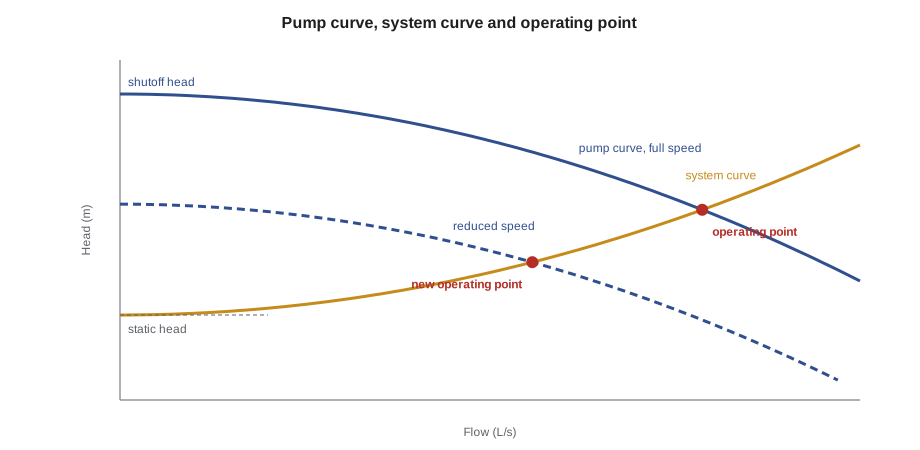
A centrifugal pump's performance is shown by its pump curve, a graph of head against flow at a fixed speed. At zero flow, with the discharge valve shut, the pump produces its highest head, called the shutoff head. As flow rises, the head falls. The maker's curve also shows the pump's efficiency, its power and its NPSH requirement at each flow. Every pump has a best efficiency point, the flow at which it runs most efficiently and most smoothly; running far from it, at very low or very high flow, causes vibration, heating and wear.
The piping has a curve of its own. The system curve shows the head the system needs at each flow. It starts at the static and pressure heads, which are needed even for a trickle of flow, and rises with friction as the flow increases. The pump runs where the two curves cross: the operating point. Throttling a discharge valve adds friction, making the system curve steeper and moving the operating point to a lower flow and higher head. Slowing the pump lowers the whole pump curve and moves the operating point down along the system curve.
A centrifugal pump must never be run for long with its discharge closed. With no flow, all the power going into it turns into heat in the small amount of water trapped in the casing, which can quickly flash to steam and damage the seals, wear rings and impeller. Feed pumps are therefore fitted with a minimum flow recirculation line that returns a small flow to the deaerator whenever the boiler demand is low.
Net positive suction head and cavitation
Water boils when its pressure falls to its vapour pressure, the saturation pressure for its temperature. As water enters a centrifugal pump, it speeds up into the eye of the impeller, and its pressure falls below the pressure in the suction pipe, as Bernoulli's principle predicts. If the pressure there falls to the vapour pressure, bubbles of vapour form. A moment later, as the water reaches the higher pressure further out on the vanes, the bubbles collapse violently. That is cavitation. It sounds like gravel passing through the pump, reduces the head and flow, and over time eats pits into the impeller.
To stay out of cavitation, the water arriving at the pump must have enough pressure above its vapour pressure to cover the drop inside the pump. The margin available, expressed as a head, is the net positive suction head available (NPSHa). The pump maker's curve gives the net positive suction head required (NPSHr) at each flow. NPSHa must always exceed NPSHr, with a safety margin.
Each term is a head of the liquid being pumped: the pressure on the liquid surface, the height of that surface above the pump suction (negative if the pump lifts from below), the friction loss in the suction line, and the vapour pressure of the liquid at its temperature.
For a deaerator, the water is at its saturation temperature, so the pressure on the surface equals the vapour pressure, and those two terms cancel. The only thing keeping the water from boiling at the pump is the static head of the water above it, minus the suction friction. That is why deaerators are mounted high above the feed pumps, and why a low deaerator level is so dangerous for them.
Worked problem
NPSH at a low deaerator level
At normal level the deaerator water is 9 m above the pump suction. At the low-level alarm point it is 6.5 m. Suction friction at full flow is about 0.8 m, and the pump data sheet gives NPSHr of 3.2 m. Find NPSHa and the margin at the low level.
Show solution
- With saturated water, the surface pressure and vapour pressure heads cancel:
- \[\text{NPSH}_a = 6.5 - 0.8 = 5.7 \text{ m}\]
- Margin over NPSHr:
- \[5.7 - 3.2 = 2.5 \text{ m}\]
Answer: On paper there is still a margin of 2.5 m even at the alarm point. But a load swing does something the steady calculation misses: when the deaerator pressure falls quickly, the water in it is suddenly hotter than its new saturation temperature, and the water already in the suction line is hotter than the pressure arriving behind it. For a few seconds the effective NPSHa drops sharply. Low level and falling pressure together are what made feed pump 2 cavitate.
Worked problem
NPSH from a vented tank
The condensate transfer pump draws from the vented condensate tank, open to an atmospheric pressure of 101.3 kPa, with condensate at 60 °C (vapour pressure 19.9 kPa, density 983 kg/m³). The water level is 2 m above the pump and suction friction is 0.5 m. What is NPSHa?
Show solution
- Net pressure above vapour pressure, as a head:
- \[\frac{(101.3 - 19.9) \times 1{,}000}{983 \times 9.81} \approx 8.44 \text{ m}\]
- NPSHa:
- \[8.44 + 2 - 0.5 \approx 9.94 \text{ m}\]
Answer: About 9.9 m, plenty for most small pumps. If the condensate came back hotter, near 100 °C, the vapour pressure would approach atmospheric and the first term would vanish, which is one more reason hot condensate returning to a vented tank causes trouble.
Ways to raise NPSHa include keeping tank levels up, raising the tank or lowering the pump, using larger and shorter suction piping with fewer fittings, keeping suction strainers clean, never throttling a suction valve, and keeping the liquid cooler where possible. A pump that cavitates should be investigated, not just listened to.
The affinity laws
Many plant pumps and fans now run on variable frequency drives (VFDs), which change the motor speed to match demand. For a centrifugal pump, the affinity laws describe how performance changes with speed, for the same impeller in the same system and at matching points on the curves:
- Flow changes in proportion to speed.
- Head changes with the square of speed.
- Power changes with the cube of speed.
Worked problem
Slowing a circulating pump
A hot water circulating pump delivers 28.6 L/s at a head of 30 m and takes 11 kW at full speed. Its VFD reduces the speed to 0.8 of full speed. Estimate the new flow, head and power.
Show solution
- Flow:
- \[28.6 \times 0.8 \approx 22.9 \text{ L/s}\]
- Head:
- \[30 \times 0.8^2 = 30 \times 0.64 = 19.2 \text{ m}\]
- Power:
- \[11 \times 0.8^3 = 11 \times 0.512 \approx 5.63 \text{ kW}\]
Answer: Four fifths of the flow for just over half the power. That cube law is why VFDs save so much energy compared with throttling a valve, which cuts the flow but leaves the pump working against extra resistance. In a real system with a large static head, the savings are smaller, because the affinity laws apply strictly only along a system curve that passes through zero head at zero flow.
The same laws apply to fans, which is why the forced draft fan's power falls steeply at low fire when its speed is reduced. Similar relationships, using the impeller diameter in place of speed, describe the effect of trimming an impeller to suit a system permanently.
Pumps in series and in parallel
Two pumps in series, the discharge of one feeding the suction of the next, add their heads at the same flow. That is how multistage feed pumps work: several impellers in one casing, each adding head. Two pumps in parallel, both drawing from the same header and discharging into the same line, add their flows at the same head. Cantwell's feed pumps are arranged in parallel so that one can be taken out of service while the other carries the load. Because the system curve rises with flow, two identical pumps in parallel deliver less than twice the flow of one.
Positive displacement pumps
Not every pump is centrifugal. A positive displacement pump, such as a reciprocating, gear or diaphragm pump, traps a fixed volume of liquid and forces it out with each stroke or revolution. Its flow depends on its speed almost regardless of the pressure, and it can produce very high pressure. Chemical feed pumps at Cantwell are of this kind. Because it will keep pushing against a closed valve until something breaks, a positive displacement pump must always have a relief valve on its discharge and must never be started against a closed outlet.
What Lorne asked for
Lorne asked Tamar to add two lines to the shift notes after their calculation. First, that the deaerator low-level alarm should be treated as an urgent call to restore level, not a nuisance. Second, a suggestion for Grazyna Wolanski to consider: raising the low-level alarm point by half a metre, to keep more margin during load swings. Grazyna added it to the agenda for the November operations meeting, where any change to an alarm set point would go through the plant's management of change procedure first.
Common mistakes
MistakeThrottling a pump's suction valve to reduce flow.
InsteadThrottle the discharge or slow the pump; throttling the suction causes cavitation.
MistakeRunning a centrifugal pump against a closed discharge for long.
InsteadThe trapped water overheats; use the minimum flow recirculation line.
MistakeStarting a positive displacement pump against a closed valve.
InsteadIt will build pressure until something fails; check the relief valve and open the outlet.
MistakeAssuming the affinity laws give full savings in every system.
InsteadStatic head reduces the savings; the laws apply strictly only along a curve through zero.
MistakeIgnoring a cavitation noise once it stops.
InsteadFind why NPSHa fell; repeated cavitation damages the impeller.
Summary and key terms
- Suction lines are larger and slower than discharge lines to protect the pump's suction margin.
- Head and pressure are linked by p = ρgh; pumps are rated in head.
- The pump runs where its curve crosses the system curve; the best efficiency point is where it runs best.
- NPSHa must exceed NPSHr; for a deaerator, NPSHa is essentially the static head minus suction friction.
- Affinity laws: flow with speed, head with speed squared, power with speed cubed.
- Positive displacement pumps need a relief valve and must not be started against a closed outlet.
- Head
- The height of liquid column a pump could lift, used to describe its performance.
- Shutoff head
- The head a centrifugal pump produces at zero flow.
- Best efficiency point
- The flow at which a pump operates most efficiently.
- System curve
- A graph of the head a piping system needs at each flow.
- Cavitation
- The formation and violent collapse of vapour bubbles inside a pump.
- NPSH
- Net positive suction head: the margin of suction pressure above vapour pressure, as a head.
- Affinity laws
- Rules relating a centrifugal pump's flow, head and power to its speed.
Practice problems
Work each problem on paper first, then reveal the answer to check.
What pressure does a 50 m head of cold water (1,000 kg/m³) represent?
Show answer
About 490 kPa.
A deaerator level is 7 m above the pump, suction friction is 1 m, and NPSHr is 3 m. What is the margin?
Show answer
3 m (7 − 1 − 3).
A pump's speed is raised by a factor of 1.1. By what factor does its power rise?
Show answer
About 1.33 (1.1³).
At 0.9 of full speed, a pump that gave 40 m of head gives about how much?
Show answer
About 32.4 m.
Two identical pumps run in series. What adds: flow or head?
Show answer
Head.
Lesson quiz · 5 questions
Score 60% or more to complete this lesson.
Create a free account to save your progress, take quizzes and earn a certificate.