
PWR-210 · Lesson 4 of 12 · 23 min
Stress, strain and materials
▶ Video coming soon A video version of this lesson is on the way.
On Monday, October 5, 2026, Grazyna Wolanski brought the original data report for hot water boiler 1 into the control room, because Ottoline Brackwater, the insurer's inspector, would want it in December. Tamar Ellingsen read the first page and stopped at a line that gave the shell plate material, its thickness and its maximum allowable working pressure. "How do they get from a plate thickness to a pressure?" she asked. Grazyna pulled out a pad. "With the same idea that keeps a bolt from snapping and a safety valve spring from sagging. Stress."
This lesson covers stress and strain in tension, compression and shear, the stress-strain curve and the properties it reveals, Young's modulus, factor of safety and allowable stress, the stresses in the shell of a boiler drum or pressure vessel, and the material properties that matter in a boiler plant. PWR-220 builds on it with the code rules for boiler design.
Stress
When a force acts on a solid, the material inside resists it. The internal force per unit of area is called stress. A thick bar and a thin bar can carry the same load, but the thin bar is more highly stressed, because the same force is shared by less material.
Here σ (sigma) is the stress, F the force and A the cross-sectional area that carries it. In SI, stress is measured in pascals; because a pascal is tiny, engineers use megapascals (MPa). Conveniently, one MPa is one newton per square millimetre (N/mm²), so a force in newtons divided by an area in mm² gives a stress directly in MPa.
There are three basic kinds of stress, set by the way the force acts:
- Tensile stress pulls the material apart: a bolt holding a manway cover, a stay rod, the shell of a pressurized drum.
- Compressive stress squeezes the material together: a column under a tank, a pipe support, the gasket under a tightened flange.
- Shear stress makes one part of the material slide past the next: a pin in a clevis, a key in a shaft, a rivet in an old lap joint. Shear stress is the force divided by the area that would be sheared, which is not the same area as for tension.
Strain and the stress-strain curve
Under stress, a material changes shape. Strain is the change in length divided by the original length. It has no units, because it is a length divided by a length, and it is usually a very small number: a steel bolt tightened hard may stretch by a few parts in ten thousand.
If a steel test piece is pulled in a testing machine and the stress is plotted against the strain, the result is the stress-strain curve. Its shape tells an engineer most of what they need to know about a metal.
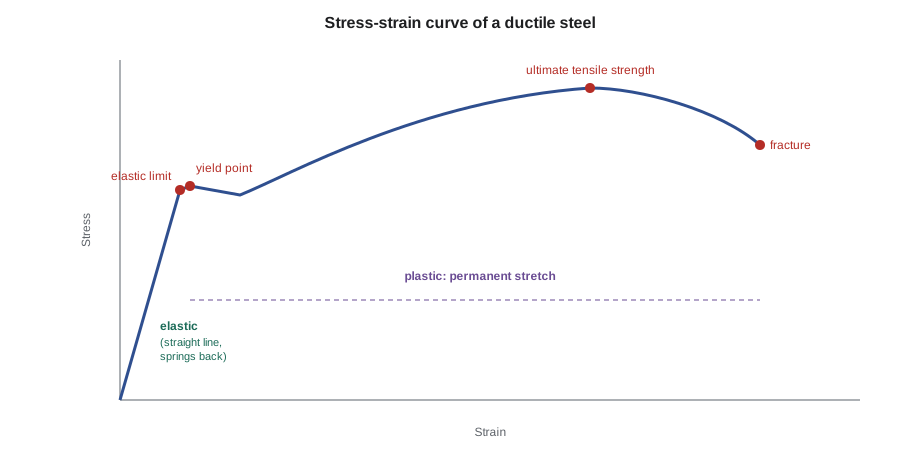
- In the elastic region, stress is proportional to strain, and the metal springs back to its original length when the load is removed. This straight-line behaviour is called Hooke's law.
- At the yield point (or yield strength), the metal begins to stretch permanently. Above it, the deformation is plastic: remove the load and the piece stays longer.
- The ultimate tensile strength is the highest stress the metal can carry before it starts to neck down and fail.
- At fracture, the piece breaks. A ductile metal like boiler plate steel stretches a long way before it breaks, giving warning; a brittle material like cast iron or glass breaks with little stretch.
Boilers, pipes and pressure vessels are designed so that the stresses in service stay well inside the elastic region, far below the yield point. A boiler that has been pushed past yield has been permanently deformed, and bulged tubes or a bowed furnace are signs that it has.
Young's modulus
In the elastic region, the ratio of stress to strain is constant for a given material. It is called the modulus of elasticity or Young's modulus, E, and it measures stiffness: how much stress it takes to produce a given strain. Steel is about three times as stiff as aluminum, so a steel bolt stretches about a third as much as an aluminum one of the same size under the same load.
| Material | Young's modulus (typical) | Notes |
|---|---|---|
| Carbon steel | about 200 GPa (about 29,000,000 psi) | Boiler plate, tubes, bolts, structural steel |
| Stainless steel | about 193 GPa (about 28,000,000 psi) | Slightly less stiff than carbon steel |
| Cast iron | about 100 GPa (about 15,000,000 psi) | Stiff but brittle in tension |
| Copper | about 117 GPa (about 17,000,000 psi) | Tubing, heat exchangers |
| Aluminum | about 69 GPa (about 10,000,000 psi) | Jacketing, light structures |
Worked problem
Stretch in a manway bolt
A manway cover bolt has a diameter of 20 mm and a working length of 150 mm. When the cover is tightened, it carries a tensile force of 25 kN. Using E = 200,000 MPa, find the stress in the bolt, its strain and how far it stretches.
Show solution
- Area:
- \[A = \frac{\pi}{4} \times 20^2 \approx 314.2 \text{ mm}^2\]
- Stress:
- \[\sigma = 25{,}000 \div 314.2 \approx 79.6 \text{ MPa}\]
- Strain:
- \[\varepsilon = 79.6 \div 200{,}000 \approx 0.000398\]
- Stretch:
- \[\Delta L = 0.000398 \times 150 \approx 0.060 \text{ mm}\]
Answer: About 80 MPa, a strain of about 4 parts in 10,000, and a stretch of only about 0.06 mm. That tiny stretch is what clamps the gasket: the bolt acts as a stiff spring, which is why bolts are tightened in a pattern and to a set torque, and why an over-tightened bolt that has been taken past yield should be replaced.
Factor of safety and allowable stress
No design should run a material close to its breaking point. The material may be a little weaker than its specification, the loads may be higher than expected, corrosion may thin the metal over the years, and calculations always simplify the real shape. The factor of safety is the ratio of the stress that would cause failure to the stress the part actually carries.
Pressure equipment codes, such as the ASME Boiler and Pressure Vessel Code that CSA B51 adopts in Canada, build the safety margin into an allowable stress for each material at each temperature. In current editions, the allowable stress for most steels at moderate temperatures is roughly the lower of the tensile strength divided by 3.5 and two-thirds of the yield strength; at high temperatures, creep and other limits take over. The designer looks the value up in the code's tables rather than choosing a factor of safety. For SA-516 Grade 70 plate, a common boiler and pressure vessel steel with a minimum tensile strength of 485 MPa, 485 ÷ 3.5 gives about 139 MPa.
An operator never designs a boiler, but understanding allowable stress explains several rules they live by: why a boiler must never be operated above its maximum allowable working pressure even for a moment, why the safety valve set pressure is tied to that pressure, why corrosion that thins a shell is a serious finding at inspection, and why a repair must use material and welding approved for the code.
Stress in a cylindrical shell
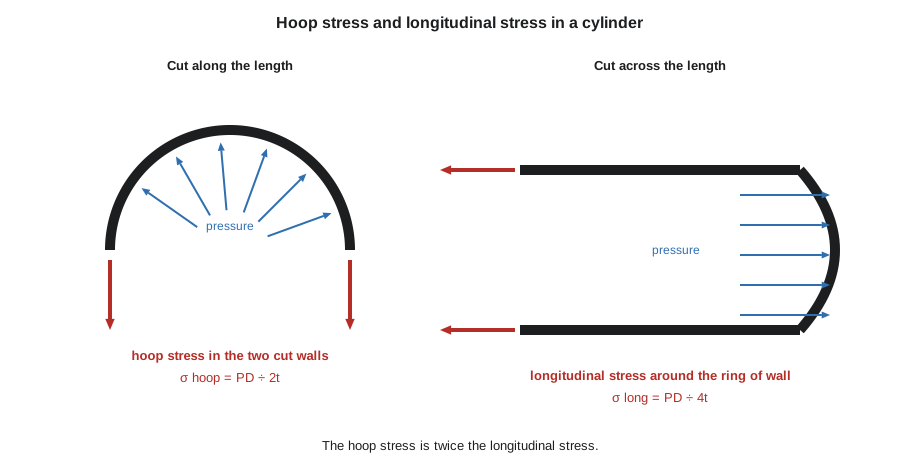
A boiler drum, a steam header and a pressure vessel are cylinders under internal pressure. The pressure pushes outward on every part of the wall, and the wall resists in two directions. The stress around the circumference, trying to split the cylinder along its length, is the hoop stress (or circumferential stress). The stress along the length, trying to pull the end caps off and split the cylinder around its girth, is the longitudinal stress. For a thin-walled cylinder, with the wall thin compared with the diameter, simple formulas give both.
Here P is the internal (gauge) pressure, D the inside diameter and t the wall thickness. The hoop stress is twice the longitudinal stress. That is why a cylinder that fails by overpressure usually splits along its length, and why the longitudinal seams of old riveted boilers were made much stronger than the circumferential seams.
Worked problem
Stress in a steam drum
A steam drum has an inside diameter of 1,200 mm and a shell thickness of 10 mm. It works at 1,035 kPa and its safety valves are set at 1,380 kPa. Find the hoop stress at each pressure, the longitudinal stress at the set pressure, and the factor of safety on a tensile strength of 485 MPa at the set pressure.
Show solution
- Pressures in MPa: 1,035 kPa = 1.035 MPa; 1,380 kPa = 1.38 MPa.
- Hoop stress at working pressure:
- \[\sigma = \frac{1.035 \times 1{,}200}{2 \times 10} \approx 62.1 \text{ MPa}\]
- Hoop stress at set pressure:
- \[\sigma = \frac{1.38 \times 1{,}200}{2 \times 10} = 82.8 \text{ MPa}\]
- Longitudinal stress at set pressure:
- \[\sigma = \frac{1.38 \times 1{,}200}{4 \times 10} = 41.4 \text{ MPa}\]
- Factor of safety:
- \[485 \div 82.8 \approx 5.9\]
Answer: About 62 MPa in service, 83 MPa at the set pressure, 41 MPa along the drum, and a factor of safety of almost 6 on tensile strength, comfortably below the allowable stress of about 139 MPa. A real design also accounts for weld joint efficiency, holes for nozzles and tubes, and an allowance for corrosion, which is why real drums are thicker than this simple formula suggests. PWR-220 covers the code formula.
The same formula shows why corrosion matters. Hoop stress is inversely proportional to thickness, so a shell that has lost a fifth of its thickness to pitting carries a quarter more stress at the same pressure. An inspector who finds thinning may reduce the boiler's allowed pressure until it is repaired.
Temperature and materials
Metals behave differently when hot. As temperature rises, both the yield and tensile strengths of steel fall, slowly at first and quickly above a few hundred degrees. At high temperatures steel also creeps: it stretches slowly and permanently under a steady stress that would be quite safe at room temperature. This is why a tube that loses its water cooling, through scale (lesson 8) or low water (PWR-120), can bulge and fail at normal pressure. The steel has become too hot to carry the stress.
Cold has its own danger. Some steels become brittle at low temperatures and can crack suddenly under a load they would carry easily when warm. That is one reason a hydrostatic test is done with water that is not too cold, and why outdoor equipment is made from steels tested for toughness at low temperature. Repeated heating and cooling, or repeated pressure swings, can also cause fatigue: small cracks that grow a little with each cycle until the part fails at a stress well below its tensile strength. Boilers that cycle on and off many times a day are more prone to fatigue at tube ends and welds.
| Property | What it means | Why it matters in a boiler plant |
|---|---|---|
| Strength | Stress the metal can carry before yielding or breaking | Sets the allowable stress and the wall thickness |
| Ductility | Ability to stretch before breaking | Gives warning by bulging before rupture |
| Toughness | Ability to absorb energy without cracking | Resists sudden cracking, especially when cold |
| Hardness | Resistance to indentation and wear | Valve seats, pump wear rings, bearing surfaces |
| Creep resistance | Resistance to slow stretching when hot | Superheater tubes and high-temperature piping |
| Corrosion resistance | Resistance to chemical attack | Tubes, condensate piping, chemical feed equipment |
Springs and safety valves
Lesson 2 showed that a safety valve's spring must balance the steam force on the disc at the set pressure. A spring is a coil of steel wire stressed in shear as it is compressed. Within its elastic range, its compression is proportional to the force on it, so its spring rate (force per unit of compression) stays constant. A spring that has been overheated or overstressed loses force, and the valve then lifts below its set pressure, or simmers. That is one reason why only an authorized valve repair shop adjusts and reseals safety valves, and why an operator who finds a valve simmering below its set point reports it instead of adjusting it.
Back to the data report
Grazyna turned the data report around so Tamar could read the shell thickness, the material and the design pressure, and Tamar ran the hoop stress formula on the pad. Her answer was well below the allowable stress in the report. "Good," Grazyna said. "Now look at the inspection history." The report's later pages showed the shell thickness measured by ultrasound at each internal inspection. It had barely changed in twenty years. "That's what good water treatment buys you," she said. "Ottoline will measure it again in December. If it ever starts to drop, the stress goes up with it."
Common mistakes
MistakeUsing the outside diameter in the thin-shell formula without checking which the problem gives.
InsteadThe simple formula uses the inside diameter; use the value the problem states and note which it is.
MistakeForgetting that hoop stress is twice the longitudinal stress.
Insteadσ_hoop = PD/2t; σ_long = PD/4t.
MistakeMixing kPa with mm and expecting MPa.
InsteadConvert the pressure to MPa (divide kPa by 1,000) so that MPa × mm ÷ mm gives MPa.
MistakeThinking a metal is just as strong when hot.
InsteadStrength falls and creep begins at high temperature.
MistakeAdjusting a simmering safety valve on the boiler.
InsteadReport it; only an authorized repair shop resets and reseals safety valves.
Summary and key terms
- Stress is force per unit area; it can be tensile, compressive or shear.
- Strain is change in length divided by original length and has no units.
- In the elastic region stress is proportional to strain; Young's modulus E = σ ÷ ε.
- Yield strength marks the start of permanent stretch; ultimate tensile strength is the highest stress before failure.
- Codes set allowable stresses with safety margins built in; operators must never exceed the maximum allowable working pressure.
- In a thin cylinder, hoop stress is PD/2t and longitudinal stress PD/4t; thinning raises the stress.
- Stress
- Internal force per unit area in a material.
- Strain
- Change in length divided by original length.
- Young's modulus
- The ratio of stress to strain in the elastic region; a measure of stiffness.
- Yield strength
- The stress at which permanent deformation begins.
- Hoop stress
- The stress around the circumference of a pressurized cylinder.
- Creep
- Slow, permanent stretching of a metal under steady stress at high temperature.
Practice problems
Work each problem on paper first, then reveal the answer to check.
A rod of area 200 mm² carries 30 kN. What is the stress?
Show answer
150 MPa.
A bar 2 m long stretches 0.5 mm. What is the strain?
Show answer
0.00025.
A drum of 1,000 mm diameter and 12 mm wall works at 1.2 MPa. What is the hoop stress?
Show answer
50 MPa.
What is the longitudinal stress in that drum?
Show answer
25 MPa.
A metal has a tensile strength of 420 MPa and carries 105 MPa. What is the factor of safety?
Show answer
4.
Lesson quiz · 5 questions
Score 60% or more to complete this lesson.
Create a free account to save your progress, take quizzes and earn a certificate.