
PWR-210 · Lesson 1 of 12 · 28 min
Units, measurement and plant calculations
▶ Video coming soon A video version of this lesson is on the way.
On Tuesday, September 22, 2026, two weeks after she started at Cantwell Energy Centre, Tamar Ellingsen found a textbook on her desk in the control room with a note from the chief engineer, Grazyna Wolanski: "Part A starts here. Every number in this plant has a unit. Learn the units first." Lorne Fitzwilliam, her supervising engineer, pointed at the board. Boiler 3's steam flow, header pressure, feedwater temperature and gas flow were all on the screen, each with a different unit. "If you can't move between those without thinking," he said, "every calculation after this one will go wrong somewhere."
This course covers the science of the Fourth Class syllabus: the applied mechanics and thermodynamics that sit in the first part of the Fourth Class examinations. Under the standardized SOPEEC syllabus that Ontario's TSSA and the other provinces use, the Fourth Class certificate needs two examinations, 4A1 and 4B1, each of 150 multiple-choice questions in three and a half hours, with a pass mark of 65 in 100 on each. Most of the material in this course belongs to 4A1, which opens with elementary mechanics and dynamics and with elementary chemistry and thermodynamics. Tamar plans to write 4A1 early in 2027.
This first lesson is about the tools of every later one: units and unit systems, converting between them, measurement and its limits, significant figures and rounding, and a tidy way of setting out a plant calculation so that someone else can check it.
Quantities, units and dimensions
A physical quantity is something that can be measured, such as a length, a mass, a time, a temperature or a pressure. Every measurement is a number and a unit. A reading of 1,035 on a gauge means nothing until you know whether it is kilopascals, gauge or absolute. Engineers say that a number without its unit is not an answer.
Some quantities are base quantities, defined directly: length, mass, time, temperature, electric current, amount of substance and luminous intensity. All the others are derived quantities, built from the base ones. Speed is length divided by time. Force is mass times acceleration. Pressure is force divided by area. Energy is force times distance, and power is energy divided by time. Knowing how a quantity is built tells you its unit, and it lets you check a formula: if the units on the two sides of an equation do not match, the equation is wrong.
Canada uses the International System of Units (SI) for engineering and for the TSSA examinations, although the plant still meets older units on nameplates, pipe sizes and imported equipment. An Ontario engineer must be able to read pounds per square inch on an older gauge, Btu on a burner plate and inches on a pipe schedule, but works and writes calculations in SI.
The SI system
SI has seven base units. The four a power engineer uses every shift are the metre (m) for length, the kilogram (kg) for mass, the second (s) for time and the kelvin (K) for temperature. The ampere (A), for electric current, appears in lesson 11. From these come the derived units in the table below. Prefixes scale a unit up or down by powers of ten, so that numbers stay readable: 1,035 kPa is easier to read than 1,035,000 Pa.
| Quantity | SI unit | Symbol | Built from |
|---|---|---|---|
| Force | newton | N | kg·m/s² |
| Pressure | pascal | Pa | N/m² |
| Energy, work, heat | joule | J | N·m |
| Power | watt | W | J/s |
| Temperature | kelvin (or degree Celsius) | K (°C) | base unit |
| Volume | cubic metre (or litre) | m³ (L) | m³; 1 L = 0.001 m³ |
| Prefix | Symbol | Multiplier | Plant example |
|---|---|---|---|
| giga | G | 1,000,000,000 | GJ of fuel in a month |
| mega | M | 1,000,000 | MJ per cubic metre of gas, MW of boiler output |
| kilo | k | 1,000 | kPa of steam pressure, kW of motor power |
| milli | m | 0.001 | mm of tube wall, mA of control signal |
| micro | µ | 0.000001 | µS/cm of water conductivity |
US customary units
The US customary system grew out of older English units. Its base units for plant work are the foot (ft) and inch (in), the pound (lb) and the second or hour, with temperature in degrees Fahrenheit (°F). Two awkward points need care.
- Pound mass and pound force. The pound is used both for mass (lbm) and for force (lbf). A one-pound mass weighs one pound force under standard gravity, so in everyday plant work the two are used side by side. Pressure in psi means pounds force per square inch.
- Heat and work have different units. Heat is measured in British thermal units (Btu), the heat that raises one pound of water by 1 °F, while mechanical work is measured in foot-pounds (ft·lb) and power in horsepower (hp). The link is that 1 Btu is about 778 ft·lb and 1 hp is 550 ft·lb per second, about 2,545 Btu/h.
| Quantity | US customary unit | Approximate SI equivalent |
|---|---|---|
| Length | foot (ft), inch (in) | 1 ft = 0.3048 m; 1 in = 25.4 mm |
| Mass | pound (lb) | 1 lb = 0.4536 kg |
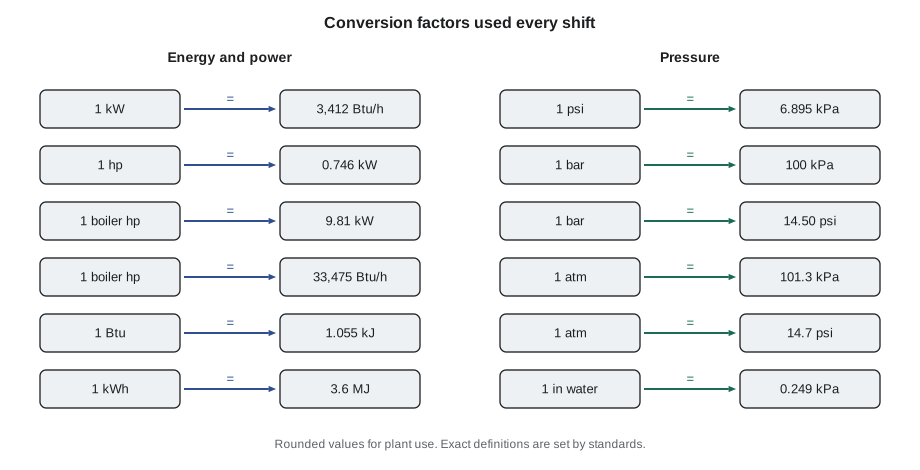
| Pressure | psi | 1 psi = 6.895 kPa |
| Energy | Btu | 1 Btu = 1.055 kJ |
| Power | horsepower (hp), Btu/h | 1 hp = 0.7457 kW; 1 kW = 3,412 Btu/h |
| Boiler output | boiler horsepower (bhp) | 1 bhp = 33,475 Btu/h, about 9.81 kW |
| Volume | US gallon, cubic foot | 1 gal = 3.785 L; 1 ft³ = 28.32 L |
Converting units without mistakes
The safest way to convert units is to multiply by a conversion factor written as a fraction equal to one, arranged so that the unit you do not want cancels. To turn 8,000 kW into Btu per hour, multiply by (3,412 Btu/h ÷ 1 kW): the kW on top and bottom cancel and Btu/h is left. Writing the units in every step catches the most common error, which is multiplying when you should divide.
Worked problem
Converting a boiler rating
Each of Cantwell's steam boilers is rated 8,000 kW. Express the rating in megajoules per hour, in Btu per hour and in boiler horsepower, using 1 kW = 3,412.14 Btu/h and 1 bhp = 33,475 Btu/h.
Show solution
- One kilowatt is 1 kJ/s, so in an hour of 3,600 s:
- \[8{,}000 \text{ kJ/s} \times 3{,}600 \text{ s/h} = 28{,}800{,}000 \text{ kJ/h} = 28{,}800 \text{ MJ/h}\]
- In Btu per hour:
- \[8{,}000 \text{ kW} \times \frac{3{,}412.14 \text{ Btu/h}}{1 \text{ kW}} \approx 27{,}297{,}000 \text{ Btu/h}\]
- In boiler horsepower:
- \[27{,}297{,}000 \div 33{,}475 \approx 815 \text{ bhp}\]
Answer: 28,800 MJ/h, about 27.3 million Btu/h, or about 815 boiler horsepower. A nameplate from a US manufacturer would show the same boiler as roughly 815 bhp.
Temperature conversions are different, because the Celsius and Fahrenheit scales have different zero points as well as different sizes of degree. A temperature is converted with an offset; a temperature difference is converted with the ratio of degree sizes only.
So the saturation temperature at Cantwell's header, 185 °C (about 365 °F), is 1.8 × 185 + 32 = 365 °F, and 185 + 273.15 = 458 K. A rise of 20 °C, on the other hand, is a rise of 36 °F, not 68 °F. Absolute temperatures, in kelvin or in degrees Rankine (°R = °F + 459.67), are needed in the gas laws and in radiation calculations (lesson 8), because those laws are written for temperatures measured from absolute zero.
Pressure: gauge, absolute and the units on the dial
Pressure is so central to the plant that lesson 6 is devoted to it, but its units belong here. A gauge pressure is measured above the local atmosphere; an absolute pressure is measured above a perfect vacuum. Atmospheric pressure at sea level is about 101.3 kPa (14.7 psi), so absolute pressure equals gauge pressure plus about 101 kPa. Steam tables, the gas laws and pump suction calculations use absolute pressure; gauges and code limits usually use gauge pressure.
Worked problem
Header pressure in other units
Cantwell's steam header gauge reads 1,035 kPa. Express the pressure as an absolute pressure in kPa and bar, and convert the gauge reading to psi using 1 psi = 6.895 kPa.
Show solution
- Absolute pressure:
- \[1{,}035 + 101 = 1{,}136 \text{ kPa abs}\]
- In bar (1 bar = 100 kPa):
- \[1{,}136 \div 100 = 11.36 \text{ bar abs}\]
- Gauge reading in psi:
- \[1{,}035 \div 6.895 \approx 150 \text{ psig}\]
Answer: 1,136 kPa absolute, 11.36 bar absolute, and 150 psi gauge. The same steam, three ways of writing its pressure: the unit and the word gauge or absolute must always go with the number.
Measurement, accuracy and precision
Every plant number comes from an instrument, and no instrument is perfect. Accuracy is how close a reading is to the true value. Precision (or repeatability) is how closely repeated readings agree with each other. A pressure gauge can be precise but inaccurate if its pointer has slipped: it gives the same wrong reading every time. A flow meter with a dirty sensor may wander from reading to reading, which is imprecise. Resolution is the smallest change an instrument can show: a dial marked every 10 kPa (2 psi) cannot honestly be read to 1 kPa (0.1 psi).
Instrument accuracy is often stated as a fraction of full scale. A gauge with a range of 0 to 2,000 kPa (0 to 300 psi) and an accuracy of 1 in 100 of full scale may be off by 20 kPa (3 psi) anywhere on the dial. That is a small error near the top of the scale but a large one near the bottom, which is why gauges are chosen so that normal readings sit in the middle third of the dial. PWR-240 covers instruments and their calibration; for calculations, the point is that an answer can never be more certain than the readings it starts from.
Significant figures and rounding
The significant figures in a number are the digits that carry meaning: all the non-zero digits, zeros between them, and trailing zeros after a decimal point. 1,035 has four significant figures; 0.0035 has two; 2.50 has three. In a calculation, the answer should be rounded to about the same number of significant figures as the least precise reading that went into it. A calculator will happily give a boiler output to nine digits, but if the steam flow was read to three significant figures, the output is known to about three as well.
Two habits keep rounding errors from creeping in. First, carry one or two extra digits through the working and round only the final answer. Second, round sensibly for the use: a log entry of 7,350 kW is honest, while 7,347.2 kW claims more than the instruments know. Examination answers are usually multiple choice with options far enough apart that sensible rounding will not change the choice, but careless rounding early in a long problem can.
Worked problem
A shift total and its precision
Boiler 3's steam flow averaged 11,480 kg/h over a 12-hour shift, read from a meter with a stated accuracy of about 2 in 100. How much steam did it make, and how should the total be written?
Show solution
- Total:
- \[11{,}480 \times 12 = 137{,}760 \text{ kg}\]
- Uncertainty of 2 in 100:
- \[0.02 \times 137{,}760 \approx 2{,}760 \text{ kg}\]
Answer: About 138,000 kg, or 138 tonnes, for the shift. Writing 137,760 kg suggests the total is known to the last kilogram, when the meter alone could be off by nearly 3 tonnes.
Setting out a plant calculation
Lorne's rule for every calculation was the same, whether it went in the log, on a work order or on an exam paper. It is worth adopting from the first day:
- Write down what is given, with units, and what you are asked to find.
- Sketch the situation if there is any geometry or flow: a pipe, a beam, a tank, a boiler with its inlets and outlets.
- Choose the formula and write it in symbols before putting numbers in.
- Convert everything to consistent units before substituting. Mixing kPa with metres of head, or psi with feet, is the source of most wrong answers.
- Substitute and work through, keeping units in each line.
- Check the answer for size and sense. Is a feed pump really drawing 700 kW? Does the steam really leave colder than it entered? A rough mental estimate will catch most slips.
- State the answer with its unit and sensible rounding, and say what it means for the plant.
Tamar tried it on the first problem Grazyna had marked in the book. She wrote the givens, converted the hot water loop flow, and caught herself about to multiply a flow in litres per second by a specific heat per kilogram. The extra step of writing units had done its job before she had even reached for the calculator.
Worked problem
A flow conversion that needs density
Cantwell's hot water loop flow meter reads 28.6 L/s. The return water at about 70 °C has a density of about 978 kg/m³. What is the mass flow in kg/s?
Show solution
- Volume flow in m³/s:
- \[28.6 \text{ L/s} \times 0.001 = 0.0286 \text{ m}^3\text{/s}\]
- Mass flow:
- \[0.0286 \times 978 \approx 28.0 \text{ kg/s}\]
Answer: About 28.0 kg/s. For rough work, a litre of water is taken as a kilogram, but hot water is less dense, so the rough figure of 28.6 kg/s overstates the mass flow by about 2 in 100.
Reading the plant through its units
By the end of the session Tamar had rewritten the board's readings in both unit systems in the margin of her book. Lorne looked at the list and pointed at one line. "The deaerator is at 115 °C (239 °F) and 69 kPa (10 psi) gauge. Look those up on the steam table and tell me whether they agree." They did, within a degree. "That's what units are for," he said. "Not just to get through the exam. Two readings that should agree, and don't, are the plant telling you something." Lesson 7 returns to that check.
Common mistakes
MistakeConverting a temperature difference with the full Fahrenheit formula.
InsteadA difference uses the ratio only: a 20 °C rise is a 36 °F rise.
MistakeMixing gauge and absolute pressure in one calculation.
InsteadDecide which one the formula needs and convert before substituting.
MistakeTreating a gallon or a litre as a fixed mass of water at any temperature.
InsteadUse the density at the actual temperature; hot water is lighter.
MistakeWriting every digit the calculator shows.
InsteadRound the final answer to match the precision of the readings.
MistakeDropping units in the middle of a calculation.
InsteadKeep units on every line so that mistakes show up as units that do not cancel.
Summary and key terms
- Every measurement is a number and a unit; derived units are built from base units.
- SI uses the metre, kilogram, second and kelvin, with derived units such as the newton, pascal, joule and watt; Ontario examinations use SI.
- Convert with factors written as fractions equal to one, so that unwanted units cancel.
- Temperatures convert with an offset; temperature differences convert with the ratio of degree sizes.
- Absolute pressure is gauge pressure plus atmospheric pressure; steam tables use absolute pressure.
- Round answers to the precision of the readings, and check every answer for size and sense.
- Base quantity
- A quantity defined directly, such as length, mass, time or temperature.
- Derived quantity
- A quantity built from base quantities, such as force, pressure, energy or power.
- Conversion factor
- A ratio equal to one, used to change a value from one unit to another.
- Accuracy
- How close a measurement is to the true value.
- Precision
- How closely repeated measurements agree with each other.
- Significant figures
- The digits of a number that carry meaningful information.
Practice problems
Work each problem on paper first, then reveal the answer to check.
Convert 2,500 kW to Btu/h.
Show answer
About 8,530,000 Btu/h (2,500 × 3,412).
A gauge reads 690 kPa. What is the absolute pressure?
Show answer
About 791 kPa absolute.
Convert 120 °C to °F.
Show answer
248 °F.
A temperature rises by 15 °C. What is the rise in °F?
Show answer
27 °F.
How many significant figures are in 0.0450?
Show answer
Three.
Lesson quiz · 5 questions
Score 60% or more to complete this lesson.
Create a free account to save your progress, take quizzes and earn a certificate.