
PWR-120 · Lesson 1 of 12 · 27 min
Heat, steam and hot water basics
▶ Video coming soon A video version of this lesson is on the way.
On Thursday, September 17, 2026, the day after the inspector signed off boiler 3, Lorne Fitzwilliam stood with Tamar Ellingsen in front of the control room's steam header gauge. It read 1,035 kPa (150 psi). "Tell me the temperature of the steam in that header," he said. Tamar looked for a thermometer and found none. "You don't need one," Lorne said. "If the steam is saturated, the pressure tells you the temperature. That's the first thing a boiler operator learns, and everything else in this course builds on it."
This course covers the boilers and plant equipment that SOPEEC's Fifth Class syllabus describes, which is also the foundation Ontario's Fourth Class exams build on. Ontario has no Fifth Class certificate, so Tamar studies this material for her Fourth Class; in provinces such as Alberta, a Fifth Class certificate is the first rung. This first lesson explains heat and temperature, sensible and latent heat, how water turns to steam, how pressure sets the boiling point, and how to read a steam table.
Heat and temperature are not the same
Temperature tells you how hot something is: it measures the average energy of motion of the molecules in a substance. Heat is energy moving from a hotter body to a colder one because of the temperature difference. A bathtub of warm water and a cup of boiling water have very different temperatures, but the bathtub holds far more heat because it holds far more water. A boiler operator cares about both: temperature decides whether a pipe can burn you or a metal can be damaged, and heat decides how much fuel the plant burns.
In SI units, temperature is measured in degrees Celsius (°C) or kelvin (K), and heat in joules (J), usually kilojoules (kJ) or megajoules (MJ). A rate of heat flow is measured in watts (W), one joule per second, so a boiler rated 8,000 kW delivers 8,000 kJ of heat to its water every second at full load. The kelvin scale starts at absolute zero; a change of 1 °C is the same size as a change of 1 K.
Heat always flows from hot to cold, by three routes. Conduction carries heat through solid material, as through a boiler tube wall. Convection carries heat by the movement of a fluid, as hot flue gas sweeps past tubes or boiler water circulates. Radiation carries heat as infrared energy, as the burner flame radiates to the furnace walls. In a boiler all three work together: the flame radiates to the furnace tubes, hot gases convect heat to the rest of the tubes, and the heat conducts through the steel into the water.
Sensible heat and specific heat
Heat that changes the temperature of a substance, without changing its state, is called sensible heat, because you can sense the change with a thermometer. The amount of heat needed depends on the mass, the temperature change and the material's specific heat capacity, the heat needed to raise one unit of mass by one degree. Water's specific heat is high compared with most materials, which is why water is such a good way to carry heat around a building.
| Quantity | SI | US customary |
|---|---|---|
| Specific heat of water (typical) | about 4.19 kJ/(kg·K) | 1 Btu/(lb·°F) |
| Specific heat of steel (typical) | about 0.49 kJ/(kg·K) | about 0.12 Btu/(lb·°F) |
| Specific heat of air at constant pressure (typical) | about 1.0 kJ/(kg·K) | about 0.24 Btu/(lb·°F) |
The formula for sensible heat is the same in any unit system: heat equals mass times specific heat times temperature change.
Worked problem
Heating feedwater
The deaerator heats 14,600 kg of feedwater each hour from 60 °C to 115 °C. Using a specific heat of 4.19 kJ/(kg·K), how much heat does that take each hour, and what is that rate in kW?
Show solution
- Temperature rise:
- \[115 - 60 = 55 \text{ K}\]
- Heat per hour:
- \[14{,}600 \times 4.19 \times 55 \approx 3{,}364{,}600 \text{ kJ/h}\]
- As a rate (divide by 3,600 s per hour):
- \[3{,}364{,}600 \div 3{,}600 \approx 935 \text{ kW}\]
Answer: About 3,364,600 kJ every hour, or about 935 kW. That heat comes from low pressure steam that would otherwise be wasted, which is one reason a deaerator saves fuel.
Latent heat: changing state
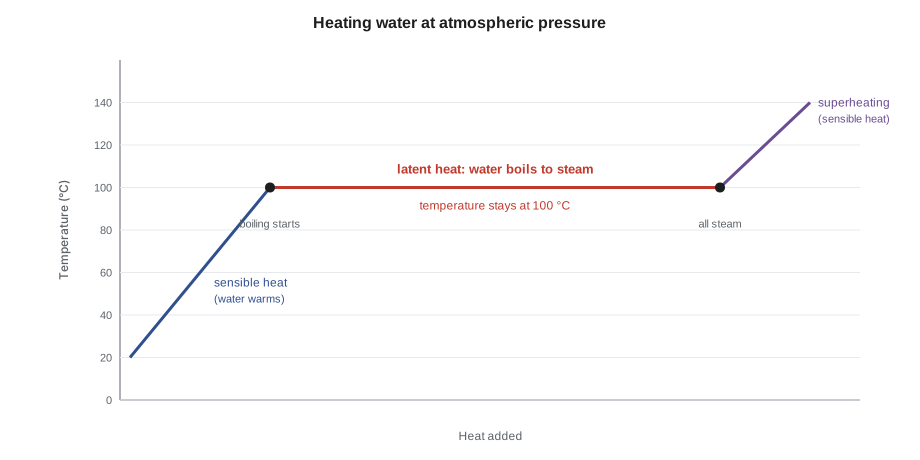
Heat that changes the state of a substance, without changing its temperature, is called latent heat, from the Latin for hidden. When water at its boiling point takes in heat, its temperature does not rise; instead the heat breaks the bonds between molecules and turns liquid into vapour. The heat needed to turn a unit mass of water at its boiling point into steam at the same temperature is the latent heat of vaporization (or of evaporation). When steam condenses, it gives exactly that heat back. That is why steam is such a powerful way to deliver heat: a kilogram of steam condensing in a customer's heat exchanger gives up far more heat than a kilogram of hot water cooling by a few degrees.
At atmospheric pressure, water boils at 100 °C (212 °F), and its latent heat of vaporization is about 2,257 kJ/kg (970 Btu/lb). Raising a kilogram of water from 0 °C to 100 °C (32 °F to 212 °F) takes only about 419 kJ (180 Btu), so boiling it takes more than five times as much heat as heating it to the boiling point.
There is also a latent heat of fusion, the heat needed to melt ice at 0 °C (32 °F), about 334 kJ/kg (144 Btu/lb). It matters to a boiler operator mainly in winter, when an idle pipe, a steam trap or a sensing line freezes, and in refrigeration plants.
Boiling point depends on pressure
Water does not always boil at 100 °C (212 °F). The boiling point, called the saturation temperature, rises with pressure. In a closed boiler the steam pressure builds up above the water and pushes the boiling point higher. At Cantwell's operating pressure of 1,035 kPa (150 psi) gauge, water boils at about 185 °C (366 °F). As long as liquid and vapour are both present, the pressure and the temperature are locked together: if you know one, a steam table gives the other. Steam and water in this state are called saturated.
This link explains several things an operator sees every day. When the steam pressure drops, some of the hot water in the boiler instantly flashes to steam because it is now above its new boiling point. When condensate at 185 °C (366 °F) is released to an atmospheric tank, part of it flashes to steam, which is the cloud above a vent. And when a boiler is shut down and cools, the pressure falls with the temperature, until steam condensing inside it can pull a vacuum unless the vent is opened.
| Gauge pressure | Absolute pressure (approx.) | Saturation temperature (approx.) |
|---|---|---|
| 0 kPa | 101 kPa | 100 °C |
| 100 kPa | 201 kPa | 120 °C |
| 500 kPa | 601 kPa | 159 °C |
| 1,035 kPa | 1,136 kPa | 185 °C |
| 1,380 kPa | 1,481 kPa | 198 °C |
Remember from PWR-110 that steam tables are written in absolute pressure, so an engineer adds atmospheric pressure, about 101 kPa, to the gauge reading before looking up a value. Forgetting that step is one of the most common mistakes on Fourth Class exams.
Reading a steam table
A saturated steam table lists, for each pressure (or temperature), the saturation temperature, the specific volume of the water and the steam, and three enthalpies. Enthalpy is the heat content of a unit mass of water or steam, measured from a reference point (water at 0.01 °C (32 °F)). The three columns are:
- h_f (water): the enthalpy of saturated water, which is the sensible heat needed to bring water from the reference point to its boiling point at that pressure.
- h_fg (evaporation): the latent heat needed to turn that saturated water into saturated steam.
- h_g (steam): the enthalpy of dry saturated steam, which is h_f plus h_fg.
As pressure rises, h_f rises (the water must be hotter before it boils) and h_fg falls (less latent heat is needed). The total h_g changes only a little. This is why low pressure steam carries more latent heat per kilogram than high pressure steam, and why plants often reduce steam pressure before sending it to heating coils.
| Pressure | Temperature | h_f, water | h_fg, evaporation | h_g, steam |
|---|---|---|---|---|
| 101 kPa abs | 100 °C | 419 kJ/kg | 2,257 kJ/kg | 2,676 kJ/kg |
| 1,136 kPa abs | 185 °C | 787 kJ/kg | 1,996 kJ/kg | 2,783 kJ/kg |
Worked problem
Heat to make the plant's steam
Boiler 3 makes 11,500 kg/h of saturated steam at 1,035 kPa gauge from feedwater at 115 °C. Water at 115 °C has an enthalpy of about 483 kJ/kg. Using the table, how much heat goes into each kilogram, and what is the boiler output in kW?
Show solution
- Heat per kilogram:
- \[2{,}783 - 483 = 2{,}300 \text{ kJ/kg}\]
- Heat per hour:
- \[11{,}500 \times 2{,}300 = 26{,}450{,}000 \text{ kJ/h}\]
- As a rate:
- \[26{,}450{,}000 \div 3{,}600 \approx 7{,}347 \text{ kW}\]
Answer: About 2,300 kJ per kilogram, or about 7,350 kW, which is within boiler 3's 8,000 kW nameplate rating. The example shows how a steam table turns a flow and two temperatures into a heat load.
Wet, dry and superheated steam
Steam leaving a boiler drum is rarely perfectly dry. Tiny droplets of water are carried along with it, and the fraction of the mixture that is actually vapour is called the dryness fraction or steam quality. Steam with a quality of 0.97 is 97 parts vapour and 3 parts water by mass, and it carries only 97 in 100 of the latent heat that dry steam would. Wet steam erodes valves and turbine blades and causes water hammer, so drums have separators and dryers to remove the water.
If dry steam is heated further, away from contact with water, its temperature rises above the saturation temperature and it becomes superheated steam. Superheated steam behaves more like a gas: its pressure and temperature are no longer locked together, so an operator needs both to describe it. Superheaters are fitted to power boilers that drive turbines, because superheated steam does not condense in the turbine's first stages. Cantwell's boilers make saturated steam for heating customers, so the plant has no superheaters; PWR-220 covers them.
Worked problem
Wet steam carries less heat
Steam at 1,035 kPa gauge has a quality of 0.97. Using h_f = 787 kJ/kg and h_fg = 1,996 kJ/kg, what is its enthalpy, and how much less heat does each kilogram carry than dry steam?
Show solution
- Enthalpy of wet steam:
- \[h = h_f + x \, h_{fg} = 787 + 0.97 \times 1{,}996 \approx 2{,}723 \text{ kJ/kg}\]
- Shortfall:
- \[2{,}783 - 2{,}723 = 60 \text{ kJ/kg}\]
Answer: About 2,723 kJ/kg, which is 60 kJ/kg (3 in 100 of the latent heat) less than dry steam. The water also has to be drained by traps before it causes trouble.
Hot water as a heat carrier
Not every plant makes steam. Cantwell's two hot water boilers heat water that is pumped around a closed loop to customer buildings and back, giving up sensible heat in their heat exchangers. A hot water system's capacity depends on the flow and on the temperature drop between supply and return. The same formula, Q = m c ΔT, applies, with the flow rate in place of the mass.
Hot water systems are classed by temperature. Low temperature systems run below about 120 °C and are common in buildings; high temperature hot water systems run above that and need pressure to keep the water from boiling, so they are treated much like steam boilers. Cantwell's loop supplies about 95 °C water and returns at about 70 °C (typical).
Worked problem
Heat carried by the hot water loop
The hot water loop circulates 28.6 kg/s with a supply of 95 °C and a return of 70 °C. Using 4.19 kJ/(kg·K), how much heat is the loop delivering?
Show solution
- Temperature drop:
- \[95 - 70 = 25 \text{ K}\]
- Heat rate:
- \[28.6 \times 4.19 \times 25 \approx 2{,}996 \text{ kW}\]
Answer: About 3,000 kW, which is one hot water boiler at full rating. If the return temperature crept up, the loop would deliver less heat at the same flow.
Why this matters on the floor
Lorne ended the lesson back at the gauge. A pressure reading tells an operator the temperature of every surface in contact with the steam, so a steam line at 1,035 kPa (150 psi) is at about 185 °C (366 °F) even where its insulation is missing. Pressure falling while the burners are firing hard means the steam is being used faster than the boiler can make it. Condensate flashing at a vent shows that heat is being lost. And a pressure gauge that reads higher than the temperature allows means a gauge, a thermometer or the steam itself is not what it seems. "You read the plant through its pressures and temperatures," Lorne said. "Learn to check one against the other."
Common mistakes
MistakeLooking up a steam table with the gauge pressure.
InsteadAdd atmospheric pressure to get absolute pressure first.
MistakeTreating heat and temperature as the same thing.
InsteadTemperature says how hot; heat is the energy that flows. Mass matters.
MistakeExpecting water to boil at the same temperature at any pressure.
InsteadThe saturation temperature rises with pressure.
MistakeIgnoring the water in wet steam.
InsteadWet steam carries less latent heat and must be drained by traps.
MistakeAssuming an insulated steam line is cool where the insulation is missing.
InsteadEvery surface touching saturated steam is at the saturation temperature.
Summary and key terms
- Temperature measures how hot something is; heat is energy flowing because of a temperature difference.
- Sensible heat changes temperature (Q = m c ΔT); latent heat changes state at constant temperature.
- Water boils at 100 °C (212 °F) at atmospheric pressure; the saturation temperature rises with pressure.
- Steam tables use absolute pressure and give h_f, h_fg and h_g; h_g = h_f + h_fg.
- Wet steam has a quality below 1 and carries less heat; superheated steam is heated above its saturation temperature.
- Hot water systems carry sensible heat; their output depends on flow and temperature drop.
- Saturation temperature
- The boiling point of water at a given pressure.
- Sensible heat
- Heat that changes a substance's temperature.
- Latent heat
- Heat that changes a substance's state at constant temperature.
- Enthalpy
- The heat content of a unit mass of water or steam, from a reference point.
- Steam quality
- The fraction of a steam and water mixture that is vapour.
- Superheated steam
- Steam heated above its saturation temperature.
Practice problems
Work each problem on paper first, then reveal the answer to check.
What does a saturated steam table need you to do with a gauge pressure reading?
Show answer
Add atmospheric pressure to get absolute pressure.
What is the saturation temperature at 1,035 kPa (150 psi) gauge?
Show answer
About 185 °C (366 °F).
Which column of a steam table gives the latent heat?
Show answer
h_fg, the heat of evaporation.
Steam has a quality of 0.95. What does that mean?
Show answer
95 parts vapour and 5 parts water by mass.
How does the latent heat change as pressure rises?
Show answer
It falls.
Lesson quiz · 5 questions
Score 60% or more to complete this lesson.
Create a free account to save your progress, take quizzes and earn a certificate.