
PWR-120 · Lesson 10 of 12 · 25 min
Heating systems: steam, hot water and glycol
▶ Video coming soon A video version of this lesson is on the way.
On Friday, October 30, 2026, the forecast called for the first hard frost of the season. Grazyna asked Lorne to take Tamar on a tour of what the plant's heat actually does once it leaves the building. They started in the basement of the Ardoch Tower, where Cantwell's steam enters through a pressure reducing station, heats the building's water in two heat exchangers and returns as condensate through a pumped trap. They walked back through the tunnel, checking steam traps on the main, and finished at the plant's own glycol loop, which melts snow on the delivery ramp and heats the boiler room's make-up air. Tamar tested the glycol with a refractometer. "Heat is no use to anyone in the boiler room," Lorne said. "You need to know how it gets where it's going, and what can stop it."
This lesson describes the three ways a plant like Cantwell delivers heat: steam heating, hot water heating and glycol systems. It covers pressure reduction, steam traps, condensate and flash steam, hot water loops with their expansion tanks and air separators, outdoor reset, and the freeze protection and testing that glycol systems need.
Steam heating systems
In a steam heating system, steam travels from the boiler or the district main to the point of use, gives up its latent heat in a radiator, a coil or a heat exchanger, and condenses. Steam moves itself: it flows from high pressure to low pressure without a pump, and its high latent heat lets a small pipe carry a large amount of heat. Cantwell sends steam at about 1,035 kPa (150 psi) through its tunnels to 26 customer buildings.
Most customers don't use steam at that pressure. A pressure reducing station at the building entrance drops it to the pressure the equipment needs, often 100 kPa (15 psi) or lower for heating. The station has a strainer, a pressure reducing valve (PRV), often two in parallel for large loads, a bypass with a globe valve for emergencies, gauges on both sides, and a safety relief valve on the low pressure side sized to protect the downstream piping if the PRV fails open. The relief valve must be able to pass all the steam the PRV could pass when wide open.
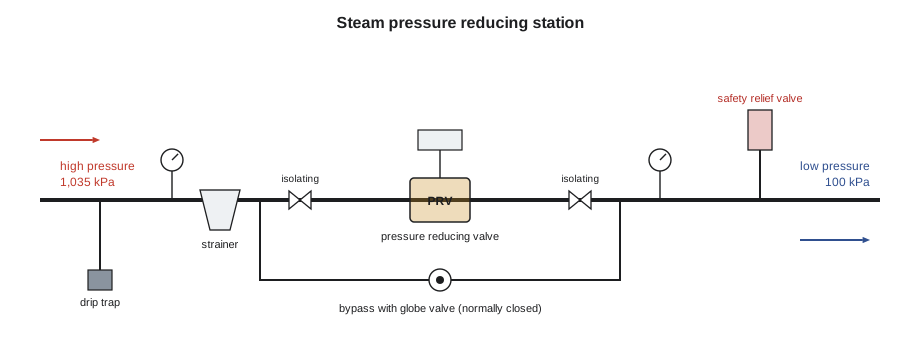
Lowering the pressure has a useful side effect. As lesson 1 showed, steam at lower pressure carries more latent heat per kilogram, and its lower temperature is gentler on equipment. Heat exchangers are often sized for steam at about 35 to 100 kPa (5 to 15 psi).
Steam traps
A steam trap lets condensate and air out of a steam space while holding the steam in. Without traps, condensate would flood heat exchangers and steam lines, causing water hammer and cutting heat transfer; with traps that fail open, live steam would blow straight through to the condensate return, wasting energy and overheating the return. Every low point and drip leg on a steam main, and the outlet of every heat exchanger and coil, has a trap. The main types are:
- Mechanical traps work by the density difference between steam and water. A float and thermostatic (F&T) trap has a ball float that rises and opens a valve as condensate collects, plus a thermostatic element that vents air; it drains continuously and suits heat exchangers. An inverted bucket trap has an upside-down bucket that floats when steam fills it and sinks when condensate replaces the steam, opening the valve; it is rugged and common on steam mains.
- Thermostatic traps open when the condensate cools a few degrees below steam temperature, using a bellows or bimetal element. They vent air well and suit radiators and tracing.
- Thermodynamic (disc) traps use the difference in velocity between steam and condensate to snap a disc open and closed. They are small and robust and are often used on high pressure drips.
A failed trap is one of the most common and expensive faults in a steam system. Operators check traps by listening with an ultrasonic tester or stethoscope, by measuring temperature on both sides with an infrared thermometer, and by looking at sight glasses where fitted. A trap that is cold on its inlet side is probably blocked and holding back condensate; one that blows steam continuously into a vented return has failed open. Cantwell runs a trap survey twice a year and records every trap's condition.
| Trap type | Works by | Typical use |
|---|---|---|
| Float and thermostatic | Float lifted by condensate; thermostatic air vent | Heat exchangers and coils with varying loads |
| Inverted bucket | Bucket floats on steam, sinks on condensate | Steam mains and drips |
| Thermostatic | Element opens when condensate cools | Radiators, tracing, air venting |
| Thermodynamic (disc) | Steam and condensate velocity under a disc | High pressure drips; outdoor use |
Condensate return and flash steam
Condensate leaves a trap at or near the saturation temperature of the steam it came from. When it is released into a return line at lower pressure, part of it instantly flashes to steam, because it is now hotter than the boiling point at the lower pressure. That flash steam is not a leak; it is a predictable result of physics, and it can be large. Plants often collect it in a flash tank and use it, for example to heat the deaerator.
where h_f1 is the enthalpy of the hot condensate at the higher pressure, h_f2 is the enthalpy of water at the lower pressure and h_fg2 is the latent heat at the lower pressure.
Worked problem
Flash steam from a drip trap
A drip trap on the steam main discharges condensate at 1,035 kPa gauge (h_f = 787 kJ/kg) into a vented return at atmospheric pressure (h_f = 419 kJ/kg, h_fg = 2,257 kJ/kg). What fraction of the condensate flashes to steam?
Show solution
- \[(787 - 419) \div 2{,}257 = 368 \div 2{,}257 \approx 0.163\]
Answer: About 0.163, or 16 parts in 100 of the condensate flashes to steam. That is why vented returns from high pressure drips show plumes even when every trap is working, and why a flash tank can recover a useful amount of heat.
The rest of the condensate comes back to the plant by gravity or through condensate pumps or pumping traps in customer buildings. Return lines must be sized for the flash steam as well as the water, and sloped to drain. A vacuum breaker on a heat exchanger lets air in when the steam valve closes, so condensate can drain instead of being held by a vacuum.
Hot water heating systems
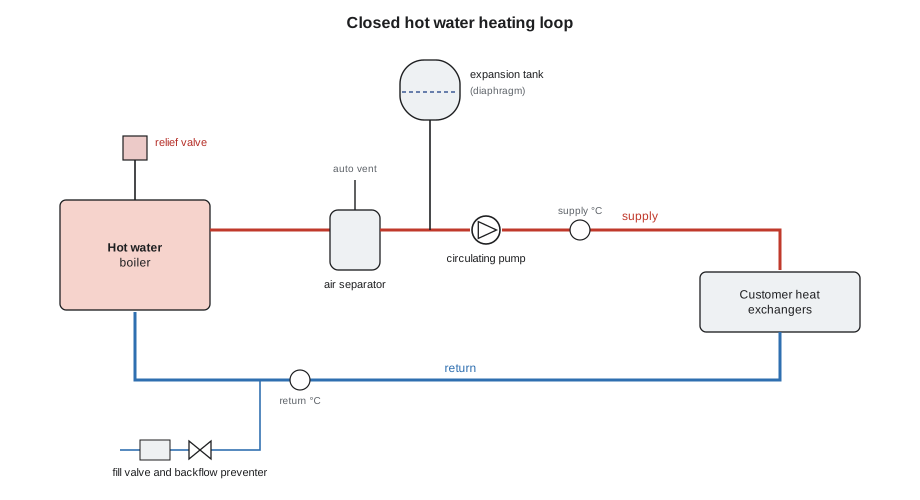
A hot water heating system circulates water through a closed loop: from the boiler or heat exchanger, through supply piping to radiators, coils or customer heat exchangers, and back. The water gives up sensible heat, so its capacity depends on the flow and the temperature drop (lesson 1). Pumps move the water; nothing moves by itself. Key parts are:
- Circulating pumps, usually two, one as standby, often with variable frequency drives that change speed to match demand.
- An expansion tank, which absorbs the change in water volume as the loop heats and cools. Most modern systems use a diaphragm or bladder tank, with an air cushion separated from the water by a membrane and precharged to a set pressure.
- An air separator and vents, because air in a hot water loop causes noise, blocks circulation in high points and brings oxygen that corrodes the system.
- A pressure reducing (fill) valve with a backflow preventer to keep the loop topped up from the city water, and a relief valve on each boiler.
- Temperature and pressure gauges on supply and return, and on each boiler.
Water expands about 4 in 100 between room temperature and its boiling point at atmospheric pressure (typical). In a closed loop that expansion has nowhere to go but the expansion tank; a tank that has lost its air charge becomes waterlogged, and then every rise in temperature lifts the loop's pressure until the relief valve opens. A relief valve that drips each time the boilers fire is often a sign of a failed expansion tank.
Outdoor reset
A hot water system does not need its full supply temperature on a mild day. Outdoor reset lowers the supply temperature as the outdoor temperature rises, following a straight-line reset schedule between two points. It saves fuel, cuts heat losses from piping, and makes condensing boilers condense more of the time. Cantwell's district loop follows a reset schedule from 95 °C (203 °F) supply at −20 °C (−4 °F) outdoors to 70 °C (158 °F) supply at 15 °C (59 °F) outdoors (plant setting).
Worked problem
Reading a reset schedule
Cantwell's schedule runs from 95 °C supply at −20 °C outdoors to 70 °C at 15 °C outdoors. On October 30 the outdoor temperature was 1 °C. What supply temperature should the loop run?
Show solution
- Slope:
- \[(95 - 70) \div (15 - (-20)) = 25 \div 35 \approx 0.714 \text{ K per K}\]
- Degrees above −20 °C:
- \[1 - (-20) = 21 \text{ K}\]
- Supply:
- \[95 - 21 \times 0.714 \approx 95 - 15.0 = 80 \text{ °C}\]
Answer: About 80 °C. The control system calculates this continuously; the operator checks that the actual supply temperature follows it.
Glycol systems
Water freezes, and frozen water expands by about 9 in 100 and splits pipes and coils. Any loop that could be exposed to freezing temperatures, such as snow-melt piping, make-up air unit coils, outdoor heat exchangers or a building's heating loop left idle in winter, is filled with a water and glycol mixture instead. Two kinds are used:
- Ethylene glycol gives the best freeze protection and heat transfer for its concentration, but it is toxic and must be handled and disposed of carefully.
- Propylene glycol is much less toxic and is used where a leak could reach drinking water or food, at the cost of slightly poorer heat transfer and higher viscosity.
Both are used as inhibited industrial glycols, with corrosion inhibitors and buffers. Automotive antifreeze is not used, because its additives can form deposits in heating systems. Glycol breaks down over years, especially if overheated, and becomes acidic; the inhibitors are used up. Operators test glycol regularly for concentration, pH and inhibitor level.
| Concentration by volume | Ethylene glycol freeze point (typical) | Propylene glycol freeze point (typical) |
|---|---|---|
| 30 in 100 | about −15 °C (about 5 °F) | about −13 °C (about 9 °F) |
| 40 in 100 | about −24 °C (about −11 °F) | about −21 °C (about −6 °F) |
| 50 in 100 | about −37 °C (about −35 °F) | about −33 °C (about −27 °F) |
More glycol is not always better. Glycol carries less heat than water: a 40 in 100 propylene glycol mix has a specific heat of about 3.6 kJ/(kg·K) (0.86 Btu/(lb·°F)) (typical), so the same loop needs more flow to carry the same heat, and the mixture is thicker, so pumps work harder. Designers choose the lowest concentration that protects against the coldest expected temperature, with a margin.
Worked problem
Checking glycol strength
Cantwell's snow-melt and make-up air loop uses propylene glycol. The design calls for protection to −21 °C, a 40 in 100 mix. Tamar's refractometer reading showed freeze protection to −15 °C. What does that mean, and what should be done?
Show solution
- Design protection:
- \[-21 \text{ °C (40 in 100)}\]
- Measured protection:
- \[-15 \text{ °C, about 33 in 100 from the chart}\]
- Shortfall:
- \[-15 - (-21) = 6 \text{ K weaker than design}\]
Answer: The glycol has been diluted, probably by water make-up after a leak earlier in the year. The loop is weaker than design and must be topped up with concentrated glycol, then retested, before cold weather. Lorne raised a work order, and the loop was brought back to 40 in 100 on November 3.
Glycol loops have their own expansion tank and fill system, kept separate from the city water fill used on water loops so no one tops them up with plain water by mistake. Glycol must never be drained to a storm sewer, and spills are cleaned up and disposed of as the safety data sheet and local rules require.
What the operator watches
| System | Watch for |
|---|---|
| Steam mains and PRV stations | Pressure held on the low side, relief valves not lifting, drips trapping properly |
| Steam traps | Hot inlets, no live steam blowing to vented returns, sight glasses clear |
| Condensate return | Return temperature and conductivity normal, receivers not flooding |
| Hot water loop | Supply on its reset schedule, return temperature reasonable, pressure steady |
| Expansion tanks | Loop pressure steady as it heats; relief valves not dripping |
| Glycol loops | Concentration, pH and inhibitor within range; no plain water make-up |
On the walk back, Tamar found one inverted bucket trap on the tunnel main cold on its inlet side: a blocked trap holding condensate in the drip leg. Lorne marked it on the trap survey and arranged for it to be isolated, cleaned and returned to service the next morning. "A cold trap on a steam main," he said, "is how water hammer starts. Today it's a work order. Next week it could be a broken valve."
Common mistakes
MistakeTreating a plume from a vented return as a failed trap.
InsteadSome flash steam is normal; check the trap itself.
MistakeSizing a PRV station's relief valve for normal flow only.
InsteadIt must pass the full flow of a PRV failed wide open.
MistakeTopping up a glycol loop with city water.
InsteadUse the glycol fill system; plain water dilutes the protection.
MistakeUsing automotive antifreeze in a heating loop.
InsteadUse inhibited industrial glycol made for heating systems.
MistakeIgnoring a relief valve that drips each time the boiler fires.
InsteadCheck the expansion tank's air charge.
Summary and key terms
- Steam carries heat as latent heat; pressure reducing stations drop it to the pressure equipment needs.
- Steam traps drain condensate and air while holding steam; failed traps waste energy or cause water hammer.
- Condensate flashes when released to lower pressure; flash fraction = (h_f1 − h_f2) ÷ h_fg2.
- Hot water loops need pumps, an expansion tank, air separation, a fill valve and relief valves.
- Outdoor reset lowers supply temperature on mild days along a straight-line schedule.
- Glycol loops protect against freezing; concentration, pH and inhibitor are tested, and more glycol is not always better.
- Pressure reducing valve
- A valve that holds a lower steam pressure downstream.
- Steam trap
- A device that releases condensate and air but holds back steam.
- Flash steam
- Steam formed when hot condensate is released to a lower pressure.
- Expansion tank
- A tank that absorbs the change in water volume in a closed loop.
- Outdoor reset
- Lowering hot water supply temperature as outdoor temperature rises.
- Inhibited glycol
- Industrial glycol with corrosion inhibitors, used for freeze protection.
Practice problems
Work each problem on paper first, then reveal the answer to check.
What must a PRV station's relief valve be able to pass?
Show answer
All the steam the PRV could pass if it failed wide open.
What does a cold inlet on a steam trap suggest?
Show answer
The trap is blocked and holding condensate.
About what fraction of condensate at 1,035 kPa gauge flashes at atmospheric pressure?
Show answer
About 16 in 100.
A hot water relief valve drips each time the boiler fires. What is a likely cause?
Show answer
A waterlogged expansion tank.
Why isn't more glycol always better?
Show answer
It carries less heat, is thicker and makes pumps work harder.
Lesson quiz · 5 questions
Score 60% or more to complete this lesson.
Create a free account to save your progress, take quizzes and earn a certificate.