
PWR-120 · Lesson 8 of 12 · 23 min
Low water conditions and their prevention
▶ Video coming soon A video version of this lesson is on the way.
On Friday, October 9, 2026, it was boiler 1's turn for its weekly low water cutoff test. Lorne made Tamar talk him through every step before she touched a valve. Then she watched the gauge glass while he opened the float chamber blowdown: the water dropped out of the chamber, the burner stopped within a second or two, and the alarm sounded. When the chamber refilled, the primary cutoff let the burner restart; the auxiliary cutoff, tested next, locked out and waited for Lorne's hand on the reset. "Low water is the one that kills boilers," he said, "and sometimes the people standing next to them. Every test we do here is about making sure that never happens on our shift."
This lesson explains why low water is so dangerous, the common causes, how the gauge glass and low water cutoffs are tested, what an operator must and must not do if the water goes out of sight, and the opposite problems of high water, priming and carryover.
Why low water is so dangerous
As lesson 2 explained, a boiler's metal survives the furnace heat only because water carries the heat away. Flue gas in a furnace can be well over 1,000 °C (1,800 °F); the water in the tubes is at its saturation temperature, about 185 °C (366 °F) at Cantwell. As long as water covers the heating surface, the steel stays within a few degrees of the water temperature. If the water level drops and uncovers part of the heating surface, that steel is now cooled only by steam, which carries heat away poorly, and it heats rapidly toward the gas temperature.
Carbon steel loses strength quickly above about 425 °C (800 °F) (typical). An uncovered tube or furnace crown sheet softens and bulges under the boiler pressure, and it can rupture. In a watertube boiler, a ruptured tube releases a jet of steam and water into the furnace; in a firetube boiler, an overheated furnace tube can collapse. Worse is what happens if an operator, seeing the water low, adds cold feedwater to a boiler whose steel is red hot. The water flashes violently to steam on the hot metal, the pressure rises faster than the safety valves can relieve it, and the shocked metal may fail all at once. Boiler explosions in history have killed hundreds of people, and low water was the cause of many.
Causes of low water
Low water almost never has a single cause; it is usually a failure of the feed system combined with a failure to notice. The common causes are:
- Feedwater failure: a feed pump trips, loses suction, cavitates, or its power fails; a feedwater control valve sticks closed; a feed line valve is left shut.
- Control failure: a feedwater regulator or level transmitter fails, or is fooled by swell during a sudden load change (lesson 4).
- Low water cutoff failure: a float jammed by sludge, a probe coated with scale, a cutoff whose blowdown has been skipped, or a cutoff that someone has jumpered.
- Water lost from the boiler: a blowdown valve left open, a tube leak, or a leaking blowdown valve that slowly drains the boiler.
- False level indication: a gauge glass with a blocked connection showing water that isn't there (lesson 3).
- Operator error: not watching the level, leaving the boiler during blowdown, misreading a glass, or misunderstanding an alarm.
Because each cause is quite common on its own, plants are designed with layers of defence: a feed system with backup pumps, level controls that alarm before they cut off, a primary and an auxiliary low water cutoff, a gauge glass and try cocks, and an operator who watches and tests them all.
How fast can it happen?
A watertube boiler like Cantwell's holds relatively little water. If the feed stops while the boiler is steaming hard, the level falls fast.
Worked problem
Time from normal level to cutoff
Between the normal water level and the low water cutoff level, boiler 3's drum holds about 0.90 m³ of water. Water at 185 °C has a density of about 882 kg/m³. If the feed stops while the boiler makes 11,500 kg/h of steam, about how long before the water reaches the cutoff level?
Show solution
- Mass of water:
- \[0.90 \times 882 \approx 794 \text{ kg}\]
- Steaming rate per second:
- \[11{,}500 \div 3{,}600 \approx 3.19 \text{ kg/s}\]
- Time:
- \[794 \div 3.19 \approx 249 \text{ s} \approx 4 \text{ min}\]
Answer: About four minutes. That is roughly the time an operator has between a feed failure and the cutoff stopping the burner. If the cutoff failed, the tubes could be uncovered soon after. It is why feed pump alarms are answered at a run, and why the cutoffs must work every time.
Blowing down the gauge glass and column
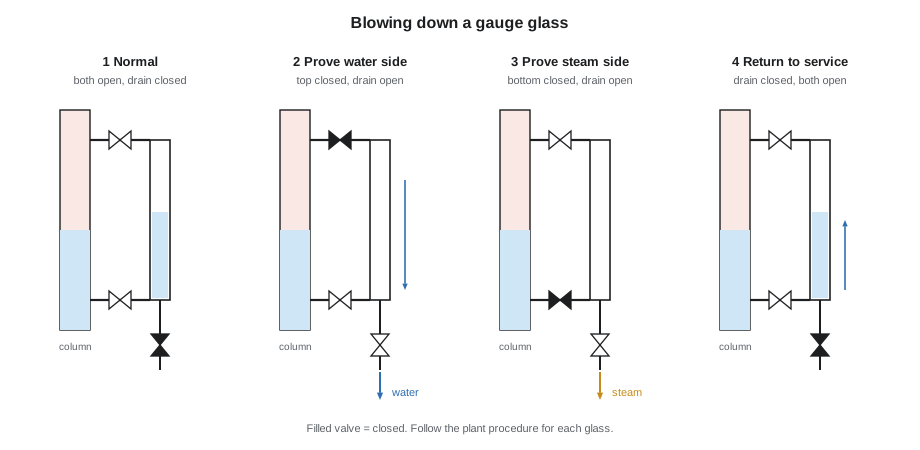
The gauge glass is the operator's direct view of the water, and it must be proved working on every shift. The usual procedure for a glass with top and bottom shutoff valves and a drain, done on a boiler that is steaming normally, is:
- Note the water level.
- Close the top (steam) shutoff valve and open the drain: the water should run out of the glass and the glass should empty. This proves the bottom (water) connection is clear.
- Close the bottom (water) shutoff and open the top: steam should blow through the glass. This proves the top (steam) connection is clear.
- Close the drain, then open the bottom valve: the water should return quickly to the same level as before.
The water column itself has a column blowdown valve at its bottom, which flushes sludge from the column and its lower connection. A glass whose level comes back slowly, sluggishly, or to a different level means a partly blocked connection. The boiler is not safe to run on that glass until the connection is cleared, and the operator uses the try cocks and the remote indicator in the meantime and reports it. Gauge glass valves often vary from boiler to boiler, so each plant's procedure says exactly which valve to open in which order.
Testing low water cutoffs
A low water cutoff that has never been tested is only an assumption. Two kinds of test are used, and plants do both on a schedule set by the manufacturer, the code, the insurer and the jurisdiction:
- Blowdown test (float chamber or probe column blowdown). With the boiler steaming normally, the operator opens the cutoff's blowdown valve. Water drains from the float chamber or probe column, the float drops or the probe uncovers, and the burner must stop. The test also flushes sediment out of the chamber, which keeps the float free. Many manufacturers call for this daily or every shift on steam boilers (typical; the manual governs).
- Slow drain or evaporation test. With the feed stopped under close supervision, the boiler is allowed to lower its water by steaming, or the level is lowered slowly through the bottom blowdown, until the cutoff acts. This tests the cutoff the way a real low water condition would, and checks that it acts at the right level, which the quick blowdown test cannot show. It is done less often, typically monthly or as the manufacturer specifies, by an experienced operator who watches the gauge glass the whole time and stops the test if the cutoff doesn't act at the expected level.
Each test is logged with the time, the boiler, the device tested, the level at which it acted and whether it passed. A cutoff that fails a test takes the boiler out of service until it is repaired.
At Cantwell, the primary and auxiliary cutoffs on each steam boiler are blown down every shift, and the slow drain test is done monthly with the shift engineer present. TSSA inspectors ask to see these records, as the inspector did on September 16.
If the water goes out of sight
If an operator finds that the water is not visible in the gauge glass on a boiler that is firing, and cannot confirm the level is safe by the try cocks, the rule is the same in every jurisdiction and every textbook:
- Shut off the fuel immediately. Stop the burner by its emergency stop.
- Do not add feedwater. Do not open the feed valve, start a feed pump, or change the feed in any way. If the tubes are uncovered and hot, cold water on them can cause an explosion.
- Do not open the safety valves or change the steam load suddenly, which would lower the pressure and could make the water flash, or disturb an already damaged boiler.
- Close the steam stop valve to isolate the boiler from the header, if it is safe to reach.
- Let the boiler cool down slowly, with the burner off and the fan run for purge if it is safe.
- Report it to the shift engineer and the chief, who will arrange for the boiler to be inspected before it is refilled or run again.
If the operator can see the water in the glass, even low, and the low water condition was caught early, the plant's procedure may allow feed to be restored carefully. The difference is whether the metal could have been uncovered: water visible means the metal is covered; water out of sight means it may not be. When in doubt, treat it as out of sight.
A boiler that has had a low water event is reported to TSSA as the regulation requires, and it may not be returned to service until it has been inspected.
| If you see | Do | Never |
|---|---|---|
| Water low but visible, falling | Find and fix the feed problem; prepare to shut down | Leave the boiler unattended |
| Water low but visible, feed restored | Restore feed carefully per procedure; watch the level | Feed a large slug of cold water at once |
| Water out of sight in the glass | Shut off fuel; isolate; let cool; report | Add feedwater or open safety valves |
| Glass lively but cutoff failed its test | Take the boiler out of service | Run the boiler on the glass alone |
| Glass sluggish after blowdown | Use try cocks and remote indicator; report; clear the connection | Trust the glass reading |
High water, priming and carryover
Too much water is a problem too. If the drum level is too high, water is carried into the steam outlet with the steam, a condition called carryover. Water slugs in steam lines cause water hammer (lesson 7), wreck turbine blades, erode valves and dump boiler water solids into customers' equipment. A steam turbine can be destroyed by a slug of water. A high water alarm and, on many boilers, a high water cutoff protect against overfeeding.
Priming is the sudden, violent carryover of water with the steam, often caused by a sudden load increase, a very high water level or a pressure drop that makes the water surge. Foaming is the build-up of a stable froth on the water surface, usually caused by too many dissolved solids, oil or contaminants in the boiler water, and it leads to carryover too. The cures are good level control, steady loads, regular blowdown to keep dissolved solids within limits (lesson 9), and keeping oil and other contaminants out of the condensate.
A sign of carryover is a gauge glass that bounces and froths, steam lines that bang, or a sharp rise in the conductivity of condensate returning from customers. Tamar learned to tell priming from a normal lively glass: the level in a priming boiler surges up and down by large amounts, and the steam flow meter often jumps at the same time.
Rounds and the level
Lorne's rule for rounds was simple: look at the gauge glass every time you pass a boiler, not just when the sheet says to. A glass that shows a level is the first thing; a glass whose level is moving gently with the firing is the second; and agreement between the glass, the remote indicator and the control system's level reading is the third. Any disagreement between them is investigated before anything else on the round.
Worked problem
Checking level indications agree
At 21:00 boiler 2's gauge glass showed the level 75 mm above normal water level; the remote indicator showed 70 mm and the control system 20 mm. What should Tamar conclude?
Show solution
- Glass against remote:
- \[75 - 70 = 5 \text{ mm, close agreement}\]
- Glass against control system:
- \[75 - 20 = 55 \text{ mm, a large difference}\]
Answer: The gauge glass and the remote indicator agree, so the level is probably about where the glass shows it. The control system's level transmitter is reading low, which means the feedwater regulator may overfeed. Tamar reported it at once; the instrument technician found a partly blocked transmitter sensing line, which was blown out, and the readings agreed again.
Common mistakes
MistakeAdding feedwater when the water is out of sight.
InsteadShut off the fuel, do not add water, isolate and let the boiler cool.
MistakeSkipping the low water cutoff blowdown because the boiler is busy.
InsteadBlow down the cutoffs as scheduled; sludge jams floats.
MistakeTreating the quick blowdown test as proof the cutoff acts at the right level.
InsteadDo the slow drain test as scheduled to check the actual level.
MistakeTrusting the control system's level over the gauge glass.
InsteadThe gauge glass is the primary indicator; investigate any disagreement.
MistakeLeaving a boiler during bottom blowdown.
InsteadStay at the boiler and watch the gauge glass throughout.
Summary and key terms
- Water keeps boiler steel cool; uncovered metal overheats, softens and can rupture.
- Adding cold water to an overheated boiler can cause an explosion.
- Low water comes from feed failures, control failures, failed cutoffs, leaks, false readings and inattention.
- Gauge glasses are blown down each shift; a sluggish return means a blocked connection.
- Cutoffs are proved by blowdown tests and slow drain tests and the tests are logged.
- If water is out of sight: shut off fuel, do not add water, isolate, cool and report. High water causes carryover.
- Low water fuel cutoff
- A control that stops the burner when the water falls to a set level.
- Slow drain test
- A test lowering the water gradually until the cutoff acts, to prove its operating level.
- Carryover
- Water carried out of the drum with the steam.
- Priming
- Sudden, violent carryover caused by surging water.
- Foaming
- A stable froth on the boiler water surface, usually from high solids or contamination.
- Crown sheet
- The top plate of a furnace, often the first surface uncovered by low water.
Practice problems
Work each problem on paper first, then reveal the answer to check.
Why is cold feedwater dangerous on an overheated boiler?
Show answer
It flashes violently to steam on the hot metal and can cause an explosion.
What does a sluggish gauge glass return after blowdown mean?
Show answer
A partly blocked connection.
What are the two kinds of low water cutoff test?
Show answer
The blowdown test and the slow drain (evaporation) test.
Water is out of sight in the glass. What is the first action?
Show answer
Shut off the fuel.
What causes foaming?
Show answer
Too many dissolved solids, oil or contaminants in the boiler water.
Lesson quiz · 5 questions
Score 60% or more to complete this lesson.
Create a free account to save your progress, take quizzes and earn a certificate.