
PWR-120 · Lesson 6 of 12 · 24 min
Burners and flame safeguard controls
▶ Video coming soon A video version of this lesson is on the way.
On Thursday, October 8, 2026, Halvard Rosemund from Calderwood Combustion Services came to Cantwell for boiler 2's semi-annual burner service. Tamar spent the morning beside him with the burner's manual open on a clipboard. He checked the gas train valves, the air damper linkage and the ignition electrode, read the flame signal at low and high fire, and ran the flame safeguard through its tests. "This box," he said, tapping the burner management controller, "doesn't care how busy you are. It will purge for as long as it's told, it will give the pilot ten seconds, and if it can't see a flame it shuts the gas. Your job is to keep it able to do that, and never to help it along."
This lesson explains how gas and oil burners mix fuel and air, how ignition works, what a flame safeguard does in each step of a burner's sequence, the interlocks it watches, how flames are detected, and what an operator does when a burner locks out. The gasfitter program's GAS-310 covers burner management in more technical depth for the technicians who install and service it; this lesson is the operator's view.
What a burner does
A burner delivers fuel and air to the furnace in the right proportions, mixes them, and holds a stable flame where the heating surfaces can use its heat. Most boilers the size of Cantwell's use forced draft power burners: a fan blows combustion air through a register or diffuser that swirls it, and the fuel is injected into that swirling air. A gas burner injects gas through ports or spuds around the air stream; an oil burner sprays atomized oil from a nozzle on the burner's centreline. Dual-fuel burners, like Cantwell's, carry both a gas ring and an oil gun and can switch between them.
The burner's firing rate changes with the load. Small burners are simply on or off; others step between low fire and high fire; most larger burners modulate, varying the firing rate smoothly across a turndown range. A burner with a 10 to 1 turndown can fire as low as one-tenth of its full rating. The fuel and air must change together, which is done by a mechanical linkage between the fuel valve and the air damper on older burners, or by separate servo motors under electronic control on linkageless burners like Cantwell's, often with oxygen trim (lesson 5).
Worked problem
Turndown and minimum firing
Boiler 2's burner is rated for a fuel input of 9,760 kW with a 10 to 1 turndown. What is its minimum firing input, and at an efficiency of 0.80 at low fire, about what output does that give?
Show solution
- Minimum input:
- \[9{,}760 \div 10 = 976 \text{ kW}\]
- Output at low fire:
- \[976 \times 0.80 \approx 781 \text{ kW}\]
Answer: About 976 kW input, or about 781 kW of output. When the plant's load falls below that, the burner must cycle off and on, so on mild nights Cantwell runs one steam boiler instead of two to avoid short cycling.
Ignition
Fuel and air do not light themselves; something must raise a small part of the mixture to its ignition temperature. Most power burners light in two stages. First an igniter, usually a high-voltage spark electrode fed by an ignition transformer, lights a small pilot flame, often of gas, even on an oil burner. Then, once the pilot is proved, the main fuel valves open and the pilot lights the main flame. On many burners the pilot is interrupted, shut off after the main flame is established; on some it is intermittent, staying lit throughout the run. Some smaller burners light the main flame directly from a spark or hot surface igniter, called direct spark ignition.
The pilot must be big enough and in the right place to light the main flame smoothly. A weak or misplaced pilot can let main fuel pour into the furnace before it lights, then light all at once with a bang called a delayed ignition or puff. A loud puff at light-off is a warning that something needs attention, and an operator reports every one.
The flame safeguard
The flame safeguard (also called a burner management system, BMS, or programming control) is the brain of the burner's safety system. It runs the burner through a fixed sequence, checks a set of interlocks before and during each step, and shuts off the fuel instantly if anything is wrong. Most power burners on boilers like Cantwell's follow the same basic sequence:
- Standby. The boiler's operating control calls for heat. The safeguard checks that the limit controls are closed: low water cutoff, high pressure or high temperature limits, fuel pressure switches and airflow switch in their safe positions, and the fuel valves proved closed.
- Pre-purge. The fan starts, the air damper drives to high fire position, and the airflow switch must prove air. The furnace is purged for a set time to sweep out any fuel that may have collected. The purge must move four or more changes of the furnace and boiler gas passage volume (typical; the code and burner manufacturer set the requirement).
- Low fire position. The damper and fuel valve drive to low fire and a low fire start switch proves they are there.
- Pilot trial for ignition. The igniter sparks and the pilot gas valves open for a short time, typically no more than about 10 seconds. The flame detector must prove the pilot within the trial or the safeguard shuts the pilot gas and locks out.
- Main trial for ignition. With the pilot proved, the main safety shutoff valves open. The main flame must be proved within a short time, typically about 10 seconds or less, then the pilot is shut off on an interrupted pilot burner.
- Run. The burner is released to modulate. The safeguard keeps watching the flame and the interlocks. If the flame is lost, it must close the fuel valves within the flame failure response time, typically about 4 seconds or less.
- Post-purge. When the call for heat ends, the fuel valves close and the fan runs for a short post-purge to clear the furnace before stopping.
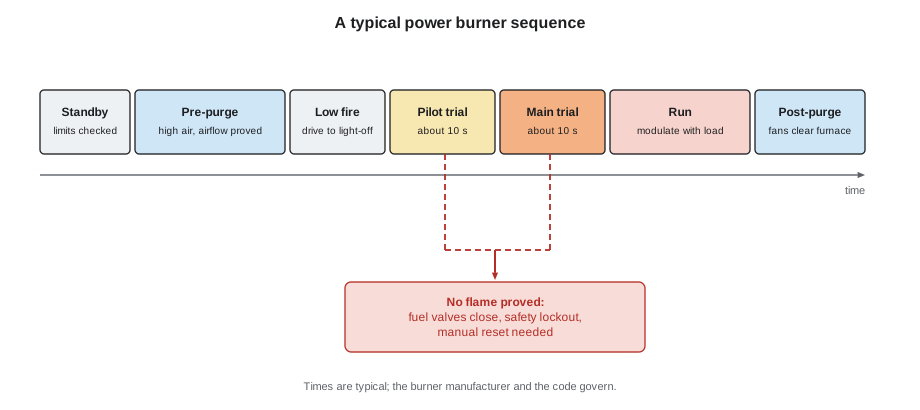
Times vary with the burner, the fuel and the code it was built to: ASME CSD-1 for most automatically fired boilers below a large size, NFPA 85 for larger boilers, and CSA B149.3 and the burner's own listing in Canada. The safeguard's settings are fixed by the manufacturer or by a qualified technician; an operator never shortens a purge or lengthens a trial for ignition.
Worked problem
How long must the purge run?
Boiler 2's furnace and gas passages hold about 42 m³. At the high fire purge position the fan moves about 3.0 m³ of air per second. At least how long must the purge run for four volume changes?
Show solution
- Air needed:
- \[4 \times 42 = 168 \text{ m}^3\]
- Time:
- \[168 \div 3.0 = 56 \text{ s}\]
Answer: About 56 seconds. The safeguard is set to a 90-second purge, which meets the minimum with a margin. Halvard checked that the setting matched the label and the commissioning record, as GAS-310 describes for technicians.
Interlocks and limits
The flame safeguard can only be as good as the devices that feed it. Each interlock proves one condition is safe; if it opens, the safeguard either won't start the burner or shuts it down. The main ones on a steam boiler are:
| Interlock or limit | What it proves | Typical result if it opens |
|---|---|---|
| Low water fuel cutoff (primary and auxiliary) | Water above the lowest safe level | Burner stops; auxiliary usually locks out |
| High steam pressure limit | Pressure below the limit setting, which is below the safety valve setting | Burner stops; often manual reset |
| Operating pressure control | Pressure within the operating band | Burner cycles off and on (not a safety shutdown) |
| Low and high gas pressure switches | Gas pressure within the burner's range | Burner stops or won't start |
| Combustion airflow switch | Fan running and air flowing | No purge, no ignition; shutdown if lost in run |
| Low fire start switch | Damper and valve at low fire before ignition | Sequence holds |
| Valve proof of closure | Safety shutoff valves fully closed before start | Won't start |
| Low oil pressure or temperature (on oil) | Oil ready to atomize | Burner stops on oil |
The high pressure limit is set below the lowest safety valve setting, so that in normal operation the burner shuts off before the safety valves have to lift. The operating control is set lower still and is what cycles or modulates the burner. Cantwell's steam boilers operate at 1,035 kPa (150 psi), with the operating control modulating around that, the high limit at 1,240 kPa (180 psi) and the safety valves at 1,380 kPa (200 psi).
Flame detection
A safeguard needs a reliable way to know there is a flame. The common methods are:
- Flame rod (flame rectification). A metal rod sits in the flame. The safeguard applies an AC voltage between the rod and the burner, and because the flame conducts current better one way than the other, it passes a small rectified DC current that the safeguard reads. Common on gas pilots and smaller gas burners; it cannot see an oil flame well.
- Ultraviolet (UV) scanner. A tube or sensor sees the UV light that flames give off. It works on gas and oil. Ordinary UV tubes can fail in a way that falsely shows a flame, so burners that run continuously use self-checking UV scanners with a shutter that blinds the sensor regularly to test it.
- Infrared (IR) scanner. Sees the infrared flicker of a flame, often used on oil. It can be fooled by hot refractory, which also glows in infrared, so it looks for flicker rather than steady glow.
The safeguard shows a flame signal, as a voltage, microamps or bar graph. Each manufacturer gives a minimum acceptable signal and a normal range; for example, one common family reads 0 to 5 volts with about 1.25 volts as its minimum (typical). Operators log the flame signal at low and high fire. A signal falling over weeks means a dirty scanner lens, a misaligned sight tube or a flame changing shape, and it should be fixed before it causes nuisance trips.
That is what happened at Cantwell on October 20, when boiler 1 locked out at night on flame failure, as PWR-110 lesson 7 told. The instrument technician found a cracked flame scanner lens. Halvard showed Tamar where the lens sits in the sight tube, how cooling air keeps it clean, and how a cracked or fogged lens weakens the signal until the safeguard decides the flame has gone.
Fuel valves
Between the gas supply and the burner, the gas train holds the fuel valves the safeguard controls. There are always at least two automatic safety shutoff valves in series, so that if one leaks or sticks open the other still stops the gas. Larger burners add a vent valve between them (double block and vent) or a valve proving system that tests the valves for leakage before each start, and proof of closure switches that show the valves have fully closed. High and low gas pressure switches stop the burner if the gas pressure moves outside the burner's range. A manual shutoff valve upstream lets the operator isolate the train, and a leak test cock lets a technician check the valves.
Oil burners have a similar arrangement: two automatic oil valves in series, an oil pressure switch, and a nozzle shutoff that closes cleanly to stop the gun dripping into the furnace after shutdown.
When a burner locks out
A lockout is the safeguard's way of saying: I have shut the fuel off for a reason, and I will not try again until a person looks. It is different from a normal shutdown when the operating control is satisfied. The rules for the operator are the ones Desmond showed Tamar on October 20:
- Don't reset straight away. Read the safeguard's display or fault code first and write it down.
- Find the cause. Check the water level, fuel pressure, airflow and flame scanner, and look at the burner through the sight port if it is safe to do so.
- Reset once, if the procedure allows, only after the cause is understood or ruled out, and only after the full purge runs.
- Never jumper an interlock, hold a fuel valve open, bypass a purge or repeatedly reset a burner that won't light. Each failed trial may leave a little fuel in the furnace.
- Report and log every lockout, puff and unusual flame.
Many plants require the shift engineer to approve any second reset, and the chief to approve a third. At Cantwell, two lockouts on the same boiler in a shift take it out of service until the cause is found.
Burner checks on rounds
| Check | What to look for |
|---|---|
| Flame through the sight port | Stable shape and colour, not touching tubes or refractory, no sparks or smoke |
| Flame signal | In the normal range at the present firing rate |
| Gas or oil pressure | Steady and in range at the train gauges |
| Air damper and linkage or servos | Moving smoothly, no slipping or loose fasteners |
| Flue gas oxygen and CO | Normal for the firing rate |
| Burner area | No fuel smell, no leaks, combustion air openings clear |
Before he left, Halvard gave Tamar the service report: flame signals at low and high fire, gas pressures, oxygen and CO across the firing range, and the safeguard's purge and trial times as tested. Lorne filed it with boiler 2's records. "The inspector will ask for that," he said, "and so will I, the next time this burner does something odd."
Common mistakes
MistakeResetting a lockout without reading the fault.
InsteadRead and log the fault code, find the cause, then reset once if the procedure allows.
MistakeShortening the purge to get the boiler back faster.
InsteadThe purge removes fuel that could explode; its time is fixed by the code and manufacturer.
MistakeJumpering an interlock that keeps tripping.
InsteadThe interlock is reporting a real problem; find and fix it.
MistakeIgnoring a weakening flame signal.
InsteadClean or fix the scanner before it causes a flame failure.
MistakeSetting the high pressure limit above the safety valve.
InsteadThe limit is set below the safety valves so the burner stops first.
Summary and key terms
- Power burners mix fuel with fan-driven air; the firing rate modulates within the burner's turndown.
- Ignition usually lights a pilot by spark, proves it, then opens the main fuel valves.
- The flame safeguard checks limits, purges, allows short trials for ignition, watches the flame and post-purges.
- Interlocks prove water, pressure, fuel, air, damper position and valve closure; limits sit below the safety valves.
- Flames are proved by flame rods, UV or IR scanners; operators log flame signals.
- Gas trains have two safety shutoff valves in series; lockouts are investigated before a single reset.
- Flame safeguard
- The control that sequences a burner and shuts off fuel on an unsafe condition.
- Pre-purge
- Running air through the furnace before ignition to remove any fuel.
- Trial for ignition
- The short time allowed for a pilot or main flame to be proved.
- Flame failure response time
- The time the safeguard takes to close fuel valves after losing the flame.
- Turndown
- The ratio of a burner's maximum to minimum firing rate.
- Lockout
- A safety shutdown that needs a manual reset.
Practice problems
Work each problem on paper first, then reveal the answer to check.
What must happen before a pilot trial for ignition?
Show answer
Limits checked, airflow proved, pre-purge completed, damper proved at low fire.
Why do continuously fired burners use self-checking UV scanners?
Show answer
An ordinary UV tube can fail in a way that falsely shows a flame.
Where is the high pressure limit set?
Show answer
Below the lowest safety valve setting.
A burner locks out. What do you do first?
Show answer
Read and log the fault, then find the cause before any reset.
Why are there two safety shutoff valves in the gas train?
Show answer
So the gas is stopped even if one leaks or sticks open.
Lesson quiz · 5 questions
Score 60% or more to complete this lesson.
Create a free account to save your progress, take quizzes and earn a certificate.