
PWR-120 · Lesson 4 of 12 · 25 min
Feedwater systems and pumps
▶ Video coming soon A video version of this lesson is on the way.
On Thursday, October 1, 2026, Cantwell ran its monthly test of the steam-turbine feed pump. Lorne and Tamar walked the feedwater system from the condensate tank to the boiler drums first, then Lorne opened the turbine's steam inlet slowly, let the casing warm, and brought the pump up to speed while the electric pumps kept running. The discharge pressure climbed past the boiler pressure, the check valve opened and the turbine pump took its share of the load. "If the power fails," Lorne said, "the electric pumps stop and this one keeps feeding the boilers on the steam they're already making. That's why we test it every month and not on the day we need it."
This lesson follows water through a boiler plant's feedwater system: condensate return, make-up water, the deaerator, the feedwater pumps and their drives, and the controls that keep the water level steady. It ends with the checks an operator makes on pumps and level controls during rounds.
The feedwater cycle
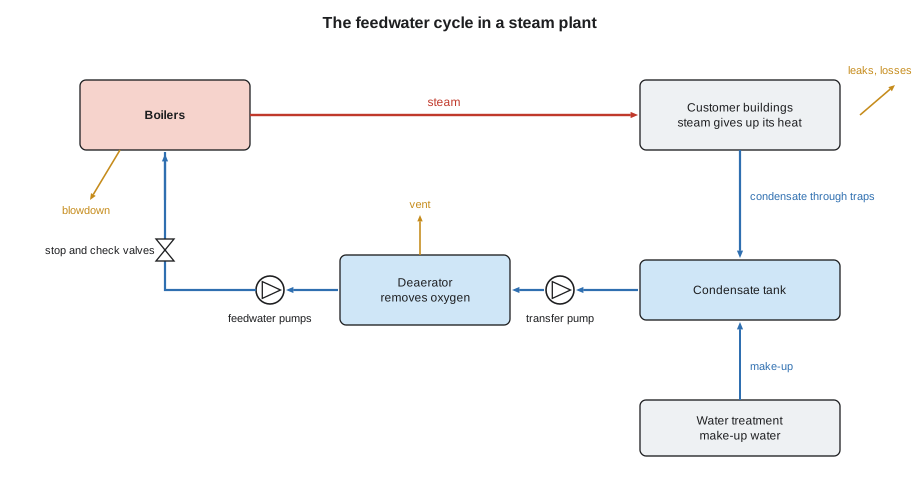
A steam plant is a loop. The boilers make steam; the steam goes out to customers and gives up its latent heat; the steam condenses to condensate; and the condensate returns, through steam traps and return lines, to the plant to be fed back to the boilers. Water lost along the way, through leaks, blowdown, flash steam vented to air, or customers who use steam directly in their processes, is replaced with make-up water, which the water treatment room softens or demineralizes first. The make-up and the returned condensate together become the boiler feedwater.
Returned condensate is valuable. It is already hot, which saves fuel; it is already pure, which saves treatment chemicals and blowdown; and every kilogram that comes back is a kilogram of city water that doesn't have to be bought, treated and heated. Cantwell's operators track the condensate return as a fraction of steam sent out, and a falling figure means a leak or a failed trap somewhere in the system.
Worked problem
Condensate return and make-up
In a shift, Cantwell sent out 175,200 kg of steam and received back 140,200 kg of condensate. What fraction of the steam returned, and how much make-up water was needed?
Show solution
- Return fraction:
- \[140{,}200 \div 175{,}200 \approx 0.80\]
- Make-up:
- \[175{,}200 - 140{,}200 = 35{,}000 \text{ kg}\]
Answer: About 80 in 100 returned, so about 35,000 kg of make-up water was needed. Some steam is used directly by two customers' processes and never returns, so 80 in 100 is normal for Cantwell; a drop to 70 would send the shift looking for a leak.
The condensate tank
Returned condensate arrives at the condensate receiver or tank, often by gravity or from pumps in customer buildings. The tank is vented to atmosphere, so condensate that arrives above 100 °C (212 °F) flashes; the vent carries the flash steam away, and many plants recover it. Make-up water is added to the tank by a level control. Transfer pumps then move the water from the condensate tank to the deaerator. Operators check the tank's level, its temperature and the vent: a vent blowing a large plume can mean failed traps passing live steam into the return.
The deaerator
Water contains dissolved gases, mainly oxygen and carbon dioxide. Oxygen attacks steel and causes pitting, especially in feedwater lines, economizers and boiler drums; carbon dioxide forms carbonic acid that corrodes condensate lines. The deaerator removes most of these gases by heating the water to its saturation temperature, at which gases are least soluble, and scrubbing them out with steam.
In a spray or tray deaerator, incoming water is sprayed into a steam-filled chamber, or cascades over trays, in thin films that heat quickly and release their gases. The released gases leave with a small amount of steam through a vent that must always be kept slightly open; closing it lets the gases build up and stops the deaerator working. The deaerated water collects in a storage section below, which holds enough for several minutes of feed. Deaerators usually run slightly above atmospheric pressure, around 35 to 70 kPa (5 to 10 psi) gauge (typical), so the water is at about 108 to 115 °C (227 to 239 °F).
A well-run deaerator reduces dissolved oxygen to a very low level, often quoted as 7 parts per billion or less (typical); a chemical oxygen scavenger fed to the storage section removes the last traces (lesson 9). The deaerator is a pressure vessel with its own safety valve, a pressure gauge, a level gauge and level controls, and it is inspected like one.
Centrifugal feedwater pumps
Almost all boiler feed pumps today are centrifugal pumps: an impeller spinning inside a volute or diffuser casing flings water outward, giving it velocity that the casing converts to pressure. A multistage pump has several impellers in series, each adding pressure, and is used where high discharge pressure is needed. Centrifugal pumps run smoothly and deliver a steady flow, but they have three needs the operator must respect:
- They must be primed. A centrifugal pump cannot pump air. The casing and suction line must be full of water before it starts.
- They need enough suction pressure. If the pressure at the impeller eye falls too low, the hot water boils there, forming vapour bubbles that collapse violently as they reach higher pressure. This is cavitation: it sounds like gravel in the pump, cuts flow and eats the impeller.
- They need a minimum flow. A pump running against a closed valve heats the water trapped in it until it flashes. Feed pumps have a minimum flow recirculation line back to the deaerator to keep water moving through them at low boiler loads.
Reciprocating (piston) pumps, steam-driven duplex pumps and steam injectors were once common and are still found on older and smaller plants. Lessons 11 and PWR-210 cover pumps in more detail.
Net positive suction head
Because feedwater leaves the deaerator at its saturation temperature, it is on the edge of boiling. The only thing that keeps it liquid at the pump suction is extra pressure, and that comes from height: the deaerator is mounted high above the pumps so that the column of water adds pressure at the pump inlet. The margin of pressure above the water's vapour pressure at the pump inlet, expressed as a height of liquid, is the net positive suction head available (NPSHa). Each pump needs a certain minimum, the NPSH required (NPSHr), which the manufacturer states. NPSHa must always be greater than NPSHr, with a margin.
For a deaerator feeding saturated water, the deaerator pressure and the water's vapour pressure are the same, so they cancel out, and NPSHa is simply the height of the water level above the pump inlet, minus the friction loss in the suction pipe. That is why a low deaerator level, a sudden drop in deaerator pressure (which lowers the boiling point and makes the water in the suction pipe flash) or a clogged suction strainer can make feed pumps cavitate.
Worked problem
Checking NPSH
Cantwell's deaerator water level is 9.0 m above the feed pump inlets. Friction loss in the suction line at full flow is 0.8 m. The pumps need an NPSH of 3.5 m. Is there enough margin?
Show solution
- NPSH available (saturated water):
- \[9.0 - 0.8 = 8.2 \text{ m}\]
- Margin:
- \[8.2 - 3.5 = 4.7 \text{ m}\]
Answer: Yes: 8.2 m available against 3.5 m required, a margin of 4.7 m. The margin shrinks if the deaerator level drops or the strainer clogs, which is why both are on the rounds sheet.
Discharge pressure and pump drives
A feed pump must deliver water at a pressure higher than the boiler's, enough to overcome the boiler pressure, the friction in the feed line, the pressure drop across the feedwater control valve and the height to the drum, with a margin so the boiler can be fed even when its safety valves are lifting. Codes require the feed system to be able to supply the boiler at a pressure somewhat above the highest safety valve setting.
Worked problem
Feed pump discharge pressure
Boiler safety valves are set at 1,380 kPa. The feed line friction and control valve drop total 250 kPa at full flow, and the drum is 6 m above the pumps (about 59 kPa). The plant aims for a margin of 100 kPa above these. What discharge pressure is needed?
Show solution
- Add the pressures:
- \[1{,}380 + 250 + 59 + 100 = 1{,}789 \text{ kPa}\]
Answer: About 1,789 kPa gauge at the pump discharge. Cantwell's pumps are rated for about 1,900 kPa at design flow, so they meet the need.
Cantwell has three feed pumps: two driven by electric motors, each able to carry the full load, and one driven by a 75 horsepower steam turbine as the backup that runs without electricity. The turbine exhausts low pressure steam to the deaerator, where its heat is used. Many codes and insurers require at least two means of feeding a power boiler, one of which does not depend on the same power supply, for exactly the reason Lorne gave.
Feedwater regulators
The water level in a steam drum has to be kept within a narrow band. Too low, and tubes may be uncovered; too high, and water is carried over into the steam lines with the steam, where it can wreck turbines, valves and customers' equipment. A feedwater regulator adjusts the feed to match the steaming rate.
In a single-element control, the regulator adjusts the feed valve on drum level alone. It suits small boilers with steady loads, but it is fooled by swell and shrink: when steam demand rises suddenly, the pressure falls, the water in the boiler flashes and swells with bubbles, and the level rises even though the boiler is losing water. A single-element control cuts the feed just when more is needed. When demand falls, the bubbles collapse and the level shrinks, and the control overfeeds.
A two-element control adds a measurement of steam flow, so the feed valve opens as soon as steam demand rises, with the level signal trimming the result. A three-element control adds feedwater flow as well, so the controller matches feed flow to steam flow directly and uses level only as a correction. Cantwell's watertube boilers, with their small water volume and swinging district loads, use three-element control.
Small low pressure boilers often use simpler devices: a float-operated pump control that starts and stops the feed pump, or a float switch combined with the low water cutoff. Whatever the device, the operator checks that the level stays in its band and that the pump or valve responds when the level changes.
Rounds checks on the feed system
| Item | What to look for |
|---|---|
| Condensate tank | Level normal, temperature steady, vent not blowing live steam |
| Make-up water | Softener or demineralizer in service, make-up flow normal for the load |
| Deaerator | Pressure and level normal, vent plume small and steady |
| Feed pumps | Suction and discharge pressures normal, no cavitation noise, bearing temperatures normal, seals not leaking excessively |
| Standby and turbine pump | Ready to start; warm-up drains working; tested as scheduled |
| Feedwater regulators | Drum levels steady in their band; valve positions reasonable for the load |
| Recirculation lines | Open and passing flow at low load |
On her own round that evening, Tamar noticed that feed pump 2's discharge pressure was slightly lower than pump 1's at the same flow. She logged it, and Lorne added it to the maintenance list: a worn impeller or a wearing ring would show the same way, long before it caused a problem.
Feedwater checks on rounds
Lorne gave Tamar a short list of feedwater checks to make on every round, because most feedwater problems announce themselves well before a boiler runs short of water:
- Deaerator pressure and temperature should match each other on the steam table. A temperature well below saturation for the tank pressure means the deaerator is not heating the water fully and oxygen is getting through.
- Deaerator vent should show a small, steady wisp of steam. No plume may mean a closed or plugged vent; a large plume wastes steam.
- Tank level should sit in the normal band. A level that keeps rising points to a make-up valve passing or a condensate surge; one that keeps falling points to a make-up supply problem or a feed pump running too hard.
- Feed pump suction and discharge pressures should be steady. Falling discharge pressure can mean a worn impeller or a recirculation valve stuck open; falling suction pressure can mean a clogging strainer.
- Pump noise, bearing temperature and packing drip tell you about the pump's mechanical health (lesson 11).
- Make-up meter reading shows how much new water the plant is using. A rising make-up rate means condensate is being lost somewhere in the building or down a drain.
Tamar found the value of the last check within a fortnight. Cantwell's make-up meter showed about a third more water than usual over two days, and a walk through the tower's basement found a condensate pump whose float switch had stuck, so its receiver was overflowing to the floor drain. Once the switch was freed, the make-up rate fell back to normal, and so did the chemical and fuel bills that rise with every litre of cold make-up water the plant has to heat and treat.
Common mistakes
MistakeClosing the deaerator vent to save steam.
InsteadThe vent must stay slightly open to carry away the oxygen and carbon dioxide.
MistakeStarting a centrifugal pump with an empty casing.
InsteadPrime the pump first; centrifugal pumps cannot pump air.
MistakeRunning a feed pump against a closed valve.
InsteadKeep the minimum flow recirculation open.
MistakeTrusting a single-element control through a sudden load change.
InsteadSwell and shrink fool level-only control; watch the drum level closely.
MistakeTesting the backup feed pump only when the power fails.
InsteadTest it on schedule so it is known to work.
Summary and key terms
- Steam, condensate and make-up water form a loop; returned condensate saves fuel, water and chemicals.
- The deaerator heats feedwater to saturation and vents oxygen and carbon dioxide; its vent must stay open.
- Centrifugal feed pumps must be primed, need enough NPSH and a minimum flow.
- NPSH available from a deaerator is the height of water above the pump minus suction friction.
- Feed pumps must deliver above the highest safety valve setting; a backup that doesn't depend on the same power is required.
- Single, two and three element regulators control drum level; swell and shrink fool level-only control.
- Condensate
- Steam that has given up its latent heat and returned to water.
- Make-up water
- Treated water added to replace losses from the steam cycle.
- Deaerator
- A vessel that heats feedwater and removes dissolved gases.
- Cavitation
- Vapour bubbles forming and collapsing in a pump, damaging it.
- NPSH
- Net positive suction head, the pressure margin above boiling at a pump inlet.
- Swell and shrink
- Temporary rise or fall in drum level caused by a sudden change in steam demand.
Practice problems
Work each problem on paper first, then reveal the answer to check.
Why is the deaerator mounted high above the feed pumps?
Show answer
To give the pumps enough net positive suction head.
What does a three-element feedwater control measure?
Show answer
Drum level, steam flow and feedwater flow.
What causes cavitation in a feed pump?
Show answer
Water boiling at the impeller eye because the suction pressure is too low.
Why do feed pumps have a minimum flow recirculation line?
Show answer
To keep water moving so it doesn't overheat and flash in the pump.
What happens to drum level when steam demand rises suddenly?
Show answer
It swells up, even though the boiler is losing water.
Lesson quiz · 5 questions
Score 60% or more to complete this lesson.
Create a free account to save your progress, take quizzes and earn a certificate.