
PWR-120 · Lesson 3 of 12 · 21 min
Boiler fittings: safety valves, gauges and water columns
▶ Video coming soon A video version of this lesson is on the way.
On Wednesday, September 23, 2026, Tamar spent her day shift with Lorne on boiler 2's fittings. They started at the top, at the two safety valves, and worked down the front of the boiler: the steam pressure gauge, the water column with its gauge glass and try cocks, the low water cutoffs, the feedwater stop and check valves and, at the bottom, the blowdown valves. "These are the parts that keep the boiler from killing someone," Lorne said. "The burner and the pumps make steam. The fittings make it safe. You learn each one well enough to tell when it's lying to you."
This lesson describes the main boiler fittings and what each does: safety valves and relief valves, pressure gauges and their siphons, water columns, gauge glasses and try cocks, low water fuel cutoffs, blowdown valves, and steam and feedwater stop and check valves. Lessons 7 and 8 cover how operators use and test them.
Fittings and the code
A boiler's fittings are part of its design, and the code it was built to says which are required and how they are arranged. In Ontario, boilers are built to the ASME Boiler and Pressure Vessel Code as adopted through CSA B51 and TSSA's Code Adoption Document: Section I for power boilers and Section IV for heating boilers. Fittings must be of a registered design, installed as the code requires and kept in working order. An operator never removes, plugs or bypasses a required fitting, and never changes a safety valve's setting.
Safety valves
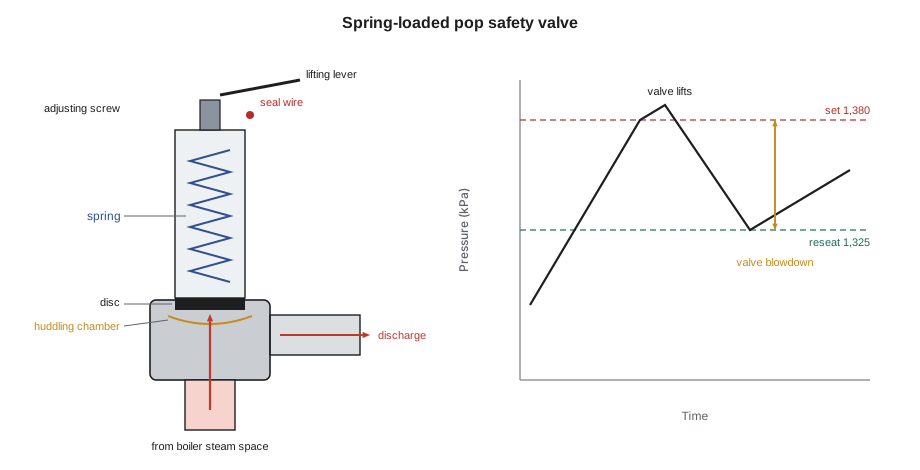
The safety valve is the last line of defence against overpressure. It is a spring-loaded valve on the steam space that opens automatically when the pressure reaches its set point and discharges enough steam to stop the pressure rising any further, then closes again once the pressure has dropped. A safety valve on steam opens with a sudden pop to full lift, because once the disc lifts slightly, the steam acts on a larger area under the disc's huddling chamber and throws it fully open. The pressure at which it reseats is a little below the set pressure; the difference is the blowdown of the valve, not to be confused with boiler blowdown.
The rules for safety valves are strict and the operator should know them well:
- A safety valve's set pressure is at or below the boiler's MAWP. A boiler with more than one safety valve may have one set at the MAWP and the others slightly higher, within limits the code sets.
- Its relieving capacity must be enough to discharge all the steam the boiler can make at full firing without the pressure rising more than a small amount above the MAWP. Power boilers with large heating surfaces need two or more valves.
- Nothing may be fitted between the boiler and the safety valve, and the discharge pipe must be at least as large as the valve outlet, be supported so it puts no load on the valve, drain away condensate and discharge to a safe place.
- Safety valves are sealed by the manufacturer or an authorized repairer. Only an authorized organization may adjust or repair them; an operator who finds a seal broken reports it.
- Every safety valve on a steam boiler has a lifting lever so it can be tested by hand. Lessons 7 and 12 explain when and how.
On a hot water boiler the equivalent fitting is a pressure relief valve, which opens in proportion to the overpressure instead of popping. A safety relief valve can work either way and is used where the valve may see steam or water. Hot water heating boilers may also need a temperature and pressure relief valve in some uses.
Worked problem
Safety valve blowdown
A safety valve on boiler 2 is set at 1,380 kPa and has a blowdown of 4 in 100 of the set pressure. At about what pressure will it reseat?
Show solution
- Blowdown:
- \[1{,}380 \times 0.04 = 55.2 \text{ kPa}\]
- Reseat pressure:
- \[1{,}380 - 55.2 \approx 1{,}325 \text{ kPa}\]
Answer: About 1,325 kPa, still well above Cantwell's 1,035 kPa operating pressure. The valve will close once the cause of the overpressure is removed and the pressure falls.
Pressure gauges and siphons
Each boiler has at least one pressure gauge connected to its steam space, or to the water at the top of a hot water boiler. Most are Bourdon tube gauges: a curved, flattened metal tube that straightens slightly as pressure inside it rises, moving a pointer through a linkage. The dial should read up to about one and a half to twice the safety valve setting, so the normal operating pressure is near the middle of the scale, where the gauge is most accurate. A red line or mark often shows the MAWP.
A Bourdon tube would be damaged by live steam, so the gauge is connected through a siphon, a loop or pigtail of pipe that fills with condensate. The water in the loop protects the gauge from the steam's heat. A shutoff cock, usually a lever-handle cock, lets the gauge be removed and tested while the boiler runs, and a test connection lets an inspector fit a calibrated test gauge alongside. When a gauge is first fitted, or the siphon has been drained, the operator lets the siphon fill with condensate before opening the gauge cock fully.
A gauge that reads wrong is dangerous both ways. One that reads low may let an operator fire a boiler to its safety valve without knowing it; one that reads high may make an operator shut down a healthy boiler. Lorne compares each boiler's gauge with the control panel's pressure transmitter and with the header gauge on every round, and the plant has the gauges checked against a calibrated master gauge on a set schedule.
Water columns and gauge glasses
The single most important thing an operator watches on a steam boiler is the water level. It is shown by a gauge glass, a strong glass tube or a flat reflex or transparent glass, mounted on a water column, a vertical chamber connected to the steam space at the top and the water space at the bottom. Because the column is connected at both ends, the water stands in it at the same level as in the drum. The column keeps the glass away from the turbulence inside the drum, where the surface is boiling and frothy.
The gauge glass has a shutoff valve top and bottom and a drain valve at the bottom. Power boiler glasses often have valves with automatic ball checks that close if the glass breaks. The lowest visible part of the glass is set above the lowest permissible water level, the level below which the heating surfaces could be uncovered, so that if water is visible in the glass the tubes are covered. On large or high pressure boilers, a remote level indicator in the control room repeats the reading, but codes still require a direct-reading gauge glass on the boiler.
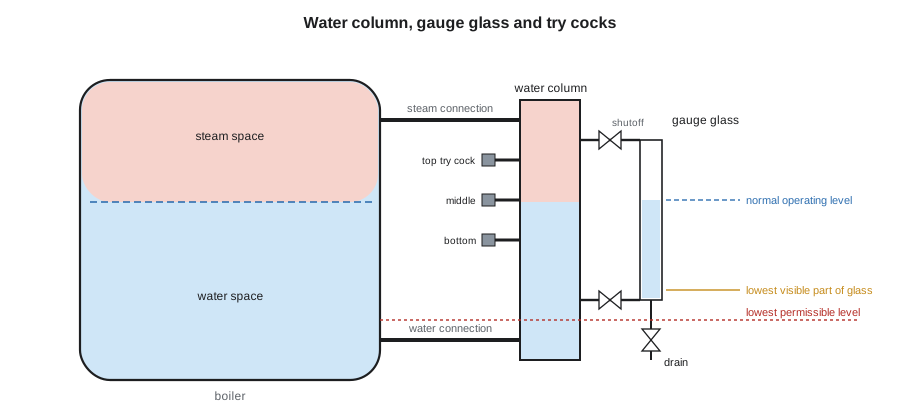
Try cocks (or gauge cocks) are small valves on the column at different heights within the normal water range. Opening one shows whether there is water or steam at that height: water discharges as a heavy spurt that flashes, steam as a clear hiss and white cloud. Try cocks give a second way to check the level if the glass is in doubt. Some codes accept a second gauge glass or remote indicator in place of try cocks.
A gauge glass can lie. If the top connection is blocked, the level in the glass can creep up as steam condenses above it and show water when the drum is nearly empty. If the bottom connection is blocked, the level freezes and doesn't move with the drum. That is why operators blow down the gauge glass and the column on every shift (lesson 8), watching the water drop out and return briskly. A level that returns slowly, or not at all, means a blocked connection, and the boiler is not safe to run until it is cleared.
Low water fuel cutoffs
A low water fuel cutoff (LWCO) shuts off the burner automatically if the water falls to a set level, before the heating surfaces are uncovered. Older designs use a float in a chamber connected to the boiler, which drops with the water and opens a switch. Others use probes or electrodes in the water that sense conductivity: when the water falls below the probe, the circuit opens. Most steam boilers have two: a primary LWCO, often combined with the feedwater pump control, and a separate auxiliary LWCO set slightly lower, which often locks out and needs a manual reset. Many hot water boilers also need a LWCO, especially where the boiler is above the radiation or is fired automatically.
A LWCO is only useful if it works. Sediment in a float chamber can jam the float; scale on a probe can insulate it. That is why the code and the manufacturer require regular testing and blowing down, which lessons 8 and 12 cover. Cantwell's boilers each have a float-type primary and a probe-type auxiliary, and the shift engineer tests them on a set schedule and logs each test.
Blowdown valves
Blowdown removes water from the boiler to carry away the dissolved and suspended solids that build up as water evaporates (lesson 9). Bottom blowdown valves at the lowest point of the boiler, or at the mud drum, remove sludge in short, sharp bursts. Surface or continuous blowdown draws water from just below the water surface in the drum, where the dissolved solids are most concentrated, through a fine control valve, often to a flash tank and heat exchanger that recover its heat.
Bottom blowdown on a power boiler usually uses two valves in series: a quick-opening valve next to the boiler and a slow-opening (screw-down) valve after it. The operator opens the quick-opening valve first, then opens the slow valve to blow; to finish, the slow valve is closed first, then the quick-opening valve. That way the slow valve, which takes the wear of throttling, can be replaced while the quick-opening valve stays tight. Blowdown water is hot and at boiler pressure, so it goes to a blowdown tank or separator that lets it flash and cool before it reaches the sewer, which has a temperature limit (typical 60 °C (140 °F)).
Stop valves, check valves and non-return valves
The main steam stop valve isolates the boiler from the header. On a plant with several boilers on a common header, codes require two valves: a stop valve at the boiler and a second stop valve or non-return valve with a free-blowing drain between them, so a boiler that is shut down cannot be fed steam back from the header. A non-return valve opens when the boiler's pressure exceeds the header's and closes if the boiler pressure falls, protecting a boiler with a tube failure from the steam in the others.
The feedwater line has a stop valve next to the boiler and a check valve between the stop valve and the pump, so water cannot flow back out of the boiler if the pump stops. The order matters: the stop valve is closest to the boiler so the check valve can be repaired with the boiler under pressure. Many plants also fit a second check valve.
| Fitting | What it does | What the operator checks |
|---|---|---|
| Safety valve | Relieves overpressure | Seal intact, no leaks, discharge clear, lever test as scheduled |
| Pressure gauge and siphon | Shows steam pressure | Agrees with transmitter and header; siphon full |
| Water column and gauge glass | Shows water level | Level visible and lively; blown down each shift |
| Try cocks | Second level check | Discharge shows water or steam as expected |
| Low water cutoffs | Stop the burner on low water | Tested and logged on schedule |
| Blowdown valves | Remove solids and sludge | Operated in the right order; no leaks |
| Steam stop and non-return valves | Isolate the boiler from the header | Drain between valves open when isolated |
| Feedwater stop and check valves | Isolate and prevent backflow | Check valve holds when pump stops |
A fitting found wrong
At the end of the day Lorne asked Tamar to read boiler 2's gauge glass while he opened the lower try cock. Water discharged, as it should, but the glass was cloudy and the level hard to read. Lorne wrote a work order for the glass to be replaced at the next opportunity and noted it in the log, and they relied on the remote level indicator and the try cocks until it was done the next morning. "A cloudy glass isn't a broken glass," Lorne said, "but if you can't read it, you can't trust it. Fix it before it matters."
Common mistakes
MistakeAdjusting a safety valve that lifts early.
InsteadReport it; only an authorized repairer may adjust or repair a safety valve.
MistakeFitting a valve between the boiler and a safety valve.
InsteadNothing may be fitted between them.
MistakeOpening a gauge cock fully on a dry siphon.
InsteadLet the siphon fill with condensate first to protect the gauge.
MistakeTrusting a gauge glass that responds slowly after blowdown.
InsteadA slow return means a blocked connection; the boiler is not safe until it is cleared.
MistakeClosing the quick-opening blowdown valve first.
InsteadClose the slow-opening valve first, then the quick-opening valve.
Summary and key terms
- Fittings are part of a boiler's code design and must never be removed, plugged or bypassed.
- Safety valves pop open at or below the MAWP, relieve full steaming capacity, are sealed and have a lifting lever.
- Pressure gauges are protected by siphons and checked against other readings.
- Water columns and gauge glasses show the level; try cocks give a second check; glasses are blown down each shift.
- Low water fuel cutoffs stop the burner before tubes are uncovered and must be tested.
- Bottom and surface blowdown remove solids; stop, check and non-return valves isolate the boiler.
- Safety valve
- A spring-loaded valve that pops open to relieve steam overpressure.
- Siphon
- A loop of pipe that holds condensate to protect a pressure gauge.
- Water column
- A chamber connected to the steam and water spaces that holds the gauge glass.
- Try cock
- A small valve on the water column used to test for water or steam at its height.
- Low water fuel cutoff
- A control that stops the burner if the water level falls too low.
- Non-return valve
- A steam valve that closes automatically if boiler pressure falls below the header's.
Practice problems
Work each problem on paper first, then reveal the answer to check.
What may be fitted between a boiler and its safety valve?
Show answer
Nothing.
Why is a pressure gauge fitted with a siphon?
Show answer
The condensate in it protects the gauge from live steam.
Where is the lowest visible part of a gauge glass set?
Show answer
Above the lowest permissible water level.
In what order are bottom blowdown valves closed?
Show answer
The slow-opening valve first, then the quick-opening valve.
Why is the feedwater stop valve placed closest to the boiler?
Show answer
So the check valve can be repaired with the boiler under pressure.
Lesson quiz · 5 questions
Score 60% or more to complete this lesson.
Create a free account to save your progress, take quizzes and earn a certificate.