
PLB-330 · Lesson 9 of 12 · 23 min
Medical gas systems I: gases, sources and pipeline design
The first time Maya walked through the Ridgeview mechanical rooms with the medical gas foreman, Daniela, she noticed how quiet everyone became. Copper tubing came off the truck in sealed, capped lengths, each stamped and marked for oxygen service. Nobody touched the open ends with bare hands. The valve boxes outside each patient room were labelled with gas names and colour bands, and the drawings had their own sheet set, stamped by the engineer and listing the standard the whole system had to meet: CSA Z7396.1. "Everything you've learned about water and drainage is about keeping things clean and contained," Daniela said. "Medical gas is the same, except a patient on a ventilator is breathing what's in this pipe. A drop of oil, a wrong connection or a missed purge can kill someone. That's why only certified people install it, and why every joint is checked by someone else." This lesson and the next introduce medical gas systems at the level an apprentice needs to understand them, to work safely around them and to prepare for certification.
What medical gas systems are
A medical gas system is a piping network that delivers gases and vacuum from central sources to outlets at the bedside, in operating rooms, in emergency departments and in other clinical areas. Instead of carrying cylinders to every patient, the hospital supplies oxygen, air and vacuum continuously through the walls, with alarms that warn staff if anything goes wrong. In large hospitals, these systems are as essential as electricity: a failure of the oxygen supply is an emergency for every patient who depends on it.
Because the systems are life support, they are governed by their own standard, separate from the plumbing code, and the people who install, inspect, verify and maintain them must be trained and certified for that role. A plumbing apprentice may work on a medical gas crew under a certified installer, but the apprentice does not braze, test or certify medical gas piping without the required qualifications. Understanding the system is the first step toward earning them.
In Canada, the governing standard is CSA Z7396.1, Medical gas pipeline systems, Part 1: Pipelines for medical gases, medical vacuum, medical support gases and anaesthetic gas scavenging systems. Health authorities, building codes and hospital owners require compliance with it, and the CSA Group operates a certification program for medical gas pipeline installers. Provinces and owners decide which certifications they require on a project, and on Ridgeview the contract required every installer on the medical gas crew to hold current certification and every brazer to hold a brazing procedure qualification.
The gases and what they do
Each gas in a hospital has a specific clinical use, and each is piped separately, with its own source, valves, alarms and outlets. The common services are:
- Oxygen, the most critical gas, used for patients who need supplemental oxygen, for ventilators and for anaesthesia. Oxygen strongly supports combustion, which is why cleanliness and freedom from oil are essential.
- Medical air, clean, dry compressed air of breathable quality, used for ventilators, respiratory therapy and anaesthesia machines. It is not the same as instrument or shop air and must never be used for tools or other equipment.
- Nitrous oxide, an anaesthetic gas used mainly in operating rooms, labour and delivery and dental clinics.
- Carbon dioxide, used for insufflation during minimally invasive surgery.
- Nitrogen or instrument air, used to drive surgical tools and some equipment at higher pressure. It is a support gas and is never delivered to patients.
- Medical vacuum, used for suction to clear airways and surgical sites. The vacuum system draws fluid and air from patients into canisters and exhausts the air outdoors.
- Waste anaesthetic gas disposal, a low-vacuum system that removes exhaled anaesthetic gases from the anaesthesia machine so staff are not exposed to them.
The operating pressures differ. Oxygen, medical air, nitrous oxide and carbon dioxide are typically supplied at about 350 to 400 kPa at the outlets, set by the standard. Nitrogen and instrument air for surgical tools are supplied at higher pressure, typically around 1100 to 1400 kPa. Medical vacuum operates below atmospheric pressure, typically holding about 60 kPa of vacuum at the outlets. Because each gas has its own pressure and purpose, connecting the wrong gas to an outlet, or cross-connecting two pipelines, is one of the most dangerous errors possible.
Sources of supply
Every medical gas system starts at a source, which must be reliable and have a backup. The main types are:
Bulk oxygen systems. Large hospitals store oxygen as a cryogenic liquid in an insulated tank outdoors, supplied by tanker trucks. Vaporizers turn the liquid into gas, which flows through a pressure regulator into the pipeline. A reserve supply, either a second liquid vessel or a bank of high-pressure cylinders, takes over automatically if the main supply fails, and an emergency oxygen connection outside the building lets a truck connect if both fail. Bulk tanks have setback and location rules under fire and gas codes, and their foundations and piping are usually installed by the gas supplier.
Manifolds. Smaller hospitals, clinics and gases used in lower volumes, such as nitrous oxide and carbon dioxide, are supplied from banks of cylinders connected to a manifold. A typical manifold has a primary bank and a secondary bank, and switches automatically from one to the other when the primary bank empties, triggering an alarm so staff replace the empty cylinders. Manifold rooms must be ventilated and built to the standard's requirements for enclosure and temperature.
Medical air compressor plants. Medical air is produced on site by a dedicated plant of at least two compressors, sized so the plant meets peak demand with the largest compressor out of service. The intake draws outdoor air from a location free of exhaust and contamination, usually above the roof. The air passes through aftercoolers, receivers, desiccant dryers, filters and regulators, and is continuously monitored for dew point and carbon monoxide. Compressors for medical air are typically oil-free types so that no oil can enter the air. A medical air plant must never supply anything other than medical air.
Vacuum plants. Medical vacuum is produced by a plant of at least two vacuum pumps with a receiver, again sized for peak demand with the largest pump out of service. The exhaust is discharged outdoors away from intakes, doors and windows, because it may carry infectious material. Waste anaesthetic gas disposal uses its own producer or a dedicated connection to a suitable system.
All of these sources are on the hospital's essential electrical system so that they keep running during a power failure. Their alarms report to master alarm panels in at least two locations that are staffed at all times, such as the facilities office and a nursing or switchboard area.
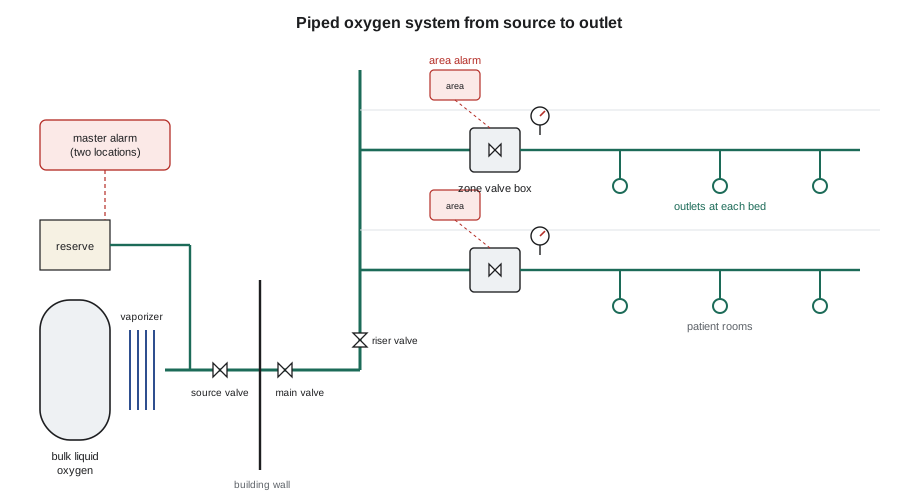
Distribution: valves, zones and alarms
From the source, the pipeline runs through a series of valves that let staff isolate parts of the system without shutting down the whole hospital. A source valve isolates the source equipment. A main shut-off valve is located where the pipeline enters the building. Each riser has a riser valve at its base, and each branch serving a floor or wing has a service valve. Zone valves, mounted in boxes with breakable or removable windows near the areas they serve, allow clinical staff to shut off gas to a group of rooms in an emergency such as a fire. Each zone valve box has a pressure gauge on the patient side of the valve, so staff can see that gas is flowing. Valves in critical areas such as operating rooms and intensive care units are arranged so that each area can be isolated without affecting others.
Alarms are the second line of defence. Master alarms monitor the sources: they warn when a manifold changes over, when a reserve is in use, when a bulk tank is low, when line pressure is high or low, and when air quality or dew point is out of range. Area alarms monitor pressure in the branch serving each critical care area and in each general area, and are located where staff are always present, typically at the nurses' station. Local alarms on the source equipment signal maintenance conditions. The standard sets exactly which conditions each alarm must signal and where alarm panels are placed.
Outlets, also called station outlets or terminal units, are where clinicians connect equipment. Each gas has its own connector type, designed so that only equipment for that gas can be plugged in. Outlets are labelled with the gas name and the colour code required by the standard. The colours used in Canada under CSA Z7396.1 are not all the same as the colours used elsewhere, so a worker who has worked in other countries must check the standard rather than rely on memory.
Pipe, fittings and cleanliness
Medical gas pipelines for positive-pressure gases are made of seamless copper tube that has been cleaned for oxygen service by the manufacturer, capped at both ends and marked to show it is suitable for medical gas, commonly to ASTM B819. Fittings must also be cleaned for oxygen service and are delivered sealed. The reason is fire: in pure oxygen at pressure, oil, grease or cutting fluid can ignite, and a pipe fire can burn through copper. Tubing is kept capped until it is cut, and cut ends are recapped immediately. Tools that touch the pipe are kept clean and free of oil. Ordinary plumbing copper, even new, must never be used for medical gas.
Joints in positive-pressure piping are brazed, not soldered, because soft solder joints can fail in a fire and release oxygen. Brazing is done while the inside of the pipe is purged with nitrogen, so that copper oxide scale does not form inside the joint, where it would flake off and travel to patient equipment. Some systems permit approved mechanical or press-type fittings in certain sizes and locations where the standard allows them. Lesson 10 covers brazing, purging and testing in detail.
Pipelines are installed in protected locations, supported at regular intervals, protected from physical damage and labelled at intervals and at every wall or floor penetration with the gas name and direction of flow. They are not run through spaces where they could be exposed to oil or heat, such as kitchens or electrical rooms, and they are kept separate from other piping so that nobody can mistake them for a water or compressed air line.
Sizing the pipeline
Medical gas pipelines are sized so that the pressure at the farthest outlet stays within the allowed range at the design flow. The designer estimates the flow for each zone from the number of outlets, the expected flow per outlet and a diversity factor, because not every outlet is used at once. The standard and design guides give recommended flows and diversity for each type of area. The pipeline is then sized so that the pressure drop from the source to the farthest outlet is within the limit the standard allows, often a small percentage of the operating pressure. Oversizing adds cost and volume to purge; undersizing starves the farthest outlets during peak use.
# Medical gas pipe sizing - course PRACTICE method (illustrative values only)
# The real design uses the flows, diversity and pressure-drop limits of the governing standard.
PRACTICE_CAPACITY = {  # tube size: L/min of free oxygen per 30 m run at an allowed small pressure drop
    "1/2 in": 170, "3/4 in": 450, "1 in": 920, "1-1/4 in": 1600, "1-1/2 in": 2500}

zones = {  # zone: (outlets, practice flow per outlet L/min, practice diversity)
    "Ward 5 East": (32, 10, 0.5),
    "Step-down unit": (16, 20, 0.75),
    "ICU 6": (24, 40, 1.0),
}

def pick(flow):
    for size, cap in PRACTICE_CAPACITY.items():
        if cap >= flow:
            return size
    return "larger than table"

total = 0
for name, (n, q, div) in zones.items():
    flow = n * q * div
    total += flow
    print(f"{name:15s} {n:3d} outlets x {q:2d} L/min x {div:.2f} = {flow:6.0f} L/min -> {pick(flow)}")
print(f"{'riser':15s} total {total:.0f} L/min -> {pick(total)}")Ward 5 East 32 outlets x 10 L/min x 0.50 = 160 L/min -> 1/2 in Step-down unit 16 outlets x 20 L/min x 0.75 = 240 L/min -> 3/4 in ICU 6 24 outlets x 40 L/min x 1.00 = 960 L/min -> 1-1/4 in riser total 1360 L/min -> 1-1/4 in
The practice table shows the pattern even though its numbers are only illustrative: small general wards need modest flows because few patients are on high-flow oxygen at once, while an intensive care unit is sized for every outlet in use. The riser that feeds all three zones carries their sum. On the real project, the engineer also checked the source capacity and the reserve against the same peak flow.
Worked problem
Free gas and line velocity
The ICU 6 branch carries 960 L/min of free oxygen in 1-1/4 in tube with an inside diameter of about 32 mm, at a line pressure of 380 kPa gauge. Find the actual flow in the pipe at line pressure and the average velocity.
Show solution
- Gas compresses, so the volume in the pipe is smaller than the free volume by the ratio of absolute pressures.
- \[Q_{line} = Q_{free} \times \frac{p_{atm}}{p_{atm} + p_g} = 960 \times \frac{101}{101 + 380} \approx 202\ \text{L/min}\]
- \[A = \frac{\pi d^2}{4} = \frac{\pi \times 0.032^2}{4} \approx 8.04 \times 10^{-4}\ \text{m}^2\]
- \[v = \frac{Q_{line}}{A} = \frac{0.00337\ \text{m}^3/\text{s}}{8.04 \times 10^{-4}\ \text{m}^2} \approx 4.2\ \text{m/s}\]
Answer: About 200 L/min actually flows in the pipe, at roughly 4 m/s, a moderate velocity that keeps noise and pressure drop low.
The apprentice's place on a medical gas crew
On Ridgeview, Maya's work on the medical gas crew was clearly defined. She could help unload and store tubing and fittings, keep them capped and clean, help set supports and sleeves, carry and set up nitrogen purge equipment, and assist with labelling and documentation. She could not braze joints, set or adjust source equipment, perform the required tests or sign any record. Daniela explained that this was not a judgement of her skill. The standard and the contract required certified personnel for those tasks, and every task outside them was still part of learning the system.
Maya also learned to respect the existing systems. Ridgeview's tower stayed open throughout construction, and its medical gas pipelines ran through ceiling spaces where the new wing's crews were working. Any work near an existing medical gas line needed a permit from the hospital, and nobody but the hospital's own authorized staff could close a zone valve or source valve serving patients. A closed valve in the wrong place could cut off oxygen to a ward.
Common mistakes
MistakeUsing new plumbing copper for a medical gas line.
InsteadOnly tubing and fittings cleaned and marked for oxygen service are allowed.
MistakeLeaving tube ends uncapped on the job.
InsteadCaps keep dirt, moisture and oil out until the joint is made.
MistakeConnecting a tool or shop equipment to the medical air system.
InsteadMedical air is only for patient use; tools use nitrogen or instrument air.
MistakeClosing a zone valve to make work easier.
InsteadOnly authorized hospital staff operate valves serving patients, under the facility's permit process.
Summary and key terms
- Medical gas systems follow their own standard, CSA Z7396.1, and are installed only by certified personnel.
- Each gas has its own source, pipeline, valves, alarms, outlets, connectors and colour code.
- Sources include bulk liquid oxygen with reserve, cylinder manifolds, medical air compressors and vacuum pumps, all with backup.
- Source, main, riser, service and zone valves allow isolation; master and area alarms warn of supply and pressure problems.
- Positive-pressure pipelines use copper cleaned for oxygen service, brazed under a nitrogen purge.
- Pipelines are sized for diversified flow with a limited pressure drop to the farthest outlet.
- Zone valve box
- A box with a window near a clinical area, containing shut-off valves and gauges for each gas serving it.
- Master alarm
- An alarm panel that monitors the sources and main lines of a medical gas system.
- Area alarm
- An alarm panel that monitors pressure in the line serving a clinical area.
- Manifold
- An assembly that connects banks of cylinders to a pipeline and switches between them.
- Cleaned for oxygen service
- Tube and fittings cleaned of oil and residue and sealed so they are safe in oxygen.
Practice problems
Work each problem on paper first, then reveal the answer to check.
Why is oxygen tubing cleaned and capped?
Show answer
Oil or residue can ignite in oxygen under pressure, and caps keep contaminants out.
What happens when the primary bank on a manifold empties?
Show answer
The manifold switches to the secondary bank and an alarm signals that cylinders need replacing.
Why must a medical air plant have at least two compressors?
Show answer
So it can meet peak demand with the largest compressor out of service.
What does a zone valve box allow?
Show answer
Clinical staff to shut off gas to a group of rooms in an emergency, with gauges showing the pressure.
Who may braze medical gas piping?
Show answer
Only brazers qualified to the required procedure, working under the certified installer.
Lesson quiz · 5 questions
Score 60% or more to complete this lesson.
Create a free account to save your progress, take quizzes and earn a certificate.