
PLB-330 · Lesson 4 of 12 · 21 min
Grease interceptors and FOG programs
The two restaurants in the Kingsway podium were very different. One was a small café serving sandwiches and coffee. The other was a full-service grill with a deep fryer bank, a flat-top, a dishwasher and three-compartment pot sinks. When Maya looked at the plumbing drawings, she found a small grease interceptor under the café's sink and a large concrete tank shown outside the building wall for the grill. "Same problem, two answers," Luis said. "Grease is the single biggest cause of sewer blockages in most cities. Every kitchen has to keep it out of the sewer. How you do it depends on how much grease the kitchen makes and how much space you've got." This lesson covers what grease does in drains, the kinds of interceptors that catch it, how they are sized, installed and maintained, and the municipal programs that enforce the rules.
Why fats, oils and grease are a problem
Fats, oils and grease, usually shortened to FOG, come from cooking: frying oil, meat fats, butter, sauces, dairy products and the residue on dishes and pans. In a hot kitchen sink, FOG is a liquid that flows easily into the drain. As it travels down the pipe and cools, it congeals and sticks to the pipe walls. Over months, the layers build up like plaque in an artery. FOG also reacts with calcium in the wastewater and sewer to form hard, soapy deposits that are very difficult to remove. The result is blocked building drains, overflowing manholes and sewage backing up into basements, streets and waterways. Municipalities spend large sums every year clearing grease blockages, and the costs are often charged back to the restaurants that caused them.
Grease is not only a sewer problem. It also causes trouble inside the building. Grease builds up in the kitchen's own branch drains, in the building drain downstream and in lift station wet wells, where it forms a thick mat that clogs pumps and floats. A grease blockage in a mixed-use building like Kingsway can back sewage up into another tenant's space or the residents' units, which turns a maintenance problem into a legal one.
How a grease interceptor works
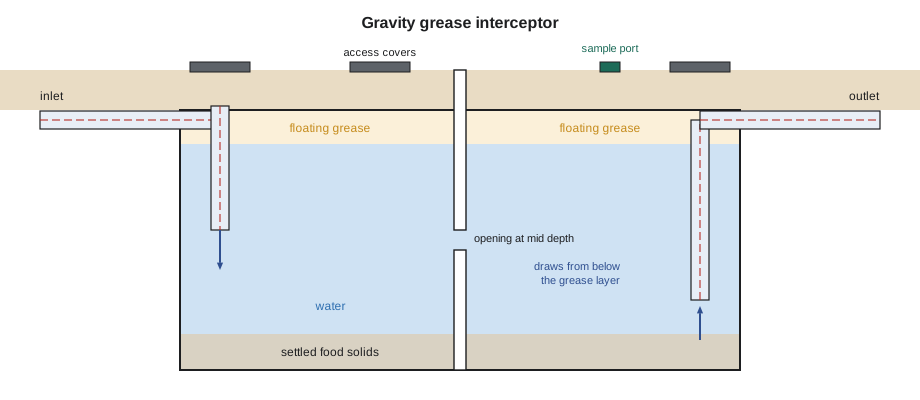
Every grease interceptor relies on the same physics. FOG is lighter than water, so if greasy wastewater is slowed down and held for long enough in a calm tank, the grease rises to the surface and the food solids sink to the bottom. Relatively clean water in the middle layer leaves through an outlet that draws from below the grease layer. Baffles slow and spread the flow and keep the incoming water from stirring up what has already separated. The grease layer and the settled solids stay in the tank until they are pumped out.
Two things work against separation. Heat keeps grease liquid and mixed into the water; very hot water from a dishwasher can carry melted grease straight through a small interceptor. Detergents and emulsifiers break grease into tiny droplets that stay suspended in water instead of rising. This is why codes and municipal rules often restrict how dishwashers and food waste grinders connect to interceptors, and why some programs ban enzyme or chemical additives that claim to dissolve grease. Those products usually only move the grease further down the sewer, where it congeals again.
Types of grease interceptors
There are two main families of grease interceptors, plus some specialized devices.
- Hydromechanical grease interceptors are compact units, usually installed indoors under or near the fixtures they serve. They use internal baffles and a flow control device on the inlet side to slow the flow to the unit's rated capacity, and they separate grease efficiently in a small volume. They are rated by flow, in litres per second or gallons per minute, and by grease storage capacity. They must be cleaned often, sometimes weekly.
- Gravity grease interceptors are large tanks, often concrete, polyethylene or fibreglass, installed outside or below the floor. They rely on long retention time rather than internal baffling, and they are sized by volume. They hold much more grease and solids, so they are pumped less often, typically every one to three months depending on use.
- Grease removal devices are hydromechanical interceptors with an automatic skimming system that removes grease to a collection container on a timer. They reduce pumping but need regular emptying of the container and maintenance of the motor and skimmer.
Each type is tested and rated to a standard. In Canada, the CSA B481 series covers grease interceptors: their construction, testing and rating, sizing and selection, installation, and maintenance. Rating tests measure how much grease a unit removes at its rated flow and how much it can store before its efficiency drops. Only certified units bearing the rating mark may be installed, and the rated flow must not be exceeded.
Where interceptors are required
The plumbing code requires a grease interceptor where wastewater from food preparation could introduce grease into the drainage system. That usually means pot and pan sinks, prep sinks, floor drains and floor sinks in kitchens, wok stations, and in some jurisdictions dishwashers and mop sinks. Fixtures that do not carry grease, such as hand sinks, toilets and urinals, must not drain through the interceptor, because they would add flow and reduce retention time. The municipality's sewer-use by-law often adds its own requirements, sets limits on the grease concentration allowed in the discharge, and may require a gravity interceptor for larger food service operations.
Food waste grinders, sometimes called garbage disposers, are a special case. A grinder adds a large load of food solids that quickly fill an interceptor's solids storage and reduce its efficiency. Many codes and municipal programs either prohibit grinders in commercial kitchens or require them to discharge through a solids interceptor before the grease interceptor. On the Kingsway grill, the owner wanted a pulper for food scraps. The engineer said no, and specified a scraping station and organics bins instead.
Sizing a hydromechanical interceptor
Hydromechanical interceptors are sized by flow. One common practice method, used in this course, looks at how fast the fixtures connected to the unit can empty. A sink compartment full of water drains in about one to two minutes. The volume of each compartment, multiplied by a fill factor of about 0.75 because sinks are not filled to the brim, divided by the drain time, gives the flow. The unit selected must be rated for at least that flow, and the flow control device supplied with it limits the flow so the rating is never exceeded.
Worked problem
Sizing the café interceptor
The Kingsway café has one two-compartment prep sink. Each compartment measures 450 mm × 500 mm × 300 mm deep. Using the course's practice method with a one-minute drain time, what flow rating does the interceptor need?
Show solution
- Volume of one compartment: 0.45 × 0.50 × 0.30 = 0.0675 m³ = 67.5 L.
- Two compartments: 135 L.
- Working volume at 0.75: 135 × 0.75 = 101 L.
- Flow over 60 s: 101 ÷ 60 ≈ 1.7 L/s.
Answer: The café needs an interceptor rated for at least 1.7 L/s, so the next standard size up, about 2 L/s, with its flow control device.
Sizing a gravity interceptor
Gravity interceptors are sized by volume, because their job is to hold wastewater long enough for separation and to store a large amount of grease between pumpings. Methods vary by jurisdiction. Some codes and municipalities use tables based on drainage fixture units. Others use a calculation from the number of meals served, the wastewater produced per meal, a retention time and a storage factor that reflects the hours of operation. This course uses a practice method of that second kind. The engineer always follows the method the local authority accepts.
# Grease interceptor sizing - course PRACTICE methods, not a code table
# 1) Hydromechanical: flow from fixture drain-down
def hgi_flow_lps(compartments_l, fill=0.75, drain_s=60):
    return sum(compartments_l) * fill / drain_s

# 2) Gravity: volume from meals, waste per meal, retention and a storage factor
def ggi_volume_l(meals_peak_hour, waste_l_per_meal=19, retention_h=2.5, storage_factor=1.5):
    return meals_peak_hour * waste_l_per_meal * retention_h * storage_factor

cafe = hgi_flow_lps([67.5, 67.5])
print(f"cafe prep sink: {cafe:.2f} L/s -> choose a unit rated at least that")

for meals in (60, 90, 120):
    v = ggi_volume_l(meals)
print(f"grill, {meals:3d} meals in peak hour: about {v / 1000:.1f} m3 gravity interceptor")cafe prep sink: 1.69 L/s -> choose a unit rated at least that grill, 60 meals in peak hour: about 4.3 m3 gravity interceptor grill, 90 meals in peak hour: about 6.4 m3 gravity interceptor grill, 120 meals in peak hour: about 8.6 m3 gravity interceptor
For the grill, the engineer's design was based on 90 meals in the peak hour, and the tank shown on the drawings was a 6,800 litre concrete interceptor, close to the practice estimate above. That size also gave enough grease storage for the municipality's minimum pumping interval.
Installation
A grease interceptor only works if it is installed so it can be maintained and so the flow through it stays calm. Indoor hydromechanical units should sit as close as practical to the fixtures they serve, so grease has little chance to cool and stick in the branch drain. They need a flow control device on the inlet side, vented as the manufacturer and code require, and a vent on the interceptor or its outlet so the unit does not siphon. The unit must be level, and there must be enough clear space above it to lift the lid and remove the baffles for cleaning. Units set in the floor need a cover rated for foot or cart traffic and a lid gasket that seals odours.
Gravity interceptors are usually outside the building where a vacuum truck can reach them. They need traffic-rated access covers over each chamber, a sample port or sampling manhole on the outlet so the municipality can test the discharge, and a vent. In cold climates the tank and piping must be deep enough to avoid freezing. The inlet and outlet pipes must be the correct sizes and at the correct elevations, because a reversed inlet and outlet or an outlet set too high can carry grease straight through. Before backfilling, the tank is water tested to confirm it does not leak.
Maya spent two days helping set the café's hydromechanical unit under the counter. Most of the work was not plumbing at all. It was making sure the cabinet could be opened wide enough, that the unit could be lifted out, and that the flow control fitting was installed on the inlet, not forgotten in the box. Luis checked the inlet and outlet orientation twice. "Every interceptor has arrows on it," he said. "Every year someone still installs one backward."
Maintenance and FOG programs
An interceptor that is not cleaned becomes a grease source rather than a grease trap. Once grease and solids fill a large share of the tank, typically about a quarter of its liquid depth, the retention time drops and separation stops working, and grease passes straight through. Municipal FOG programs therefore set maximum cleaning intervals and grease thresholds, require food service operators to keep maintenance logs and pumping receipts, and inspect kitchens. Many also require best management practices: scraping plates into the bin before washing, using drain screens, collecting used frying oil for recycling, and training staff.
Hamilton, like most Ontario municipalities, enforces its program through the sewer-use by-law, which limits the concentration of oil and grease allowed in sewer discharges and gives inspectors the power to sample, order cleaning or repairs, and recover costs from a business whose grease causes a blockage. The plumber's part is to install a correct, accessible, certified interceptor, and to explain to the owner what the cleaning schedule means in practice.
Maintenance itself is a dirty, confined job. Large gravity interceptors are cleaned by vacuum truck crews, not plumbers. Smaller indoor units are often cleaned by kitchen staff or service contractors. When a plumber does have to open or enter an interceptor vault, it is treated as a confined space: hydrogen sulphide and methane can build up in sealed tanks of decaying food waste, so testing the atmosphere, ventilating and following a permit procedure come first.
Common mistakes
MistakeConnecting hand sinks and toilets to the grease interceptor.
InsteadOnly grease-producing fixtures should drain through it; extra flow cuts retention and efficiency.
MistakeLeaving out the flow control device on a hydromechanical unit.
InsteadThe flow control limits flow to the unit's rating; without it grease passes through.
MistakeInstalling the interceptor where it cannot be opened or pumped.
InsteadAccess for cleaning is part of the design; an unmaintained interceptor fails.
MistakeUsing enzymes or chemicals to dissolve grease in the interceptor.
InsteadAdditives usually move grease further down the sewer, where it congeals again; many programs ban them.
Summary and key terms
- FOG congeals in drains and sewers, causing blockages and overflows; municipalities enforce strict rules.
- Interceptors slow and hold wastewater so grease floats and solids sink.
- Hydromechanical interceptors are compact and rated by flow; gravity interceptors are large tanks sized by volume.
- Only grease-producing fixtures should connect, and food waste grinders are usually restricted.
- Correct installation includes flow control, venting, access for cleaning and correct inlet and outlet orientation.
- Regular pumping, logs and best management practices are enforced through FOG programs.
- FOG
- Fats, oils and grease from food preparation.
- Hydromechanical grease interceptor
- A compact interceptor with baffles and flow control, rated by flow.
- Gravity grease interceptor
- A large tank interceptor sized by volume and retention time.
- Flow control device
- A fitting that limits flow into a hydromechanical interceptor to its rated capacity.
- Retention time
- The time wastewater stays in an interceptor, allowing grease to separate.
Practice problems
Work each problem on paper first, then reveal the answer to check.
A sink has three compartments of 60 L each. Using the practice method with a one-minute drain, what flow rating is needed?
Show answer
180 × 0.75 ÷ 60 = 2.25 L/s.
Why are dishwashers sometimes restricted from draining to small interceptors?
Show answer
Hot water and detergents keep grease melted and emulsified so it passes through.
When does an interceptor stop working well?
Show answer
When grease and solids fill a large share of its depth, often about a quarter, so retention drops.
Why does a gravity interceptor need a sample port?
Show answer
So the municipality can test the discharge for grease concentration.
What hazards exist when entering an interceptor vault?
Show answer
Hydrogen sulphide, methane and low oxygen; it is a confined space needing testing and a permit.
Lesson quiz · 5 questions
Score 60% or more to complete this lesson.
Create a free account to save your progress, take quizzes and earn a certificate.