
NUC-430 · Lesson 7 of 12 · 21 min
Inspection and enforcement
Marcel Thibodeau spent five years as a CNSC site inspector before returning to industry, and he still talks about the job with affection. "You live near the station, you badge in every morning, you walk the plant, you sit in on the morning meeting," he tells Hana. "You get to know which supervisor fixes problems and which one hides them. The licence and the safety report say what the plant should be. The inspector's job is to find out what it actually is."
Why inspection matters
A licence is a set of promises. The licensee promises to operate within limits, maintain its equipment, train its staff, keep records, report events and run its programmes as described. Inspection checks that the promises are kept. It is the regulator's main source of first-hand information about a facility, complementing the reports the licensee submits. Inspection also has a deterrent effect: a licensee that knows it may be inspected at any time has a strong incentive to keep its house in order. And inspection findings, analysed across many facilities, show the regulator where its rules or guidance may need to change.
Inspections take several forms. Routine baseline inspections follow a planned programme that covers every important area over a cycle of a year or more. Reactive inspections follow an event or a performance problem. Special team inspections look in depth at a topic such as fire protection, design basis or emergency preparedness. Desktop reviews examine documents and data without a site visit. And on-site inspectors carry out continuous observation of daily activities. Inspections may be announced, to allow the right people and documents to be available, or unannounced, to see the plant as it normally is.
The CNSC compliance programme
The CNSC verifies compliance through a programme of inspections, desktop reviews and event reviews planned for each licensee according to its risk and performance. Each nuclear power plant has a team of site inspectors based at or near the station, supported by specialists from headquarters for technical inspections. Findings are recorded against the safety and control areas and the licence conditions. Every year staff rate each licensee's performance in each safety and control area as fully satisfactory, satisfactory, below expectations or unacceptable, and publish the ratings in regulatory oversight reports that are presented to the Commission at public meetings.
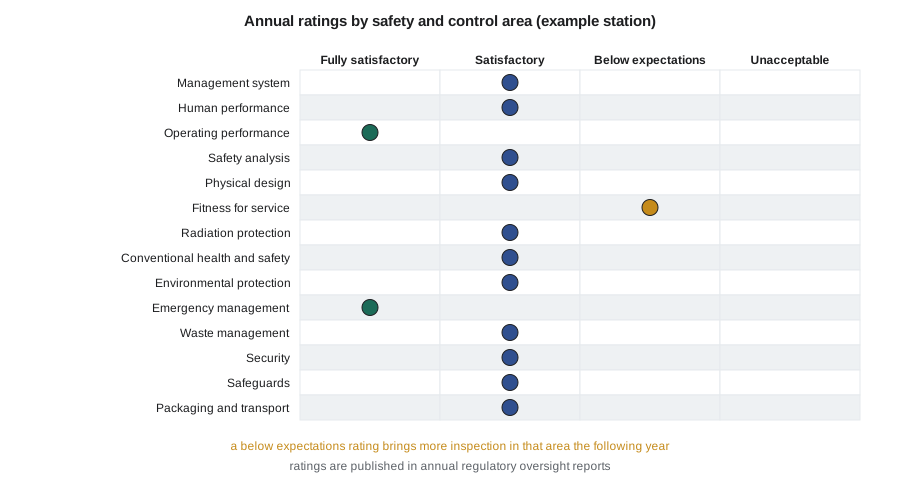
The ratings guide the next year's compliance plan. A licensee rated satisfactory in an area receives the baseline level of inspection there; one rated below expectations receives more inspections and closer monitoring until it improves. Staff also track the licensee's corrective actions for each finding to closure. The aim, as Marcel puts it, is to spend regulatory effort where it does the most good.
Judging significance
Not every finding is equally important. CNSC staff assess each non-compliance for its safety significance, considering whether it caused or could have caused harm, whether it was repeated, whether the licensee identified and reported it, and how quickly it was corrected. Low-significance findings are handled by recording them and requiring correction. More significant ones lead to stronger enforcement, as described below. The CNSC has also used risk insights from probabilistic safety assessment to judge the significance of equipment problems.
# Graded enforcement toy: pick a response and an illustrative penalty (teaching scheme only).
TOOLS = ["record and close", "notice of non-compliance", "request with deadline", "order", "licence action"]
def respond(significance, repeated, self_identified, concealed):
    score = significance + (1 if repeated else 0) - (1 if self_identified else 0) + (2 if concealed else 0)
    tool = TOOLS[max(0, min(score, len(TOOLS) - 1))]
    penalty = 0
    if score >= 3:  # penalty grows with score, capped at the corporate maximum per violation
        penalty = min(100_000, 15_000 * 2 ** (score - 3))
    return score, tool, penalty
cases = [("documentation lapse", 1, False, True, False),
         ("missed surveillance test", 2, False, False, False),
         ("procedure not followed, repeated", 2, True, False, False),
         ("dose record altered", 3, False, False, True)]
for name, sig, rep, selfid, conc in cases:
    s, t, p = respond(sig, rep, selfid, conc)
print(f"{name:36s} score {s} -> {t:26s} illustrative penalty {p:>7,} dollars")documentation lapse score 0 -> record and close illustrative penalty 0 dollars missed surveillance test score 2 -> request with deadline illustrative penalty 0 dollars procedure not followed, repeated score 3 -> order illustrative penalty 15,000 dollars dose record altered score 5 -> licence action illustrative penalty 60,000 dollars
The output shows how the same kind of finding can lead to different responses. A minor documentation lapse found and fixed by the licensee is recorded and closed. A repeated failure to follow a procedure leads to an order. Penalty amounts grow with significance, history and whether the licensee concealed the problem. Marcel stresses that the real decision rests on judgement and a written rationale.
Enforcement tools
The CNSC uses a graded approach to enforcement, choosing tools in proportion to the significance of the non-compliance. The least severe is a notice of non-compliance or a written request for corrective action. Next come warnings and requests under the General Nuclear Safety and Control Regulations that require the licensee to take actions or provide information by a deadline. Orders, issued by inspectors or designated officers, can require immediate measures, including stopping an activity; they are reviewed by the Commission. The Commission can amend, suspend in whole or in part, or revoke a licence. Administrative monetary penalties of up to 25 000 dollars for an individual and 100 000 dollars for a corporation per violation can be imposed without going to court. And the most serious cases can be referred for prosecution under the Act.
| Tool | When used | Effect |
|---|---|---|
| notice of non-compliance | low significance | licensee corrects and reports |
| Request under the regulations | moderate significance | actions or information by a deadline |
| Order | risk needing prompt action | legally binding measures, reviewed by the Commission |
| Administrative monetary penalty | violations warranting a financial penalty | penalty without court proceedings |
| Licence amendment, suspension or revocation | serious or persistent problems | changes or ends the authorization |
| Prosecution | serious offences | fines or imprisonment on conviction |
The corrective action programme
The most important mechanism for fixing problems at a nuclear plant is not the regulator but the licensee's own corrective action programme. Every worker can raise a condition report about anything that looks wrong, from a dripping valve to a confusing procedure. Each report is screened for significance, assigned to an owner, investigated in proportion to its importance, and closed when the fix is verified. Significant problems get a root cause analysis that looks beyond the immediate cause to the organizational factors behind it. A healthy plant raises thousands of condition reports a year. Regulators look closely at the corrective action programme, because a licensee that finds and fixes its own problems is far safer than one that waits for the inspector.
Worked problem
Rating trend
Over five years, a station's rating in fitness for service was satisfactory, satisfactory, below expectations, below expectations, satisfactory. How many years did it receive increased oversight in that area, assuming each below expectations rating triggers one year of extra inspection?
Show solution
- Count the below expectations years: 2.
- Each triggers one year of extra inspection the following year.
Answer: Two years of increased oversight, after which the rating returned to satisfactory.
Event reporting
Licensees must report events to the CNSC. REGDOC-3.1.1 sets out what must be reported for power reactors and how quickly: some events, such as a serious process failure or a release above a set level, must be reported immediately, others within a day or a few days, and others in quarterly or annual reports. Event reports let the regulator respond quickly when needed, see patterns across the industry and check that the licensee has understood and fixed the causes. Significant events are also reported to the Commission at public meetings through event initial reports, so that members and the public hear about them promptly.
Prompt and honest reporting is one of the most important obligations of a licensee. Regulators treat a failure to report, or a misleading report, far more seriously than the event itself in many cases, because the whole system of oversight depends on the regulator being able to trust what licensees tell it. Marcel tells Hana about a case early in his career in which a minor equipment fault became a significant enforcement matter because a shift supervisor had delayed the report to avoid embarrassment. "The fault was trivial," he says. "The delay was not."
Raising concerns
Workers who see a safety problem must be able to raise it without fear. The Nuclear Safety and Control Act and the General Nuclear Safety and Control Regulations require workers to report to their employer or to the CNSC any situation they believe could pose a risk, and prohibit employers from taking reprisals against workers who do so. The CNSC accepts reports from workers and members of the public and follows them up, protecting the identity of the person who raised them where possible.
A strong reporting culture inside the plant is one of the clearest signs of a healthy safety culture. When workers raise many small concerns, the organization learns about problems while they are still small. When workers stop raising concerns, because they think nothing will happen or because they fear the consequences, problems grow unseen. Inspectors therefore pay attention not only to the problems a licensee finds but to how many it finds, who finds them and what happens next.
What an inspector looks for
Experienced inspectors look beyond individual requirements to patterns. A missed test is a finding; three missed tests in different systems may point to a weakness in work planning. A procedure that operators routinely work around may point to a procedure that is wrong. Repeated equipment failures may point to an ageing problem that the maintenance programme has not caught. Inspectors also watch how the organization behaves: whether the morning meeting discusses safety honestly, whether supervisors challenge each other, whether management visits the plant floor, and whether problems raised by workers are fixed or ignored. These observations feed into the regulator's assessment of safety culture, which both regulators now treat as an inspectable area.
Hana asks Marcel how an inspector avoids becoming too close to the plant after years on site. "It is a real risk," he says. "You get to like the people. You start to see the plant through their eyes. That is why regulators rotate site inspectors every few years, send teams from headquarters who see things fresh, and review the site team's work. The best protection is to keep asking the simple question: if this were the first day I saw it, would I accept it?"
Enforcement in practice
The CNSC uses its enforcement tools regularly but sparingly at the high end. Most findings each year are of low significance and are closed after the licensee corrects them. Orders are issued several times a year across all licensees, most often to holders of nuclear substance licences such as industrial radiography companies, where a lapse can quickly cause a significant dose. Administrative monetary penalties are published on the CNSC's website with the name of the licensee and the nature of the violation, which adds a reputational effect to the financial one. Prosecutions are rare.
Elena adds one more point. "Enforcement is not the goal. Compliance is the goal, and beyond compliance, safety. A regulator that issues many penalties is not necessarily doing a better job than one that issues few. What matters is whether problems are found early and fixed for good."
Is oversight working?
Regulators also have to judge whether their own oversight is effective. A falling number of findings could mean that plants are getting safer, or that inspectors are looking less hard. Regulators therefore look at several kinds of evidence together: trends in performance indicators such as unplanned shutdowns and safety system failures, the number and significance of events, the results of international peer reviews, surveys of their own staff and of licensees, and independent audits. They compare the issues their inspectors found with the issues that later caused events, to see whether the inspection programme is looking in the right places.
Over the past few decades the performance of the reactor fleets in both countries has improved markedly by most measures. Unplanned shutdowns have become rarer, capacity factors have risen and significant events have declined. Regulators and industry both claim part of the credit, and both are probably right: oversight that focuses on what matters, combined with licensees' own programmes for learning from experience, has driven steady improvement. The danger that both warn about is complacency. A long period without serious events can lead organizations to believe that they are safer than they are, and to cut back on the very activities that kept them safe.
For this reason the CNSC reviews its compliance programme regularly, adjusts the baseline inspection plan as risks change, and has moved toward more risk-informed planning that focuses inspection where performance or hazard warrants it.
Common mistakes
MistakeInspection catches every problem.
InsteadInspection samples; the licensee's own corrective action programme finds most problems.
MistakeEvery non-compliance leads to a penalty.
InsteadMost are handled by correction; penalties are for more significant cases.
MistakeUnannounced inspections are unfair.
InsteadThey show the plant as it normally operates.
Summary and key terms
- Inspection checks that licensees keep the promises in their licences.
- The CNSC rates performance in each safety and control area every year.
- Findings are assessed for safety significance.
- Enforcement is graded, from notices to orders, penalties and licence actions.
- The licensee's corrective action programme is the main way problems are fixed.
- Site inspector
- A CNSC inspector based at a power plant.
- notice of non-compliance
- A written record that a requirement was not met.
- Order
- A legally binding direction to take measures.
- Administrative monetary penalty
- A financial penalty imposed without prosecution.
- Regulatory oversight report
- The annual public report on licensee performance.
- Corrective action programme
- The licensee’s system for finding and fixing problems.
Practice problems
Work each problem on paper first, then reveal the answer to check.
Name the four CNSC performance ratings.
Show answer
Fully satisfactory, satisfactory, below expectations, unacceptable.
What is the maximum AMP for a corporation per violation?
Show answer
100 000 dollars.
Why are unannounced inspections used?
Show answer
To see the plant as it normally operates.
What does a root cause analysis look for?
Show answer
The organizational factors behind the immediate cause.
Who reviews an inspector's order?
Show answer
The Commission.
Lesson quiz · 5 questions
Score 60% or more to complete this lesson.
Create a free account to save your progress, take quizzes and earn a certificate.